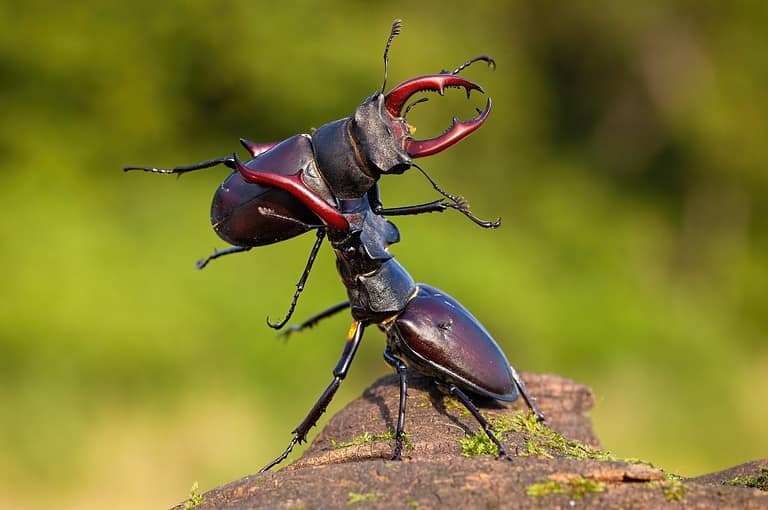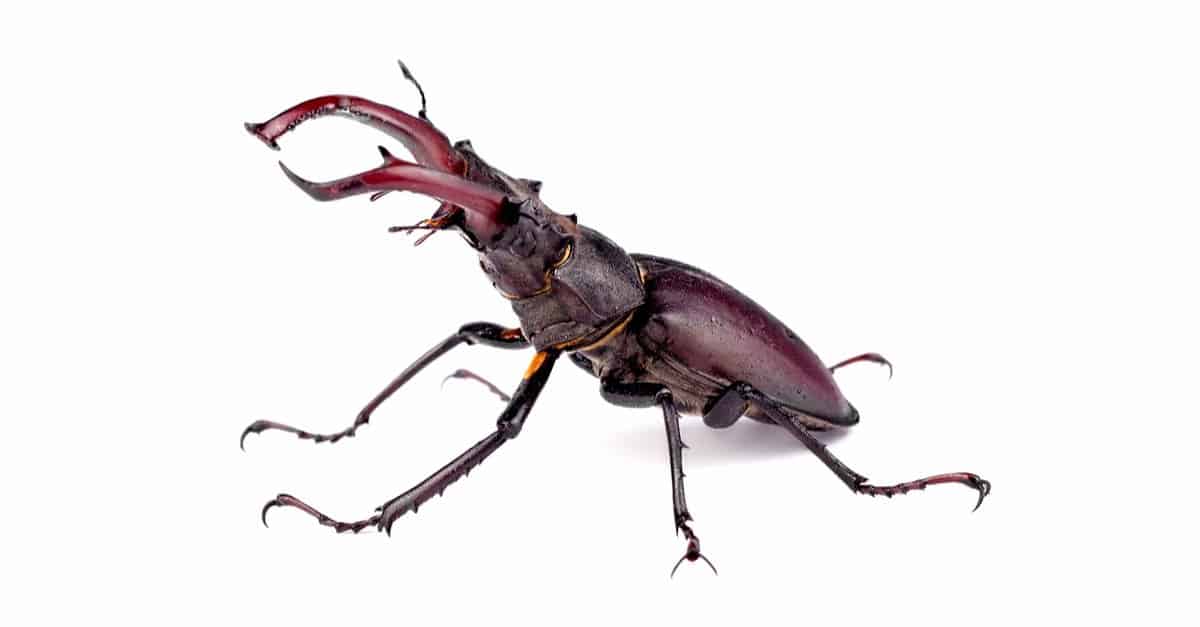

With more than 350,000 described species, and many more still waiting to be discovered, beetles are among the most diverse and resilient creatures on Earth, thriving in nearly every environment from rainforests to deserts. Within this vast group are some true giants, insects that stand out not just for their size but also for their extraordinary adaptations, from massive horns used in combat to antennae longer than their entire bodies. These oversized beetles capture the imagination with their power and presence. In the list that follows, we’ll explore the world’s 10 largest species, their unique characteristics, and the habitats they call home.
This post was updated on September 19, 2025 to clarify beetle extinction, Actaeon beetle larval weight, Wallace’s longhorn antennae length, male stag beetle mandible strength, and Hercules beetle lifespan.
10. Atlas beetle (Chalcosoma atlas)
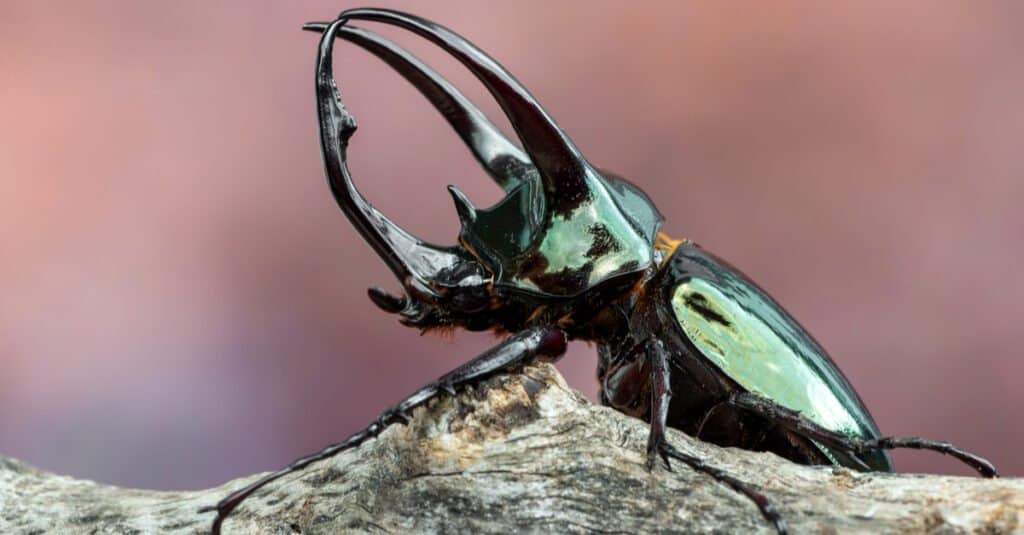
Atlas beetles, which live in Southeast Asia, can reach lengths of up to 4.7 inches.
©Marek R. Swadzba/Shutterstock.com
Having been named after the Greek titan, Atlas, it makes sense that the Atlas beetle is on this list. Atlas beetles are yet another gigantic member of the Scarabaeidae family and are known for the males’ three long, curved horns. These horns, as you might imagine, are used to compete with other males for food, territory, and mating rights.
Atlas beetles are highly sexually dimorphic, with males being much larger than females. While male Atlas beetles can reach lengths of up to 4.7 inches, females are usually only around 2 inches long. They are distributed throughout much of Southeast Asia.
These giant beetles are fierce from birth, with their massive larvae being especially vicious and competitive towards one another. They will commonly fight to the death when food becomes scarce!
9. Caucasus beetle (Chalcosoma chiron)
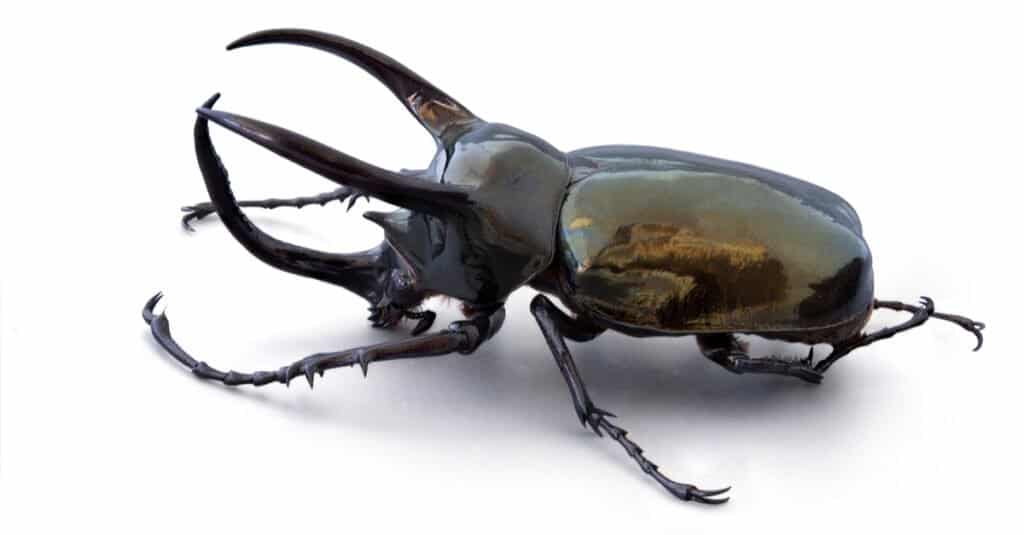
Caucasus beetles, which live in Asia, can reach up to 5 inches in length.
©Sanit Fuangnakhon/Shutterstock.com
These enormous scarab beetles are known for their uniquely curved, three-pronged horns. Protruding from their cephalothorax, these horns form an imperfect W-shape when viewed from above. Males commonly use these horns to compete with each other for mates and food. There are four subspecies of Caucasus beetles, most of which are found throughout Malaysia and Indonesia.
Caucasus beetles are the largest members of the Chalcosoma genus and are one of the largest species of beetles in all of Asia, with males commonly reaching lengths of 3.5 to 5 inches or more. Females are on the smaller side, usually reaching around 2 to 2.5 inches long.
8. Giraffe stag beetle (Prosopocoilus giraffa)
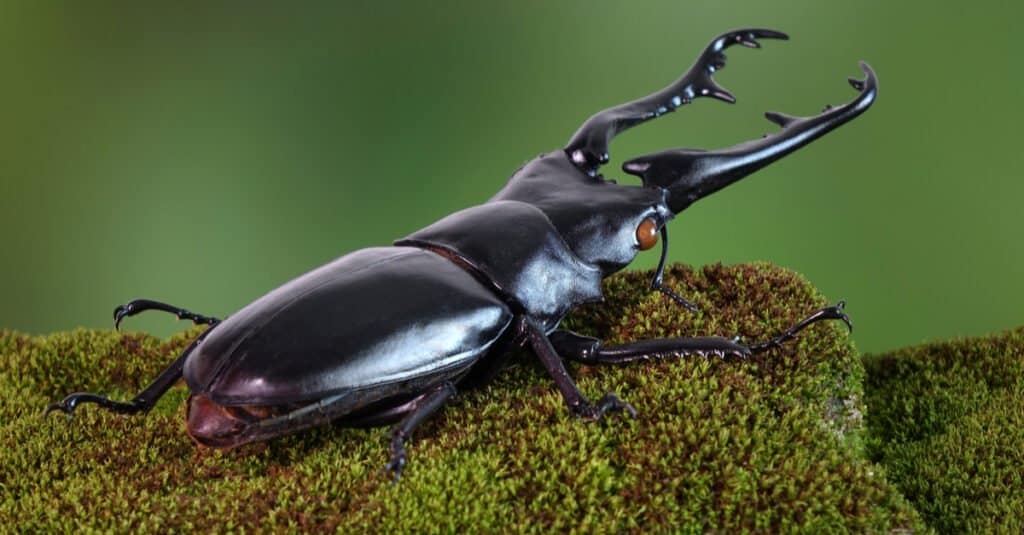
Giraffe stag beetles live in the humid forest of Southeast Asia.
©Mark Brandon/Shutterstock.com
The giraffe stag beetle is the world’s largest member of the stag beetle family, commonly measuring up to 12 centimeters, or 4.7 inches long. There are eight unique subspecies of Prospocoilus giraffa, most of which are distributed throughout Asia’s humid forests in countries like the Philippines, Thailand, Vietnam, and even India.
These menacing giant beetles have distinct-looking mandibles with serrated, tooth-like notches. These mandibles take up about half of the insect’s entire body length! Like many other species on this list, males of the species have far larger mandibles, which they use like antlers to pick up and throw each other when competing for food and mates.
7. Actaeon beetle (Megasoma actaeon)
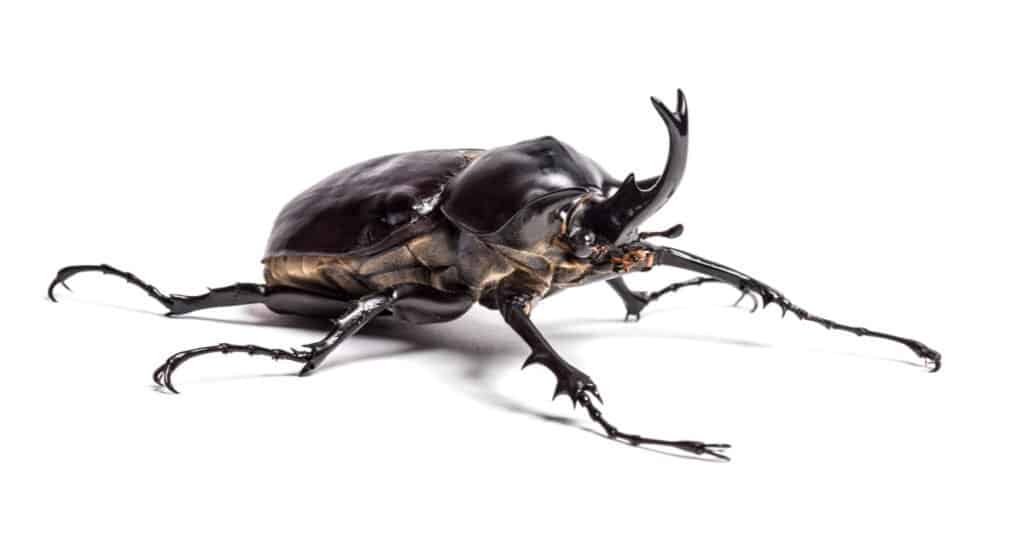
Actaeon beetles are one of the heaviest insects in the world!
©Eric Isselee/Shutterstock.com
The Actaeon beetle is another massive type of rhinoceros beetle and is one of the heaviest insects in the world. Their larvae are typically around 130 grams, while adults of the species weigh in at around 150 grams (5.5 ounces).
In terms of their body length, Actaeon beetles also top the charts at anywhere from 2 to 5 inches. Males are much longer than females, with their long horn-like protrusions making up as much as a quarter of their body length. Females lack these horns and instead have small, pincer-like mandibles.
The Actaeon beetle’s name comes from Actaeon himself, a hero in Greek mythology who was trained by the centaur Chiron, who also famously trained Achilles!
6. Wallace’s long-horn beetle (Batocera wallacei)
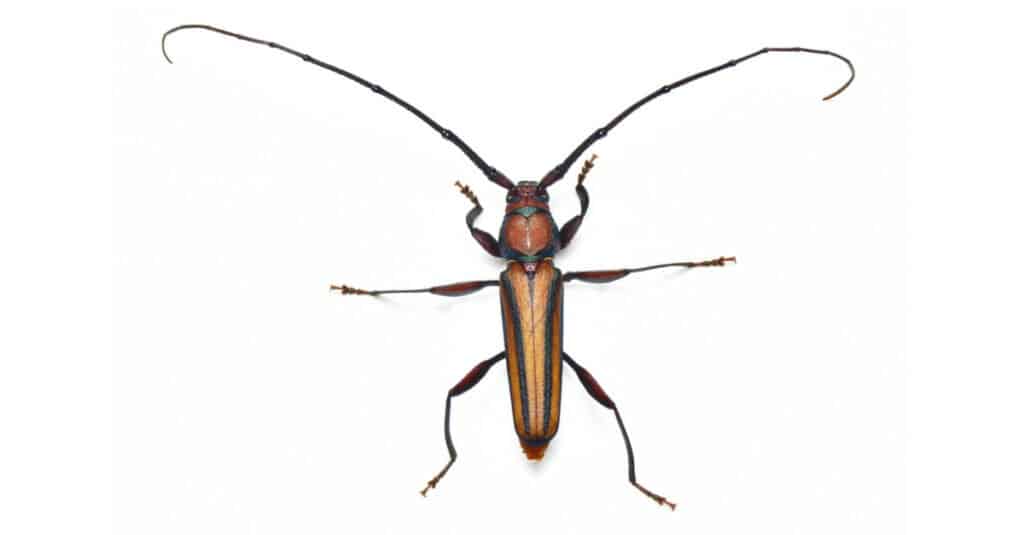
Long-horn beetles have extremely long antennae!
©SIMON SHIM/Shutterstock.com
Although the Wallace’s long-horn beetle’s body isn’t particularly large or bulky, it is still the longest species of beetle in the world when including their super long antennae!
The titan beetle (Titanus giganteus) holds the record for body length, at 6.5 inches. While Wallace’s longhorn only reaches 2–3.5 inches in body length, it can exceed 10 inches with antennae! Their massive antennae are typically more than twice the length of their body. These unique beetles are native to New Guinea, Indonesia, and parts of Australia.
The species was named after Alfred Russel Wallace in 1858. Wallace was a British explorer and biologist who discovered the beetle on Indonesia’s Aru Islands.
5. Elephant beetle (Megasoma elephas)
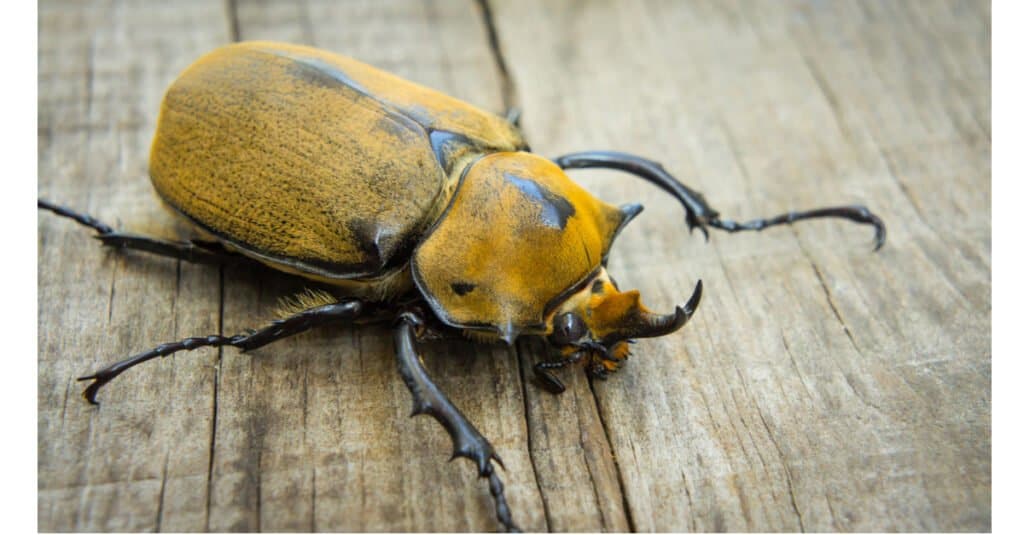
Male elephant beetles have powerful trunk-like horns that are used for fighting other males.
©Bildagentur Zoonar GmbH/Shutterstock.com
The elephant beetle is another member of the Dynastidae subfamily, which makes up a group of insects known as rhinoceros beetles. While over 1,500 unique species of rhinoceros beetles are known to exist, the elephant beetle is one of the largest! They typically grow to anywhere from 2.5 to 4.75 inches in length, with males being significantly larger than females.
Elephant beetles are named for the males’ long, powerful trunk-like horns, which are used to fight with other males when competing for food or mates. Females lack these horns and instead have smaller mandibles that they use to bite into fruits and tree bark.
Although elephant beetles are usually solid brown or black in color, their bodies are covered in very fine yellow hairs, which give them a golden-colored tinge. The hairs are especially abundant on the beetles’ elytra, or their forewings.
4. European stag beetle (Lucanus cervus)
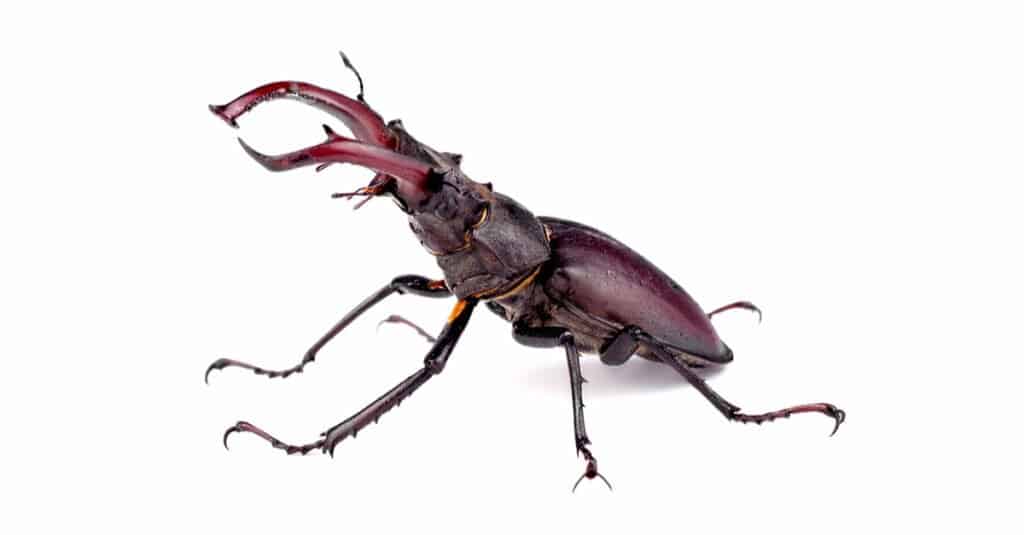
The mandibles on male European stag beetles look terrifying but are weaker than the females’.
©Oleksandr Khalimonov/Shutterstock.com
While there are over 1,200 species of stag beetles, perhaps the best known by far is the European stag beetle, both for its size and prominent pincer-like mandibles. Like most other sexually dimorphic species of beetles, the males have far larger mandibles than females.
The size of the average European stag beetle varies depending on the country it resides in. Stag beetles from countries like Germany and Spain tend to be larger than beetles living in the UK or Belgium, for instance. It is common for male stag beetles to reach two and a half inches or more in length!
Interestingly, while the males’ mandibles look terrifying, they are actually weaker than the female’s mandibles. Males can pinch but not as forcefully as females. Instead, they generally use their mandibles sort of like antlers when in combat with other males, especially when competing for a mate. Females, on the other hand, use their much smaller mandibles with more precision and can inflict a seriously painful bite!
3. Goliath beetles (Goliathus regius, cacicus, albosignatus, kolbei, orientalis, and goliatus)
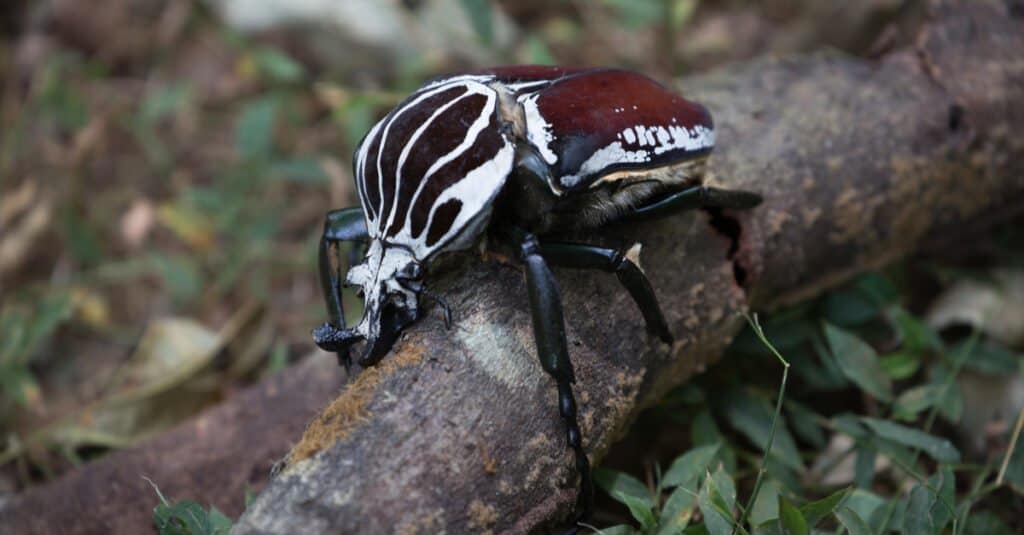
Goliath beetles can lift up to 850 times their body weight!
©Nickolas warner/Shutterstock.com
There are six unique species of Goliath beetles within the Goliathus genus and many lesser-known subspecies. Like many others on this list, these giant beetles are also highly sexually dimorphic, meaning males and females of the species have many physical differences, most notably size.
Male Goliath beetles commonly reach up to 4 inches in length, while females usually reach around 2 to 3 inches long. They can weigh up to 3.5 ounces, or 100 grams, both as larvae and as adults.
Although Goliath beetles lack teeth, their mandibles are very sharp and can draw blood fairly easily. They are also very strong insects, capable of lifting objects as much as 850 times their size.
These beetles have six legs with very sharp claws and two different sets of wings. The claws allow the Goliath beetles to climb trees. The outer set of wings are called the elytra and they protect the second, less durable set of wings. The inner wings are solely used for flying.
2. Hercules beetle (Dynastes hercules)
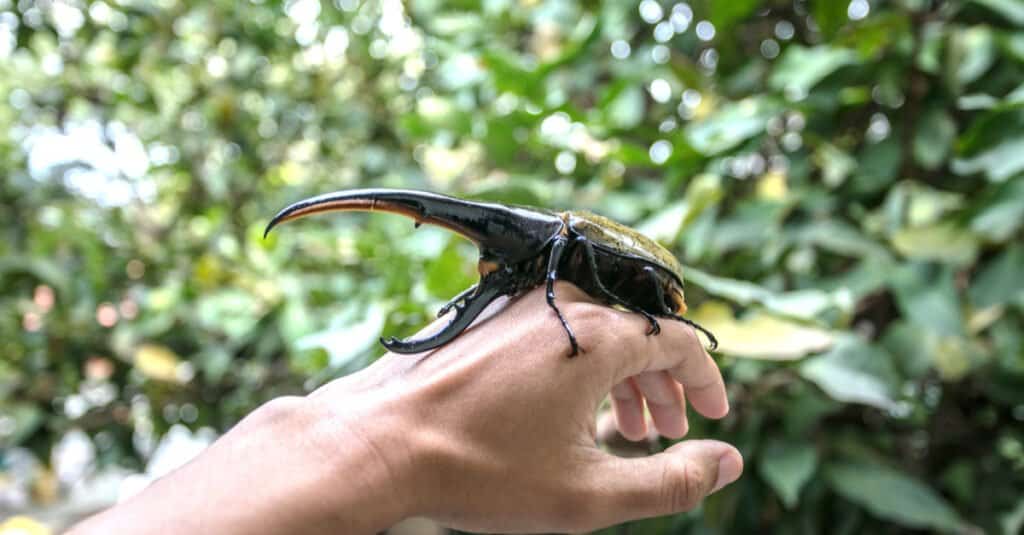
Male Hercules beetles have extremely large horns.
©Tanawat Palee/Shutterstock.com
The Hercules beetle is another aptly named insect. It is one of the largest flying insects and lives 6–12 months as an adult, which is long for beetles! This powerful bug is actually a species of rhinoceros beetle, and only males of the species display the massive horns they are known for.
Including the length of their characteristic horn on their thorax, it is common for Hercules beetles to reach up to 7 inches long! This horn makes up much of the length of their body, and without it, they are only about 3 inches long. Only males possess this horn, so females of the species are far smaller and less intimidating in appearance.
Despite how scary they look, Hercules beetles primarily feed on both rotting and fresh wood and various kinds of fruit. They mostly use their horns as a self-defense mechanism or to fight with competing males rather than to hunt prey.
1. Titan beetle (Titanus giganteus)
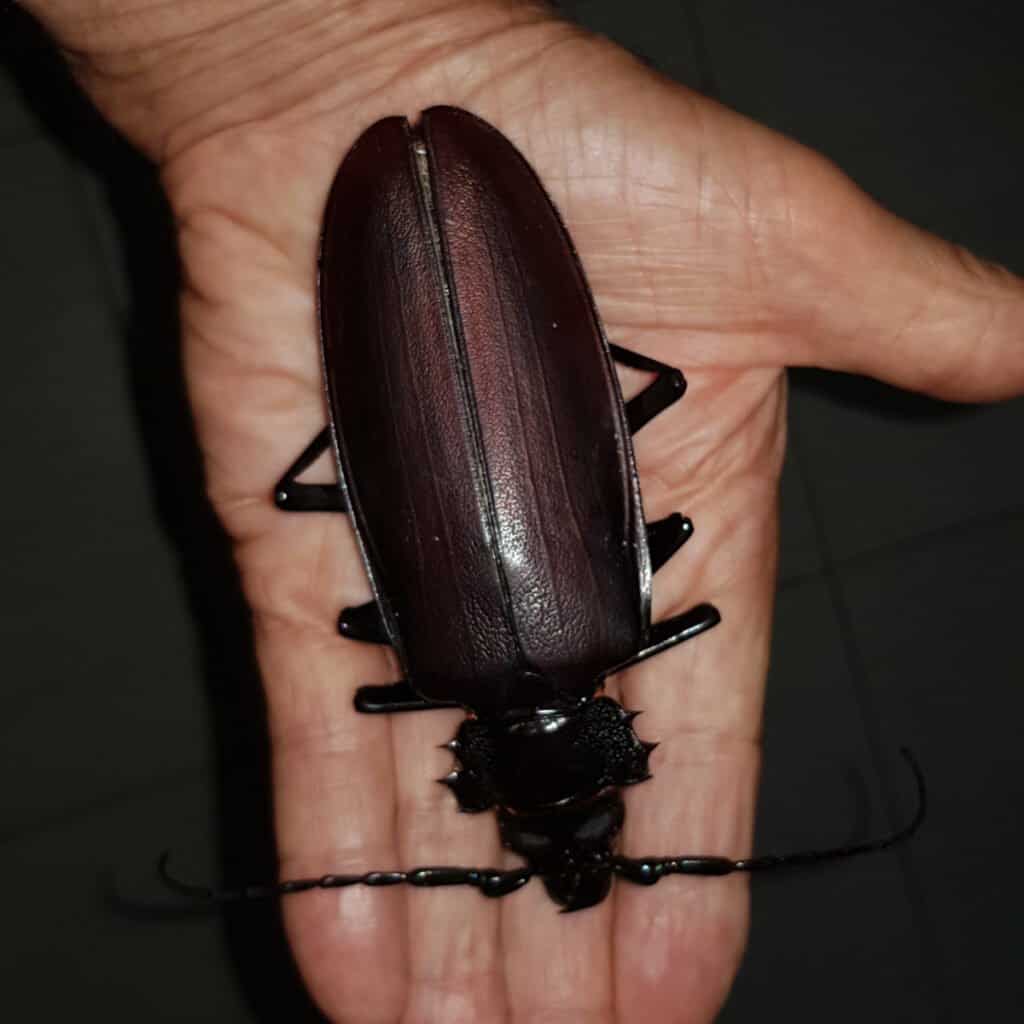
Titan beetles can reach more than 6 inches in length.
©guentermanaus/Shutterstock.com
The titan beetle is the world’s largest beetle as measured by body length. It towers over other insects within its natural habitat, often reaching an astonishing 6.5 inches long! It mostly occupies the rainforests in Colombia, Peru, Bolivia, Brazil, and Ecuador.
Titan beetles are not to be messed with, as their enormous, sharp mandibles are able to cut into human skin with ease and even snap branches in two. Other powerful defense mechanisms possessed by this incredible insect include their sharp spines and the ability to hiss to ward off predators by pushing air through many tiny holes on the sides of their body known as spiracles.
Interestingly, titan beetles strongly resemble cockroaches, though they are actually more closely related to longhorn beetles.
Summary Of The 10 Largest Beetles In The World
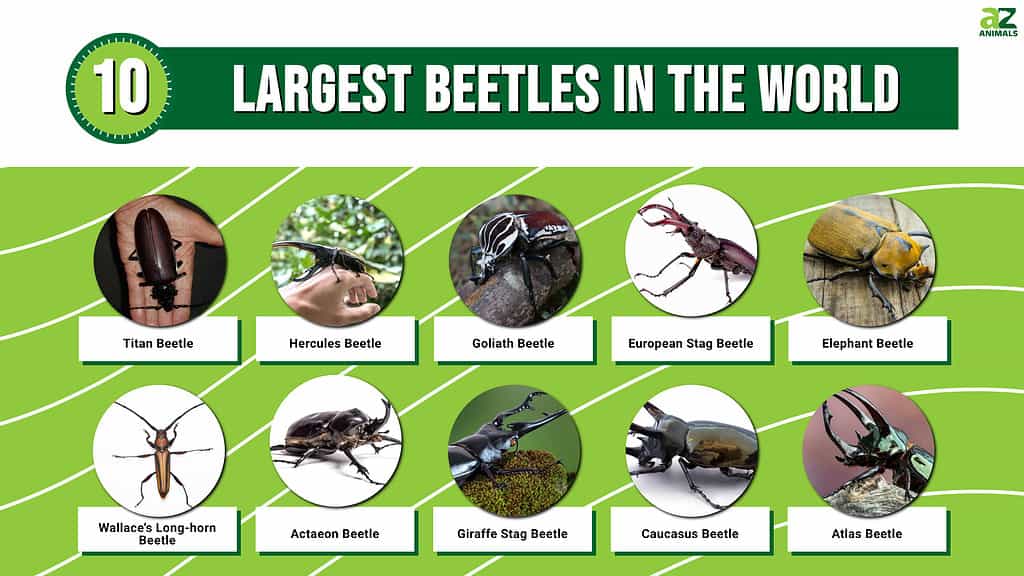
| Rank | Beetle Species | Length |
|---|---|---|
| 1. | Titan beetle | Can reach an astonishing 6.5 inches long |
| 2. | Hercules beetle | Can reach up to 7 inches with their “horn”, or 3 inches in body length |
| 3. | Goliath beetles | Males commonly reach up to 4 inches in length, females reach around 2 to 3 inches |
| 4. | European stag beetle | Can reach 2.5 or more inches (size varies by country) |
| 5. | Elephant beetle | Grow to anywhere from 2.5 to 4.75 inches in length |
| 6. | Wallace’s long-horn beetle | Can reach up to an astonishing 10.5 inches long (most is antennae length) |
| 7. | Actaeon beetle | Can be anywhere from 2 to 5 inches |
| 8. | Giraffe Stag Beetle | Commonly measuring up to 4.7 inches long |
| 9. | Caucasus Beetle | Males reach lengths of 3.5 to 5 inches or more, females reach around 2 to 2.5 inches |
| 10. | Atlas Beetle | Males can reach lengths of up to 4.7 inches, females only 2 inches |