Quick Take
- One beetle native to California is something gardeners should actively want roaming their beds, even though most people instinctively try to get rid of it. Meet this garden ally →
- California's largest beetles look like they belong in a horror movie, but their behavior surprises almost everyone who encounters one. See California's largest beetles →
- A beetle that flies like a tiny bulldozer is drawn to something you would never expect, and that something is already common across California's farmland. Discover what attracts it →
- Despite California's enormous size, it actually has fewer native beetle species than many much smaller states, a surprising fact that reveals something unexpected about the state's ecosystem.
Most people think of Silicon Valley and Hollywood when they think of California, but most of the state is rural, and there are more than 63,000 farms and ranches as well. Where there are crops, vegetables, fruit trees, animals, and flowers, beetles are a certainty. They make up 40% of all the insects in the world, after all. However, most of them are genuinely fascinating and harmless. As big as California is, it doesn’t quite have the number of beetle species that some of the other, much smaller states do. There are only about 142 different types commonly identified throughout the state. As far as beetles native to California, the number is far fewer. Read on to discover some amazing beetles native to the state.
Big-Headed Ground Beetle
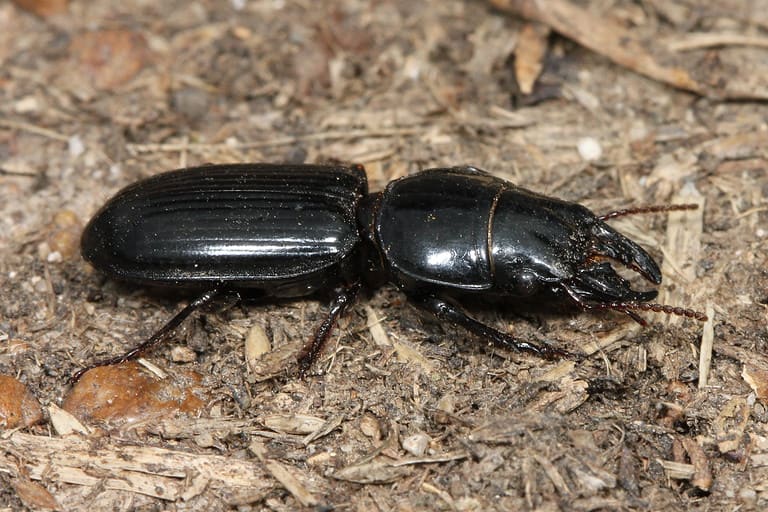
Big-headed ground beetles (Scarites subterraneus) have an intimidating look, but they are generally beneficial. They have flat, glossy black or dark brown bodies with striated wing covers (elytra) that are deeply grooved in a series of vertical lines. There is a small waist in between the abdomen and thorax, and they have large mandibles, or pincers. These beetles average around 0.80 inches long. These beetles are voracious predators, grow fairly large, and are just as ferocious in their larvae stage as they are in their adult stage.
What makes them beneficial is their garden patrols. When one of these beetles wanders into your garden, don’t get rid of it. They’ll wreak havoc on every type of pestilential bug you can imagine, consuming them all and looking for more. The big-headed ground beetle will help clear your garden of dangerous insects, so of all the beetles native to California, this is the one you want on your property.

Big-headed ground beetles have an intimidating look, but they are generally beneficial.
©3,000 × 2,000 pixels, file size: 2.09 MB, MIME type: image/jpeg – Original / License
Flatheaded Hardwood Borer
As the name implies, the flatheaded hardwood borer (family Buprestidae) can be found on and inside hardwood trees, burrowing down into the wood to lay their eggs. There are at least 330 species of this beetle found in California. The Pacific flatheaded borer (Chrysobothris mali) is among the most common. These beetles have a hard, bullet-shaped body that measures between 0.5 and 0.75 inches long. They have coppery, bronze, or grey bodies with mottled elytra.
These beetles infest 70 species of trees in 21 plant families, especially broadleaved, fruit and nut trees, as well as woody ornamentals. They particularly favor trees that are sick or dying. Of course, this has a detrimental effect on the tree, especially when infestation occurs en masse. While flatheads avoid living conifers, they are quick to take advantage of recently felled trees, which has an impact on the lumber industry if the trees aren’t processed quickly.

Flathead hardwood borers dig into the outer layers beneath the bark of their hardwood trees of choice.
©Jay Ondreicka/Shutterstock.com
Hister Beetle
There are more than 160 species of hister beetle (family Histeridae), also called the clown beetle, in California. These beetles generally have oval-shaped bodies and are typically glossy black or metallic greenish-brown. Their elytra are shorter than their abdomen and they also have short antennae. Hister beetles are typically very small, measuring only around 0.063.
The hister beetle is known to consume large numbers of housefly eggs and housefly larvae. They are often found around animal carcasses, in wet and decaying plant matter, and in animal and human feces where they can find eggs and larvae to prey on.

Hister beetles are known to prey on houseflies.
©Nick Valego/Shutterstock.com
Knapweed Root Weevil
The knapweed root weevil (Cyphocleonus achates) is an interesting-looking beetle, with a snout reminiscent of an anteater. The antennae are located on the pointed end of the snout, seemingly distant from the actual head, though the snout is a part of the head. The largest knapweed root weevils only grow to about 0.75 inches.
They are a mottled grey and tan color with tiny black spots across the surface of their wings. If you look closely enough, the surface of the knapweed root weevil looks like it is covered in a fine layer of fur. This is especially true with the legs, which feature large segmentations and have a wooly mammoth-like appearance. They feed on the roots of various plants and trees indiscriminately, which allows fungi and other pathogens to intrude, ultimately killing the tree.

The knapweed root weevil has a snout reminiscent of an anteater.
©886 × 980 pixels, file size: 68 KB, MIME type: image/jpeg – Original / License
Pink Spotted Lady Beetle
The pink-spotted ladybeetle (Coleomegilla maculata) belongs to the large family of ladybugs and resembles the seven-spotted ladybug in many ways. They have flatter, more oblong bodies measuring up to about 0.24 inches long. These beetles are more pink than red, with two black spots on the thorax and six black spots on each wing cover.
Unlike most species, the pink-spotted lady beetle primarily feeds on nectar and pollen. They also consume aphids, mites, eggs, and larvae, so its presence is a boon to gardeners. These beetles can usually be found in different types of agricultural fields, such as corn, apples, and wheat. They also inhabit field edges and anywhere aphids or their other prey can be found.

The pink-spotted lady beetle primarily feeds on nectar and pollen, but they also consume aphids.
©Steven Ellingson/Shutterstock.com
Fig Beetle
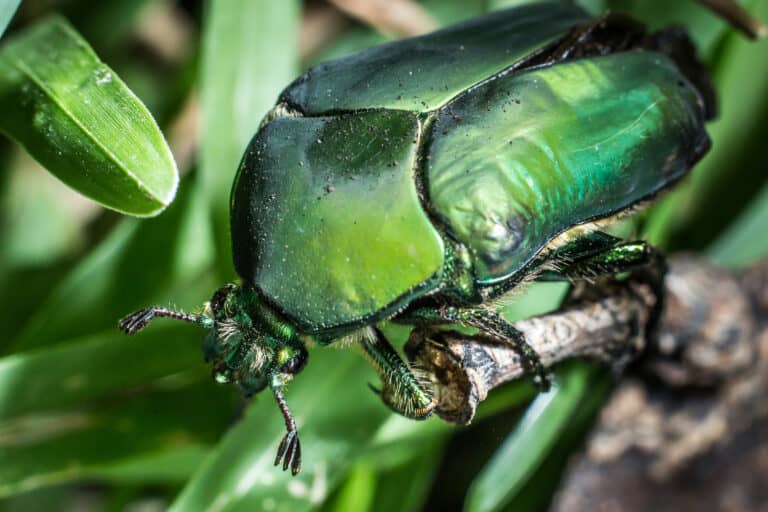
One of the most notable flying beetles in California is the fig beetle (Cotinis mutabilis). They have oval bodies and bright green iridescent shells with brown to tan edges. They typically measure 0.75 to 1.3 inches long. These pretty beetles are also known as figeater beetles, green fruit beetles, or western green June beetles.
Unlike most beetles, they are known to fly relatively long distances, drawn by the smell of manure and fermenting fruit. These beetles can sometimes damage soft, ripe fruit by gathering in fields in large numbers during mating. Fig beetles are considered pests of ripe figs, grapes, apricots, peaches, and plums.

Figeater beetles feed on ripe fruits and may become pests if they infest a field in large numbers.
©Grayson Schmidt/Shutterstock.com
Flying Beetles in California
Most beetles fly, but most of them aren’t very good at it. Their flight capabilities are slow, sluggish, and occasionally meandering. Most beetles have two sets of wings. The outer wings, which are generally the most colorful and unique, rest on top of the inner wings. One of the most notable fliers is the fig eater beetle, discussed above. These beetles are like bulldozers in the air, flying smack into anything in their path, whether it’s a porch light or your face.
The outer wings serve as a protective shell for the far more vulnerable inner wings, the latter of which is responsible for most of the beetle’s propulsion. Cigarette beetles, June beetles, rice weevils, and a variety of longhorn beetles are fliers as well. However, since they tend not to fly into people and objects, they are less well-known and not recognized by most Californians.
Large Beetles in California
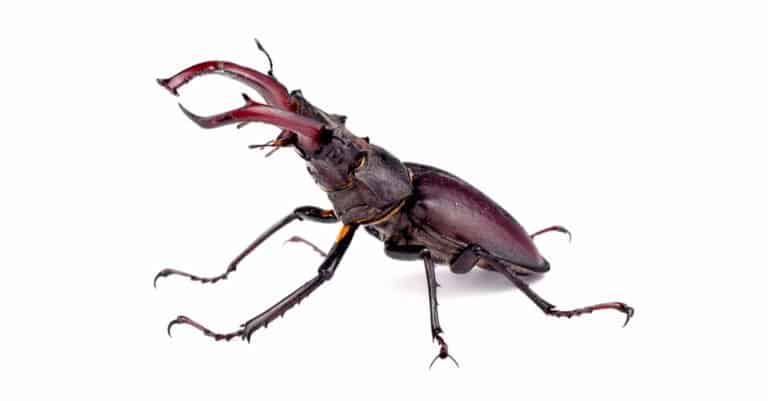
Honestly, there are some beetles out there that belong in a Hollywood horror movie, and most of them are massive. These types of beetles make huge, vibrating flight sounds (like a hummingbird) that strike fear in everything around them. Some of them also sport massive pincers that look like they could take down an adult bull.
Fortunately, for the human race as a whole, these beetles are often pretty docile and harmless. The California prionus beetle can reach 2.25 inches in length. They are known for their appetite for certain trees, which qualifies them as a pest. The ponderous borer beetle, also known as the Western Pine Sawyer, can reach up to 2 to 3.5 inches in length. They prefer to go after dead conifers and pines, boring down inside them to lay their eggs.

The California prionus beetle can reach up to 2.25 inches in length.
©mikeledray/Shutterstock.com
Brown Beetles in California
One of the most well-known California beetles is the darkling beetle, which belongs to the family of brown beetles. These specific darkling beetles are dark, almost black in appearance. The cigarette beetle, June beetle, rice weevil, and longhorn beetles listed above are also brown beetles.
California is also home to leaf beetles, click beetles, water-scavenger beetles, rove beetles, and pinching bugs, all of which belong to the brown beetle family. Brown beetles are fairly common — among the most common insects in the world.