
Quick Take
- Caracals and servals are two African felines with distinct appearances, habitats, and hunting styles.
- Caracals have uniform reddish tan fur with tufted ears and large paws; servals have golden-yellow fur with spots and longer legs.
- They are solitary and not well suited as pets; ownership may require permits or be illegal in some states.
Caracals (Caracal caracal) and servals (Leptailurus serval) are sympatric species that are believed to share a common ancestor. The serval is the only member of its genus and has three recognized subspecies. The Caracal genus includes only the caracal, which also has three recognized subspecies, and the African golden cat. Continue reading to learn about the key differences and similarities between these two felines.
Appearance
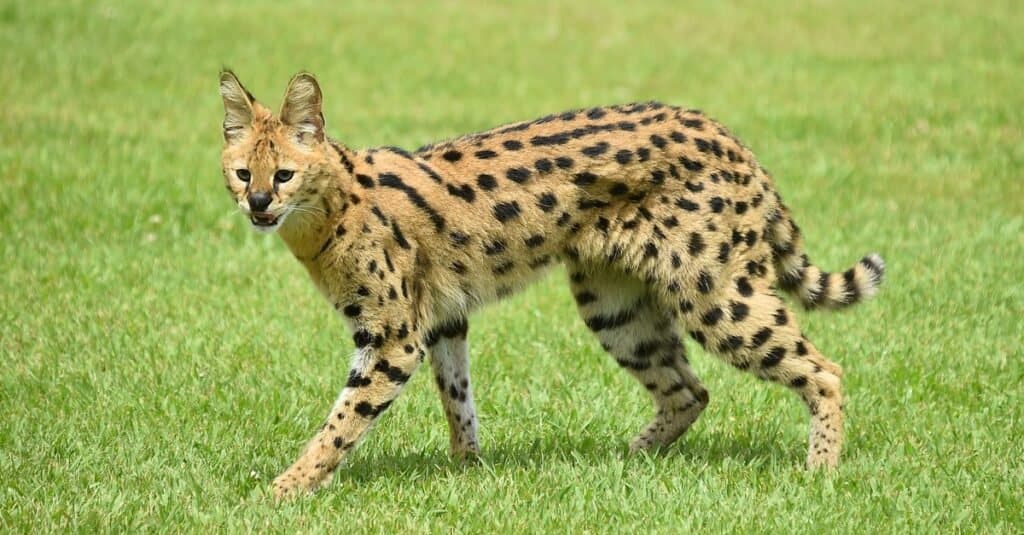
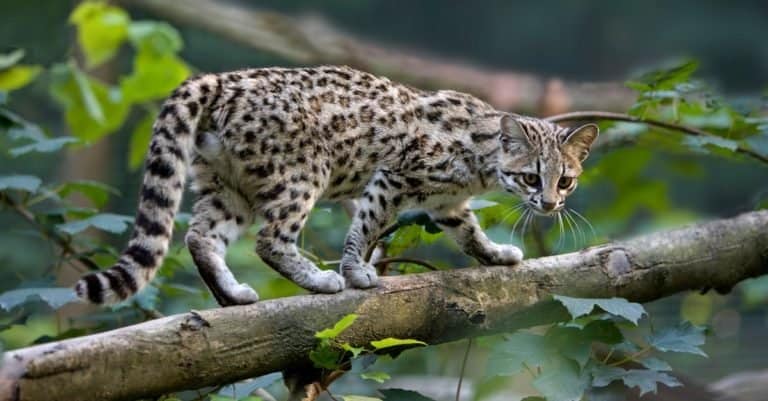
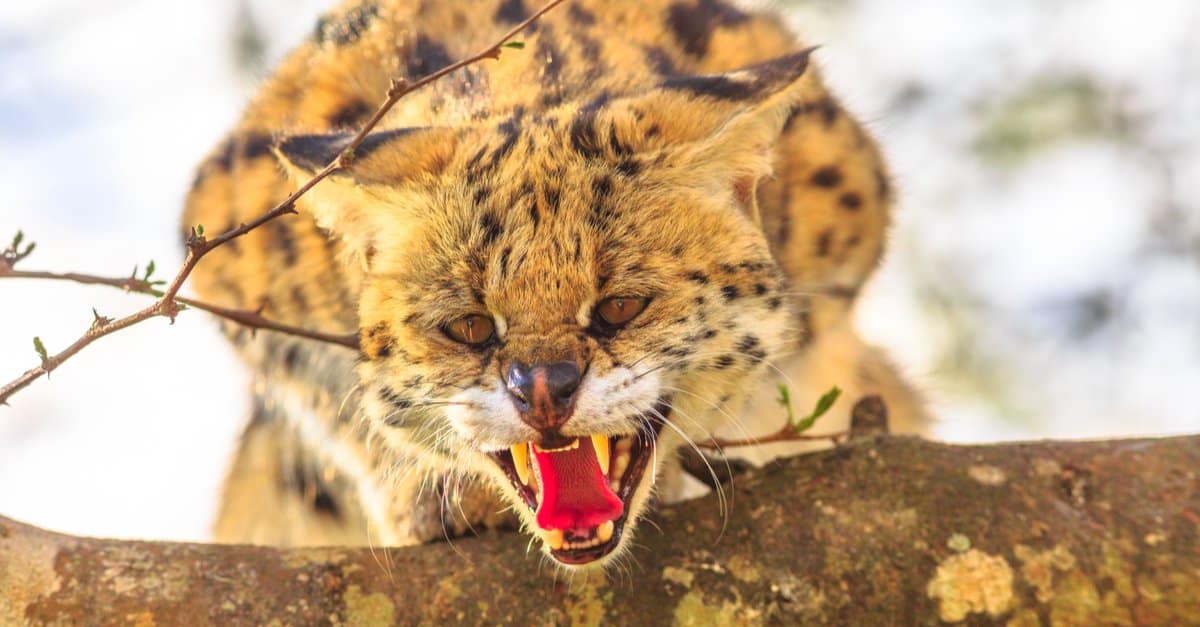
The serval is known for its long tail and long legs.
©alberto clemares exposito/Shutterstock.com
Servals stand 1.75 to 2 feet tall at the shoulder and weigh 18 to 40 pounds. They measure 1.9 to 3 feet long, and their tails are approximately 1 foot long. Caracals are shorter, with a shoulder height of 1.3 to 1.6 feet. However, they are slightly larger than servals. They measure 2.6 to 3.6 feet long, have tails that measure 9 to 13 inches long, and weigh 18 to 42 pounds.
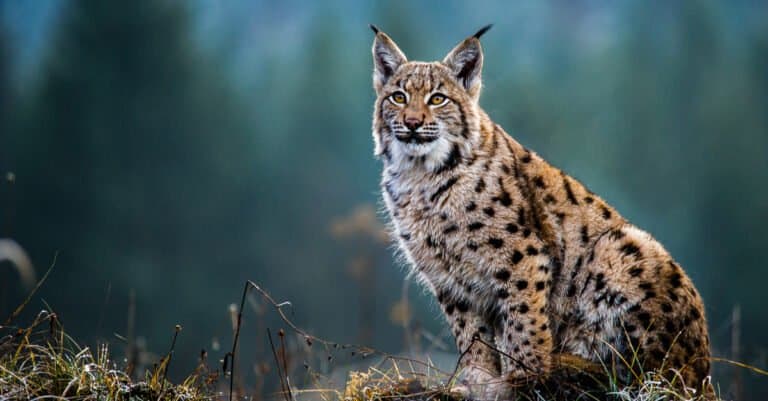
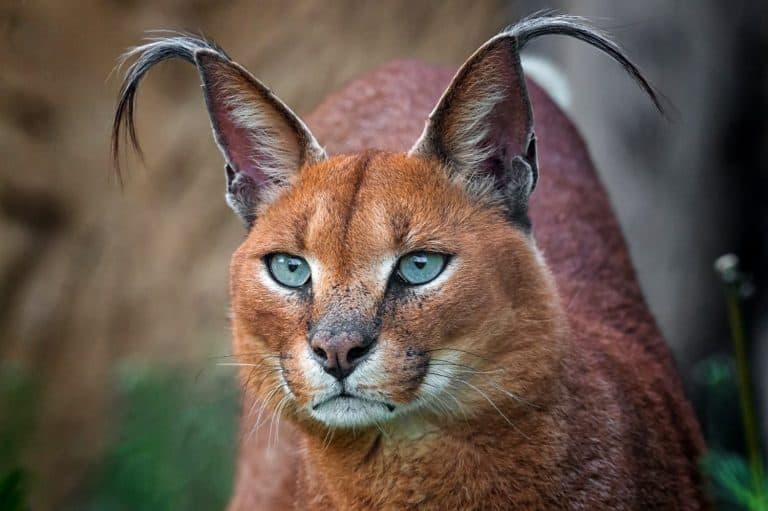
Visually, caracals resemble lynxes because of their ear tufts and are believed to be the animal referred to as the lynx by ancient Greeks and Romans. However, true lynxes have spotted or blotched fur, while the caracal’s coat is uniform and without markings. In addition to its tufted ears, the caracal is known for its large paws, long legs, short face, and reddish tan or sandy fur. Servals are easily distinguished from caracals by their golden-yellow fur that is marked with spots and stripes. Compared to caracals, servals have longer legs, smaller paws, rounder skulls, and no ear tufts.
Predators and Prey
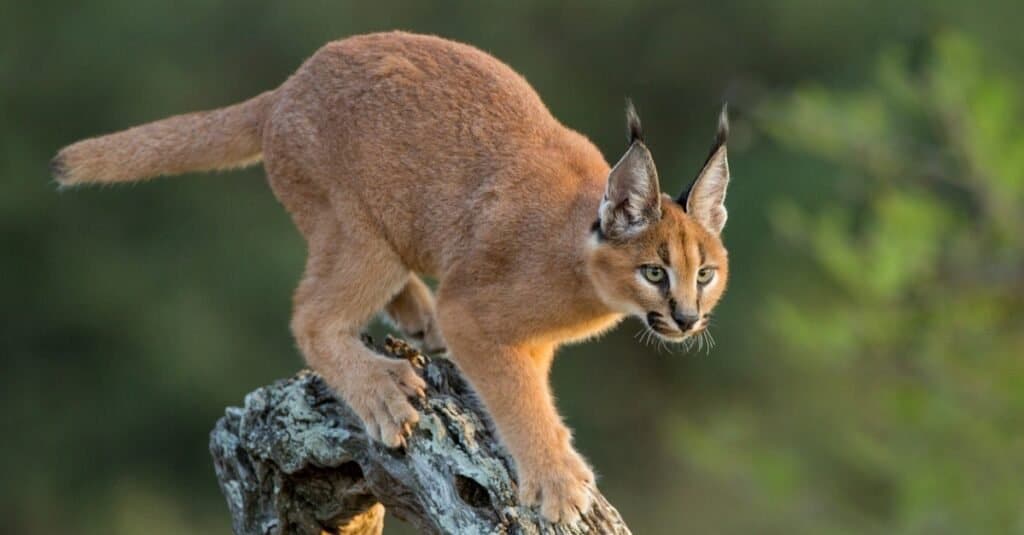
Caracals can subdue prey up to three times their size.
©iStock.com/StuPorts
Caracals are fast, agile, efficient hunters that can subdue prey up to three times their size. They are adroit climbers and can jump over 9.8 feet in the air, which enables them to catch birds midair. Caracals stalk their prey until they are close enough to kill it with a swift bite to the throat or back of the neck. They are carnivores that primarily prey on a variety of small mammals, lizards, snakes, young monkeys, and young antelopes. They will also eat grasses and grapes. Caracals are preyed upon by lions, hyenas, and leopards, and are often killed by humans in an effort to protect livestock.
Servals also stalk and ambush their prey, remaining motionless for up to 15 minutes while using their strong sense of hearing to locate prey. They jump up to 13 feet in the air to pounce on their prey with their forepaws. Servals then kill prey with a bite to the head or neck before swallowing it whole. They primarily prey on African vlei rats (Otomy), shrews, small birds, frogs, and hares. Servals will sometimes hunt larger prey such as flamingoes, spoonbills, waterfowl, and young antelopes. However, the majority of their prey, up to 90 percent, weighs less than 7.1 ounces. Servals are also hunted by lions, hyenas, and leopards, but also by wild dogs, eagles, and Nile crocodiles.
Habitat and Distribution
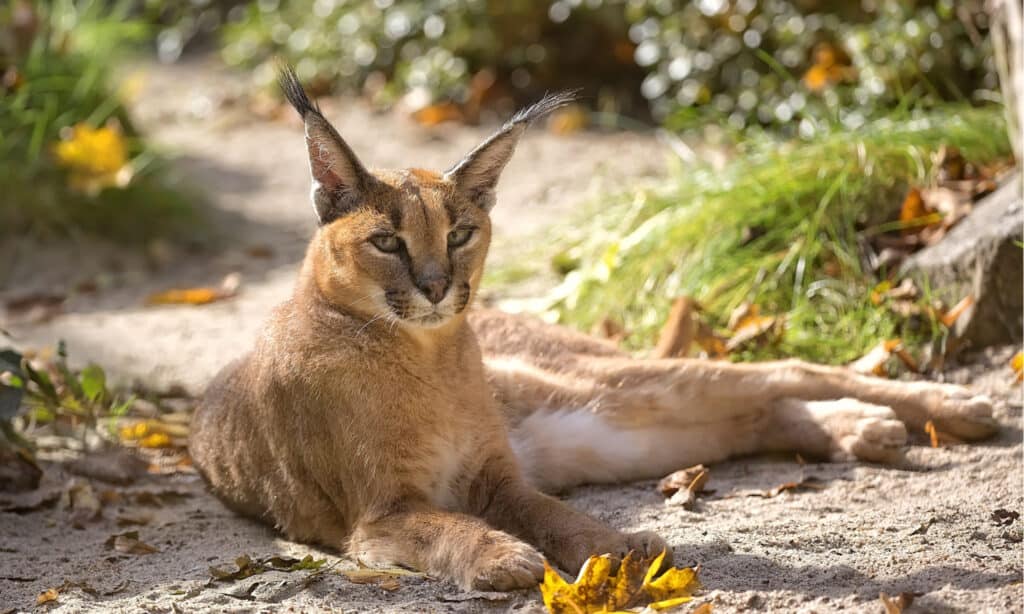
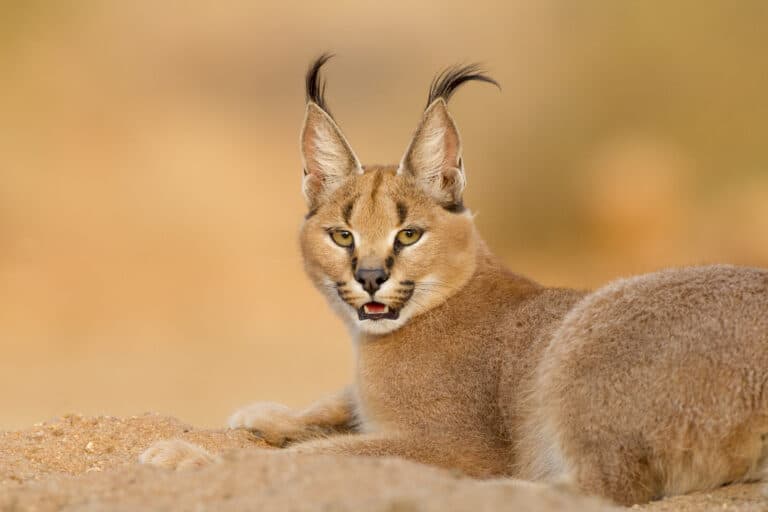
Caracal resting in a clearing.
©Janusz Pienkowski/Shutterstock.com
The caracal is found throughout Africa, the Middle East, and Western India. They inhabit forests, semideserts, savannas, and marshy lowlands. Dry areas with low rainfall and plentiful cover are the caracal’s ideal habitat. In mountain regions, they have been observed at elevations up to 9,800 feet. Caracals are solitary, nocturnal, and highly territorial.
Servals are endemic to Africa, where they are primarily found throughout Southern Africa and the Sahel. In North Africa, a critically endangered population exists in Morocco, and the species has been reintroduced in Tunisia. Servals inhabit grasslands, moorlands, and bamboo thickets. Areas near water bodies, such as wetlands and savannas, are their ideal habitat. They are also solitary, but individuals’ home ranges tend to overlap. On Mount Kilimanjaro, servals have been observed living at elevations as high as 12,500 feet.
Do Servals and Cacacals Make Good Pets?
Servals and caracals are generally not recommended as pets due to their wild nature. They are wild animals that aren’t well-suited to domestication. They pose significant risks to humans and other animals, as they retain strong hunting instincts. These breeds can also be destructive and aggressive. It is illegal to own servals and caracals in some U.S. States, while others require special permits and licenses.