
Quick Take
- One sawshark lived for years in shallow waters regularly visited by divers before science even knew it existed, and the reason it stayed hidden is unsettling. Anna's hidden discovery →
- Most sawsharks hunt alone, but one species turns dramatically more dangerous under a very specific condition. Schooling feeding frenzies →
- One sawshark's rostrum looks nothing like a saw, and its scientific name tells you exactly what it resembles instead. The knife-like rostrum →
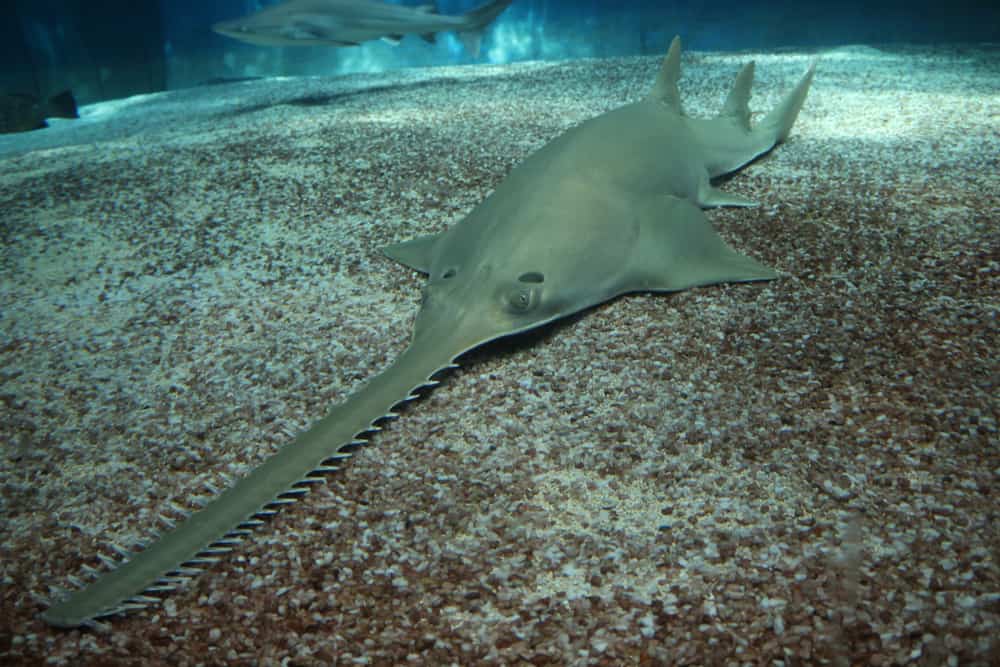
Ten species of sharks belong to the Pristiophoriformes order, and they’re all sawsharks. As the name implies, sawsharks are sharks with a “saw”-like rostrum that protrudes from their skull. These are some of the world’s most recognizable marine species, and also some of its most innovative. They’re widespread throughout Earth’s oceans and rule their habitats as ruthless and efficient predators.
While coveted for their rostrums, sawsharks are also essential to marine habitats. They each play a crucial role in the food chain, using their unique snouts to hunt and defend themselves.
Common Sawshark (Pristiophorus cirratus)
The common sawshark, also known as the long-nose sawshark, lives off the coast of southern Australia, in the Eastern Indian and Southwest Pacific Oceans. It typically remains offshore, preferring depths of 130-194 feet. Unlike some other shark species that prefer rocky bottoms, the common sawshark prefers sandy seabeds. This habitat supports its diet, which is notably different from that of other carnivorous sharks.
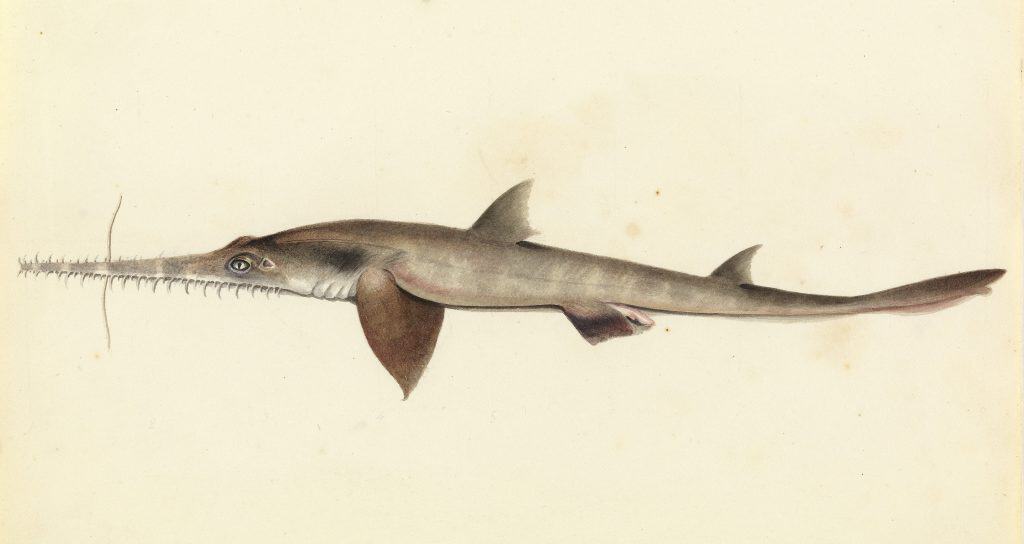
Common sawsharks are rarely seen by humans and shy away from confrontation.
©By William Buelow Gould (1801 – 1853).Reproduction by the Allport Library and Museum of Fine Arts, Tasmanian Archive and Heritage Office. – Reproduced with kind permission of the Allport Library and Museum of Fine Arts, Tasmanian Archive and Heritage Office – Original / License
Crustaceans, mollusks, and bony fish are common prey for the sawshark. It’s timid compared to others in the Pristiophoriformes order, using its long rostrum to swipe and trap shellfish. With 40 rostrum teeth and 39-49 rows of teeth within its mouth, de-shelling crustaceans and mollusks is an easy task. Its sand and rust coloring also helps with this, camouflaging the common sawshark along the sandy seafloor.
Shortnose Sawshark (Pristiophorus nudipinnis)
The shortnose sawshark is unique to the Australian continental shelf. Here, it spends its time around depths of roughly 500 feet. Its rostrum is distinctive, protruding from its body and tapering to a narrow, flat point at the end. This ghost-like shark is almost completely pale white and gray, with no color on its body. It uses countershading, which helps it blend in with the ocean surface when viewed from below and with the seabed when viewed from above.
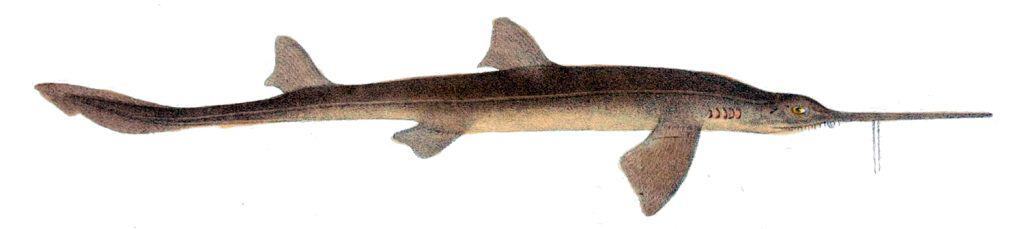
The shortnose sawshark has a narrow rostrum, helping it dig out shrimp and other bottom-dwelling prey.
©https://en.wikipedia.org/wiki/Shortnose_sawshark#/media/File:Pristiophorus_nudipinnis_McCoy.jpg – Original / License
It spends the majority of its time on the ocean floor scouting for crustaceans, shrimp, squid, and the occasional bony fish. When it finds prey, the shortnose sawshark uses violent side-to-side motions to quickly shock and paralyze its target. Like other sawsharks, whisker-like organs called barbels help it detect movement on the seabed.
This shark is rarely seen at the surface, as it prefers to remain in deeper water. It has many predators in southern Australia, including larger sharks, and staying below allows it to remain undetected.
Japanese Sawshark (Pristiophorus japonicus)
As one of the most recognizable sawsharks, the Japanese sawshark is native to the northwest Pacific. It can grow up to 4.6 feet, also making it one of the largest of the Pristiophoriformes order. While it remains in coastal waters surrounding Japan, China, Korea, and Taiwan, it may change depths to migrate to warmer waters.
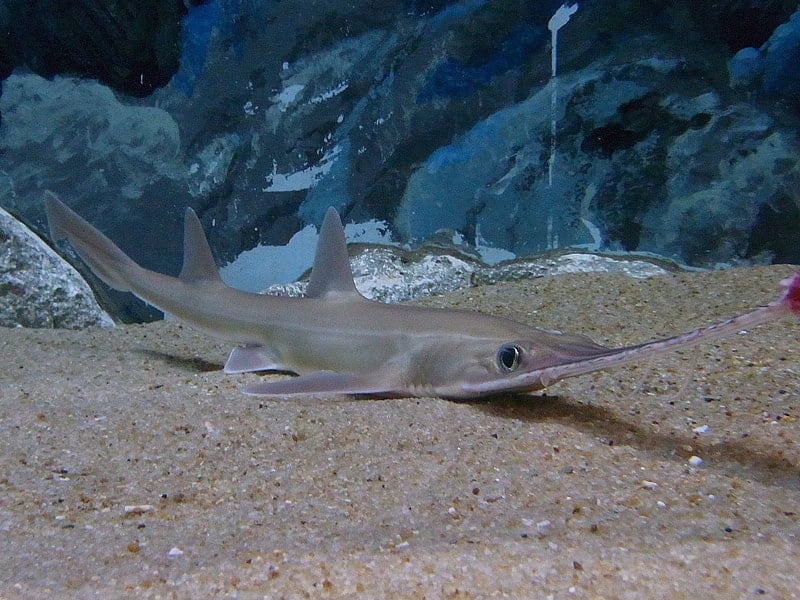
As one of the larger sawsharks in the Pristiophoriformes order, this species is accidentally caught by fishermen quite often.
©http://opencage.info/pics.e/large_13173.asp (archive), CC BY-SA 2.5, https://commons.wikimedia.org/w/index.php?curid=9826979 – Original / License
Japanese sawsharks live in deeper waters than other sawsharks, preferring depths around 1,640 feet. While they’re rarely seen at the surface, they are at risk of being accidentally fished or caught as bycatch due to heavy fishing in the region. This risk increases because their diet consists of the same bottom-dwelling marine species targeted by anglers.
The Japanese sawshark is also unique because its rostrum makes up roughly 26% to 29% of its total body length, with up to 26 teeth at the front of the rostrum and another 9 to 17 at the back. This helps it dig for prey, while also slashing and grinding to paralyze it before consuming it.
Bahamas Sawshark (Pristiophorus schroederi)
As a frequent visitor to coral reefs, the Bahamas sawshark is often spotted by snorkelers and divers. It’s native to the tropical waters around the Bahamas and Cuba, and is usually a solitary shark. However, there have been observations of Bahamas sawsharks forming schools, particularly during feeding frenzies.
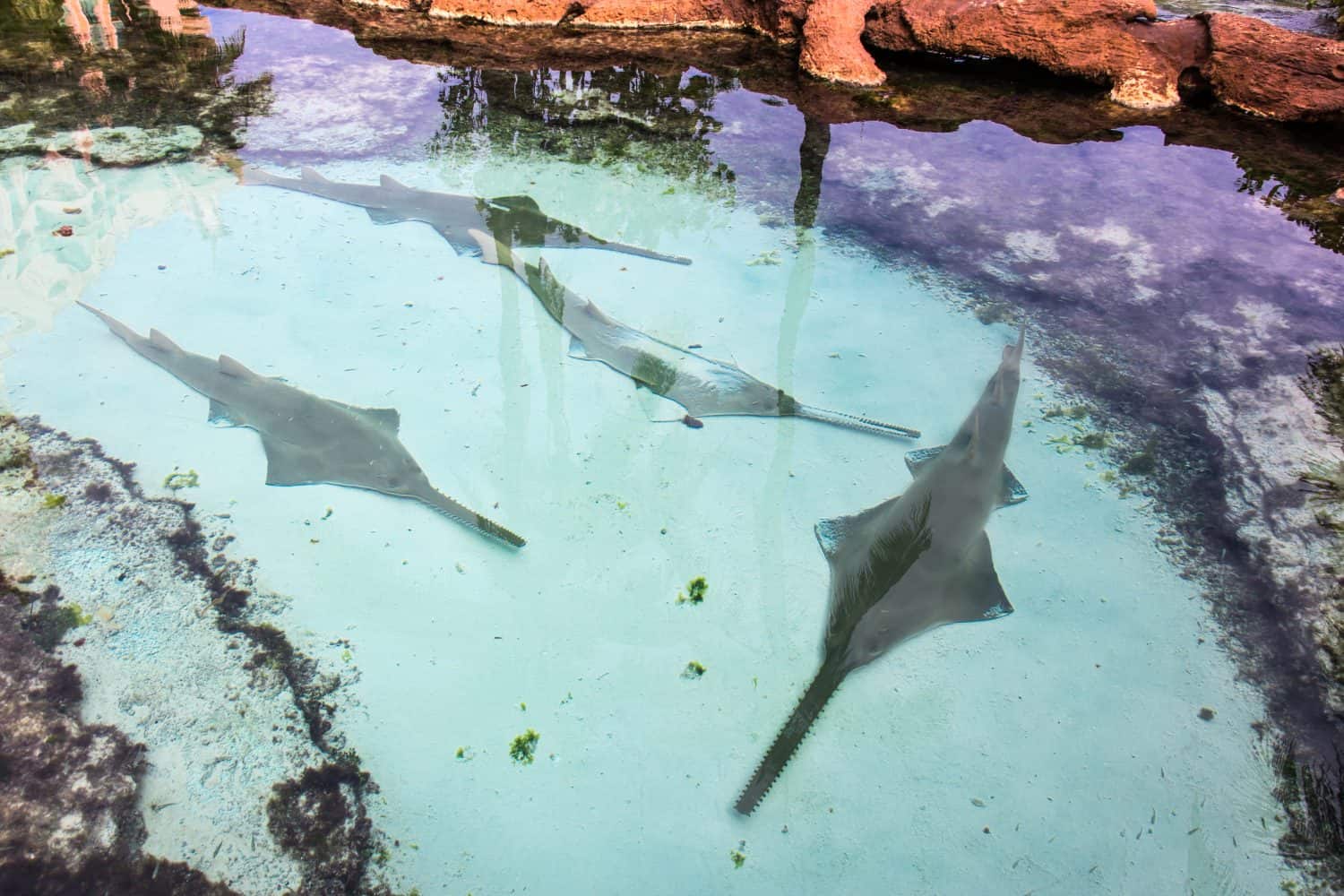
One of the only sawsharks that visits coral reefs in search of bottom-dwelling prey.
©Arzi/Shutterstock.com
Although smaller than most, this sawshark has an impressive row of 36 upper jaw teeth and 32 along its lower jaw. Its rostrum typically has up to 48 spines, and its snout is slightly longer than others in the Pristiophoriformes order. Although Bahamas sawsharks are sometimes seen by humans, they usually stay at depths of 1,400 to 3,100 feet. They are not aggressive and primarily consume small tropical fish, squid, and other tiny bottom-dwellers.
Warren’s Sixgill Sawshark (Pliotrema warreni)
Native to the subtropical waters of the Indian Ocean, Warren’s sixgill sawshark is one of several unique six-gilled species. Whereas most sharks have five gill slits, these have an extra (sixth) gill slit, which helps them survive in deeper waters. This species is also one of the largest sawsharks, with some females growing to 54 inches long.
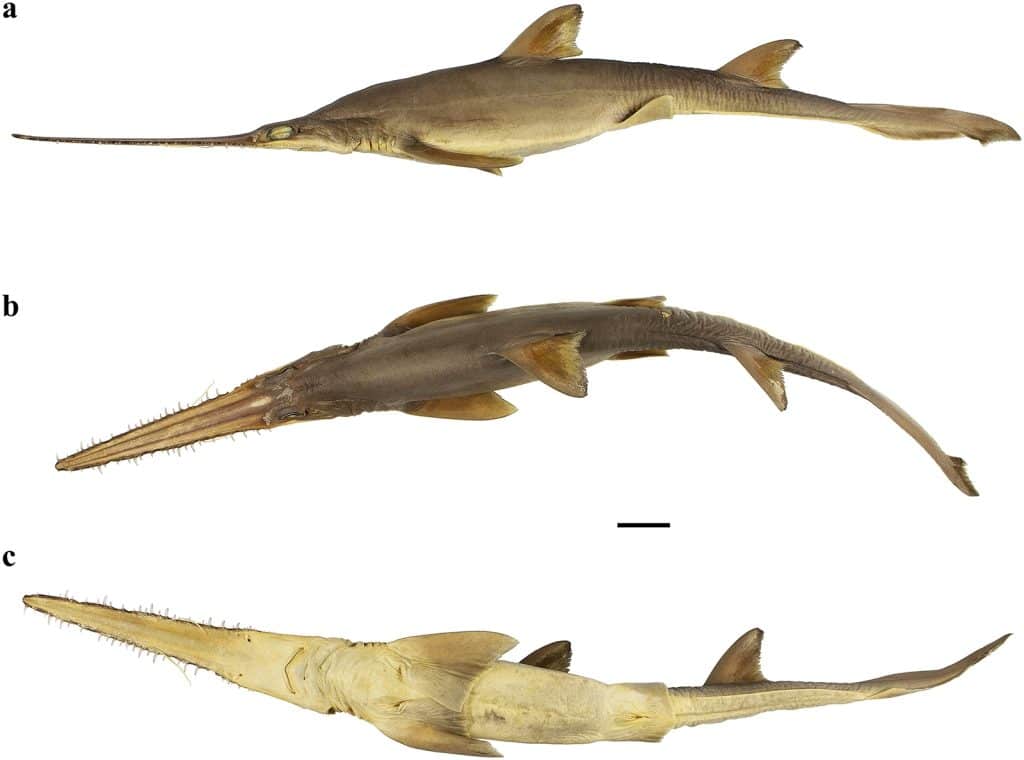
The sharp, irregular spines on Warren’s sixgill sawshark help it pin down wily squid.
©https://en.wikipedia.org/wiki/Sixgill_sawshark#/media/File:Pliotrema_warreni.jpg – Original / License
This is another species that prefers to remain in lower zones, hanging out at depths between 120 and 1,640 feet. Along with the typical diet of crustaceans and small fish, Warren’s sixgill sawsharks also consume squid. Their rostrum is also larger than many others, and its teeth-like spines continue onto its head. This gives it an edge over prey and many predators, with the exception of the tiger shark, which is known to prey on Warren’s sixgill sawsharks.
Anna’s Sixgill Sawshark (Pliotrema annae)
As one of the rarest sawshark species, Anna’s sixgill is unique to the coastal waters of the Indian Ocean off Zanzibar. It also has a shallower depth range than others in the Pristiophoriformes order, staying within 66 to 115 feet of the ocean surface. Despite its overlapping range with divers and boats, Anna’s sixgill sawshark was not identified as a new species until 2020.
This species has an appearance that’s similar to the shortnose sawshark, with a pale body and shorter rostrum. Little is still known about this shark, but scientists have confirmed it preys on bottom-dwellers like others in its order. It has also been observed rapidly swiping its head from side to side not only to stun prey, but also to cut it down into bite-sized pieces.
Kaja’s Sixgill Sawshark (Pliotrema kajae)
Another recent discovery as of 2020 was Kaja’s sixgill sawshark. It’s equally as rare as Anna’s sixgill, but lives in the western Indian Ocean around Madagascar and the Mascarene Plateau. This species prefers depths of 702–1,050 feet, where it can prey on bottom-dwellers along submarine ridges and continental slopes.
Few have seen the rostrum of Kaja’s sixgill sawshark up close, but photos taken from specimens show that it has sharp, irregular teeth that resemble a chainsaw. As its name implies, this species is ruthless in its hunting techniques, using its rostrum to slash through schools of fish and prey on the injured. The six-gilled anatomy of this sawshark adds to its uniqueness, making it one of the rarest in the Pristiophoriformes order.
African Dwarf Sawshark (Pristiophorus nancyae)
The African dwarf sawshark is one of the smallest, measuring just under two feet in length. It’s native to the warm waters around Africa, particularly those off the coast of Mozambique. It was first declared a new species in 2011, when the first specimen was caught at a depth of 1,600 feet.
The rostrum of this small sawshark is roughly one-third of its body length, making it a prominent feature of the species. Scientists are still studying its habits, but believe it primarily eats crustaceans. Due to its small size, eating anything larger would be risky, even with its rostrum as a weapon. So little is known about this species that the IUCN currently has its status listed as “data deficient,” highlighting the elusive nature of the African dwarf sawshark.
Lana’s Sawshark (Pristiophorus lanae)
Lana’s sawshark is native to the coastal waters of the Philippines. It was first discovered by researcher Dave Ebert in 1966, who named the species after his shark-loving niece, Lana. This small sawshark grows to about 30.5 inches and lives at a depth of around 800 feet.
While it’s possible that Lana’s sawshark has a wider distribution than just the Philippines, it is so rarely sighted that this has yet to be confirmed. Using its rostrum, Lana’s sawshark primarily feeds on bottom-dwelling marine life that’s native to the Philippines. This includes squid and small fish, which it kills by wielding its rostrum as a sword.
Tropical Sawshark (Pristiophorus delicatus)
The tropical sawshark is yet another small member of the Pristiophoriformes order. It measures roughly 33 inches and lives at depths of 807–1,329 feet. Its scientific name, delicatus, refers to its rostrum, which has teeth that are finer than those of other sawsharks. Its rostrum is also the narrowest among sawsharks, resembling a knife more than a saw.
Tropical sawsharks also have a secondary weapon in the form of 47 upper teeth and 37 lower teeth, which is significant for a shark of this small stature. Rather than maintain a solitary nature, tropical sawsharks are also known to form schools. When hunting, they use their rostrums to decimate schools of small, bony fish, squid, and shrimp, or stun crabs and other shellfish.