
Hamsters are small rodents of the subfamily Cricetinae, which contains about 19 species. The golden or Syrian hamster (Mesocricetus auratus) is one of the best-known species of hamster. Syrian hamsters have prominent barrel-shaped bodies and stubby tails. The standard-sized Syrian hamster is marketed under various names based on coat type and color, such as the short-haired (sometimes called fancy bear), long-haired (often called teddy bear), and the classic golden hamster. However, these are all the same species. Syrian hamsters are marketed under many names, such as teddy bear hamster, fancy bear hamster, and panda bear hamster. All of these names refer to the same animal. Continue reading to learn more about these adorable little rodents.
Key Differences Between the Fancy Bear Hamster and the Syrian Hamster
The fancy bear hamster and the Syrian hamster are identical. They share colors, diets, characteristics, and origins. Breeders have created many fun names for the Syrian hamster, and Fancy Bear Hamster is one of those fun names for the same animal.
Color
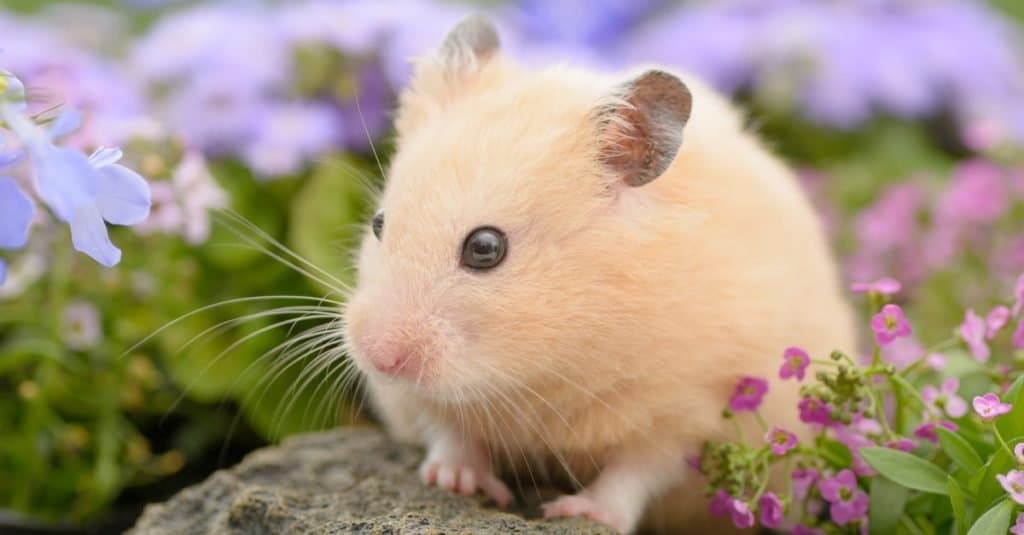
Syrian hamsters come in a few different colors.
©stock_shot/Shutterstock.com
Initially, only the golden color pattern was available in Syrian hamsters. Selective breeding has produced several fancy bear hamsters with unique colors, including cinnamon, grey, cream, and black. Some fancy bear hamsters are named for their color variations, such as the tan honey bear hamster, the white polar bear hamster, the black-and-white panda bear hamster, the black spotted dalmatian hamster, and more.
Physical Appearance

Syrian hamsters are easy to train.
©Mary Swift/Shutterstock.com
Syrian hamsters, also called fancy bear hamsters, come in several different coat types. Common coat types include short-haired and long-haired. Fancy bear hamsters usually fall under the category of short-haired hamsters. Long-haired Syrians are often called teddy bear hamsters. Fur types are satin, glossy, and rex, which is curly.
Habitat

Syrian hamsters are solitary creatures and should be kept one per enclosure.
©stock_shot/Shutterstock.com
Fancy bear hamsters are solitary creatures that require a habitat with separate spaces for sleeping, feeding, and playing. They thrive in an arid climate with temperatures between 65 and 75 degrees. They will exhibit decreased activity and may start hibernating when temperatures fall below 60 degrees. Fancy bear hamsters that are kept as pets can live in a large enclosure as long as there is a layer of aspen shavings or shredded paper for bedding. They are comfortable in a warm room that is free of cold drafts.
The wild population of Syrian hamsters is found in fertile, agricultural, and densely populated areas in the Middle East, including Northern Syria and Southern Turkey. Their habitats include the edges of deserts, dunes, plateaus, steppes, and more.
Diet
All Syrian hamsters are omnivorous. Wild Syrian hamsters feed on a wide variety of foods, including nuts, seeds, flies, cockroaches, wasps, ants, and other insects.
Domesticated hamsters need a similar diet, including various proteins (mealworms are a favorite), fresh vegetables, grains, seeds, nuts, and fruit.
.
Personality
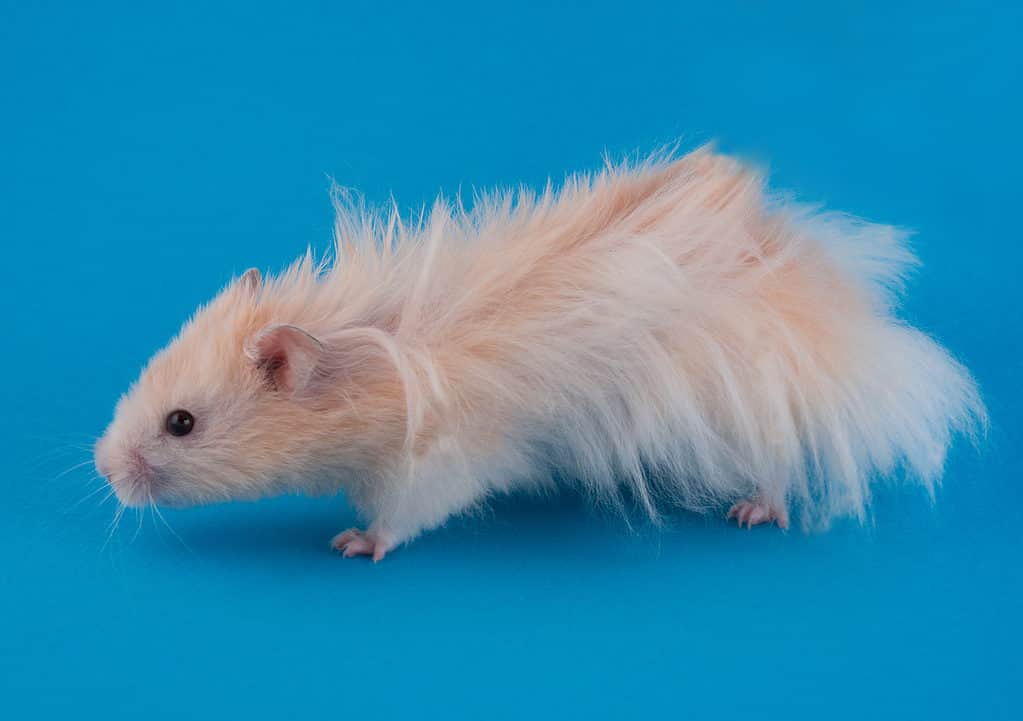
Syrian hamsters can have long or short hair.
©Olena Kurashova/Shutterstock.com
Fancy bear hamsters are docile, friendly, curious, and adventurous. These creatures love to explore their surroundings. However, they may react by biting if they become scared or startled. Although fancy bear hamsters are small, their bites can hurt.
Hamsters are territorial and intolerant of one another. They will attack each other, except when a male encounters a female in heat. Even siblings may fight once they mature, sometimes to the death.
Origin

Hamsters are very active in the wild and travel up to 5 miles per day. As pets, they need very large enclosures (like a 40-gallon aquarium).
©iStock.com/Conny V
Syrian hamsters originated in Syria and were first described in 1797. A litter of Syrian hamsters was captured in Aleppo, Syria, and brought to a laboratory in Jerusalem. These hamsters, studied by zoologist Israel Aharoni, became the foundation for all subsequent domesticated Syrian hamsters, with the entire global population of pet Syrian hamsters descending from this single litter.