
Quick Take
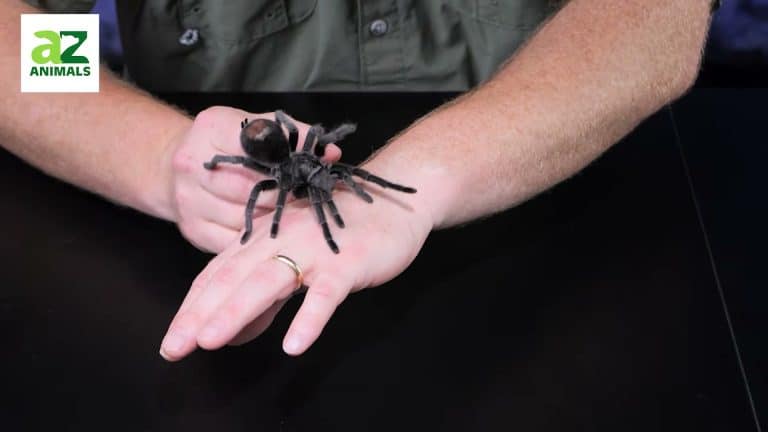
- Brazil has over 200 species, with some tarantulas topping 8 to 10 inch leg spans.
- Some Guyruita and Notahapalopus species inhabit iron ore caves in the Carajás region of Brazil.
- The Catumiri genus defies New World norms by lacking the urticating hairs typical of tarantulas in the Americas.
- Theraphosa blondi, the Goliath birdeater, is the largest tarantula in the world with a leg span of 12 inches.
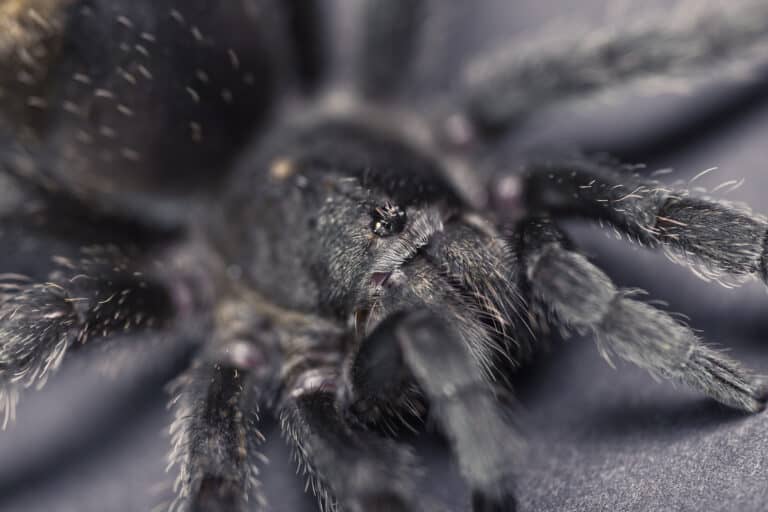
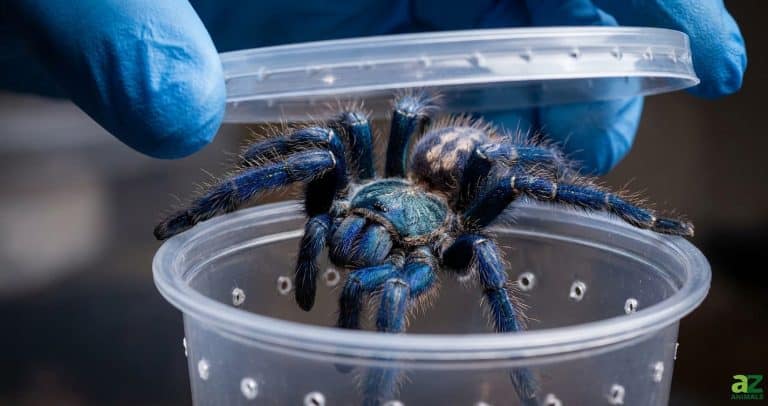
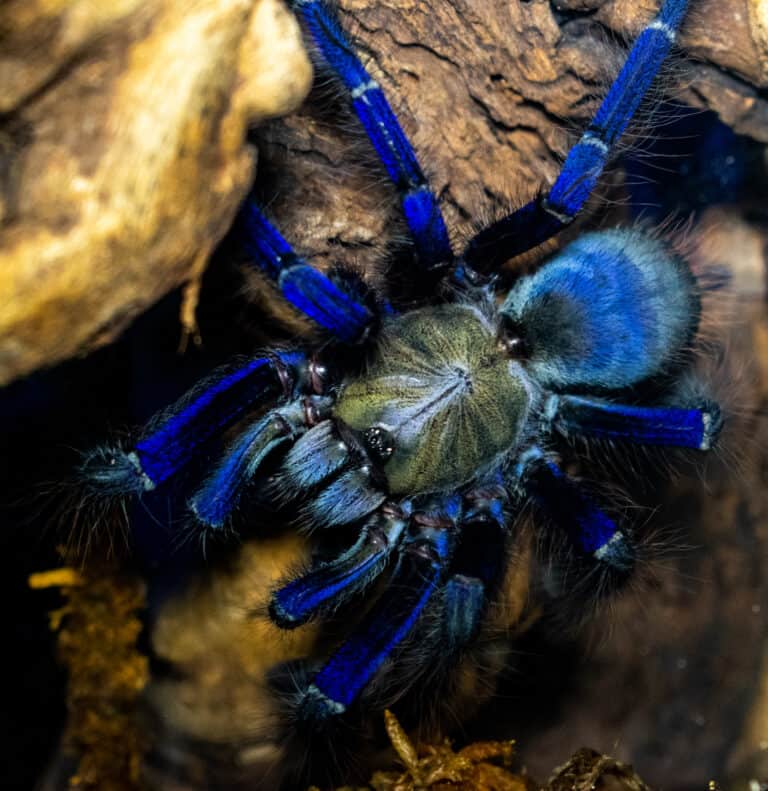
Brazil is considered the most biodiverse country on Earth, with 15%-20% of the world’s biodiversity. The Amazon rainforest, the Cerrado savannas, the semi-arid Caatinga, the coastal Atlantic Forest, the wetlands of the Pantanal, and the Pampas grasslands are home to over 120,000 animals and over 4,000 plants. Brazil is home to the greatest diversity of tarantulas in the world, with over 200 species.
The following list includes currently recognized tarantula species native to Brazil according to the World Spider Catalog as of December 2025. An asterisk after the tarantula’s name indicates that it is the type species. Many species do not have common names because they are newly discovered or have not been formally described. For lesser-known species, common names are typically unnecessary. Where possible, we have included common names, but scientific names provide the most precise identification. See our complete list of tarantula species for a comprehensive reference of all tarantula species.
Acanthoscurria Ausserer, 1871
Members of the genus Acanthoscurria are primarily distinguished from other genera by the presence of stridulatory setae (noise-making hairs). They can grow to large sizes, with leg spans measuring up to 8 inches. These spiders often have dark bodies with reddish-tinted setae on their abdomen and legs, plus light-colored bands at the leg joints. Tarantulas in this genus frequently build tube-like burrows under rocks or in ravines. Some spiders may also be found in silken retreats inside tree trunks or fallen logs. In Brazil, many Acanthoscurria species inhabit the Amazon in the states of Amazonas, Mato Grosso, Pará, Rondônia, and Roraima.
- Acanthoscurria belterrensis Paula, Gabriel, Indicatti, Brescovit & Lucas, 2014 – Brazil
- Acanthoscurria chacoana Brèthes, 1909 – Brazil, Bolivia, Paraguay, Argentina
- Common name: Bolivian red rump tarantula
- Acanthoscurria cordubensis Thorell, 1894 – South America, except Colombia, Suriname, Ecuador, and Chile
- Common name: Rusty brown birdeater
- Acanthoscurria geniculata* (C. L. Koch, 1841) – Brazil
- Common name: Brazilian whiteknee tarantula
- Acanthoscurria gomesiana Mello-Leitão, 1923 – Brazil
- Acanthoscurria insubtilis Simon, 1892 – Brazil, Bolivia
- Common name: Bolivian black velvet
- Acanthoscurria juruenicola Mello-Leitão, 1923 – Brazil
- Common name: Brazilian orange-banded tarantula
- Acanthoscurria melloleitaoi Bertani, 2023 – Brazil
- Acanthoscurria natalensis Chamberlin, 1917 – Brazil
- Common name: Natal brown birdeater
- Acanthoscurria paulensis Mello-Leitão, 1923 – Brazil
- Common name: Brazilian giant black
- Acanthoscurria rhodothele Mello-Leitão, 1923 – Brazil
- Acanthoscurria simoensi Vol, 2000 – Guyana, French Guiana, Brazil
- Acanthoscurria tarda Pocock, 1903 – Brazil
- Acanthoscurria theraphosoides (Doleschall, 1871) – Peru, Bolivia, Brazil, French Guiana
- Common name: Brazilian black-and-white tarantula
- Acanthoscurria urens Vellard, 1924 – Brazil
Amazonius Cifuentes & Bertani, 2022
Amazonius is a genus of arboreal tarantulas found in the Amazon rainforest. They are medium-sized spiders that can reach leg spans of up to around 5 inches. Amazonius are similar to Psalmopeous in the presence of stridulatory setae on their mouthparts, although the hairs are slim and more numerous in Amazonius. Brazilian Amazonius species are generally shades of brown to brownish-orange. The cephalothorax and abdomen are covered in short, dense, dark setae with long, light reddish setae scattered on the abdomen. Their legs are also covered in dense setae.
- Amazonius elenae* (Schmidt, 1994) – Ecuador, Brazil
- Common name: Ecuadorian orange
- Amazonius germani Cifuentes & Bertani, 2022 – French Guiana and Brazil
- Common name: Orange tree spider
- Amazonius giovaninii Cifuentes & Bertani, 2022 – Brazil
Arboriticus Borges & Bertani, 2025
Arboriticus is a recently described genus of medium to large arboreal tarantulas. A. giganticus is the largest species discovered to date, with a leg span of around 6.4 inches. Females were also found to have a thicker, stronger leg IV, covered in stiff setae. They are often muted shades of brown, grey, and olive with light leg bands. Specimens have been observed on tree trunks and walking along branches. Arboriticus spiders create their silken retreats in the cavities of trees up to 8 feet off the ground. These spiders are found in the Brazilian Atlantic Forest from northeastern to southeastern Brazil, occasionally in highly deforested regions.
- Arboriticus celsoi* Borges & Bertani, 2025 – Brazil
- Arboriticus giganteus Borges & Bertani, 2025 – Brazil
- Arboriticus maculatus Borges, Abegg & Bertani, 2025 – Brazil
- Arboriticus minor Borges & Bertani, 2025 – Brazil
- Arboriticus petropolis Borges & Bertani, 2025 – Brazil
- Arboriticus spinosissimus (Mello-Leitão, 1923) – Brazil
- Arboriticus tarsicrassus (Bücherl, 1947) – Brazil
Avicularia Lamarck, 1818
Members of the genus Avicularia are small to medium-sized arboreal tarantulas, often favoring the mid-to-upper canopy of the rainforests for their retreats. In the Brazilian Amazon, Avicularia retreats are frequently found at the base of palm tree leaves. These spiders generally have long setae on their legs and abdomens, as well as urticating setae type II on the top of the abdomen. Type II hairs are primarily transferred through direct contact, as they are too heavy to be carried by air. Avicularia species are some of the most in-demand tarantulas in the pet trade due to their unique, vibrant color patterns and metallic sheen as juveniles.
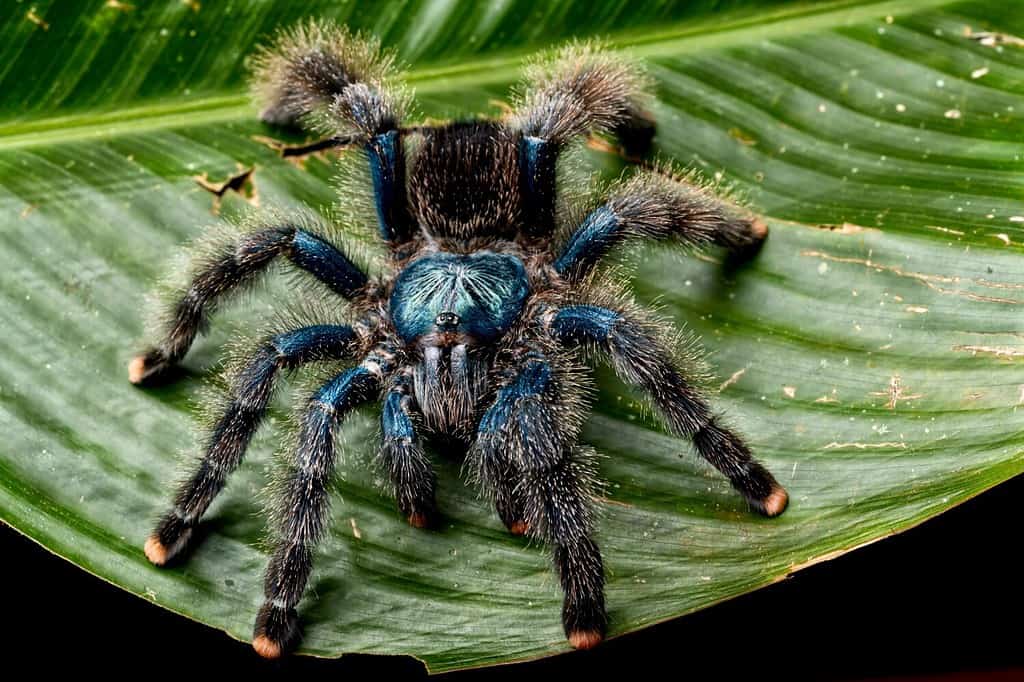
The Guyana pinktoe, Avicularia avicularia, has a wide distribution from South America to the Caribbean.
©reptiles4all/Shutterstock.com
- Avicularia avicularia* (Linnaeus, 1758) – Venezuela, Guyana, Suriname, French Guiana, Trinidad and Tobago, Brazil, Peru, Bolivia
- Guyana pinktoe, pinktoe tarantula
- Avicularia caei Fukushima & Bertani, 2017 – Brazil
- Avicularia hirschii Bullmer, Thierer-Lutz & Schmidt, 2006 – Ecuador, Peru, Brazil
- Avicularia juruensis Mello-Leitão, 1923 – Colombia, Ecuador, Peru, Brazil
- Yellow-banded tarantula
- Avicularia minatrix Pocock, 1903 – Venezuela, Brazil
- Avicularia rufa Schiapelli & Gerschman, 1945 – Ecuador, Peru, Bolivia, Brazil
- Avicularia taunayi (Mello-Leitão, 1920) – Brazil
- Avicularia variegata F. O. Pickard-Cambridge, 1896 – Venezuela, Brazil
Bumba Pérez-Miles, Bonaldo & Miglio, 2014
One way to distinguish the genus Bumba is the type IV urticating setae on their abdomens, which are short, very fine hairs with barbs and pointed tips. They are generally medium-sized terrestrial tarantulas that reach leg spans of 4-6 inches. Most species are shades of brown to black overall, but B. horrida has a vivid red cephalothorax with a black abdomen and legs. Some species may also display abdominal patterns. In Brazil, these spiders occur in the states of Pará, Rondônia, Mato Grosso, Amazonas, Roraima, Goiás, Mato Grosso do Sul, Minas Gerais, Bahía, and São Paulo.
- Bumba cuiaba Lucas, Passanha & Brescovit, 2020 – Brazil
- Bumba horrida* (Schmidt, 1994) – Venezuela, Brazil
- Common name: Brazilian redhead tarantula
- Bumba humilis (Vellard, 1924) – Brazil
- Bumba lennoni Pérez-Miles, Bonaldo & Miglio, 2014 – Brazil
- Named after John Lennon of The Beatles
- Bumba mineiros Lucas, Passanha & Brescovit, 2020 – Brazil, Paraguay
- Bumba rondonia Lucas, Passanha & Brescovit, 2020 – Brazil
- Bumba tapajos Lucas, Passanha & Brescovit, 2020 – Brazil
Catanduba Yamamoto, Lucas & Brescovit, 2012
Catanduba are small tarantulas that are mainly distinguished from other genera by the morphology of the male genitalia and the triangular-shaped nodule on the base of metatarsus I in males. These nodules are believed to assist in holding the female’s fangs during mating. Catanduba species are generally shades of brown with dark abdomens and long yellowish or orange setae. Some species may also have stripes extending down the sides of the abdomen. These burrowing tarantulas primarily occur in the tropical savannas of the Cerrado in central Brazil, but some species can also be found in the Atlantic Forest and in the semi-arid Caatinga scrub forest.
- Catanduba araguaia Yamamoto, Lucas & Brescovit, 2012 – Brazil
- Catanduba canabrava Yamamoto, Lucas & Brescovit, 2012 – Brazil
- Catanduba flavohirta (Simon, 1889) – Brazil
- Catanduba peruacu Yamamoto, Lucas & Brescovit, 2012 – Brazil
- Catanduba piauiensis Yamamoto, Lucas & Brescovit, 2012 – Brazil
- Catanduba simoni (Soares & Camargo, 1948) – Brazil
- Catanduba tuskae* Yamamoto, Lucas & Brescovit, 2012 – Brazil
Catumiri Guadanucci, 2004
Tarantulas in the genus Catumiri are very small terrestrial spiders. With leg spans between 2 and 3 inches, they are considered to be among the smallest tarantula species. These spiders have few or no urticating hairs, which is uncommon in New World tarantulas. C. chicaoi is known from Bahía state in Northeastern Brazil. It is described as having a reddish-brown carapace and a black abdomen. Females are distinguished by 4–5 pairs of small white spots on the top of the abdomen. C. parvum is known from Santa Catarina and Rio Grande do Sul states in the South. It has a brown body with brown to brownish-grey legs and a coppery-brown carapace. C. petropolium is known from Rio de Janeiro state in the Southeast. It has a brown body with darker, square-shaped abdominal markings.
- Catumiri chicaoi Guadanucci, 2004 – Brazil
- Catumiri parvum (Keyserling, 1878) – Brazil, Uruguay
- Common name: Uruguayan copper dwarf
- Catumiri petropolium* Guadanucci, 2004 – Brazil
Crypsidromus Ausserer, 1871
In 2023, the genus Crypsidromus was removed from synonymy with Lasiodora. Members of the Crypsidromus genus are distinguished by a line of setae dividing tarsi IV and the lack of tibial spurs on mature males. They are often shades of brown or grey with long, reddish-orange setae scattered on the legs and abdomen. Some Crypsidromus species have abdominal patterns and/or a contrastingly colored cephalothorax. C. isabellinus is known from southeastern Brazil. C. multicuspidatus was collected in the state of Rio de Janeiro, while C nondescriptus was found in São Paulo.
- Crypsidromus isabellinus* Ausserer, 1871 – Brazil
- Crypsidromus multicuspidatus (Mello-Leitão, 1929) – Brazil
- Crypsidromus nondescriptus (Mello-Leitão, 1926) – Brazil
Cyclosternum Ausserer, 1871
Members of the genus Cyclosternum are typically small to medium-sized tarantulas found in forests and grasslands in tropical regions across Central and South America. Researchers consider the genus problematic due to historically insufficient descriptions, contradictory illustrations, inadequate or absent associations between the sexes, erroneous type localities, and intersecting distributions. There is limited public documentation regarding many Cyclosternum tarantulas, including C. garbei, and species-level identification is challenging.
- Cyclosternum garbei (Mello-Leitão, 1923) – Brazil
Cyriocosmus Simon, 1903
Members of the genus Cyriocosmus are found across subtropical South America. They occur in both lowland rainforests of the Amazon and high-elevation forests up to 9,842 feet. The genus includes small to medium-sized spiders from 0.39 inches to 1.25 inches in total body length, not including the chelicerae and spinnerets. Cyriocosmus spiders may have a bicolor reddish-brown and black or a uniform black carapace with a dark colored or laterally-striped abdomen. The legs may have pale stripes. They are covered with short black setae and long, pale guard setae. They also have a glossy, often heart-shaped reddish-brown spot of type III urticating setae on the abdomen. Their retreats are typically found under logs, rocks, leaf litter, or other forest debris.
- Cyriocosmus bertae Pérez-Miles, 1998 – Brazil
- Cyriocosmus bicolor (Schiapelli & Gerschman, 1945) – Brazil
- Cyriocosmus fasciatus (Mello-Leitão, 1930) – Brazil
- Cyriocosmus fernandoi Fukushima, Bertani & da Silva, 2005 – Brazil
- Cyriocosmus hoeferi Kaderka, 2016 – Brazil
- Cyriocosmus nogueiranetoi Fukushima, Bertani & da Silva, 2005 – Brazil
- Cyriocosmus paresi Moeller, Galleti-Lima & Guadanucci, 2024 – Brazil
- Cyriocosmus ritae Pérez-Miles, 1998 – Peru, Brazil
- Cyriocosmus sellatus* (Simon, 1889) – Peru, Brazil
Cyrtogrammomma Pocock, 1895
The genus Cyrtogrammomma includes three small tarantulas found in Guyana and Brazil. They reach a maximum total body length of around 0.55 inches. These tarantulas are generally shades of light to dark brown with lighter setae. C. frevo is differentiated by 8 central spots and lateral stripes on the abdomen. They dig silk-lined retreats in the ground, covered with a camouflaged trapdoor. C. monticola was first described from Monte Roraima, a flat-topped mountain, or tepuis, that is located where Guyana, Brazil, and Venezuela intersect. This spider has also been recorded in caves in the state of Pará. C. frevo is known from the states of Alagoas, Bahía, and Pernambuco.
- Cyrtogrammomma frevo Gonzalez-Filho, Fonseca-Ferreira, Brescovit & Guadanucci, 2022 – Brazil
- Cyrtogrammomma monticola* Pocock, 1895 – Guyana, Brazil
Devicarina Peñaherrera-R., Sherwood, Gabriel, Léon-E., Rollard, Leguin, Brescovit & Lucas, 2025
The genus Devicarina was recently created to accommodate two relatively small burrowing species that had been misplaced in Hapalopus. D. akroa is shades of orange and has a beige abdomen with a dark, longitudinal band. Females are distinguished by their dark carapace. D. guidonae is also shades of orange, but they have dark abdomens with five beige stripes. D. akroa was collected in Serra das Confusões National Park, while D. guidonae is known from the Serra da Capivara National Park, both from Piauí state in Northeastern Brazil. These parks are in the Caatinga biome, characterized by semi-arid shrubland and thorn forests.
- Devicarina akroa* (Moeller, Galleti-Lima & Guadanucci, 2024) – Brazil
- Devicarina guidonae (Moeller, Galleti-Lima & Guadanucci, 2024) – Brazil
Dolichothele Mello-Leitão, 1923
Dolichothele tarantulas are small burrowing spiders that typically reach leg spans of 3 to 4 inches. These spiders also lack urticating setae in both sexes. They can be found in a variety of environments across Brazil, including the savanna vegetation of the Cerrado in Central-Western Brazil, the Amazon region, cave habitats in the state of Pará, rocky savanna-like areas of the Espinhaço Mountains, and the Atlantic Forest region, among others. These spiders are known to create intricate, heavily-webbed tunnels under logs and rocks. Dolichothele species have distinct color patterns, sometimes among the same species depending on geographical location.
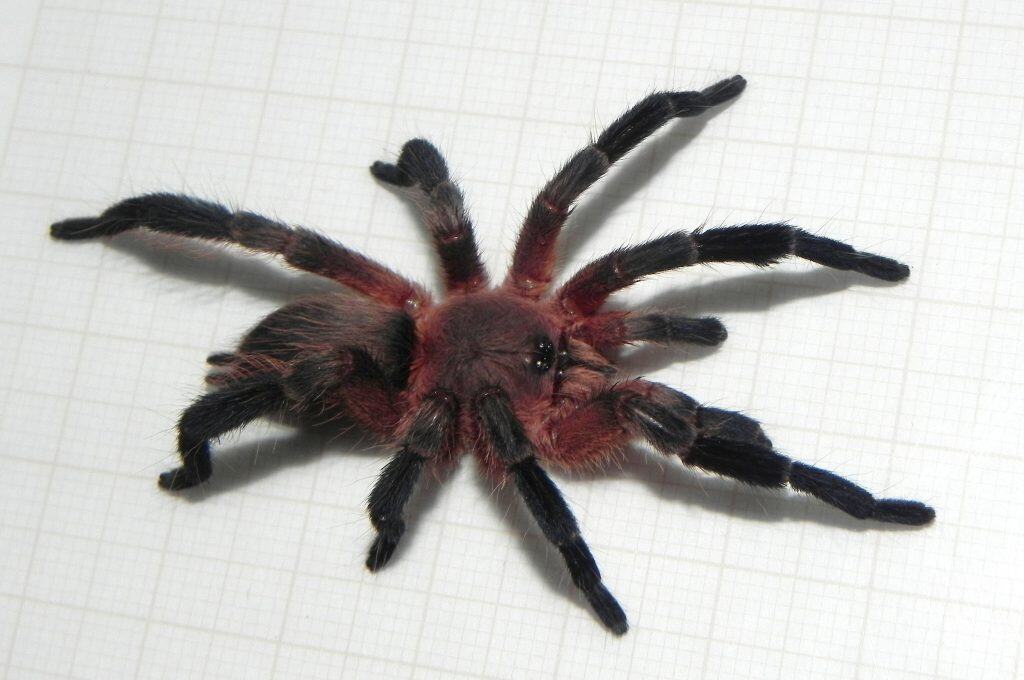
Dolichothele rufoniger is native to the rocky, savanna-like environments of the Espinhaço Mountains region of Brazil.
©Alexandre S. Michelotto / CC BY-SA 4.0 – Original / License
- Dolichothele aurata (Vellard, 1924) – Brazil
- Dolichothele boliviana (Vol, 2001) – Bolivia, Brazil
- Dolichothele camargorum Revollo, da Silva & Bertani, 2017 – Bolivia, Brazil
- Dolichothele diamantinensis (Bertani, Santos & Righi, 2009) – Brazil
- Common name: Brazilian blue dwarf beauty
- Dolichothele dominguense (Guadanucci, 2007) – Brazil
- Dolichothele exilis* Mello-Leitão, 1923 – Brazil
- Common name: Exilis bronze tarantula
- Dolichothele mineirum (Guadanucci, 2011) – Brazil
- Common name: Brazilian black dwarf beauty
- Dolichothele mottai Revollo, da Silva & Bertani, 2017 – Brazil
- Dolichothele rufoniger (Guadanucci, 2007) – Brazil
- Common name: Brazilian purple beauty, red & purple dwarf beauty, neon purple dwarf
- Dolichothele tucuruiense (Guadanucci, 2007) – Brazil
Ephebopus Simon, 1892
Members of the genus Ephebopus are medium-sized tarantulas that generally reach leg spans of 4.5-6 inches. They typically excavate tube-like burrows under logs, rocks, or tree roots in lowland and upland rainforests, as well as grasslands above flood plains. However, E. murinus has an arboreal stage during development, inhabiting silk tubes in vegetation. Ephebopus tarantulas are commonly referred to as “skeleton tarantulas” due to the light-colored markings on their dark legs, which are said to resemble bones. Ephebopus tarantulas are distinguished from other genera by the presence of type V setae, which are very short, barbed hairs located on the pedipalp femora instead of the abdomen like other New World tarantulas. Type V setae are light, and easily detach by rubbing the palps with the chelicerae.
- Ephebopus murinus* (Walckenaer, 1837) – French Guiana, Suriname, Brazil
- Common name: Skeleton leg tarantula
- Ephebopus rufescens West & Marshall, 2000 – French Guiana, Brazil
- Common name: Red skeleton, burgundy skeleton tarantula
- Ephebopus uatuman Lucas, Silva & Bertani, 1992 – Brazil
- Common name: Emerald skeleton tarantula
Eupalaestrus Pocock, 1901
Eupalaestrus tarantulas are medium to large terrestrial spiders, reaching leg spans of 5-6 inches. They often have dark brown bodies, with pale banding on their leg joints or other color patterns on their legs. They have urticating setae of types I and III and an abundance of setae on their legs and abdomen. Some species also have a thickened metatarsus IV. Eupalaestrus species tend to dig deep burrows in open grasslands inside forest habitats. In Brazil, they frequently occur in the transitional areas of the Atlantic Forest and Pampas grasslands in the states of Paraná, Rio Grande do Sul, and Santa Catarina in southern Brazil.
- Eupalaestrus anomalus Mello-Leitão, 1923 – Brazil
- Eupalaestrus campestratus* (Simon, 1891) – Brazil, Paraguay, Argentina
- Common name: Pink zebra beauty
- Eupalaestrus crassimetatarsis Borges, Paladini & Bertani, 2021 – Brazil, Argentina
- Eupalaestrus roccoi Borges, Paladini & Bertani, 2021 – Brazil
- Eupalaestrus weijenberghi (Thorell, 1894) – Brazil, Uruguay, Argentina
- Common name: White-collared tarantula
Grammostola Simon, 1892
Grammostola tarantulas are medium to large-sized terrestrial spiders. They have a maximum leg span of 8 or more inches in species such as G. iheringi, often considered to be the largest Grammostola tarantula. These spiders tend to have dark bodies, longitudinal markings on their knees, and dense, reddish-tinted setae. In Brazil, Grammostola species are distributed throughout the southern part of the country, particularly in the state of Rio Grande do Sul, where six currently known species have been documented. These spiders tend to dig deep burrows along forest edges or in open grasslands, but some species create their retreats under leaf litter, rocks, roots, or other vegetation.
- Grammostola actaeon (Pocock, 1903) – Brazil, Uruguay
- Common name: Brazilian woolly black, Brazilian red rump
- Grammostola anthracina (C. L. Koch, 1842) – Brazil, Uruguay, Paraguay, Argentina
- Common name: Brazilian giant tawny red
- Grammostola grossa (Ausserer, 1871) – Brazil, Paraguay, Uruguay, Argentina
- Common name: Guarani giant tarantula
- Grammostola iheringi (Keyserling, 1891) – Brazil
- Common name: Entre Rios tarantula
- Grammostola pulchra Mello-Leitão, 1921 – Brazil
- Brazilian black tarantula
- Grammostola quirogai Montes de Oca, D’Elía & Pérez-Miles, 2016 – Brazil, Uruguay
- Common name: Uruguayan black beauty or Uruguayan black tarantula
- Grammostola subvulpina (Strand, 1906) – South America
Guyruita Guadanucci, Lucas, Indicatti & Yamamoto, 2007
Guyruita tarantulas are usually small, with leg spans that do not exceed 4 inches. They are generally shades of brown or grey, and all species except G. atlantica have abdominal patterns. However, all Guyruita species lack urticating setae. These spiders are found in the Atlantic Forest region in Alagoas, Bahía, Paraíba, Espírito Santo, Rio Grande do Norte, and Sergipe states. They inhabit the Cerrado savannas in the states of Distrito Federal, Goiás, Piauí, Maranhão, and Tocantins. They can also be found in the Amazon Forest and in the iron ore caves (G. metallophila) in Carajás region in the state of Pará. These burrowing spiders are often found living under rocks.
- Guyruita atlantica Guadanucci, Lucas, Indicatti & Yamamoto, 2007 – Brazil
- Guyruita cerrado* Guadanucci, Lucas, Indicatti & Yamamoto, 2007 – Brazil
- Guyruita giupponii Fukushima & Bertani, 2018 – Brazil
- Guyruita isae Fukushima & Bertani, 2018 – Brazil
- Guyruita metallophila Fonseca-Ferreira, Zampaulo & Guadanucci, 2017 – Brazil
- Guyruita tepequem Santos, Almeida, de Morais & Bertani, 2025 – Brazil
Holothele Karsch, 1879
Members of the genus Holothele are small terrestrial tarantulas that lack urticating setae on their abdomens. They are widespread across northern South America and the Caribbean islands. H. longipes is the only species recorded for Brazil. It has bluish-grey legs with darker femora, and the legs are covered in black setae with patches of orange and blue. Its cephalothorax and chelicerae are are covered in long, dense, peachy-pink setae, while its abdomen is covered with short, dense, black setae and longer orange setae. H. longipes has been found in the humid forests of the Amazon region. They often dig deep, heavily webbed burrows, sometimes using rotting logs or other organic debris.
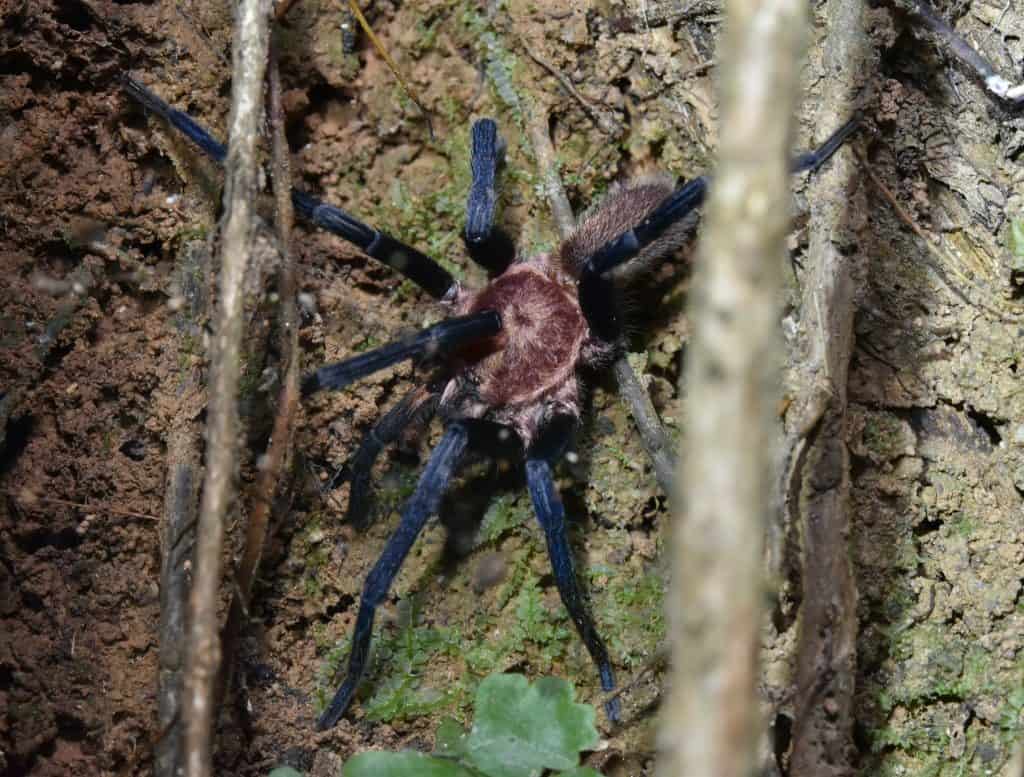
Holothele longipes has a wide distribution from the Caribbean to South America.
©Stephanie Tran / CC BY 4.0 – Original
- Holothele longipes* (L. Koch, 1875) – Venezuela, Bolivia, Trinidad and Tobago, French Guiana, Suriname, Brazil
- Common name: Trinidad pink tarantula
Homoeomma Ausserer, 1871
Members of the genus Homoeomma are distingusihed by the morphology of their genitalia in combination with the presence of urticating setae types III and IV, which are short, fine hairs with pointed, barbed tips. This type of setae is less irritating to humans than type III hairs, which are longer and more potent. They are small tarantulas with leg spans of 2-4 inches. These dwarf spiders generally make shallow retreats under stones in areas with dense vegetation. Many Homoeomma species have dark bodies with vivid orange or reddish setae on the abdomen. Many Brazilian species inhabit the Atlantic Forest in southeastern states such as Rio de Janeiro, as well as Bahía in the northeast.
- Homoeomma brasilianum (Chamberlin, 1917) – Brazil
- Homoeomma familiare Bertkau, 1880 – Brazil
- Homoeomma hirsutum (Mello-Leitão, 1935) – Brazil
- Homoeomma montanum (Mello-Leitão, 1923) – Brazil
- Homoeomma nigrum (Walckenaer, 1837) – Brazil
- Currently considered nomem dubium, of doubtful name.
- Homoeomma strabo (Simon, 1892) – Colombia, Brazil
- Homoeomma stradlingi* O. Pickard-Cambridge, 1881 – Brazil
- Homoeomma villosum (Keyserling, 1891) – Brazil
Iridopelma Pocock, 1901
Members of the arboreal genus Iridopelma range from small (I. zorodes) to large (I. vanini). Males differ from other Aviculariinae genera by the presence of tibial spurs on both legs I and II. Females differ by having a strongly forward-curving anterior eye row. Type II urticating hair is also present on the abdomen of males and females (except adult females of I. marcoi). Iridopelma are mostly found in Brazilian Atlantic rainforest in Northeastern Brazil, from the Reconcave region in Bahía State northwards. Some species build retreats by connecting leaves with silk, while others make their retreats in bromeliads (a family of flowering, tropical plants). Most species are shades of brown, grey, or black, and some species retain the abdominal patterns found in juveniles.
- Iridopelma hirsutum* Pocock, 1901 – Brazil
- Iridopelma katiae Bertani, 2012 – Brazil
- Iridopelma marcoi Bertani, 2012 – Brazil
- Iridopelma oliveirai Bertani, 2012 – Brazil
- Iridopelma vanini Bertani, 2012 – Brazil
- Iridopelma zorodes (Mello-Leitão, 1926) – Brazil
Ischnocolus Ausserer, 1871
All other known species of the genus Ischnocolus are found in Europe, the Middle East, and Africa. As I. rubropilosus is an outlier that was described in 1891, researchers consider the specimen’s placement in Ischnocolus to be a mistake.
- Ischnocolus rubropilosus Keyserling, 1891 – Brazil
Jambu Miglio, Perafán & Pérez-Miles, 2024
Jambu tarantulas are small terrestrial spiders, primarily distinguished by the morphology of the reproductive organs and type IV urticating setae. Both sexes of most species have light brown abdomens with a pattern of dark brown spots. They are found in the Amazon Basin in Northern Brazil.
- Jambu butantan (Pérez-Miles, 1998) – Brazil
- Jambu manoa Miglio, Perafán & Pérez-Miles, 2024 – Brazil
- Jambu paru* Miglio, Perafán & Pérez-Miles, 2024 – Brazil
- Jambu yanomami Santos, Almeida, de Morais & Bertani, 2025 – Brazil
Kochiana Fukushima, Nagahama & Bertani, 2008
Tarantulas in the genus Kochiana are small terrestrial tarantulas found in the states of Paraíba, Alagoas, and Sergipe in fragments of the northeastern Brazilian Atlantic rainforest. K. brunnipes is primarily black with pinkish-orange legs. K. fukushimae is larger than K. brunnipes, and it is shades of dark grey and black with vivid red setae on its abdomen.
- Kochiana brunnipes* (C. L. Koch, 1841) – Brazil
- Dwarf pink leg
- Kochiana fukushimae Moeller, Galleti-Lima & Guadanucci, 2024 – Brazil
Lasiocyano Galleti-Lima, Hamilton, Borges & Guadanucci, 2023
Lasiocyano is a monotypic genus established to accommodate L. sazimai, which was transferred from Pterinopelma due to differences in phylogeny and morphology. In both males and females, the carapace, legs, and chelicerae are covered in varying shades of blue or purple iridescent setae. These terrestrial spiders are exclusively found in the highlands of the Espinhaço Mountain Range in the states of Bahía and Minas Gerais, where they excavate their burrows in rocky fields.
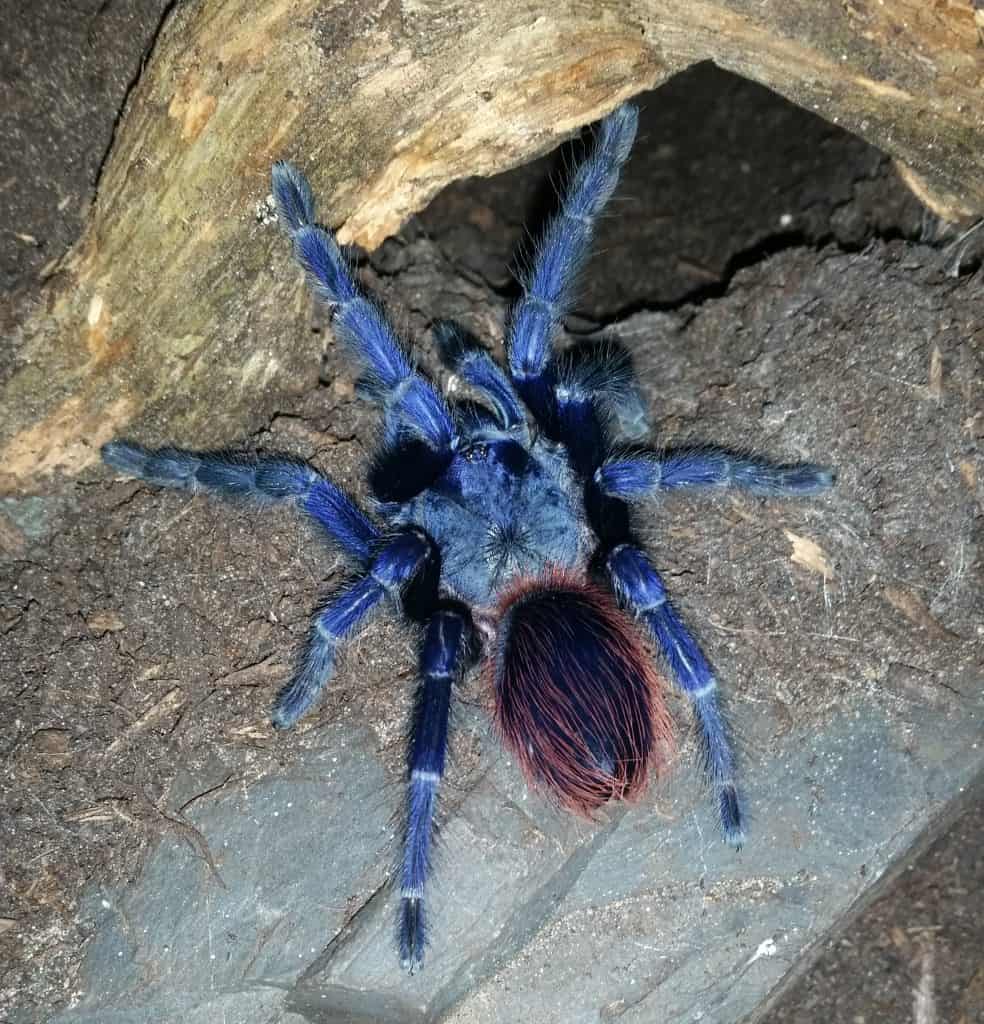
Lasiocyano sazimai is exclusively found in the rocky fields of the Espinhaço Mountain Range.
- Lasiocyano sazimai* (Bertani, Nagahama & Fukushima, 2011) – Brazil
- Common name: Brazilian blue, iridescent blue tarantula
Lasiodora C. L. Koch, 1850
The genus Lasiodora was revised in 2023 and reduced to just 7 species. It is primarily diagnosed by the presence of stridulating setae on coxae I and II. These spiders can grow very large, with leg spans reaching 8 to 10 inches. They generally have dark bodies, often with banding around the leg joints and/or longitudinal stripes on their legs. Some species, such as L. klugi and L. subcanens have long setae on their legs and abdomens, giving them a fuzzy appearance. They have been recorded in forest habitats, from the semi-arid scrubby forest of the Caatinga to the Atlantic rainforest in the states of Sergipe, Minas Gerais, Bahia, Goiás, and Espírito Santo.
- Lasiodora benedeni Bertkau, 1880 -Brazil
- Common name: Brazilian red birdeater
- Lasiodora camurujipe Bertani, 2023 – Brazil
- Lasiodora franciscana Bertani, 2023 – Brazil
- Lasiodora klugi* (C. L. Koch, 1841) – Brazil
- Common name: Bahia scarlet birdeater
- Lasiodora parahybana Mello-Leitão, 1917 – Brazil
- Common name: Brazilian salmon pink birdeater
- Lasiodora sertaneja Bertani, 2023 – Brazil
- Lasiodora subcanens Mello-Leitão, 1921 – Brazil
Megaphobema Pocock, 1901
Members of the genus Megaphobema are terrestrial spiders found in the Amazon rainforest region. They are large tarantulas with leg spans of 6-8 inches. Pocock’s original description of the genus notes that legs III and IV are “longer and stronger” than legs I and II. Megaphobema species generally have dark bodies with long, vivid reddish setae on their abdomens.
- Megaphobema lakoi (Mello-Leitão, 1943) – Brazil
- Megaphobema teceae Pérez-Miles, Miglio & Bonaldo, 2006 – Brazil
- Megaphobema velvetosoma Schmidt, 1995 – Ecuador, Peru, Brazil
- Common name: Ecuadorian brown velvet tarantula
Munduruku Miglio, Bonaldo & Pérez-Miles, 2013
The genus Munduruku differs from most other genera by the presence of urticating setae type III in males and types III and IV in females, plus patterned abdomens. As the name indicates, M. bicoloratum has a bicolor abdomen with light brown on the sides and bottom and a dark brown chevron pattern on the top. It has a reddish-brown carapace and legs. M. bicoloratum is a terrestrial tarantula originally collected in the Eastern Amazon region in the state of Pará.
- Munduruku bicoloratum* Miglio, Bonaldo & Pérez-Miles, 2013 – Brazil
Neischnocolus Petrunkevitch, 1925
There are two Neischnocolus tarantulas found in Brazil: N. caxiuana, found in the state of Pará, and N. valentinae, collected in the state of Amazonas. Neischnocolus species are small burrowing spiders. Both sexes are brown or reddish-brown overall with cream-colored bands at their leg joints. They have either dark brown or reddish-brown setae on their legs and their dark abdomens are covered in long, reddish setae. Some Neischnocolus species may also have indistinct abdominal patterns. Members of Neischnocolus can be distinguished from nearly all other genera by the combination of their specific genitalia morphology and the presence of type I (subtype d) urticating setae.
- Neischnocolus caxiuana (Pérez-Miles, Miglio & Bonaldo, 2008) – Brazil
- Neischnocolus valentinae (Almeida, Salvatierra & de Morais, 2019) – Brazil
Nhandu Lucas, 1983
Tarantulas in the genus Nhandu are primarily distinguished by the morphology of the genitalia and the tibial apophysis (protrusion). They typically have dark bodies with long, woolly, reddish setae on their abdomens and legs. They also have banded legs with dark femora. Species in this genus inhabit tropical and subtropical forests, as well as grasslands. They are medium to large-sized terrestrial spiders that often construct their burrows under rocks.
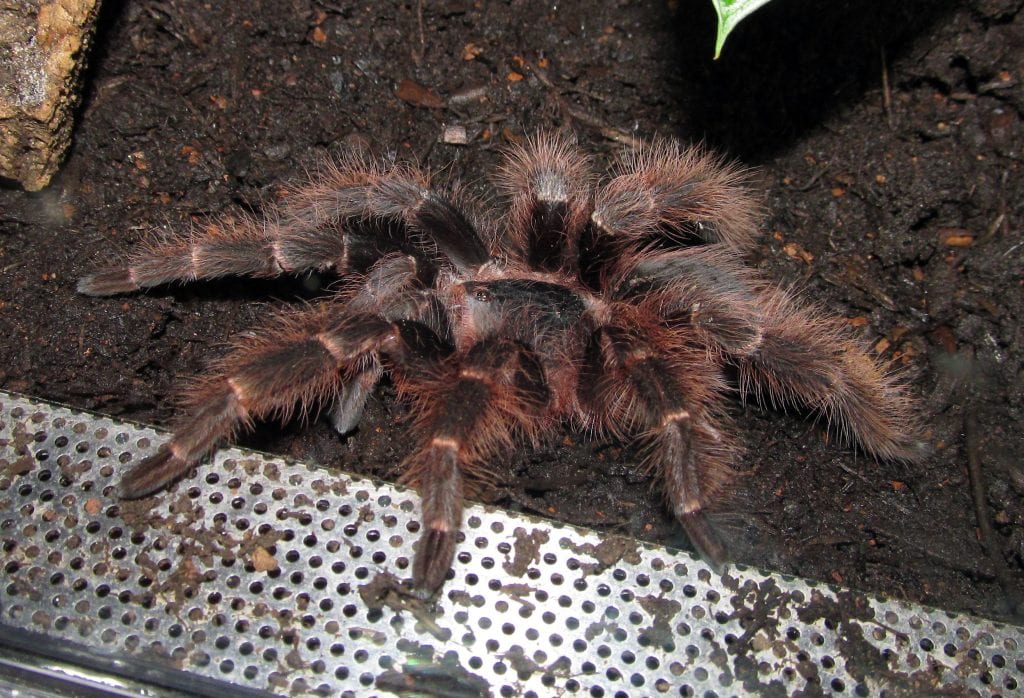
The Brazilian red tarantula, Nhandu carapoensis, is native to Brazil and Paraguay.
- Nhandu carapoensis* Lucas, 1983 – Brazil, Paraguay
- Common name: Brazilian red tarantula
- Nhandu cerradensis Bertani, 2001 – Brazil
- Common name: Brazilian red and blue tarantula
- Nhandu coloratovillosus (Schmidt, 1998) – Brazil
- Common name: Brazilian black and white tarantula, bombardier tarantula
- Nhandu tripepii (Dresco, 1984) – Brazil
- Common name: Brazilian giant blonde tarantula
Notahapalopus Sherwood, Gabriel, Peñaherrera-R., Osorio, Benavides, Hörweg, Brescovit & Lucas, 2024
The genus Notahapalopus was created to house one newly described species and three species that were transferred from Hapalopus. These small spiders were moved from Hapalopus to Notahapalopus based on the morphology of the tibia and the male reproductive organ. Some species also lack the spotted and/or striped abdomen found in Hapalopus. N. aymara has been recorded in the southern part of the Amazonian forest, as well as in caves in the Serra Norte de Carajás iron ore mining complex in the state of Pará. N. parauapebas and N. serrapelada have been recorded in the montane region of the Parnaiba basin. The species N. serrapelada has also been recorded in caves in the Serra Leste mining complex in Pará state, near the famous Serra Pelada gold mine, where it got its name.
- Notahapalopus aymara* (Perdomo, Panzera & Pérez-Miles, 2009) – Bolivia, Brazil
- Notahapalopus parauapebas Sherwood, Gabriel, Osorio, Benavides, Peñaherrera-R., Hörweg, Brescovit & Lucas, 2024 – Brazil
- Notahapalopus serrapelada (Fonseca-Ferreira, Zampaulo & Guadanucci, 2017) – Brazil
Pachistopelma Pocock, 1901
Pachistopelma are small arboreal tarantulas that mainly occur in the coastal region of Northeastern Brazil, from the state of Rio Grande do Norte to the state of Bahia. These tarantulas make their retreats exclusively inside bromeliads. They are distinguished by a straight or slightly forward-curving first eye row, the lack of leg spines, a spiny spur on tibia I in males, and the presence of urticating type II hair on the abdomen (except in mature females, whose abdomens are also flattened). P. bromelicola are blackish with pale setae, while P. rufonigrum are dark brown with pinkish setae. Both species lack the metallic sheen and abdominal patterns found in juveniles.
- Pachistopelma bromelicola Bertani, 2012 – Brazil
- Pachistopelma rufonigrum* Pocock, 1901 – Brazil
Pamphobeteus Pocock, 1901
Pamphobeteus species generally have dark bodies with colored stripes on either side of the cephalic region (head). These markings may connect to pink or purple radial stripes on the carapace. These spiders may also have longitudinal stripes on their legs. Members of Pamphobeteus are medium to very large tarantulas with a total body size that can reach up to 3.78 inches and a leg span of up to 9 inches. They can primarily be found in the Brazilian Amazon forest where they typically inhabit burrows and other natural cavities.
- Pamphobeteus amazonas Sherwood, Gabriel, Peñaherrera-R., Cisneros-Heredia, León-E., Brescovit & Lucas, 2023 – Brazil
- Pamphobeteus crassifemur Bertani, Fukushima & Silva, 2008 – Brazil
- Pamphobeteus grandis Bertani, Fukushima & Silva, 2008 – Brazil
- Pamphobeteus nigricolor* (Ausserer, 1875) – Colombia, Brazil
- Common name: Giant blue bloom
Parvicarina Galleti-Lima, Hamilton, Borges & Guadanucci, 2023
Pterinopelma felipeleitei was transferred to the recently established monotypic genus Parvicarina based on differences in morphology and phylogeny. The holotype male has a body length of approximately 1.57 inches, and its longest legs (pair IV) measure 2.23 inches. Its carapace and legs are black with distinctive pale bands on the leg joints and light-colored longitudinal stripes on its legs. The abdomen is black with long brown setae. P. felipeleitei is found in the Espinhaço Mountain Range in the central part of the state of Minas Gerais. It occurs in the highlands above 3,608 feet in open, rocky fields.
- Parvicarina felipeleitei* (Bertani & Leal, 2016) – Brazil
Phormictopus Pocock, 1901
Members of the genus Phormictopus are distinguished from most genera by club-like stridulatory setae on the trochanters and coxae of palps and legs I. They are typically large, with leg spans measuring 7-8 inches, although females of some species may grow larger. Some Phormictopus tarantulas have iridescent or metallic colors. Nearly all of the species in this genus are found in Cuba and Hispaniola, so it is likely that these spiders are restricted to the West Indies, and the Brazilian species are misplaced. These spiders tend to excavate silk-lined burrows in forested areas, often beneath rocks.
- Phormictopus cancerides* (Latreille, 1806) – Caribbean to Brazil
- Common name: Hispaniolan giant tarantula
- Phormictopus ribeiroi Mello-Leitão, 1923 – Brazil
Plesiopelma Pocock, 1901
Plesiopelma tarantulas are small to medium-sized spiders found in southern parts of South America, including Brazil. The type locality is unknown for some Brazilian species, but P. insulare is known from the state of São Paulo, while P. physopus is known from the state of Paraíba. Most Plesiopelma species can be characterized by the long setae that converges at a central point on top of the abdomen. The tarantulas in this genus are generally found in mountainous regions. They often create their silk-lined burrows under rocks, sometimes also covering the entrance with heavy silk.
- Plesiopelma insulare (Mello-Leitão, 1923) – Brazil
- Plesiopelma minense (Mello-Leitão, 1943) – Brazil
- Plesiopelma physopus (Mello-Leitão, 1926) – Brazil
- Plesiopelma rectimanum (Mello-Leitão, 1923) – Brazil
Psalmopoeus Pocock, 1895
Members of Psalmopoeus are arboreal tarantulas that lack urticating setae. They are medium to large spiders, with most species averaging leg spans of 5 to 7 inches. P. irminia is a dark grey to black tarantula with dense, dark setae, bright orange markings on its legs and palps, and a tiger-striped abdomen. It has been documented in the state of Roraima, close to the Venezuelan border. P. irminia was collected at an elevation of around 2,952 feet, along the southern border of the Paracaíma Mountains. It was found close to its tube-like retreat in a forested area near the Miang River.
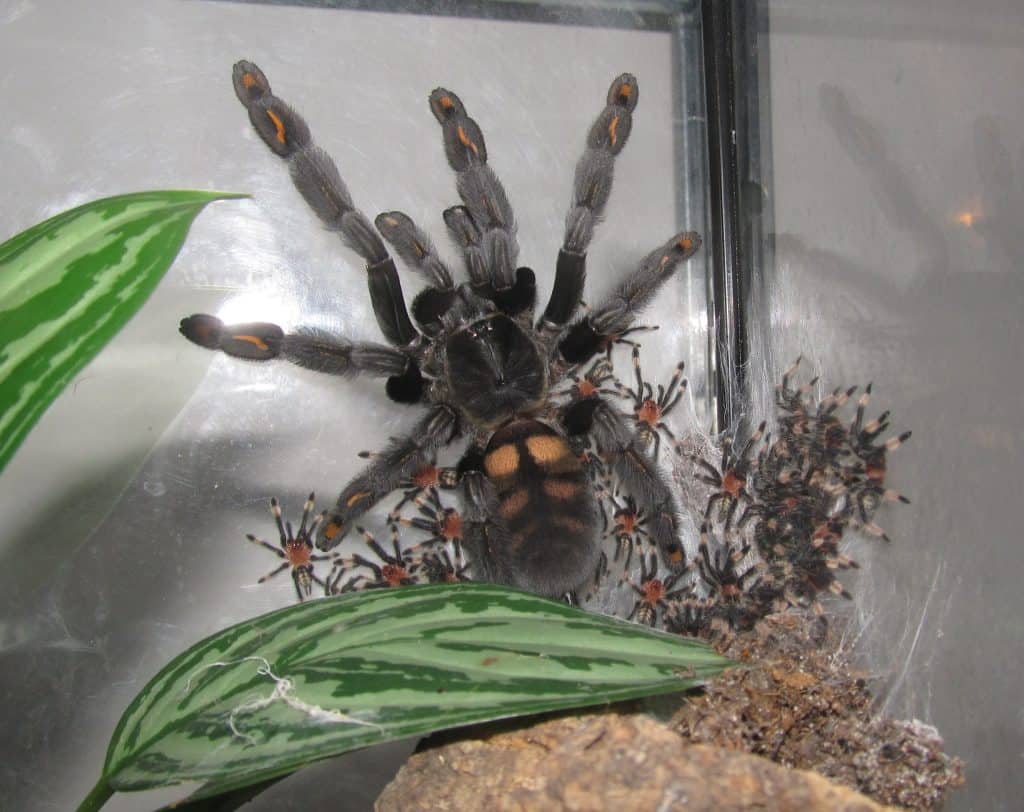
Psalmopoeus irminia lacks urticating setae but has some of the most potent venom of any New World tarantula.
- Psalmopoeus irminia Saager, 1994 – Venezuela, Guyana, Brazil
- Common name: Venezuelan Suntiger
Pterinopelma Pocock, 1901
Pterinopelma spiders are burrowers, often found beneath leaf litter. They are distinguished from similar genera by the lack of stridulatory setae on the coxae, the segment that connects the leg to the body. Females are also distinguished by having a sternum that is at least as wide as it is long. Pterinopelma species can be found in the Atlantic forest in the state of Rio Grande do Sul (P. vitiosum), in the subtropical semi-deciduous forest of the states of Paraná and Santa Catarina, west of the Serra do Mar mountains (P. longisternale), and in the subtropical semi-deciduous forest in the northwest and central parts of Rio Grande do Sul state (P. roseum).
- Pterinopelma longisternale (Bertani, 2001) – Brazil, Argentina
- Pterinopelma roseum (Mello-Leitão, 1923) – Brazil, Argentina
- Pterinopelma vitiosum* (Keyserling, 1891) – Brazil
Schismatothele Karsch, 1879
The genus Schismatothele includes small burrowing tarantulas with no urticating setae. These spiders are primarily distinguished from other genera by the morphology of their genitalia. Males also have a swollen palpal tibia with thick spines. S. benedetti is the first recorded species from Brazil in the genus. Its carapace, palps, and legs are reddish brown and it has a light brown abdomen. This spider is known from the area around Manaus, located on the banks of the Negro River in the state of Amazonas. S. wayana has a dark brown carapace, chelicerae, and legs with a light brown abdomen. It is known from the eastern region of Pará state.
- Schismatothele benedettii Panzera, Perdomo & Pérez-Miles, 2011 – Brazil
- Schismatothele wayana Moeller, Weinmann & Guadanucci, 2023 – Brazil
Sericopelma Ausserer, 1875
Although the original description of S. fallax lists Amazonas, Brazil as the type locality, all confirmed Sericopelma species have a distribution in Central America, specifically Costa Rica and Panama. Researchers note that an examination of the holotype shows this species does not belong to Sericopelma, but the best taxonomic placement of S. fallax outside Sericopelma has yet to be determined.
- Sericopelma fallax Mello-Leitão, 1923 – Brazil
Sickius Soares & Camargo, 1948
The genus Sickius is known from a single species, Sickius longibulbi. They are small spiders, with a total body length of around 0.86 inches in males and 0.98 inches in females. They are primarily brown overall with golden setae on the abdomen. These tarantulas dig shallow burrows covered with silk under rocks and fallen logs. This species is known for its uncommon mating behavior, where males hold the females by their first pair of legs instead of the chelicerae. Females also completely lack spermathecae, which is the internal reproductive organ where sperm is stored after mating. They are one of only two tarantula species in the world to lack this structure. S. longibulbi has a geographic distribution across a continuous range of over 600 miles, spanning both the savannas of the Cerrado and the coastal Atlantic Forest.
- Sickius longibulbi* Soares & Camargo, 1948 – Brazil
Tapinauchenius Ausserer, 1871
Tapinauchenius tarantulas are medium-sized arboreal tarantulas that lack urticating setae. They make their homes in the vegetation of the rainforest. T. gretae is known from Amazonas state. Its carapace, chelicerae, palps, legs, and abdomen are brown and covered in light brown setae. T. brunneus has been recorded in Rondônia and Mato Grosso. It is brown overall with a T-shaped marking on the abdomen. T. plumipes is known from the Cuminá River, in the state of Pará. It is primarily dark brown with a blue-violet sheen on the carapace, legs, and chelicerae. Males have a purple abdomen with a T-shaped marking, while females have a brown abdomen with violet shades and a central longitudinal line.
- Tapinauchenius brunneus Schmidt, 1995 – Brazil
- Tapinauchenius gretae Cifuentes & Bertani, 2022 – Brazil
- Tapinauchenius plumipes* (C. L. Koch, 1842) – Guyana, Suriname, French Guiana, Brazil
- Common name: Violet or purple tree spider
Tekoapora Galleti-Lima, Hamilton, Borges & Guadanucci, 2023
Vitalius wacketi was transferred to Tekoapora, which was created due to phylogeny and morphological differences. V. wacketi is a large, terrestrial tarantula with a dark brown carapace and abdomen. It has brown legs with darker femora, pale leg rings, and longitudinal leg stripes. Its abdomen and legs are covered in long pinkish setae. This spider inhabits tropical broadleaf forests in the Serra do Mar mountains and coastal region, including nearby islands. Its distribution ranges from south of Rio de Janeiro state to the states of São Paulo, Paraná, and Santa Catarina.
- Tekoapora wacketi* (Mello-Leitão, 1923) – Brazil
Theraphosa Walckenaer, 1805
Tarantulas in the genus Theraphosa are among the largest in the world. All of the spiders in the genus can reach nearly the same size, but Theraphosa blondi, the Goliath birdeater, is widely recognized as the largest. It is also the largest spider on the planet by body length and mass. It has a total body length of 4.75 inches, leg spans of up to 12 inches, and can weigh up to 6 ounces. Theraphosa spiders are generally light to dark brown in color with long, reddish-orange setae on the legs and abdomen. They may also have longitudinal stripes on their legs. Theraphosa species dig deep, silk-lined burrows in the rainforests, sometimes under roots or rocks.
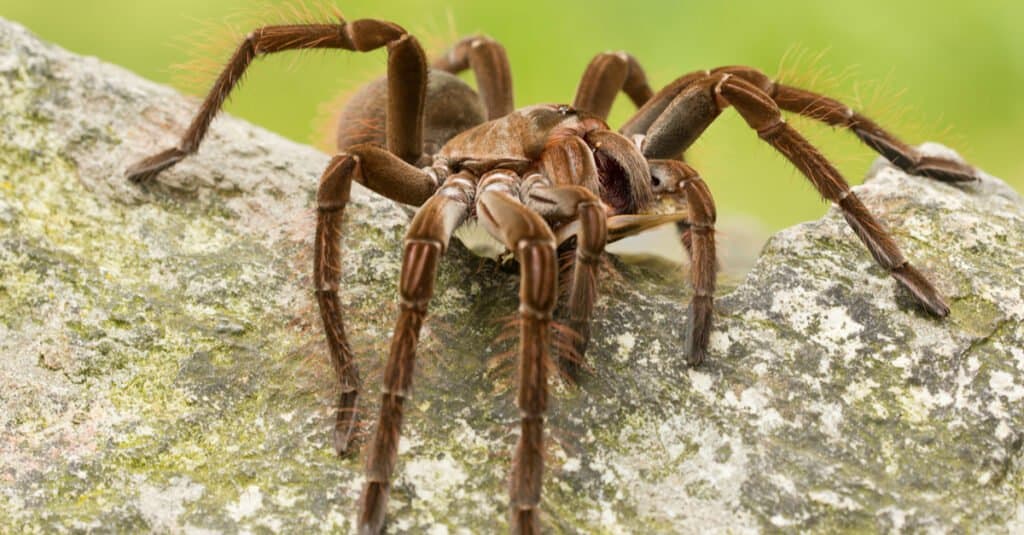
The Goliath birdeater tarantula, Theraphosa blondi, is the largest tarantula species in the world.
©Milan Zygmunt/Shutterstock.com
- Theraphosa apophysis (Tinter, 1991) – Colombia, Venezuela, Brazil
- Common name: Goliath pinkfoot
- Theraphosa blondi* (Latreille, 1804) – Venezuela, Brazil, Guyana
- Common name: Goliath birdeater
- Theraphosa spinipes (Ausserer, 1871) – Brazil
- Theraphosa stirmi Rudloff & Weinmann, 2010 – Guyana, Brazil
- Common name: Burgundy Goliath birdeater
Tmesiphantes Simon, 1892
Tmesiphantes tarantulas are small to medium-sized burrowing spiders that are primarily found in Brazil. They are differentiated by a thickened femur III, urticating hair types III and IV on the abdomen, and a more rounded sternum. These spiders are known from the states of Bahía, Minas Gerais, Pará, Goiás, Mato Grosso, Piauí, Paraíba, and Pernambuco. They occur in a wide variety of habitats, including the Cerrado savannas, Caatinga shrublands, the Atlantic rain forest, and the Brazilian Amazon.
- Tmesiphantes amadoi Yamamoto, Lucas, Guadanucci & Indicatti, 2007 – Brazil
- Tmesiphantes amazonicus Fabiano-da-Silva, Guadanucci & DaSilva, 2019 – Brazil
- Tmesiphantes aridai Gonzalez-Filho, Brescovit & Lucas, 2014 – Brazil
- Tmesiphantes bethaniae Yamamoto, Lucas, Guadanucci & Indicatti, 2007 – Brazil
- Tmesiphantes brescoviti (Indicatti, Lucas, Guadanucci & Yamamoto, 2008) – Brazil
- Tmesiphantes buecherli (Indicatti, Lucas, Guadanucci & Yamamoto, 2008) – Brazil
- Tmesiphantes caymmii Yamamoto, Lucas, Guadanucci & Indicatti, 2007 – Brazil
- Tmesiphantes guayarus Fabiano-da-Silva, Guadanucci & DaSilva, 2019 – Brazil
- Tmesiphantes hypogeus Bertani, Bichuette & Pedroso, 2013 – Brazil
- Tmesiphantes mirim Fabiano-da-Silva, Guadanucci & DaSilva, 2015 – Brazil
- Tmesiphantes nordestinus Fabiano-da-Silva, Guadanucci & DaSilva, 2019 – Brazil
- Tmesiphantes nubilus* Simon, 1892 – Brazil
- Tmesiphantes obesus (Simon, 1892) – Brazil
- Tmesiphantes perp Guadanucci & Silva, 2012 – Brazil
- Tmesiphantes raulseixasi Fabiano-da-Silva, Guadanucci & DaSilva, 2019 – Brazil
- Tmesiphantes riopretano Guadanucci & Silva, 2012 – Brazil
Trichopelma Simon, 1888
Trichopelma illetabile has historically been placed in the genus Trichopelma. However, recent taxonomic revisions and cladistic analyses have classified it as nomen dubium (of doubtful name), or effectively incertae sedis (of uncertain placement), as researchers suggest it is misplaced in Trichopelma. They speculate it may belong to the family Barychelidae, trapdoor spiders, in the genus Sasoninae.
- Trichopelma illetabile Simon, 1888 – Brazil
Typhochlaena C. L. Koch, 1850
Typhochlaena are very small arboreal tarantulas. They are primarily distinguished by the presence of urticating hair type II on the abdomen, the lack of tibial spurs in males, the morphology of the genitalia, and truncated sternums (the underside of the cephalothorax) that are as long or longer than they are wide. They are found in Northeastern Brazil, mostly in the Brazilian Atlantic rainforest, although T. costae occurs in drier, open environments and T. chapadensis occurs in the Chapada Diamantina mountainous region. These spiders typically build silken retreats under loose tree bark. Typhochlaena species generally have a metallic or iridescent sheen, patterned abdomens, pale bands at the leg joints, longitudinal stripes on the legs, and long setae on the legs and abdomen.
- Typhochlaena amma Bertani, 2012 – Brazil
- Typhochlaena chapadensis Bertani, Antunes & Gallão, 2025 – Brazil
- Typhochlaena costae Bertani, 2012 – Brazil
- Typhochlaena curumim Bertani, 2012 – Brazil
- Typhochlaena paschoali Bertani, 2012 – Brazil
- Typhochlaena seladonia* (C. L. Koch, 1841) – Brazil
- Common name: Brazilian jewel tarantula
Umbyquyra Gargiulo, Brescovit & Lucas, 2018
Tarantulas in the genus Umbyquyra are primarily distinguished from other genera by the combination of the genitalia morphology and the presence of the stridulatory setae on the palpal trochanter and on leg I. Umbyquyra species generally have a total body length ranging from a maximum of 1.57 inches in males to 1.73 inches in females. They are typically dark brown overall with lighter brown legs and long, reddish or gold setae on their abdomen and legs. Both sexes have type I and III urticating hairs. Species of Umbyquyra have been recorded in the states of Acre, Pará, Goiás, Mato Grosso, Mato Grosso do Sul, Rondônia, Tocantins, and São Paulo. Some species have been located inside rotten palm trees and in tube-like burrows in dirt hills.
- Umbyquyra acuminatum (Schmidt & Tesmoingt, 2005) – Bolivia, Brazil
- Umbyquyra araguaia Gargiulo, Brescovit & Lucas, 2018 – Brazil
- Umbyquyra belterra Gargiulo, Brescovit & Lucas, 2018 – Brazil
- Umbyquyra caxiuana Gargiulo, Brescovit & Lucas, 2018 – Brazil
- Umbyquyra cuiaba Gargiulo, Brescovit & Lucas, 2018 – Brazil
- Umbyquyra gurleyi Sherwood & Gabriel, 2020 – Brazil
- Umbyquyra palmarum (Schiapelli & Gerschman, 1945) – Brazil
- Umbyquyra paranaiba* Gargiulo, Brescovit & Lucas, 2018 – Brazil
- Umbyquyra sapezal Gargiulo, Brescovit & Lucas, 2018 – Brazil
- Umbyquyra schmidti (Rudloff, 1996) – Brazil
- Umbyquyra tapajos Gargiulo, Brescovit & Lucas, 2018 – Brazil
- Umbyquyra tucurui Gargiulo, Brescovit & Lucas, 2018 – Brazil
Vitalius Lucas, Silva & Bertani, 1993
Members of the genus Vitalius are considered to be among the largest theraphosids in the Atlantic Forest region of southeastern and southern Brazil. They have also been recorded in the transition areas of the Amazon and Caatinga biomes, as well as the Cerrado savannas. Morphologically, Vitalius species are considered homogeneous and are frequently differentiated by the structure of the male genitalia and geographical location. These spiders are typically black or brown overall. They often have distinctive banding on their leg joints and longitudinal stripes on their legs and palps in both sexes.
- Vitalius australis Galleti-Lima, Hamilton, Borges & Guadanucci, 2023 – Brazil
- Vitalius buecherli Bertani, 2001 – Brazil
- Vitalius chromatus (Schmidt, 2004) – Brazil
- Common name: Brazilian red and white tarantula
- Vitalius dubius (Mello-Leitão, 1923) – Brazil
- Vitalius lucasae Bertani, 2001 – Brazil
- Vitalius ornatissimus Bertani & Motta, 2024 – Brazil
- Vitalius paranaensis Bertani, 2001 – Brazil, Argentina
- Common name: Brazilian brown tarantula
- Vitalius restinga Bertani, 2023 – Brazil
- Vitalius sapiranga – Bertani, 2023 – Brazil
- Vitalius sorocabae* (Mello-Leitão, 1923) – Brazil
- Vitalius vellutinus (Mello-Leitão, 1923) – Brazil
Yanomamius Bertani & Almeida, 2021
Members of the genus Yanomamius are generally distinguished from other genera by the short spines on the retrolateral tibia of the palp in males and the shape of the genitalia. These tarantulas inhabit the Amazon regions of Brazil and Venezuela. In Brazil, Yanomamius species are only found in the state of Amazonas. They have been observed to live in silk-lined burrows in the forest floor.
- Yanomamius franciscoi* Bertani & Almeida, 2021 – Brazil
- Yanomamius neblina Bertani & Almeida, 2021 – Brazil
- Yanomamius raonii Bertani & Almeida, 2021 – Brazil
Ybyrapora Fukushima & Bertani, 2017
Ybyrapora is a genus of arboreal tarantulas that inhabit the Atlantic rainforest from Bahía to southern Rio de Janeiro. They can be distinguished from other genera by the morphology of their reproductive organs, lack of a developed tibial apophysis in males, and the presence of type II urticating setae. Males of Y. gamba and Y. sooretama also have a central longitudinal stripe on the abdomen. Like most Aviculariinae genera, they are covered in an abundance of long setae on their legs and abdomens. Ybyrapora spiders have been observed spinning leaves together to make retreats and inhabiting bromeliad plants.
- Ybyrapora diversipes (C. L. Koch, 1842) – Brazil
- Common name: Amazon sapphire
- Ybyrapora gamba (Bertani & Fukushima, 2009) – Brazil
- Ybyrapora sooretama* (Bertani & Fukushima, 2009) – Brazil