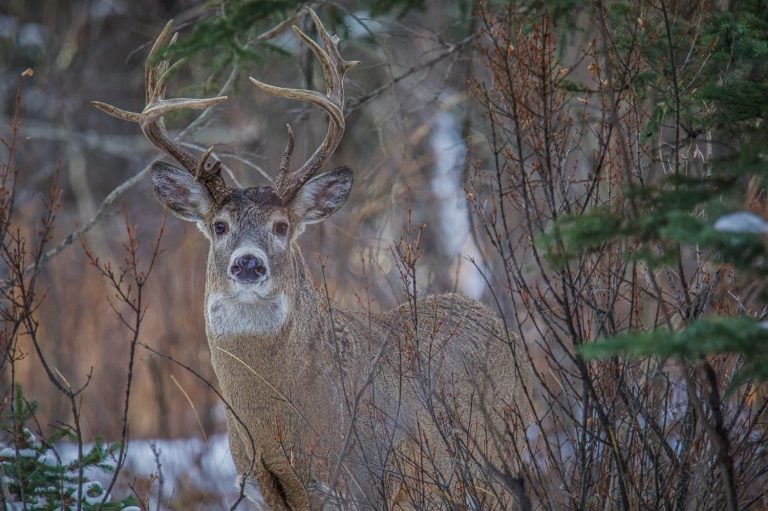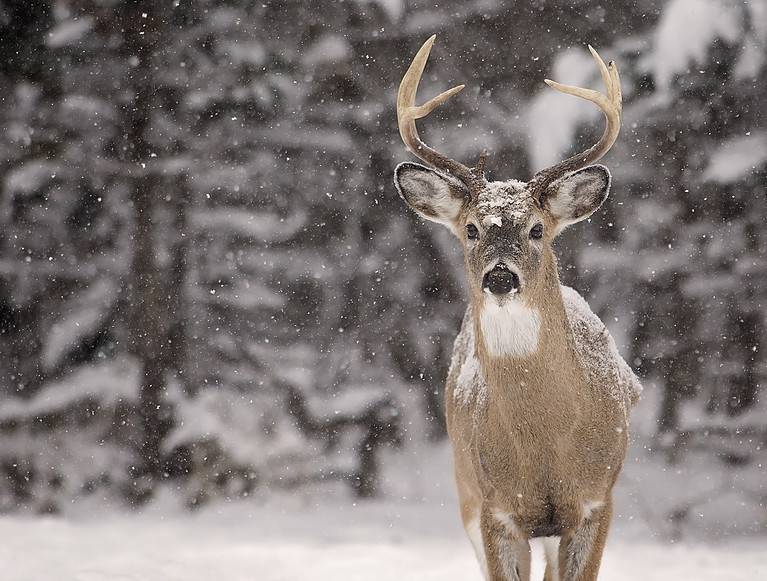

Whitetail deer populations are soaring throughout the country, and the U.S. state of Washington is no exception, although no one expects a buck from the Evergreen State to raise many eyebrows. In fact, one didn’t for nearly two decades.
A Nearly Two-Decade Wait
In October 1992, James Cartwright was hunting the public lands near his 400-acre alfalfa farm in Stevens County in northeastern Washington when he spotted and then shot a whitetail buck from 200 yards. The deer ran until it collapsed a short distance from where it had been shot. As Cartwright approached, he realized that the buck was missing its left main beam. Cartwright surveyed the buck and realized the break was fresh. He found the broken-off piece in the mud and grabbed it.
He never thought the rack was anything special, and because of the break, he never made plans to mount it. Instead, he used wood glue and wire to put it back together so it could dry.
Later, Cartwright’s friends saw it and were convinced of its epic size, so Cartwright took the antlers to a taxidermist, who agreed with the friends. At this point, Cartwright decided to enter them into a local Big Horn Show. Unofficially, the entire rack, including the damaged portion, scored 198-3/8 net inches as a typical.

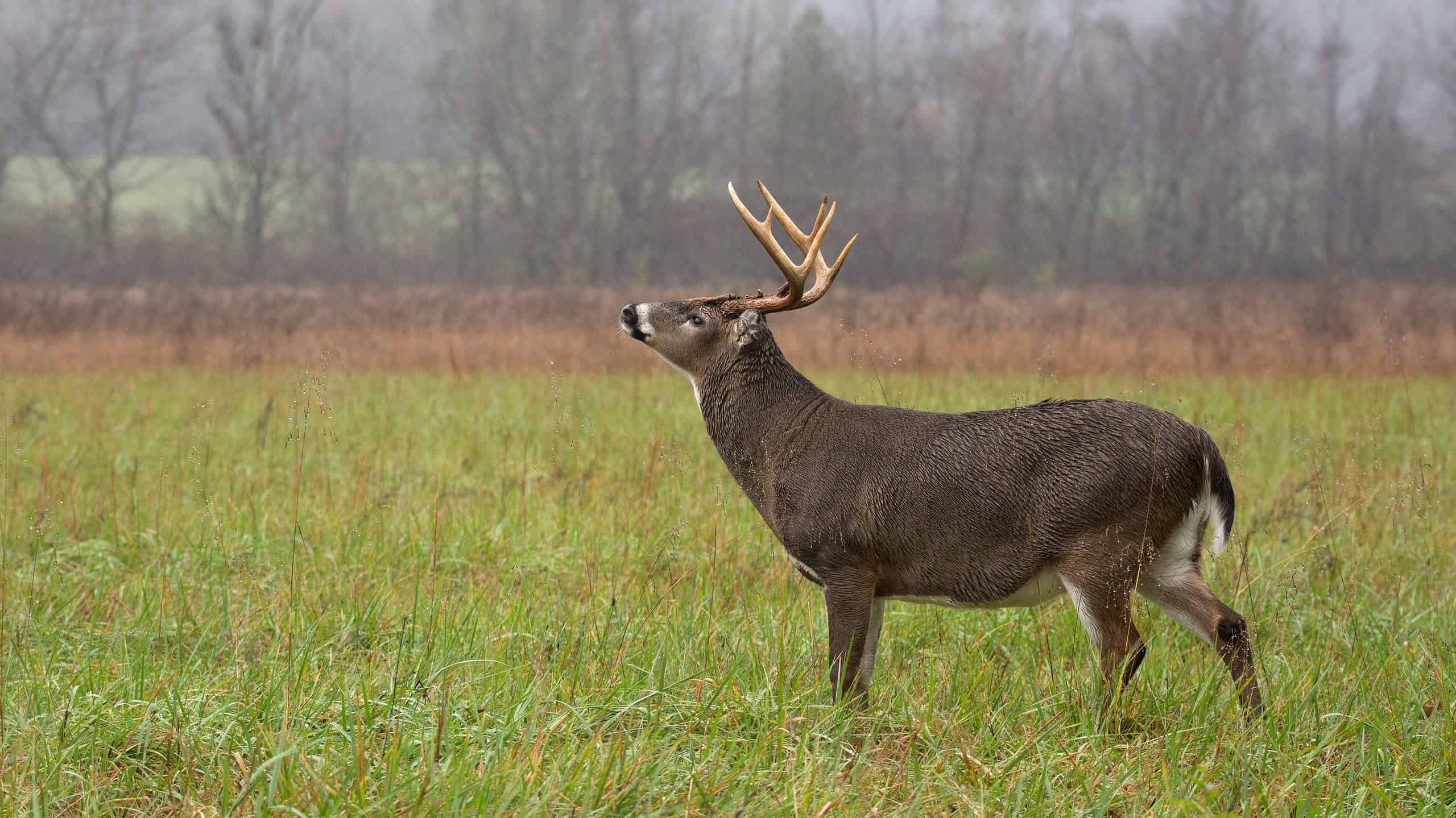
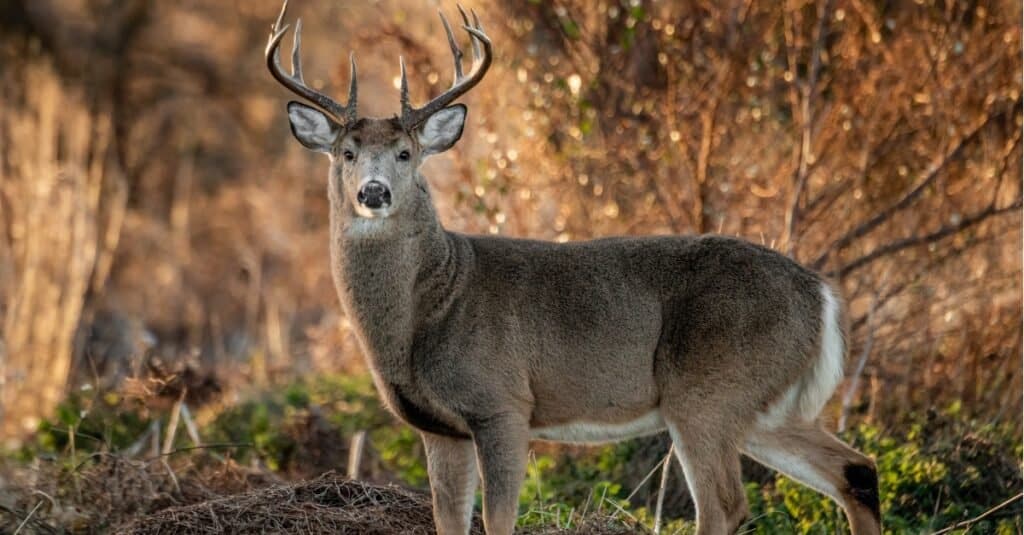
The “biggest” or “largest” whitetail deer are determined by a scoring system developed by the Boone and Crockett Club.
©Tony Campbell/Shutterstock.com
Trophies are recognized for either being typical or non-typical. Many assume an animal’s body size or weight determines which one is the “biggest” or “largest.” In point of fact, what determines “biggest” or “largest” are an antler’s size and complexity. A typical set of antlers follows a standard pattern, defined by symmetrical tines and evenly spaced points, whereas non-typical racks do not have the symmetry that is associated with typical antlers. They can drastically deviate from the standard in quite unusual, beautiful ways. A minimum score of 170 for a typical buck is in all-time record territory. A score of 195 or greater earns all-time record accolades for a non-typical.
The Boone and Crockett Club did not accept damaged trophies at the time Cartwright entered his trophy into the local Big Horn Show. It was, therefore, ineligible for any awards or entry into the record books. A few years later, Cartwright found a buyer for the antlers in Northwest Big Game, a record-keeping organization, which listed Cartwright’s buck as the Washington state record. This organization later sold the antlers to Bass Pro Shops in 2009.
Six years earlier, the Boone and Crockett Club, which developed the scoring system for big game trophies, including whitetail deer, began accepting damaged or repaired entries on a case-by-case basis. So, in 2009, Cartwright’s buck finally got its due.
The rack was officially measured and scored. At 200-3/8 inches, the Cartwright buck entered the annals of hunting history.
Had it been measured and accepted in 1992, Cartwright’s buck would have immediately unseated a 1985 record set by George A. Cook III and would have ranked as the No. 9 all-time typical. Cook’s buck scored 181-7/8.
Today, the Cartwright buck is in the top 20 all-time typical record books.
Mystery surrounds the circumstances under which Washington’s non-typical buck entered the record book.
©iStock.com/Harry Collins
A Washington Mystery
Little is known about who harvested Washington’s non-typical record and how he or she did it. The Boone and Crockett Club’s records list the hunter as “unknown.” Field and Stream list December 31, 1946, as the day the buck was harvested in Washington, County. The placard that identifies the buck at the Wonders of Wildlife National Museum & Aquarium, which is affiliated with the antlers’ owner, Bass Pro Shops, says it was found in Elk County, Washington.
There is neither a Washington nor an Elk County in Washington state, although there is an unincorporated town called Elk in Spokane County in eastern Washington. This side of the state is the range for whitetail deer.
What is known for sure is the buck’s score: 242-4/8 inches. And nothing has come close to unseating this record buck. In fact, there is only one entry from this century in the top 25 trophies for non-typical whitetail deer for the state of Washington. At no. 11 is the 2010 trophy from Thomas M. Cools, which scored 208-4/8. Most but not all of the other records come from the 1950s and 1960s.
The Largest Whitetails Ever Harvested
Milo Hanson has held the world record for the largest typical whitetail ever harvested since 1993 when the buck he shot in 1992 in Biggar, Saskatchewan, Canada, scored 213-5/8.
Just as there is mystery surrounding Washington’s non-typical whitetail record, there is a bit of mystery that accompanies the world record for non-typical whitetail. Scored 333-7/8, the non-typical trophy was found on the side of the road in St. Louis County, Missouri, in 1981. No one knows how the deer died.