Quick Take
- Doves and pigeons aren't actually different birds, and the real reason the two names exist is stranger than most people assume.
- Every dove species shares one bizarre biological trait that links them to flamingos and emperor penguins while setting them apart from almost every other bird on Earth.
- One non-native dove accidentally released decades ago has pulled off one of the fastest range expansions in recorded ornithological history, and it is now found almost everywhere. See the rapid expansion →
- The bird you see most on city streets isn't actually the most abundant dove in the United States, and the real winner might surprise you. Meet the real winner →
Doves and pigeons are the same type of bird. However, the word pigeon is typically used to describe larger, stockier birds, while the word dove is used to describe smaller, more delicate species in the family Columbidae. They are among the most prolific birds globally, with over 350 species found on every continent except Antarctica. Approximately a dozen species of doves are regularly found in the United States, including widespread natives like the mourning dove and introduced species like the Eurasian collared-dove. Continue reading to learn more about these prolific birds.
A remarkable trait shared across nearly all dove species is their ability to produce a nutritious, cottage-cheese-like secretion called crop milk in their digestive tracts, which both parents regurgitate to feed their hatchlings. Besides doves and pigeons, flamingos (both sexes) and male emperor penguins are the only other birds known to produce a similar crop milk.
©iStock.com/Malcolm
White-winged Dove
The white-winged dove (Zenaida asiatica) is a medium-sized, grayish-brown bird with a white crescent or patch on the upper edge of its wings that is visible both at rest and in flight. These doves have an average length of 11 to 12.5 inches and a broad wingspan ranging from 18.9 to 22.8 inches.
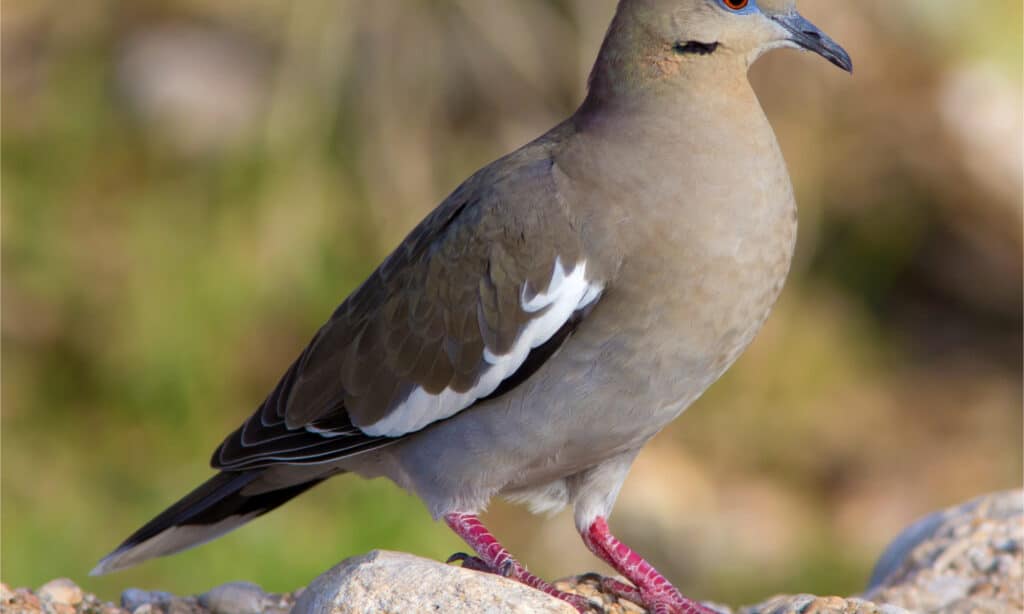
The white-winged dove is named for the white patches on its wings.
©Wingman Photography/Shutterstock.com
Originally native to the American Southwest, Mexico, Central America, and the Caribbean, the white-winged dove is now found year-round or breeding across much of the Southern United States, from California and Texas to the Gulf Coast to Florida, with occasional sightings farther north.
Inca Dove
The Inca dove (Columbina inca) has a taupe body, a square-tipped tail edged with white, and deep chestnut-red underwings. They measure approximately 6.5 to 9.1 inches in length with a wingspan ranging from 11 to 12.6 inches. Inca doves are native to the American Southwest, including Southern California, Arizona, New Mexico, and Texas.
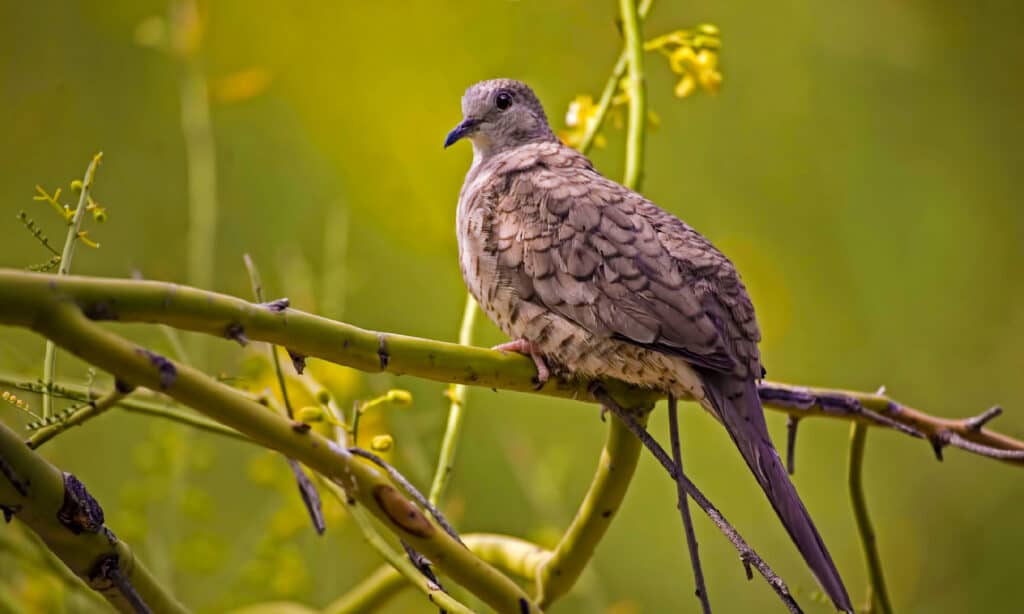
Inca doves live near towns and are not shy about visiting backyard feeders.
©iStock.com/hstiver
Common Ground Dove
The common ground dove (Columbina passerina) is North America’s smallest dove species, measuring 5.9 to 7.1 inches in length with a wingspan of approximately 9.1 to 11 inches. Its upperparts are a dusty grayish-brown accented by dark spots on the wings, while flight reveals bright rusty-red or chestnut patches in the underwings. In North America, this nonmigratory resident is distributed primarily across the extreme southern tier of the United States, from coastal California and the desert Southwest through Texas and across the Gulf Coast to Florida.
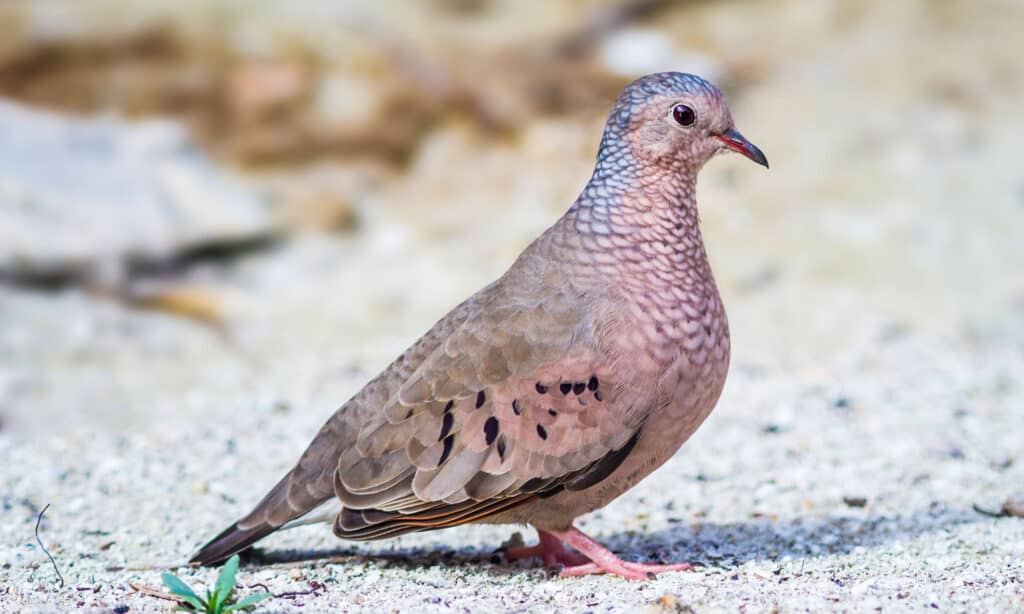
The common ground dove likes to hide under shrubs for cover.
©Golubev Dmitrii/Shutterstock.com
Band-tailed Pigeon
The band-tailed pigeon (Patagioenas fasciata) is distinguished by soft blue-gray upperparts, a purplish-pink cast on the head and underparts, a subtle white crescent on the back of the neck, and bright yellow feet and bill.

The banded-tail pigeon derives its name from a wide, pale gray band across its rounded tail.
©Agami Photo Agency/Shutterstock.com
Measuring approximately 13 to 16 inches in length with an average wingspan of about 26 inches, the band-tailed pigeon is native to western North America, where it is split into two breeding populations: one in the forests along the Pacific Coast, from British Columbia down through California, and the other in the mountain woodlands of the American Southwest.
White-tipped Dove
The white-tipped dove (Leptotila verreauxi) is a ground-foraging bird with a grayish-brown body, a pale forehead, a white chin, and red legs.
These medium-sized doves measure 9.8 to 12.2 inches in length with a wingspan of approximately 15 to 17 inches. Within the United States, its permanent distribution is primarily restricted to the extreme southern regions, specifically the lower Rio Grande Valley in southernmost Texas.

The white-tipped dove lives along the Rio Grande Valley in Texas.
©iStock.com/neil bowman
Spotted Dove
The spotted dove (Spilopelia chinensis) has a rosy-to-pinkish-gray breast and underparts, and a soft gray head. Its upperparts are light brown, with a scaly wing pattern, and a distinct black-and-white spotted semi-collar patch on the back and sides of the neck.
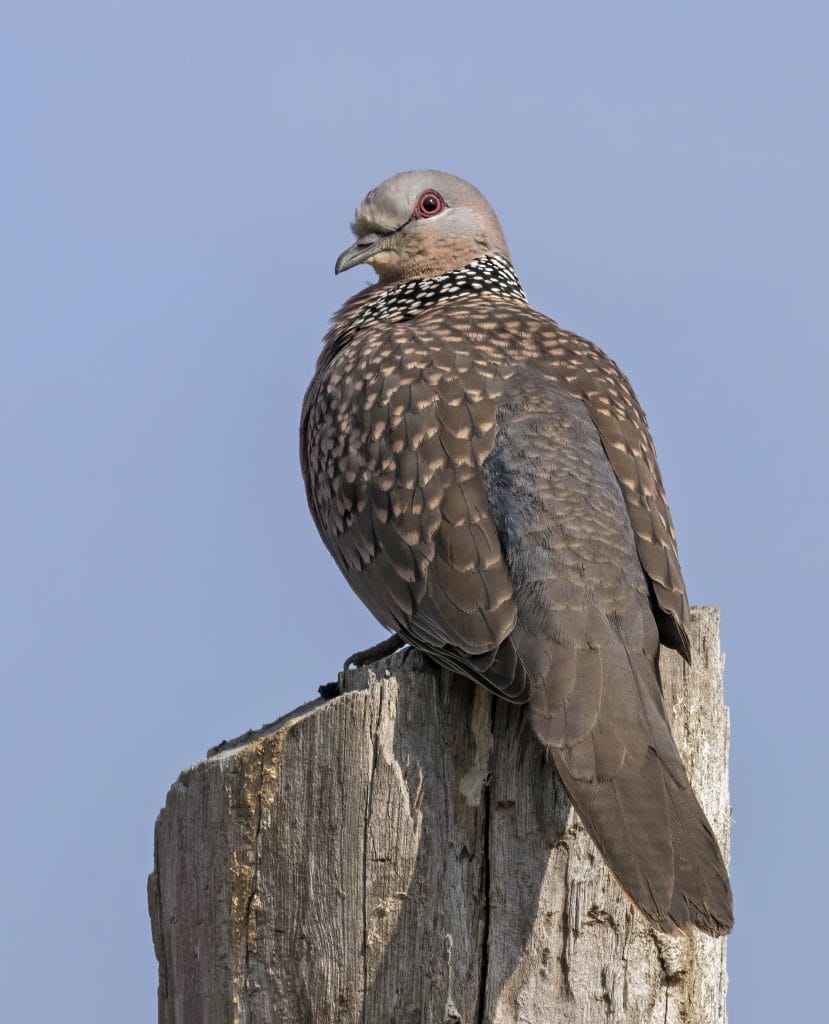
The spotted dove gets its name from the black-and-white spotted patch on the back and sides of the neck
Measuring approximately 11.2 to 12.8 inches in length with an average wingspan of 17.7 inches, the spotted dove is not native to North America, but has established resident breeding populations in Southern California, although their numbers have declined significantly since the late 1980s.
Red-billed Pigeon
The red-billed pigeon (Patagioenas flavirostris) is a large dove characterized by dark bluish-gray body plumage, a dull reddish-purple or maroon head, neck, and breast, and dark red legs and feet. Measuring approximately 12 to 14.5 inches in length with an average wingspan of about 20 to 24 inches, this arboreal species’ U.S. distribution is limited to the lower Rio Grande Valley in south Texas.
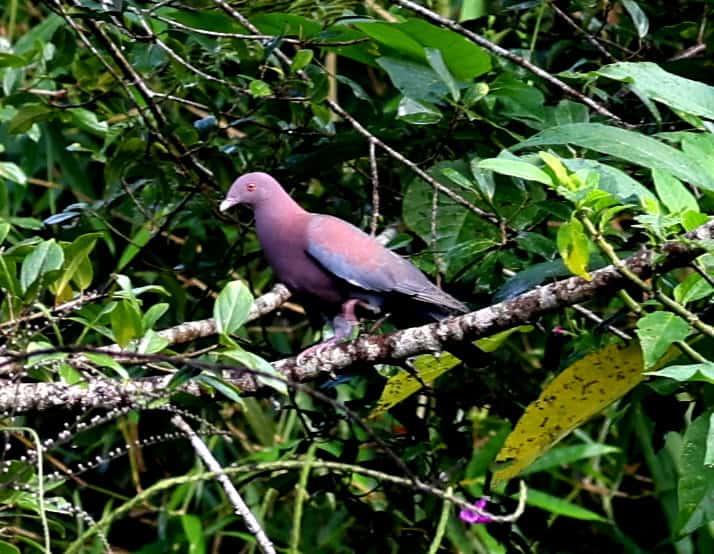
Because the red-billed pigeon crossed the US border without human intervention, it is considered a native species.
©Jean Ogden Just Chaos Photography from Shelbyville, KY – Original / License
White-crowned Pigeon
The white-crowned pigeon (Patagioenas leucocephala) is a medium-sized dove with a dark slate-gray to almost-black body, a reddish bill with a pale tip, white-to-yellowish eyes, and an iridescent collar-patch of dark green and bronze on the neck.
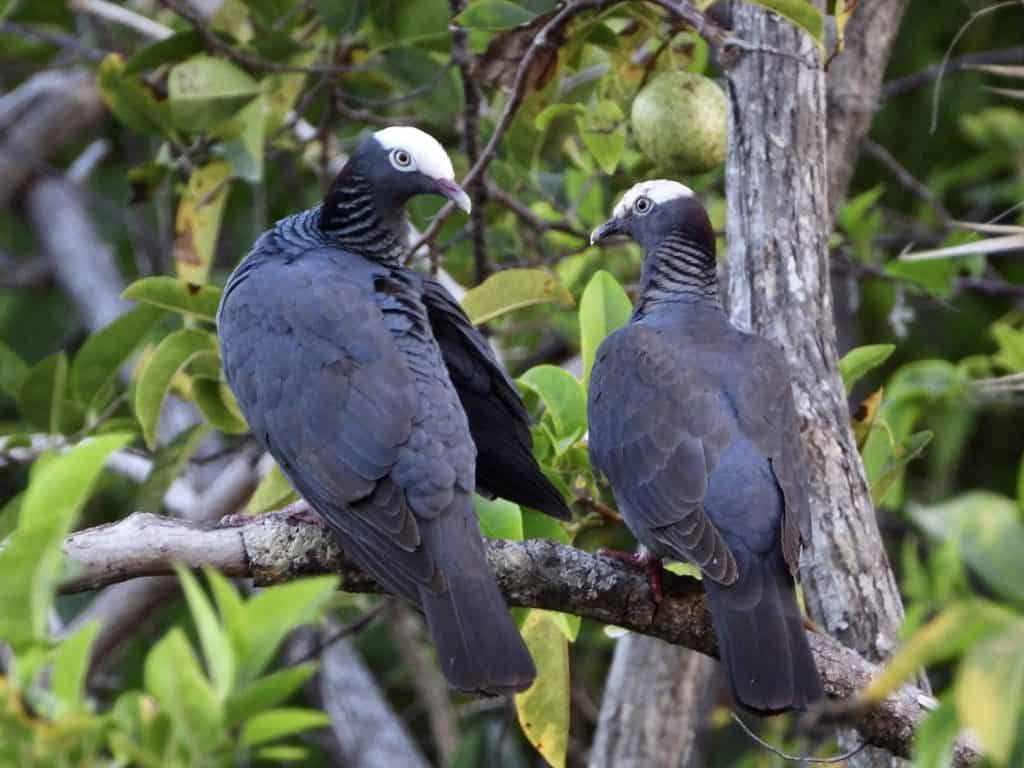
Only male white-crowned pigeons have a white crown.
The adult male features a striking, bright white cap (crown) from which this species gets its name. Females have a dull gray crown, while juveniles display a brownish-gray head. This species typically measures 13 to 15 inches in length and has a wingspan between 21 and 23 inches. In the United States, the white-crowned pigeon’s distribution is restricted to the extreme southern tip of mainland Florida and the Florida Keys during its breeding season.
Eurasian Collared-dove
The Eurasian collared-dove (Streptopelia decaocto) typically measures between 11 and 13 inches in length with a wingspan ranging from 18 to 22 inches. These doves have a pale pinkish-gray body, with a distinctive narrow black half-collar edged with white on the back of their neck.
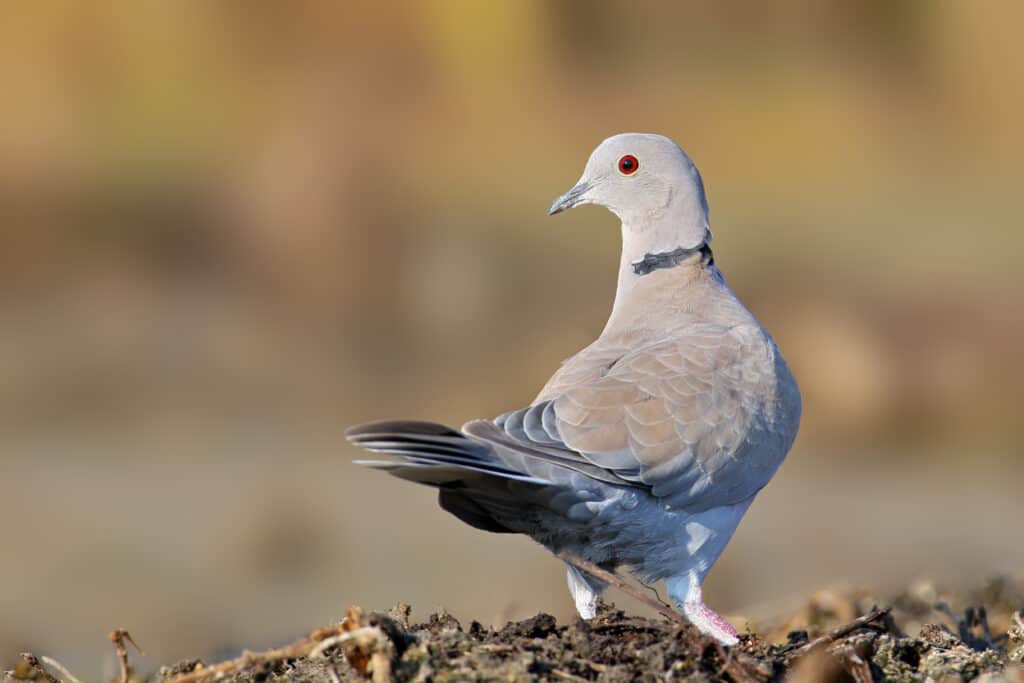
Because it is non-native, reproduces rapidly, and has established highly self-sustaining populations, the Eurasian collared dove is classified as an invasive or nuisance species across much of the United States.
©Voodison328/Shutterstock.com
Following an accidental introduction in the Bahamas in the 1970s and subsequent arrival in Florida during the early 1980s, this highly adaptable species has staged one of the most rapid natural range expansions in modern ornithological history, spreading extensively across virtually all of North America from Mexico up into Canada and Alaska.
Mourning Dove
The mourning dove (Zenaida macroura) is an exceptionally common species across the United States, ranking among the top ten most abundant birds in the country. Recognized by its small rounded head, creamy taupe body, and short red legs, it is also easily distinguished by the prominent black spots on its upper wings and its long, pointed, white-edged tail.
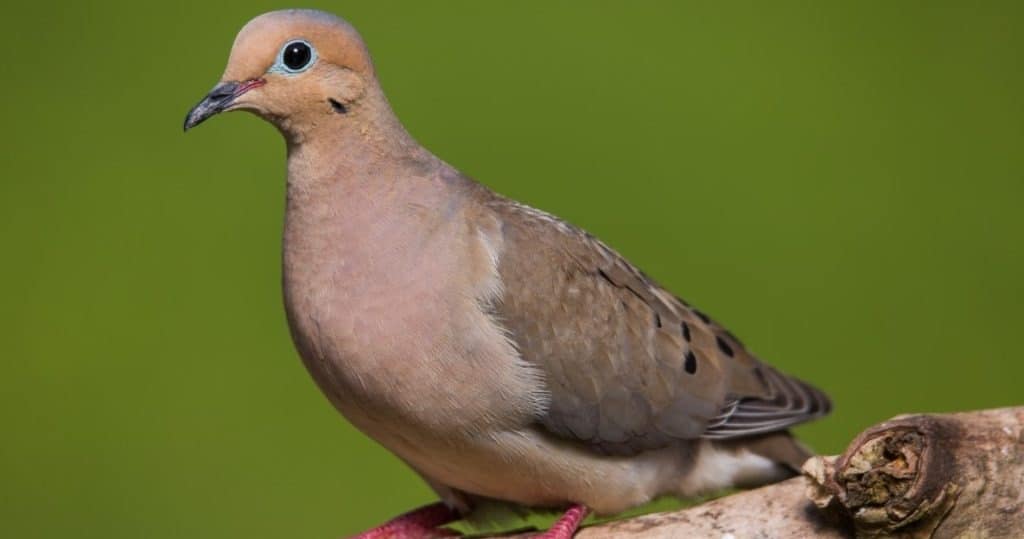
Mourning doves make a soft, sad cooing sound and a sharp whistling noise with their wings when they take off.
©A.JAREDWELLS007/Shutterstock.com
Measuring approximately 9 to 13 inches in length with a wingspan ranging from 15 to 19 inches, this highly adaptable species is one of the most abundant and widely distributed birds not only in the United States, but also in all of North America, breeding across the majority of the continent.
Rock Pigeon / Rock Dove
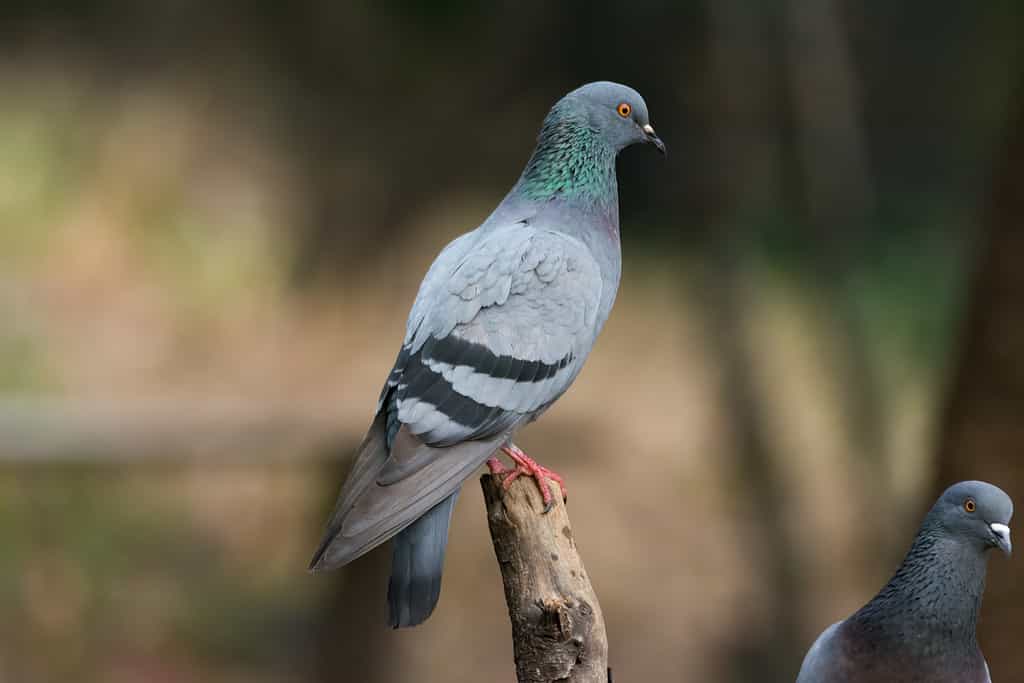
The rock pigeon (Columba livia), also called the rock dove or city pigeon, has a bluish-gray head, neck, and chest with a metallic green and purple iridescence, with gray underparts. Its pale gray wings are marked by two distinct black bars; it typically measures between 11 and 15 inches in length, with a wingspan ranging from 20 to 28 inches.

Although rock pigeons are highly visible, mourning doves are actually more numerous.
©YIUCHEUNG/Shutterstock.com
Introduced to North America in the early 17th century, the rock dove has established a widespread, abundant, and year-round distribution across the continent, stretching from southern Alaska and Canada southward through the contiguous United States, Mexico, and Central America. Rock doves tend to nest near humans, from agricultural farmlands to densely populated urban centers.