
Quick Take
- Wojtek, the war bear, started life as an orphaned Syrian bear cub found by an Iranian shepherd.
- The shepherd sold the bear cub to the Polish Army as the soldiers made their way towards Tehran to escort Polish citizens to a refugee camp.
- Wojtek was enlisted as a private in the Polish Army, later being promoted to the rank of corporal.
- Wojtek imitated his fellow soldiers by “marching” on his hind legs, “smoking” cigarettes, and even drinking his favorite beverage—beer.
Strange tales retold again and again often turn out to be based on myth. Not so for the tale of Wojtek (pronounced Voy-tek), the war bear. His story, as preposterous as it seems, is true and based on real events that unfolded during World War II. From his tragic start as an orphaned Syrian bear cub to fame as an enlisted member of the Polish Army to retirement in a Scottish zoo, Wojtek’s story is worthy of a book, play, or movie. In fact, the war bear was honored with all three. Read on to discover all the details of this incredible bear’s life.
Where Did Wojtek’s Story Begin?
Wojtek’s story begins with a tragedy. He was orphaned as a young cub when his mother was shot by hunters in Iran. A shepherd found the cub and cared for it until he had the opportunity to sell the cub to passing Polish troops. The troops he encountered were part of the newly formed Anders’ Army, which had left the Soviet Union in the spring of 1942. The army’s initial mission was to escort newly freed Polish citizens from Pahlavi to Tehran. These civilians had originally been deported to the Soviet Union after the 1939 Soviet invasion of eastern Poland.
When the group encountered the Iranian shepherd, he offered to sell the bear cub to them. One young woman, 18-year-old Irena Bokiewicz, quickly fell in love with the cub and agreed to care for it. The lieutenant in charge of the group agreed to buy the bear, and it joined the group as they made their way to a refugee camp near Tehran. Under Bokiewicz’s care, the bear remained in the camp for three months until he was given to the 22nd Artillery Supply Company. The Polish soldiers of that company named the cub Wojtek.
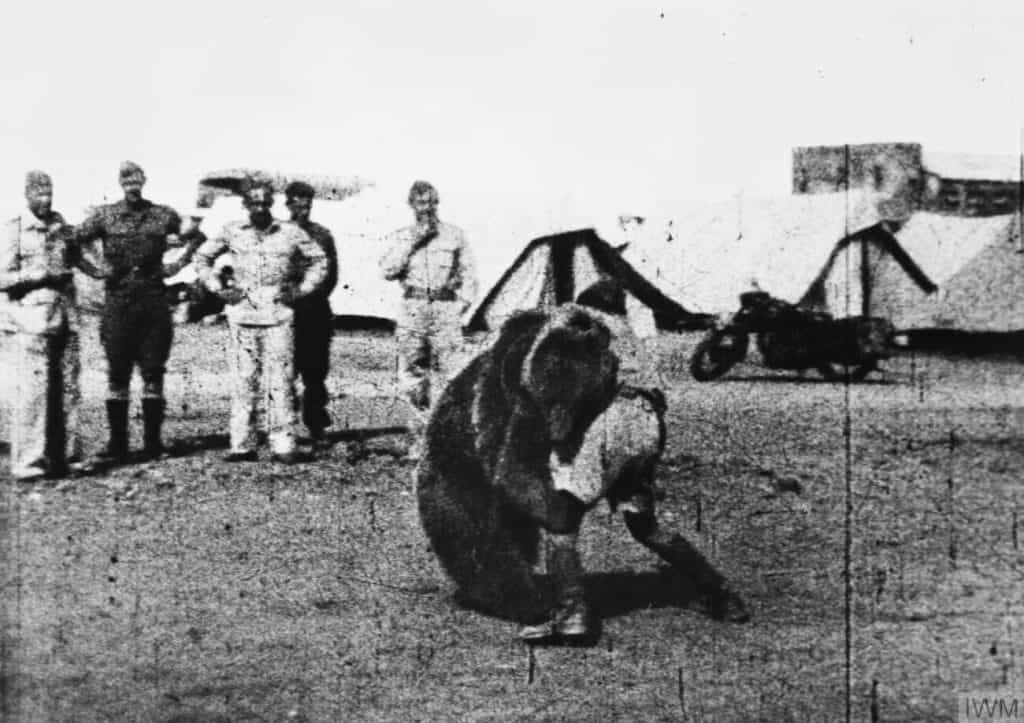
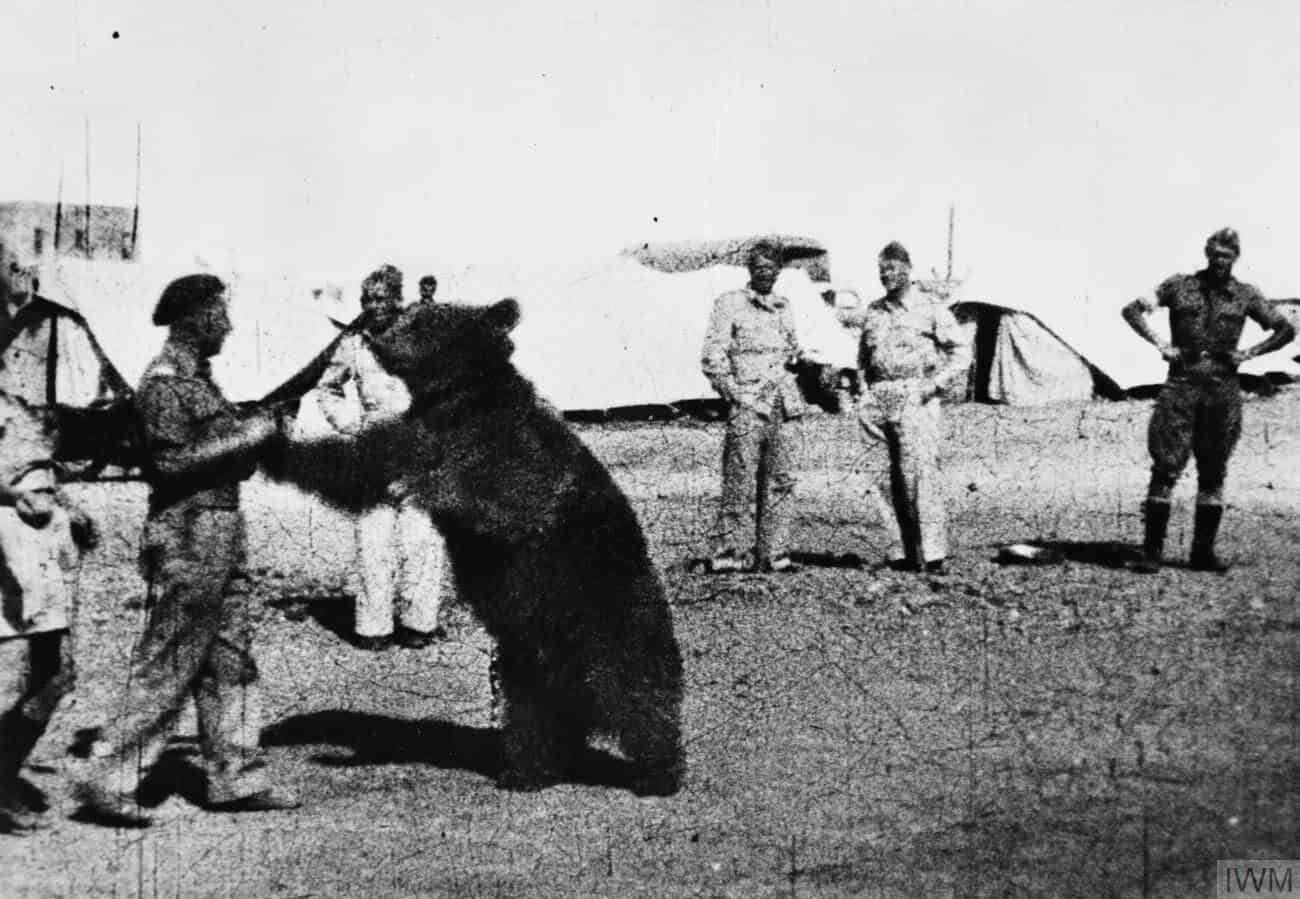
Soldiers in the Polish Army wrestling with Wojtek the war bear.
©See page for author, Public domain, via Wikimedia Commons – Original / License
Things did not go smoothly at first. Wojtek had trouble swallowing, and the soldiers’ solution was to feed the bear condensed milk from an old vodka bottle. They also gave the bear fruit, honey, syrup, and marmalade. But the biggest surprise was that they also gave the bear beer as a reward for learning new tricks, like saluting when greeted. Beer soon became Wojtek’s favorite drink.
As he grew, Wojtek began emulating the soldiers’ behaviors. This included marching on his hind legs and their not-so-healthy habits of smoking and drinking. Yes, Wojtek “smoked” cigarettes, although he actually ate them rather than lighting them up. Wojtek proved popular with both soldiers and civilians. He became the unofficial mascot not only for the 22nd Artillery Support Company but also for all nearby troops.
What Role Did Wojtek Play in World War II?
Eventually, the 22nd Artillery Support Company was ordered to move out from Iran and support British troops en route to Italy. The British transport ship assigned to carry the troops to Italy didn’t allow pets, even if they were unofficial mascots. Rather than leave Wojtek behind, the 22nd Artillery Support Company made a bold move.
They decided to officially draft Wojtek into the Polish Army as a private. He became the newest member of the 22nd Company. Two soldiers were assigned as his primary caretakers. Wojtek was treated equally to other enlisted soldiers. He received recognition and lived with the men in tents. He also had a special wooden crate of his own, which he sometimes slept in and which was also used to transport him.
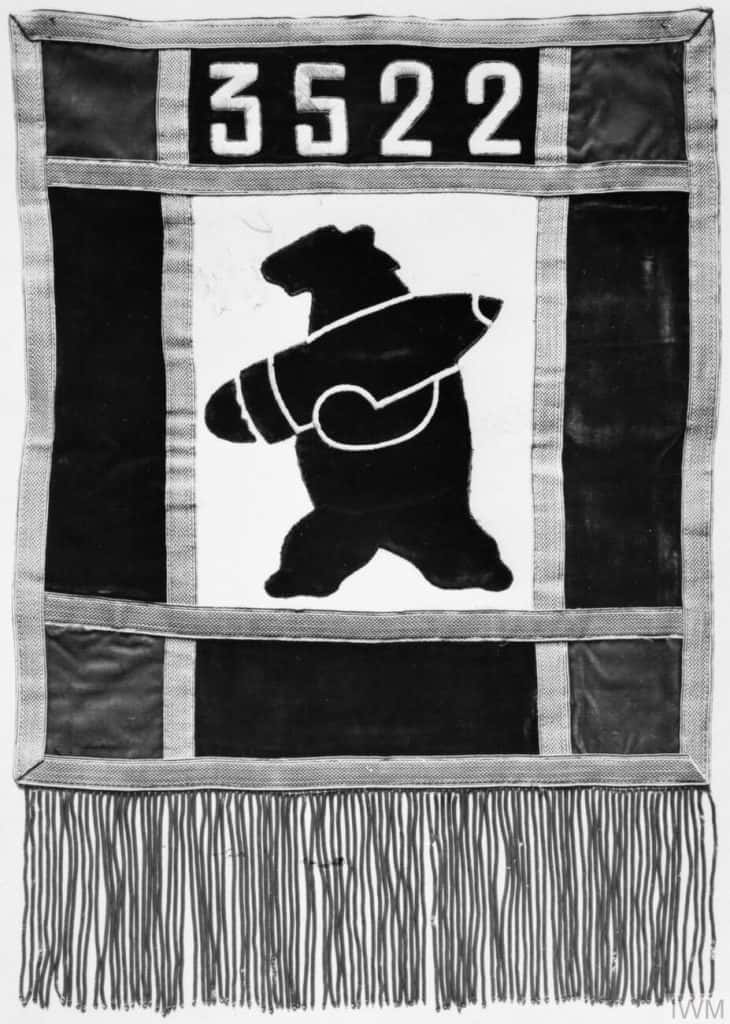
Wojtek’s work inspired the 22nd Company to adopt him as the Company’s official symbol.
©See page for author, Public domain, via Wikimedia Commons – Original / License
His most famous wartime efforts came during the Battle of Monte Cassino. There, it is claimed that he helped his fellow soldiers by carrying 100-pound crates of heavy artillery shells. While there is no physical proof that Wojtek did this, at least one British soldier wrote an account of seeing a bear carrying crates of ammunition.
The Polish Army’s success at Monte Cassino catapulted Wojtek to celebrity status among Allied troops. Wojtek’s exemplary service during the battle became legendary and earned him a promotion to corporal. It also prompted the 22nd Company to adopt a bear carrying an artillery shell as their official emblem.
How Did Wojtek End Up in Scotland?
When World War II ended in 1945, the 22nd Company was sent to Berwickshire, Scotland. Of course, they didn’t leave Wojtek behind. Once the Company settled in at Winfield Airfield, Wojtek quickly made himself at home as well. He became a sensation among local residents and the Scottish press. The war bear proved so popular that the Polish-Scottish Association, a cultural group, quickly made Wojtek an honorary member. Eventually, the 22nd Company was demobilized in November 1947. With his fellow troops returning to their homelands and the airfield closing, Wojtek’s fate became uncertain.
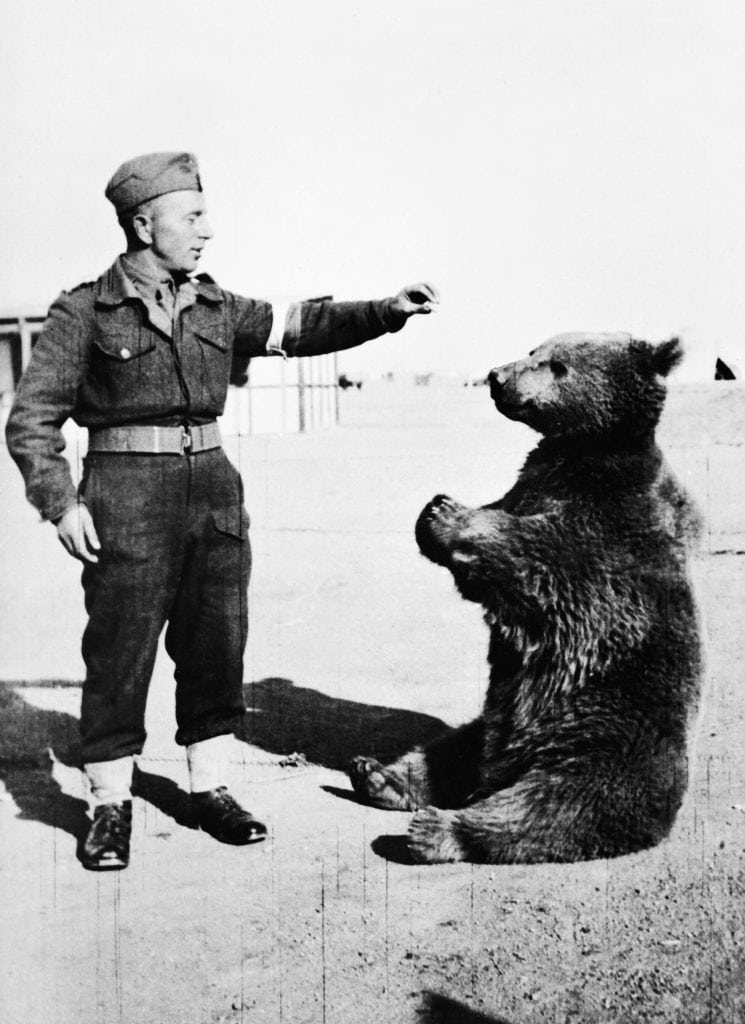
Soldiers trained Wojtek, often using beer as a reward. Beer quickly became the bear’s favorite drink.
©Imperial War Museum, Public domain, via Wikimedia Commonshttps://commons.wikimedia.org/wiki/File:Wojtek_the_bear.jpg – Original / License
However, the Edinburgh Zoo quickly stepped up and accepted the famed war bear as their newest resident. Wojtek spent the rest of his life at the zoo. He remained popular, especially with former Polish soldiers. They regularly came to see Wojtek, with some even tossing him cigarettes, which the bear would eat just like he did during the war.
It is said that he recognized many men from his former unit and readily responded when spoken to in Polish. The British media fell in love with the war bear, and he made regular appearances on the British children’s program, Blue Peter. At the time of his passing, Wojtek the war bear was 21 years old, stood nearly six feet tall, and weighed almost 1,100 pounds.
Wojtek’s Fame in Books and on Stage and Screen
Wojtek continues to capture the imagination of people around the world who discover his story. His unusual life and accomplishments have inspired authors, playwrights, and movie directors to capture his incredible tale in books, on stage, and on film.
Writer Allan Pollock wrote the children’s book The Bear Who Went to War, which he later adapted into a play that debuted at the Albany Theatre in Coventry, UK. Other books, including Soldier Bear, Wojtek: The Bear Who Beat the Nazis: Polish War Hero, and The Bear Soldier, also honor Wojtek and his incredible accomplishments. At least one documentary also tells Wojtek’s story. A Bear Named Wojtek, by director Iain Gardne,r was released in 2024. The documentary was nominated for several film awards.
How Wojtek Is Honored Today
Today, you can find monuments, memorials, and tributes to Wojtek in cities across Europe. A sculpture of Wojtek is prominently displayed in London’s Sikorski Institute and Museum. There is also a wooden sculpture located in Weelsby Woods, Grimsby, UK.
The city of Kraków erected a statue of Wojtek in Jordan Park. The statue was unveiled on the 70th anniversary of the Battle of Monte Cassino—May 18, 2014. The City of Edinburgh also unveiled a statue of Wojtek and a Polish Army soldier in Princes Street Gardens in 2015. A relief next to the statue depicts Wojtek’s travels with the Polish Army.
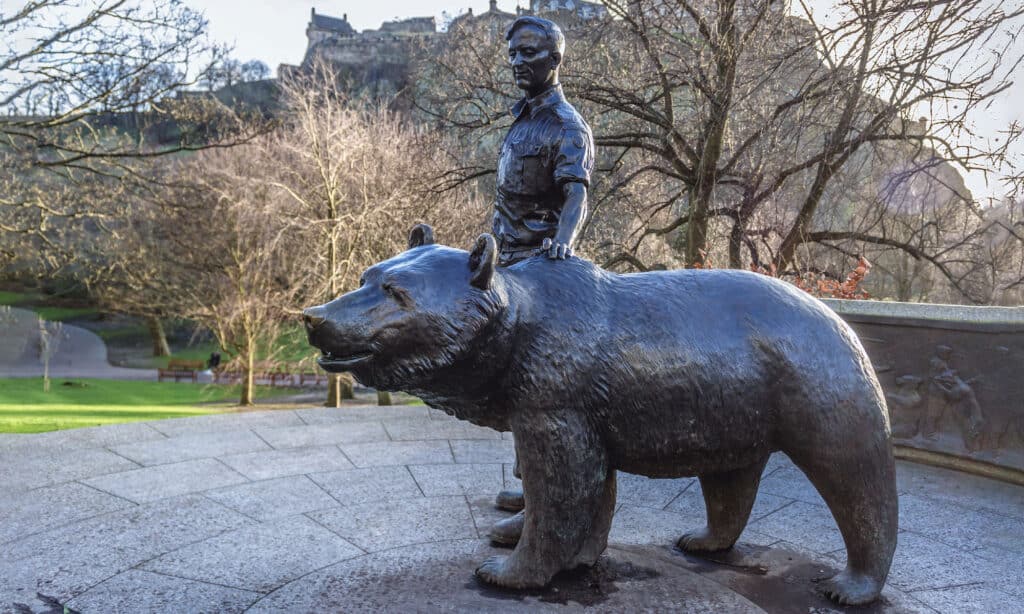
The statue of Wojtek the bear, an animal used in war, was unveiled in Princes Street Gardens in the shadow of Edinburgh Castle.
©Fotokon/Shutterstock.com
In the Italian city of Cassino, the site of Wojtek’s most famous Army activities, a marble statue was unveiled in May 2019. Other cities throughout Poland also have Wojtek statues displayed. In Poznań, Poland, there is even a street officially named after the war bear. The street, Ulica Kaprala Wojtka (Corporal Wojtek Street), leads directly to the Poznań New Zoo.