Animal species that live in environments as harsh as the Antarctic have many incredible adaptations to help them survive. Emperor penguins (Aptenodytes forsteri) are a leading example. These resilient birds breed in colonies on the Antarctic continent, which is the coldest, windiest, and driest place on the planet. To survive, they have both physical and behavioral adaptations. One of the most fascinating is their ability to ‘huddle’. So, let’s take an in-depth look at how the birds work as a team to form a life-saving huddle and why they have to do it.
Surviving in the Antarctic
Climatic conditions in the Antarctic are frighteningly harsh. Temperatures can plunge to -112 degrees F in winter with the coldest ever recorded at -128.56 degrees F on 21 July 1983. Special types of winds, called katabatic winds, blast across the continent. Wind speeds can reach 62 mph for days at a time but gusts over 124 mph have been measured. Precipitation (mainly in the form of snow) makes things worse. Loose snow is picked up by the winds and hurled around, reducing visibility. Blizzards can last for days.
To be able to survive this, emperor penguins’ bodies have evolved in very special ways. Their feathers are practically ruffle-proof, with a scale-like structure and several layers. Their bills and flippers are small to reduce heat loss, and their nasal chambers recover heat. Because their arteries and veins run close together, body heat is recycled. Arterial blood is cooled before it reaches the extremities, and blood in veins is warmed back up on its way to the heart. Even their feet contain special fats so that they do not freeze.
More About Emperor Penguins
These are the largest of all the extant 18 species of penguins. The largest can weigh up to 88 pounds. They feed by chasing fish and other marine animals in the open sea or by breaking through the ice. Their diet consists of squid, krill, fish, crustaceans, and amphipods. However, studies have shown that 78 percent of their diet by mass was fish. An adult needs to eat between four and six pounds of food every day, but this amount increases as they gain weight during the lead-up to the breeding season. They return from their hunting grounds to areas of fast ice that are stuck between islands of grounded icebergs. Here, they gather in colonies ranging from a few hundred to over 20,000 pairs, where they form their famous huddles.
Keeping Warm
Animals such as emperor penguins need behavioral as well as physical adaptations to survive in harsh conditions. This begins with their social behavior. Being a solitary animal that aggressively scares away others of its own species is not a useful behavioral trait in these conditions.. These animals do not have the luxury of being a loner. Instead, they are not territorial and seek out the company and physical protection of other penguins. Emperor penguins are unique among penguins for their non-territorial behavior. Their sociality goes a step further, as the males physically gather together to share warmth and provide protection for each other in a huddle.
Huddle Formation Dynamics
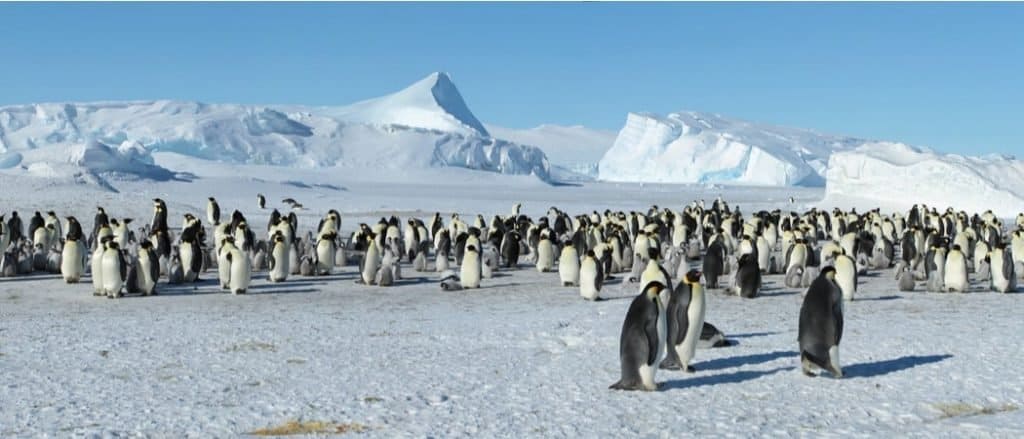
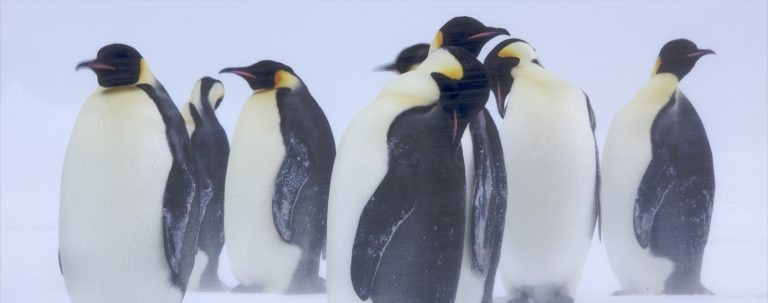
Colonies of emperor penguins form tight huddles to keep warm.
©Sergey 402/Shutterstock.com
A penguin huddle is a very tightly packed gathering. You may find up to 10 penguins in a 10-square-foot space. Viewed from a distance, it looks like a single creature, but in reality, it is hundreds of penguins moving in a perfectly synchronized way, and they all know the moves to the dance. They follow each other in a constant queuing formation.
The movements are based on the wind direction at the time. The edge of the huddle blasted by the wind is called the windward edge, and the more sheltered side is called the leeward edge. At the windward edge, the penguins peel off and shuffle down the side of the huddle, a process that takes time because they are balancing their eggs on their feet. They rejoin the huddle at the leeward side, and as more penguins join, they are gradually pushed into the warmer center. Eventually, they are crowded back toward the windward side, and when they reach the edge, the cycle repeats. During a 48-hour blizzard, the huddle can shift as much as 200 meters (about 656 feet) downwind. This behavior is extremely effective for conserving heat. It cuts down the emperor penguins’ heat loss by as much as 50 percent, which in this environment is the difference between life and death.