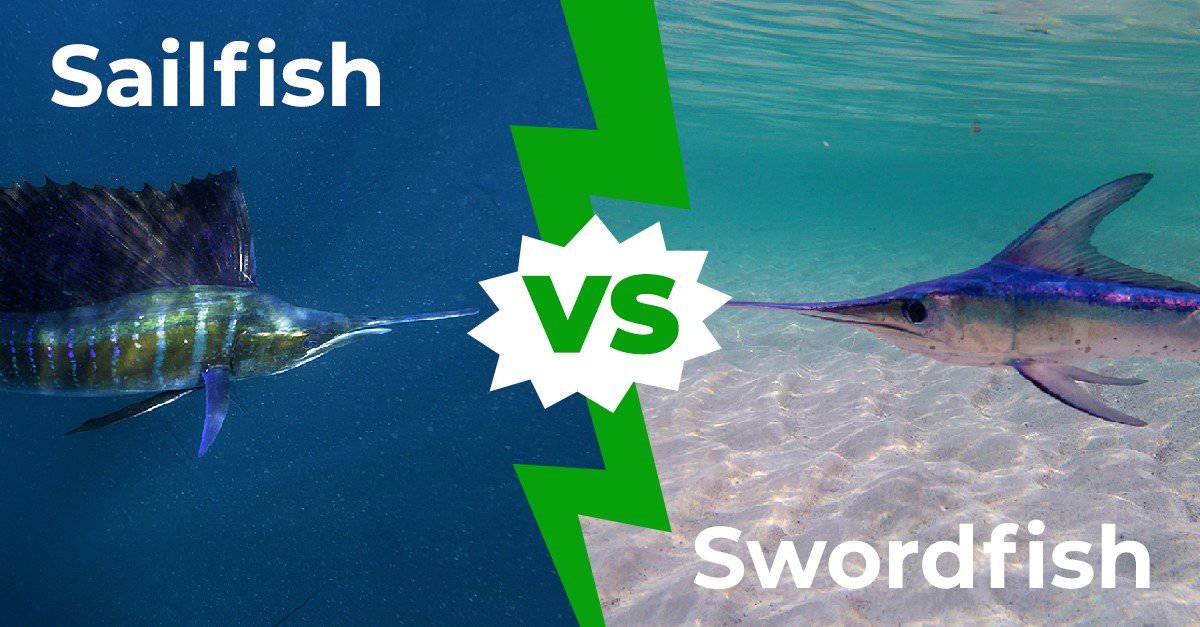

The sailfish and the swordfish are both examples of billfish, or fish with beaks that have been elongated to resemble spears or lances. To a casual observer, the swordfish and sailfish look alike, and both are prized as game fish and make good eating. Yet there are notable differences.
Read on to discover more differences between these two magnificent animals.
Comparing Swordfish vs Sailfish
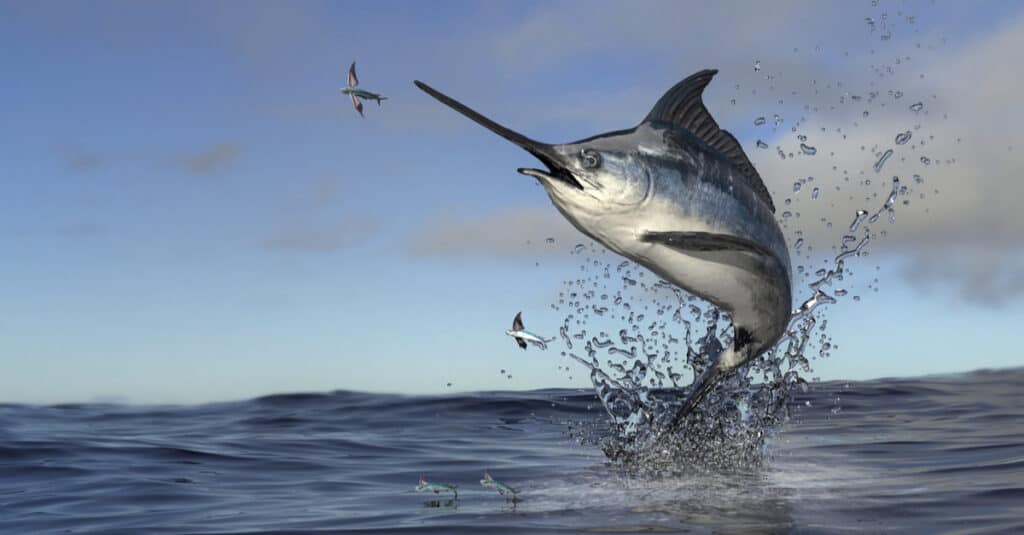
Swordfish are large, highly migratory predatory fish characterized by a long, flat, pointed bill.
©bekirevren/Shutterstock.com
Below is a table that shows the differences between sailfish and swordfish before we dive into more detail.
| Sailfish | Swordfish | |
|---|---|---|
| Length | 9.8 to 10.9 feet | 10 to 15 feet |
| Weight | 200 pounds or less | Over 1000 pounds |
| Speed | 68 miles per hour | 60 miles per hour |
| Sail | Yes | No |
| Species | One | Maybe two |
| Teeth | Yes | Teeth lost by adulthood |
| Lifespan | 13 to 15 years | As long as 16 years |
| Sexual dimorphism | Sexes alike | Females larger than males |
| Pelvic | Yes | No |
The Five Key Differences Between Swordfish vs Sailfish
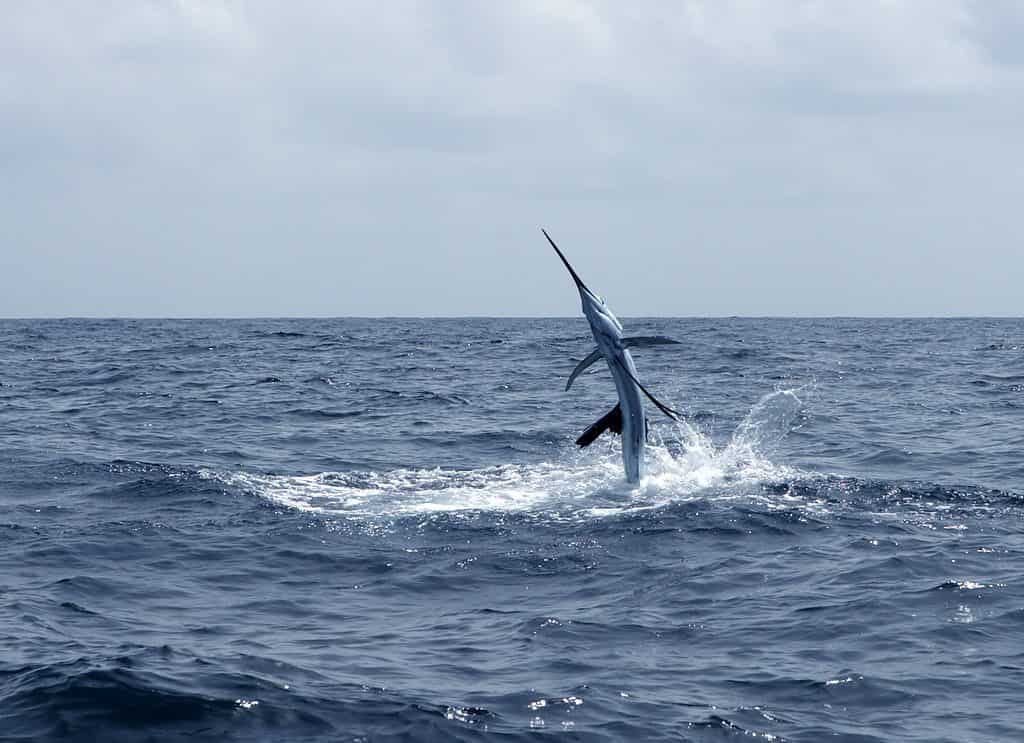
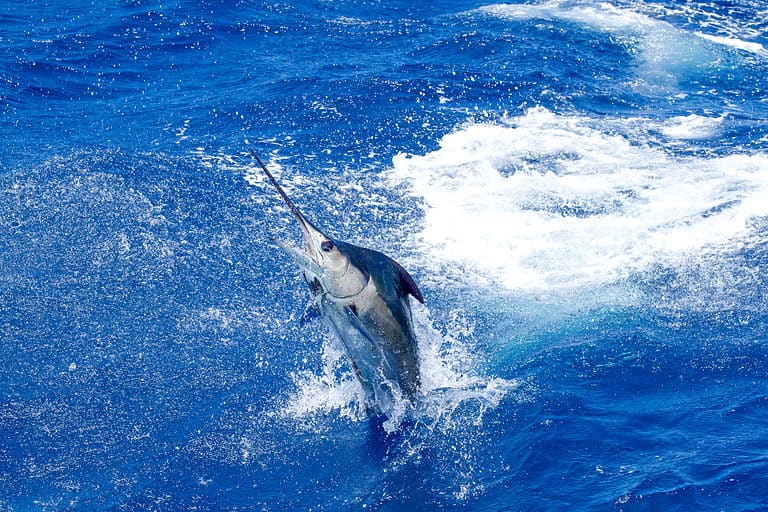
A sailfish as it jumps out of the water.
©lunamarina/Shutterstock.com
There are many distinct differences between swordfish and sailfish. For one thing, the two fish belong to different families and aren’t as closely related as some might suppose. The swordfish belongs to the Xiphiidae family and is its only member. The sailfish is part of the Istiophoridae family and is related to marlins and spearfish.
Do you want to learn more about sailfish and swordfish, especially regarding what sets them apart from one another? Here are five differences in detail.
1. Swordfish vs Sailfish: Body Type
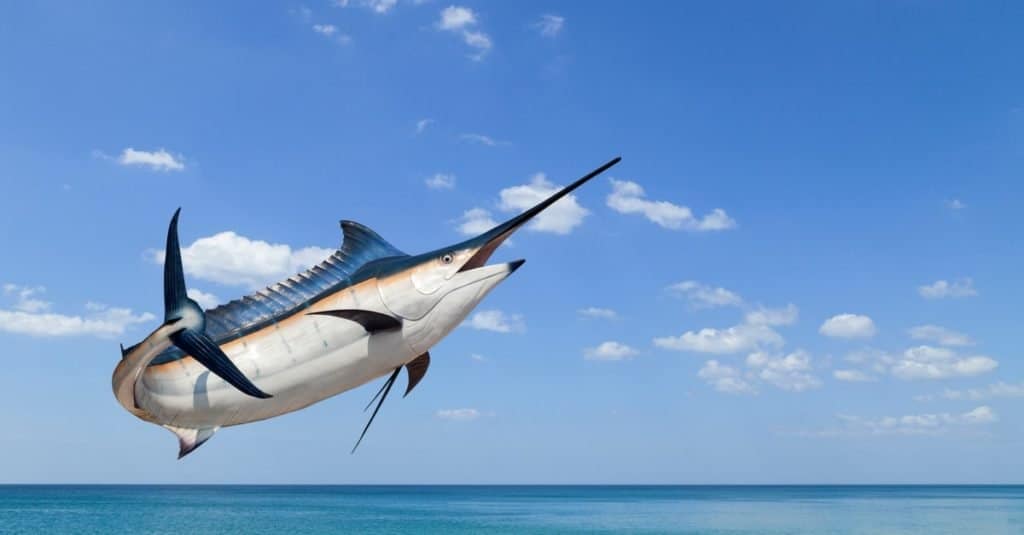
Swordfish are a popular sport fish of the billfish category like sailfish, though elusive.
©Stock High angle view/Shutterstock.com
The sailfish is shorter in length compared to the swordfish and tends to weigh much less. Sailfish rarely weigh over 200 pounds, though the heaviest swordfish caught weighed close to 1200 pounds. Both fish are compressed, torpedo-shaped, and two of the fastest swimmers in the ocean. However, the swordfish lacks the sailfish’s trademark sail, which is just a long, retractable dorsal fin that stretches most of the length of the animal’s back.
The swordfish’s first dorsal fin is near the head, large and curved, while the second is much smaller and near the stem of the tail. The first pair of pectoral fins are about as long as the first dorsal fin. The fish has no pelvic fin but a keel on the stem of the tail. The tail fin is shaped like a half-moon and has very long lobes. Adults lack scales and teeth.
Unlike swordfish, sailfish have teeth, scales, and very long pelvic fins shaped like rods, though scales may be missing in older adults. When the fish wants to go fast, it depresses its dorsal sail into a groove in its back. As for the sail itself, it has 42 to 49 rays, and its middle rays are longer than the depth of the fish’s body. The sailfish also has a much smaller second dorsal fin.
There are two keels in the root of the tail, and like the swordfish, the tail is half-moon-shaped with long lobes. The fish also seems to be left or right “handed” when it comes to using its bill. Some fish slash toward the left and some toward the right, and this appears to be advantageous when the sailfish hunts in a large group.
The bill of the sailfish is round and comes to a point, while the bill of the swordfish is flat.
2. Swordfish vs Sailfish: Habitat

While they both live in oceans, swordfish can swim in chillier waters compared to sailfish.
©BETO SANTILLAN/Shutterstock.com
Though swordfish and sailfish are both found in warm waters of the Indian, Pacific, and Atlantic Oceans, swordfish have a somewhat larger range and can swim in colder waters. They can swim in waters as cold as 41 degrees Fahrenheit and have an organ near their eyes to keep their brain and eyes warm in such chilly water.
Sailfish, on the other hand, tend to prefer warmer or more temperate waters. They, like swordfish, help themselves to the open waters and do not concern themselves with staying near coasts or the ocean floor. Sailfish typically stay in the part of the ocean that is near enough to the surface that light is able to penetrate. This is known as the epipelagic zone.
3. Swordfish vs Sailfish: Group

Sailfish prefer to swim in schools, while swordfish prefer solitary living.
©LUNAMARINA / iStock / Getty Images Plus
Swordfish tend to be solitary, and when they swim together they make sure to keep a wide distance apart. Sailfish are more likely to swim in schools. When the fish is young, the schools are arranged according to the size of the fish. Adults swim in smaller groups. Their slashing bills injure their prey, which makes it easier for members of the hunting party to catch and eat them.
4. Swordfish vs Sailfish: Coloration and Chromatophores
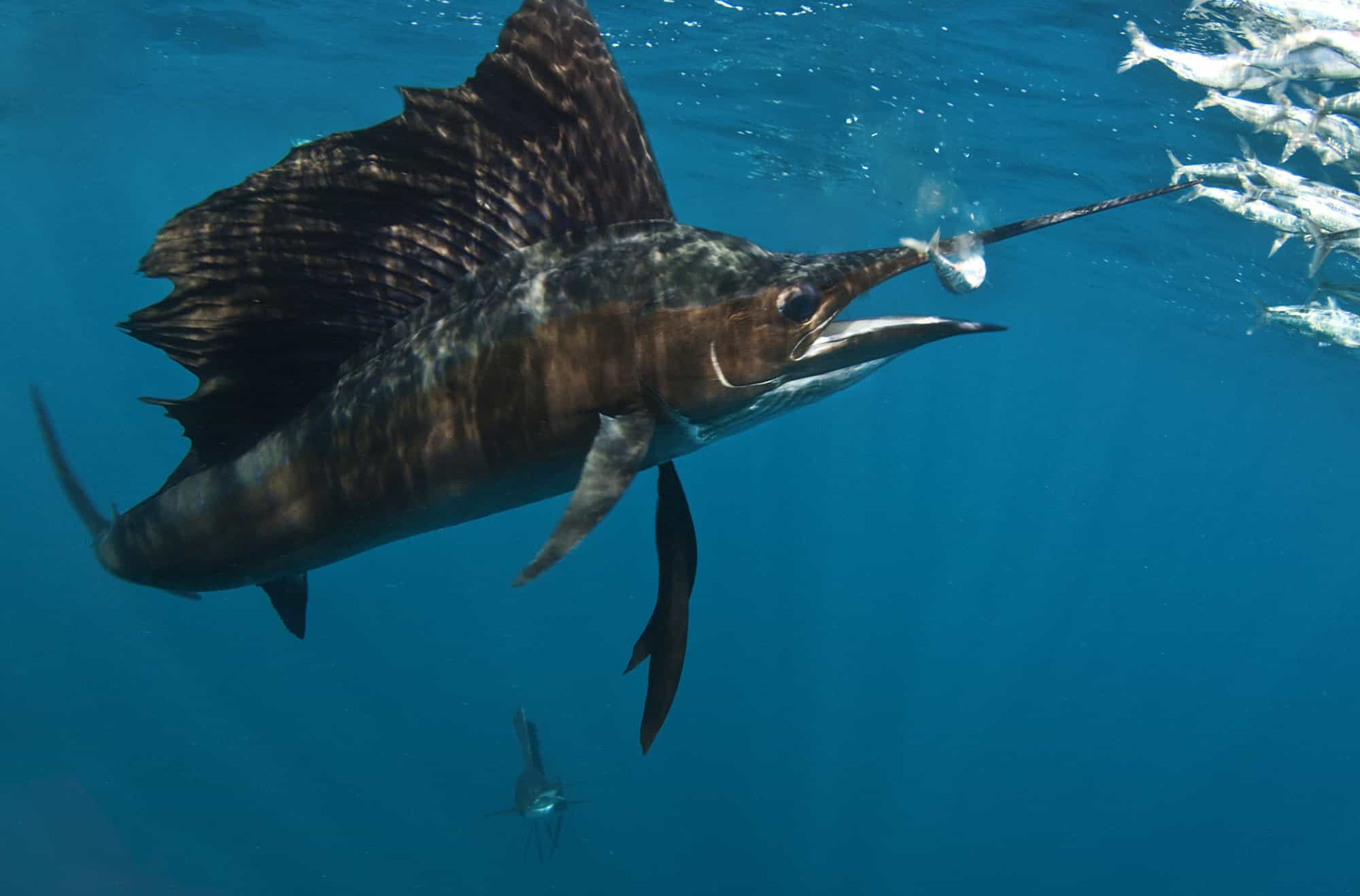
While similar in coloration, sailfish have chromatophores, while swordfish do not.
©A Cotton Photo/Shutterstock.com
Sailfish are dark blue on the top and silvery below, and adult sailfish have vertical rows of golden spots on their sides. They have chromatophores in their skin, which allows them to change or flash their colors to an extent. They do this mostly during the breeding season. Females also expand their sail fins to attract males.
Swordfish are gray, brown, or black above and gray or sometimes yellowish below.
5. Swordfish vs Sailfish: Name
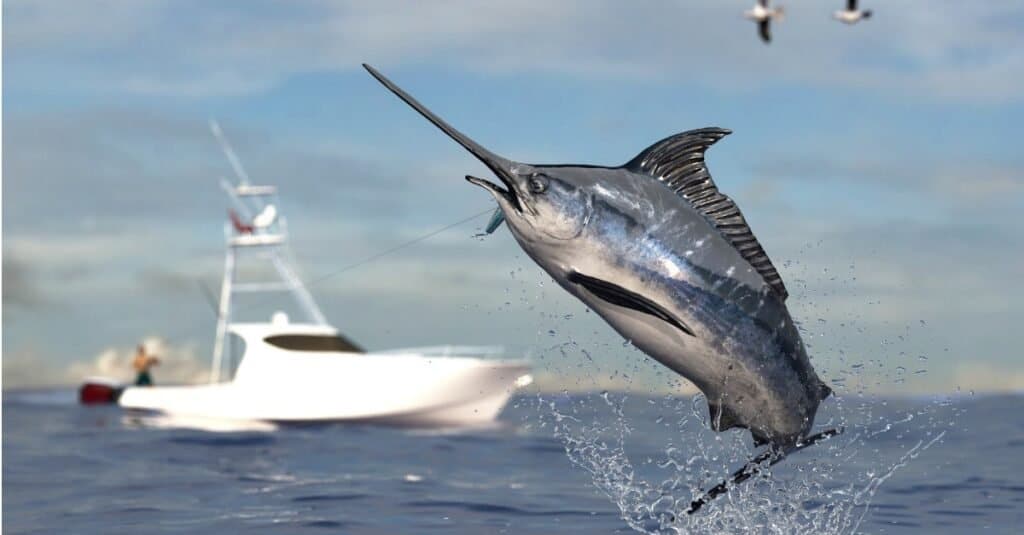
The names of swordfish and sailfish are obviously from differing origins.
©iStock.com/bbevren
Swordfish and sailfish not only do not belong to the same species, but they also don’t belong to the same genus or even family. The Indian sailfish’s scientific name is Istiophorus platypterus. Istiophorus is from the Greek words istios, which means “sail,” and pherein to “carry.” Platypterus means “flat or broad wing or feather.” The other subspecies of sailfish, the Atlantic sailfish, is Istiophorus albicans. The epithet here is Latin for “white.”
The swordfish has the scientific name Xiphias gladius. Xiphias is from the Greek word for “sword,” and gladius is from the Latin word for “sword.”