
We often see comparisons between dolphins and porpoises, but did you know that porpoises are actually more closely related to belugas? So, what’s the difference between a beluga and a porpoise? Although they are both toothed whales, there are significant differences between these two marine mammals. Aside from obvious physical differences, belugas and porpoises also have distinct habitats, communication styles, behaviors, and diets. Discover what sets these two aquatic animals apart, and find out which would come out on top in our match-up between belugas vs. porpoises.
Meet the Species
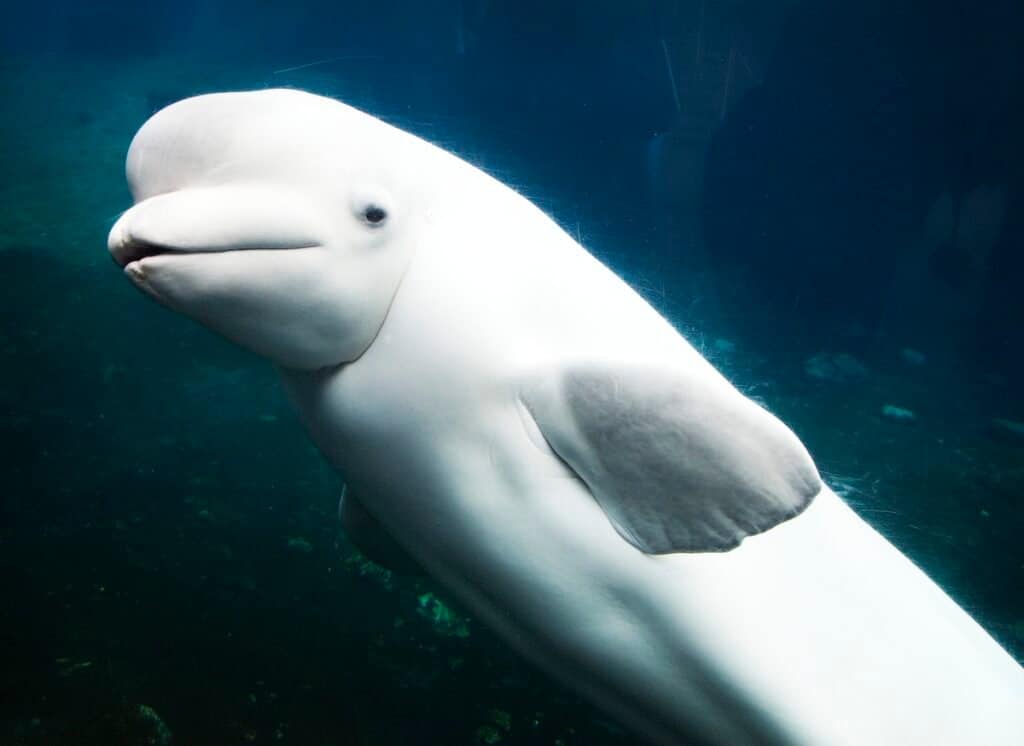
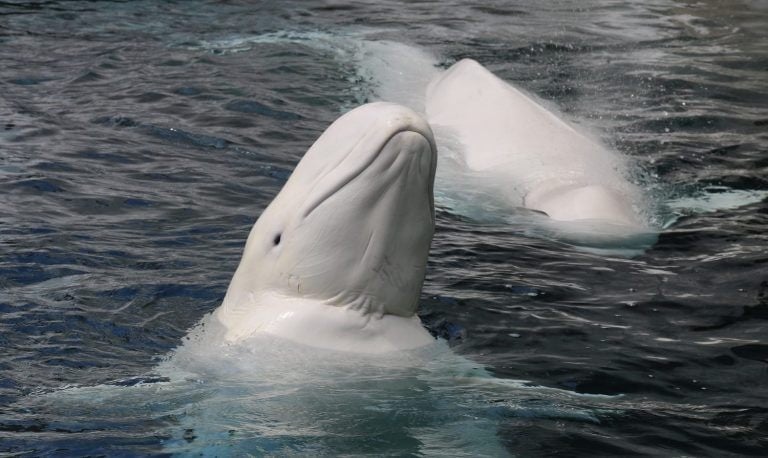
Beluga whales are more closely related to narwhals than porpoises.
Both belugas and porpoises are Cetaceans, which is an order of fully aquatic mammals. They also both belong to the suborder Odontoceti, the toothed whales. However, belugas and porpoises do not belong to the same family. There is only one species of beluga whale, Delphinapterus leucas. Belugas are one of only two species in the family Monodontidae, along with narwhals.
There are seven species of porpoise in the family Phocoenidae. These include the harbor porpoise, Dall’s porpoise, the vaquita, the spectacled porpoise, Burmeister’s porpoise, the narrow-ridged finless porpoise, and the Indo-Pacific finless porpoise. Porpoises, dolphins, and belugas are all classified as toothed whales, so the three families are related. However, researchers have found that porpoises share a more recent common ancestor with belugas.
Physical Characteristics
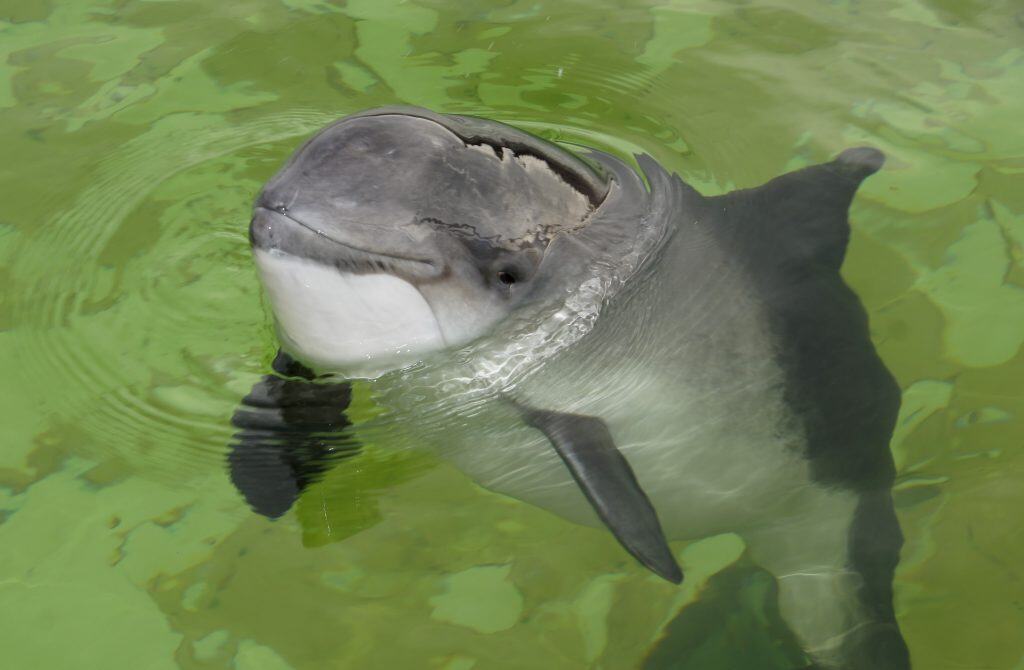
Most porpoise species have small, triangular dorsal fins.
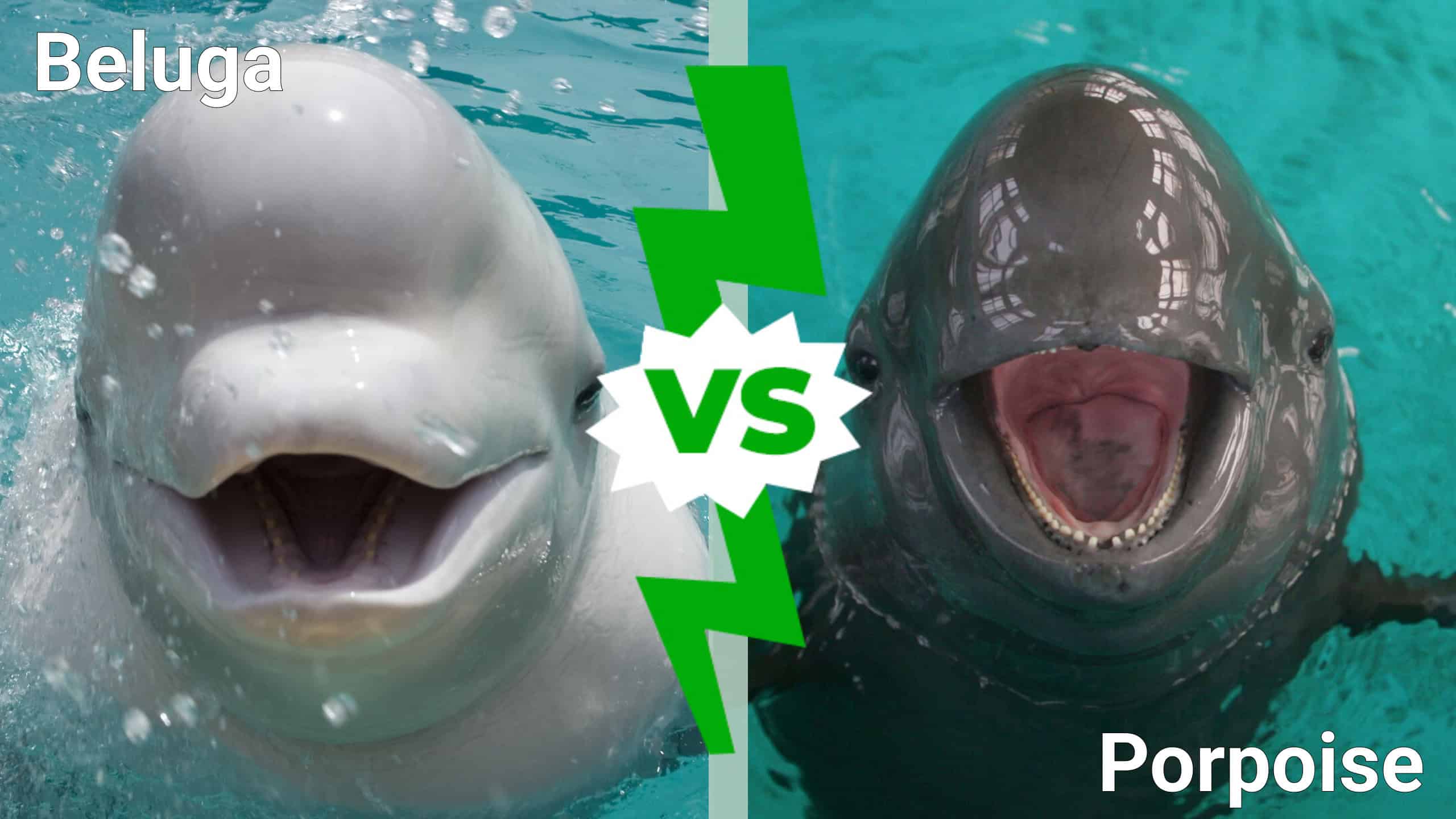
As mammals, both belugas and porpoises have lungs, not gills. They have a single blowhole on the tops of their heads that they breathe through, similar to our nostrils. Both animals also have rounded heads and lack pronounced beaks. However, belugas have bulbous foreheads, called melons, which aid in vocalization and echolocation. Unlike porpoises, belugas do not have fused neck vertebrae. Their flexible necks allow them to turn their heads and nod.
Most porpoises are dark grey to black with paler undersides. Beluga calves are also dark grey, but their skin lightens as they age until they are white by the time they reach maturity. This light coloring helps them camouflage against the ice. Belugas lack dorsal fins, instead having a narrow ridge down their backs, which helps them navigate under ice. Most porpoises have a small, triangular-shaped dorsal fin, but finless porpoises have ridges down their backs like belugas. The beluga’s scientific name, Delphinapterus leucas, was derived from the Greek words for “white dolphin without a fin.”
Beluga whales are also much larger than porpoises, with stouter bodies due to a thick layer of blubber. Belugas can reach up to 16 feet long and average around 3,150 pounds. The smallest porpoise, the vaquita, only reaches up to 5 feet in length and weighs up to 120 pounds. The largest porpoise, Dall’s porpoise, can reach nearly 8 feet in length and weigh up to 440 pounds. However, their smaller size also makes porpoises quick and maneuverable, with Dall’s porpoise being the fastest-swimming small cetacean at speeds of up to 34mph. Belugas can only reach a top speed of 17mph.
Habitat and Distribution
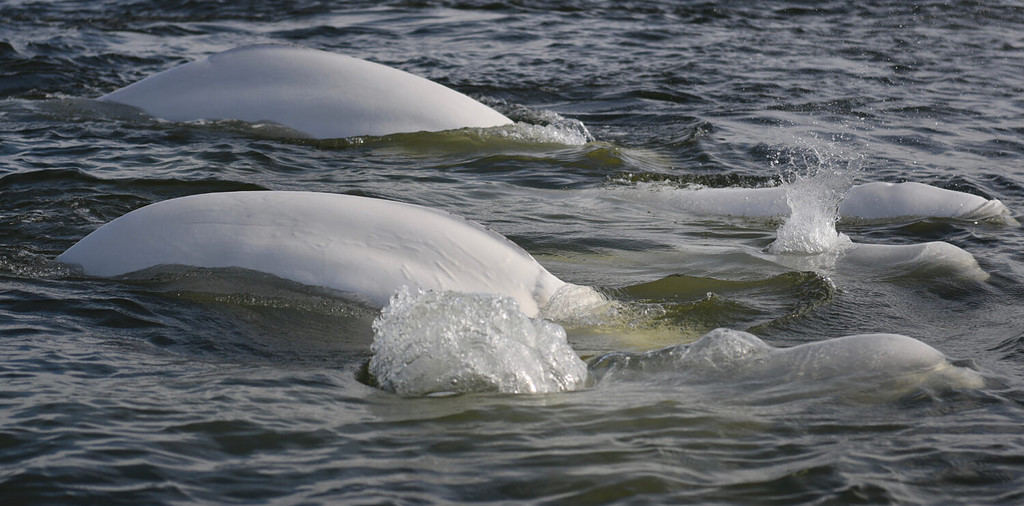
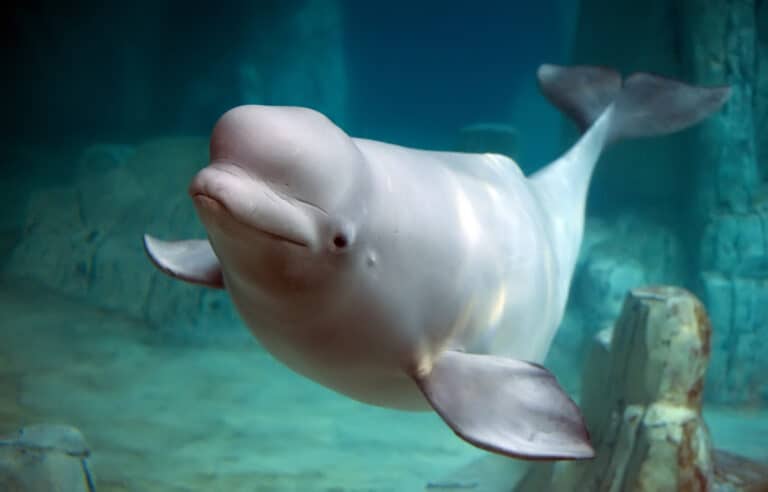
Belugas can tolerate saltwater and freshwater habitats.
©YVETTE BARNETT/Shutterstock.com
Beluga whales prefer cold Arctic and sub-Arctic waters around Canada, Europe, Russia, and Greenland. In the U.S., they are found off the coasts of Alaska. Most beluga whale populations are migratory, spending winters around the sea ice of the Arctic. Belugas can also tolerate relatively warm, shallow freshwater, as they frequently spend summers along coasts and in river estuaries and deltas. They can sometimes be found hundreds of miles inland. Researchers believe there are around 21 different sub-populations of beluga whales in the Arctic.
The seven porpoise species can be found in a variety of different habitats all over the world. Some porpoises, such as Dall’s porpoises and harbor porpoises, prefer cooler water in northern regions like belugas. The range of both of these porpoises overlaps with belugas, particularly around North America. Similarly, the spectacled porpoise inhabits cold sub-Antarctic regions of the Southern Ocean.
However, the Indo-Pacific finless porpoise prefers the tropical waters of the western Pacific and Indian Oceans. Vaquitas are only found in northwestern Mexico, while Burmeister’s porpoise inhabits the coasts of South America. The finless porpoise is found in the coastal waters of the western Pacific Ocean, including Japanese waters. Unlike belugas, most porpoises do not inhabit freshwater. A subspecies of the narrow-ridged finless porpoise, the Yangtze River porpoise, is the only freshwater porpoise in existence.
Communication
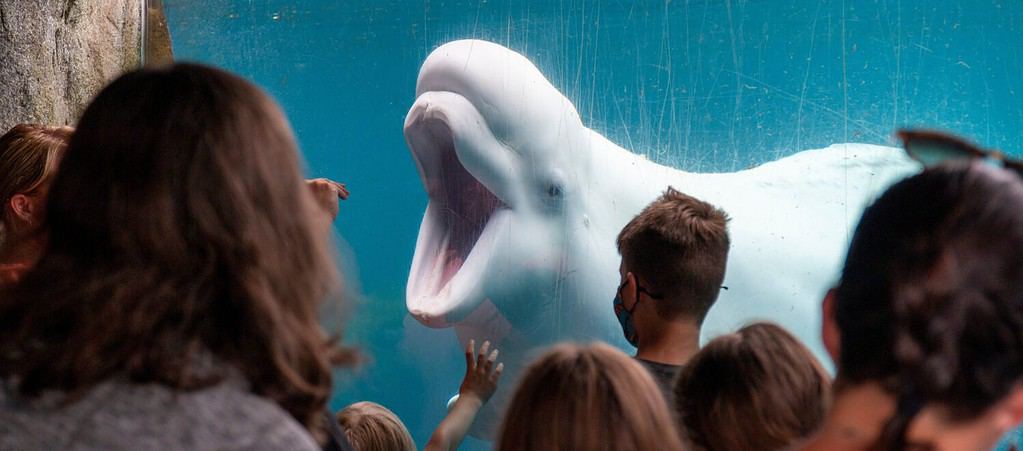
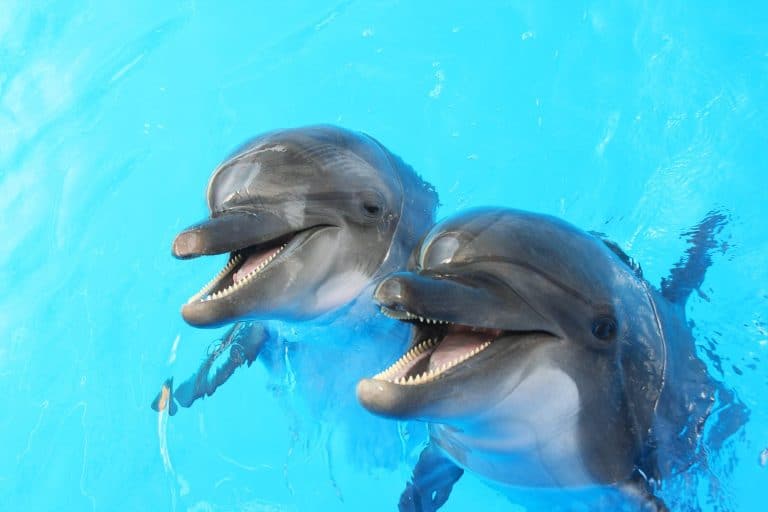
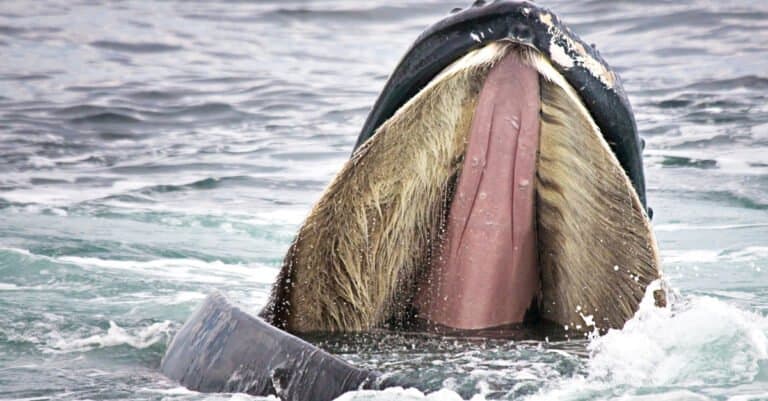
An open mouth can be a threat display, but it is also frequently used during friendly interactions.
©WoodysPhotos/Shutterstock.com
Both belugas and porpoises use acoustic communication and body language. Belugas are sometimes called the “canaries of the sea” because of their wide variety of vocalizations. They have been documented to use at least 11 different types of calls, including high and low frequency clicks, whistles, chirps, trills, squeals, and bell-like sounds for communication and echolocation. Belugas also use facial expressions, including open-mouth displays, which may be aggressive or playful, and yawn-like behavior. They can even change the shape of their melons during social interactions, including pushing it forward, flattening, lifting, pressing, or shaking it.
Porpoises also use clicks for acoustic communication and echolocation. However, they do not have a range of sounds like belugas do, so they must rely on their high-frequency clicks for social interactions. However, researchers believe that porpoises communicate information using repetition rate patterns. For example, scientists found smaller active spaces in the repetition rate patterns during aggressive encounters, suggesting the clicks were directed toward nearby animals. Larger active spaces were found during contact calling, such as between a mother and calf, indicating the recipient was further away. Like most cetaceans, porpoises are also believed to slap their tails on the water to communicate.
Social Structure
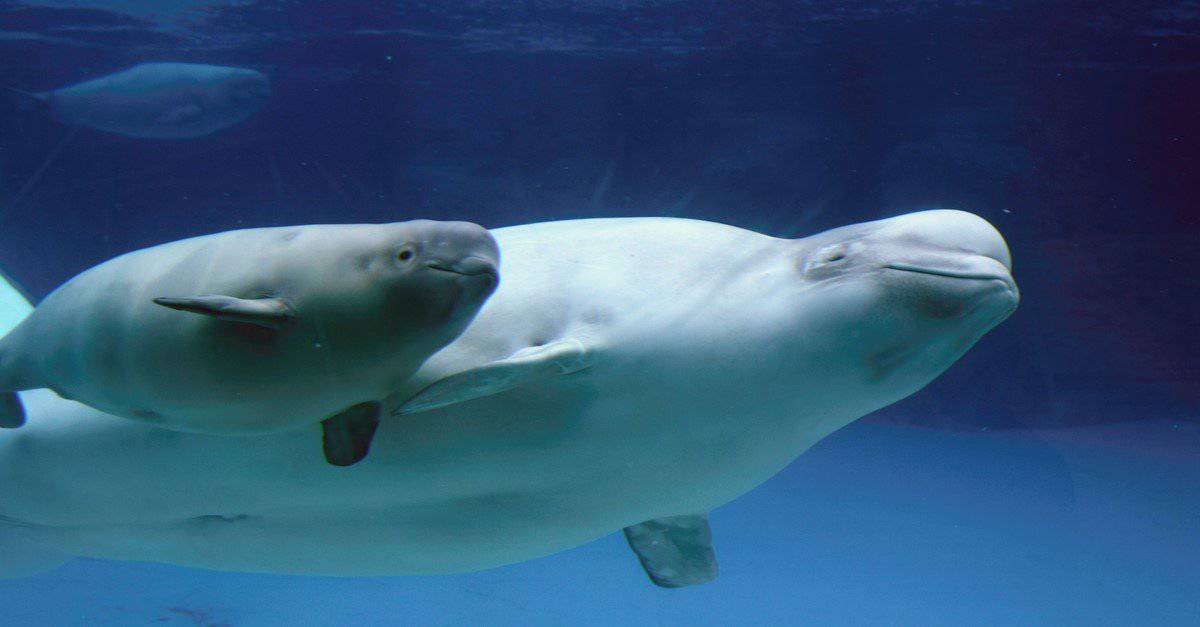
Adult female belugas are generally found in pods with juveniles and calves.
©CampCrazy Photography/Shutterstock.com
Beluga whales are known to be very social, frequently interacting, hunting, and migrating in groups. Small groups of 2-5 whales are common, but they can sometimes gather in large groups of up to 1,000 animals. While their social structure is still somewhat unknown, adult males often form bachelor pods of 8-10 whales, while adult females are regularly found in groups with juveniles and calves. Recent research has found that their highly-developed communication skills allow them to form social groups not only with close family, but with distant family, and even unrelated whales.
Porpoises are generally believed to be less social than belugas, although some species, specifically Dall’s porpoises, are known to travel in groups of 2-20. Overall, porpoises tend to be more solitary and travel in smaller, more loosely associated groups. However, tagging data has shown that porpoises are more social than researchers previously believed. Acoustic contact was observed between mother and calves over half of the time, while contact between individuals was observed over one-third of the time. Drone footage has likewise revealed that porpoises sometimes hunt in groups, similar to belugas.
Diet and Feeding Habits
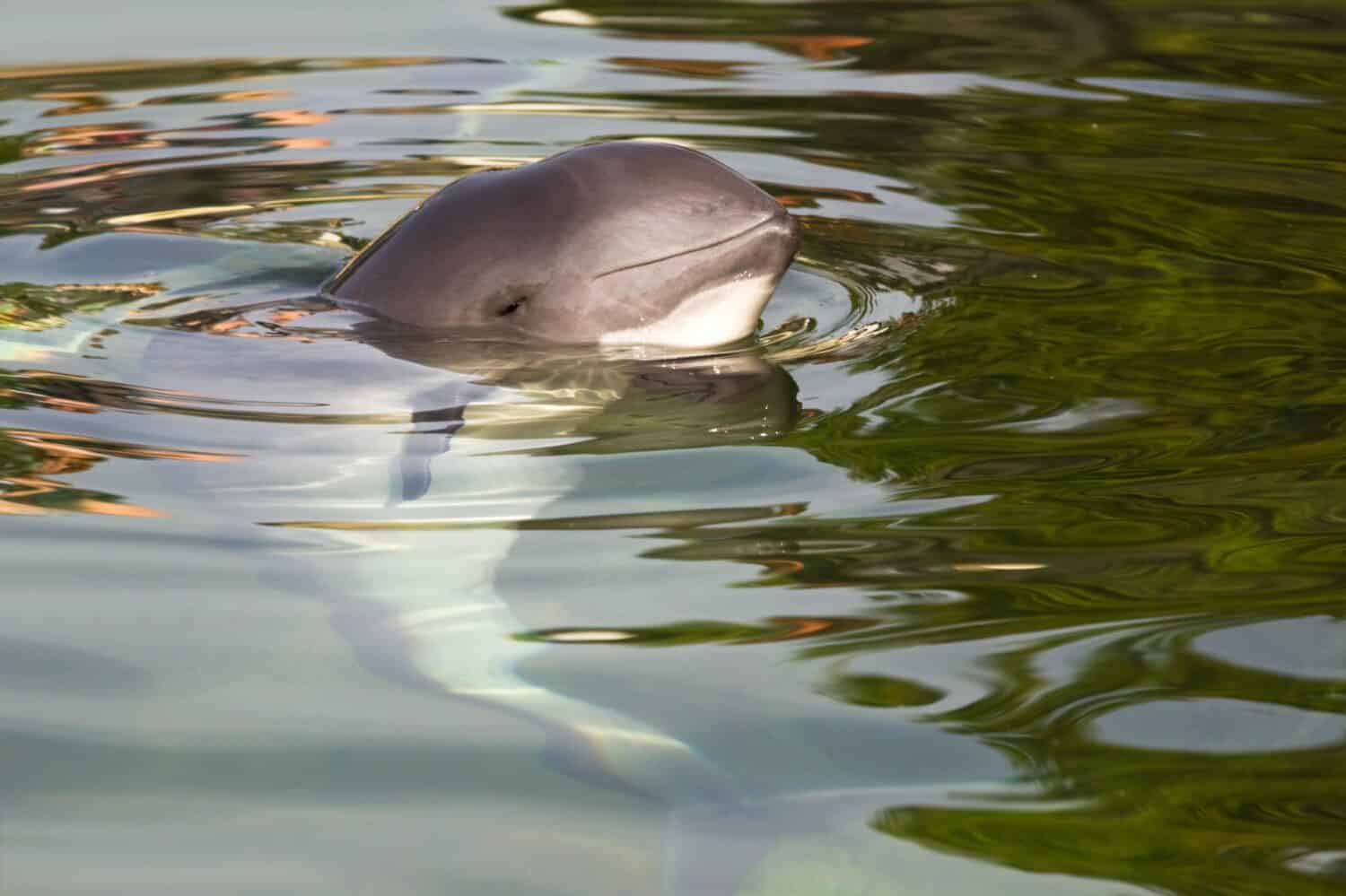
Porpoises emit narrow-band high-frequency clicks to hunt for food and communicate.
©onutancu/Shutterstock.com
Beluga whales are opportunistic carnivores. Their diet primarily consists of octopus, squid, shrimp, clams, crabs, and mollusks. Belugas also eat fish, including salmon, cod, and herring, among others. Porpoises are also carnivores, eating a similar diet of fish, crustaceans, and cephalopods, depending on their specific habitat. Although belugas have conical-shaped teeth and porpoises have spade-shaped teeth, they do not use their teeth to chew. Both belugas and porpoises use their teeth to grasp and hold prey, as they both swallow their prey whole.
Belugas and porpoises both use echolocation to hunt for food. While hunting, they emit high-frequency clicks that bounce off their prey and return in the form of an echo. Their brains interpret the sounds to give them a mental view of the target. Echolocation not only helps these animals determine the location of the object, but also the size and shape. Belugas primarily use their melons to help focus and project their clicks, while porpoises mostly rely on the vibration of their phonic lips. Both belugas and porpoises can vary their click patterns, but belugas have a wider frequency range.
Which Animal Would Win?
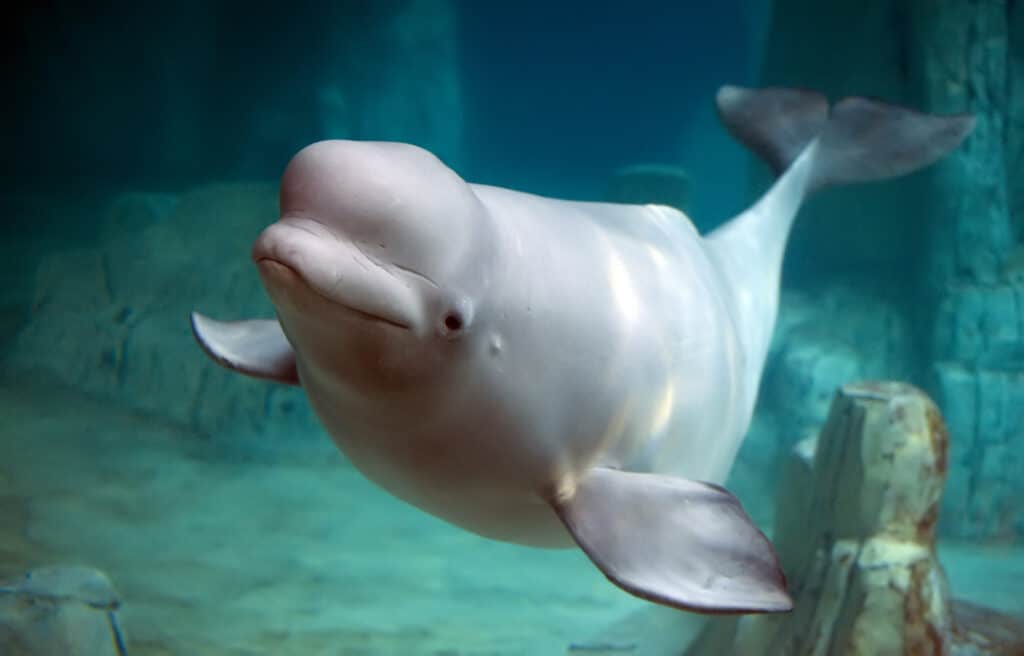
Beluga whales are twice the length of the largest porpoises.
©Luna Vandoorne/Shutterstock.com
As mentioned above, only two porpoise species, Dall’s porpoises and harbor porpoises, have ranges that overlap with beluga whales in the Arctic and subarctic regions of North America. Although there could be some competition for similar prey, neither beluga whales nor porpoises are generally considered aggressive. Like belugas, Dall’s porpoises are sociable and have been observed interacting with whales. Harbor porpoises are typically more elusive and tend to avoid other marine mammals.
However, should a confrontation occur, belugas could easily overpower even the largest porpoises. Belugas are twice the length and 7 times the weight of the largest porpoise species, Dall’s porpoise. Beluga whales are also more flexible because they do not have fused neck vertebrae like porpoises. With no dorsal fins, belugas are more streamlined and can move through the water more efficiently. They also have more robust bodies due to a thick blubber layer.
Yet, when it comes to speed, Dall’s porpoises are the fastest small marine mammals at speeds of up to 34mph. The maximum observed speed for a beluga whale is only half as fast at 17mph. So, in a one-on-one competition, a porpoise’s best shot is to swim away and live to fight another day — especially if the beluga is accompanied by its large group of companions.