
Quick Take
- Attempts to breed Gilbert's potoroo in captivity failed, and the reason why has to do with its diet. Captive breeding challenges →
- Only one wildfire stands between this species and total extinction. The translocation solution →
- Relocating this marsupial isn't just about finding suitable land. There's a hidden requirement that makes translocation far harder than it sounds. The fungi dependency explained →
- Researchers studied poop from four different animals to figure out where the potoroo can live next. How scat analysis revealed habitat →
The world’s rarest marsupial, once thought entirely extinct, may have a second chance for survival, thanks to the DNA in its poop. Researchers are searching for clues on how to save the critically endangered Gilbert’s potoroo (Potorous gilbertii) by examining DNA in its scat to learn more about its diet. There is only a small population of Gilbert’s potoroo living in one location. Conservationists hope to translocate the marsupial to multiple locations to increase its numbers. But this involves bringing along the potoroos’ main food source, a truffle-like fungi.
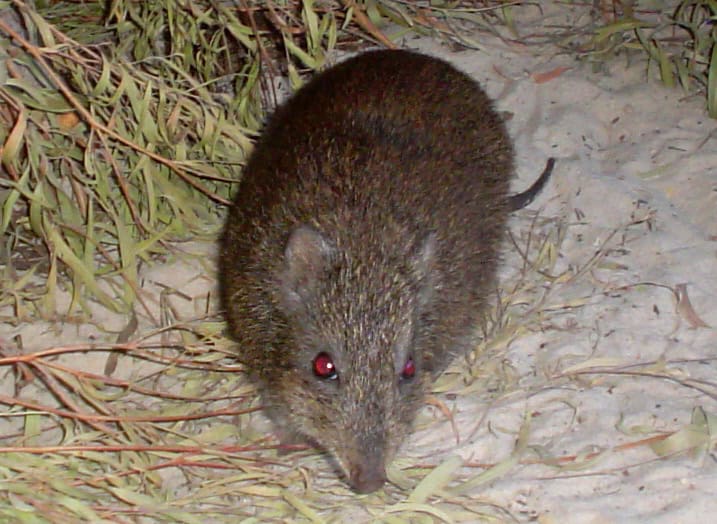
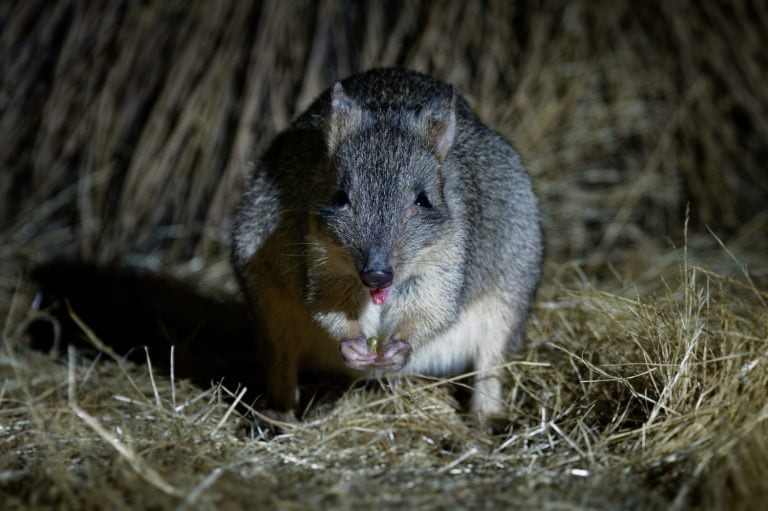
Gilbert’s potoroo is a rabbit-sized marsupial with a long tail and soft fur.
©Mick wackers at English Wikipedia, CC BY 3.0, via Wikimedia Commons – Original / License
What Is Gilbert’s Potoroo?
Gilbert’s potoroo is one of three species of potoroos native to Australia. The other two are the long-nosed potoroo (Potorous tridactylus) and the long-footed potoroo (Potorous longipes). The most widespread of the three species is the long-nosed potoroo, while the long-footed potoroo is listed as vulnerable.
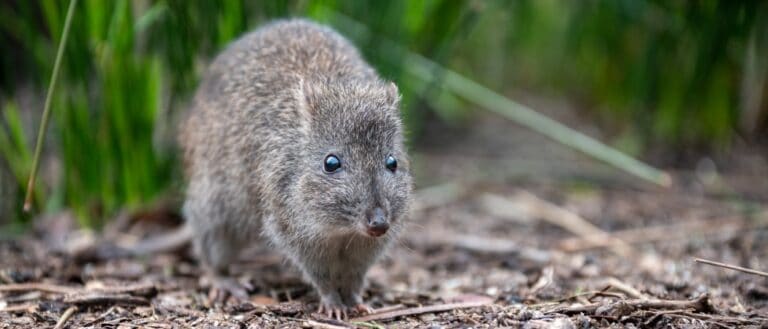
Gilbert’s potoroo is a small marsupial, about the size of a rabbit and covered in dense, dark brown fur. They are sometimes mistaken for quendas, but Gilbert’s potoroos have much softer fur and longer tails. These nocturnal animals live under thick shrubs and make tunnels underground to move around without being detected by predators. They live in small groups of around three to five individuals and eat a diet that is 90% fungi.
Why is the Potoroo Population Dwindling?
Only about 150 individuals remain in one location in the world: Mount Gardner in the Two Peoples Bay Nature Reserve in Western Australia. The species was discovered in 1840 but was thought to be extinct since the early 1900s. Reports at the time described it as “very common” due to habitat loss and the introduction of red foxes and feral cats to Australia. When the small marsupial was rediscovered in 1994, conservation efforts brought its population up to the current number of around 150.
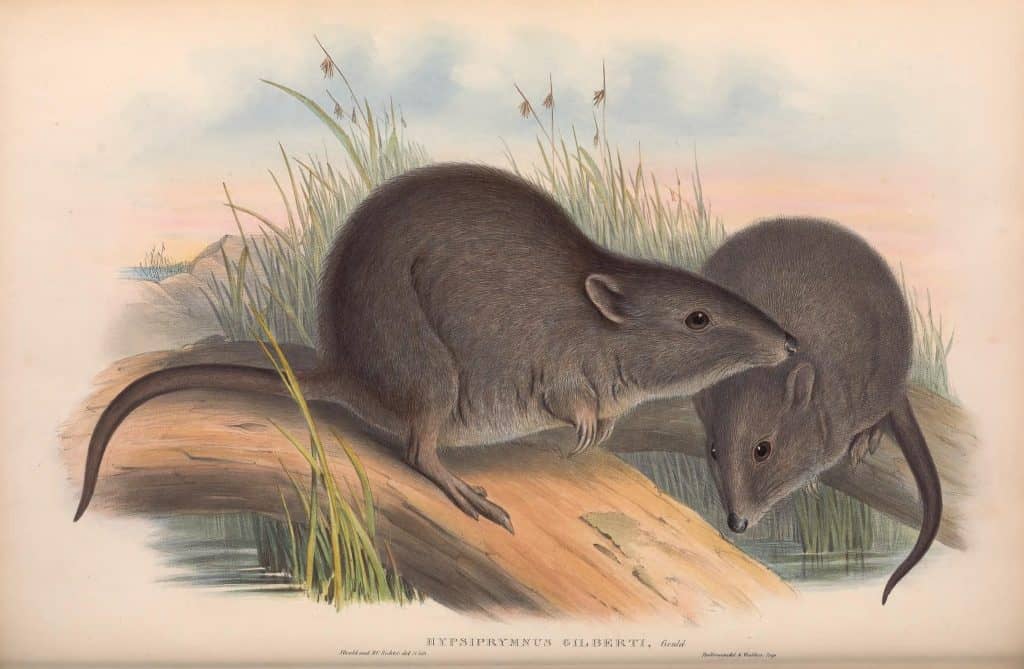
Gilbert’s potoroo was discovered in 1840, but habitat loss and invasive predators contributed to its decline.
© John Gould, Public domain, via Wikimedia Commons – Original
Unfortunately, Gilbert’s potoroo is still in a precarious situation. The area has suffered from bushfires, which wiped out 90% of the potoroo’s habitat in 2015. Further, the fungi, which are the potoroo’s favorite food, can only survive in unburnt areas of vegetation.
Finding New Homes for Gilbert’s Potoroo
It is risky for a species to live in only one location in the world. Conservationists fear that another severe fire could entirely wipe out the remaining population of Gilbert’s potoroo. If the species can be translocated to several different areas, their populations can continue to grow. In that case, if a wildfire or other catastrophe damages one habitat, backup generations in other locations will remain unaffected.
How Scat DNA is Saving the Species
The problem with moving Gilbert’s potoroo to different locations is their highly specialized diet of fungi. We know the potoroo eats fungi, but scientists are unclear about exactly what type and where it grows. Researchers published a study analyzing the DNA in Gilbert’s potoroo scat to understand their complex diet. Lead author Rebecca Quah said in a press statement, “Soon after their rediscovery, breeding them in captivity was tried, but that didn’t work out, particularly because of how picky they are with their food resources.”
She went on to explain, “Mycophagus — or fungi-eating mammal diets are quite hard to study because a lot of fungi remain undescribed.” Researchers collected a sample of potoroo feces and used a technique known as metabarcoding to investigate the marsupial’s diet by analyzing samples of environmental DNA (eDNA). According to Quah, “It’s a non-invasive way of studying diet and all you need are fresh scats from the environment.”
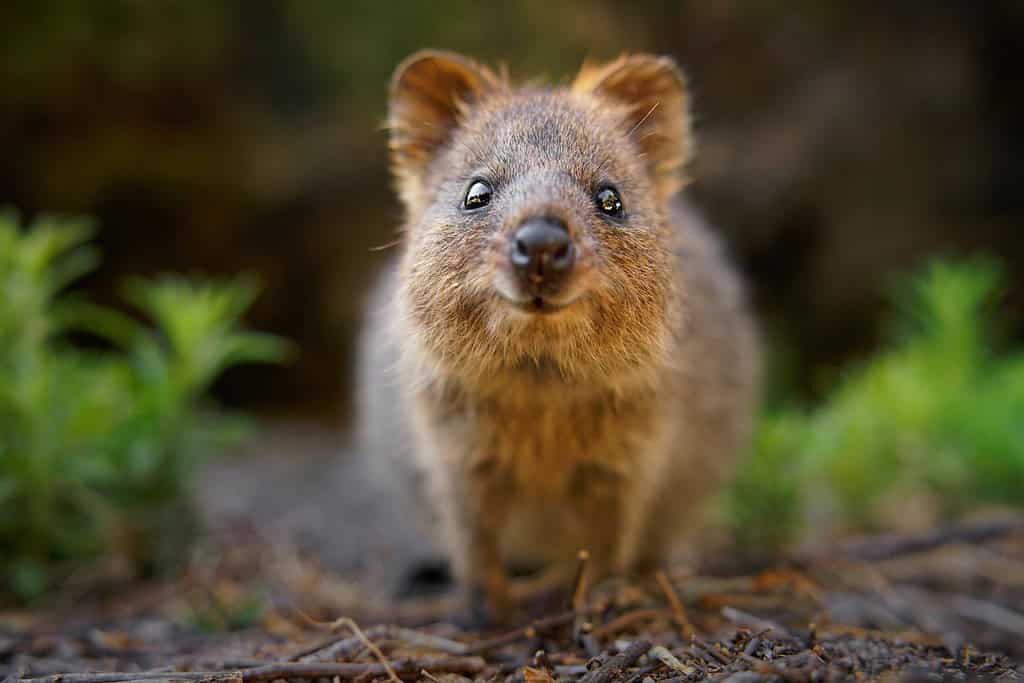
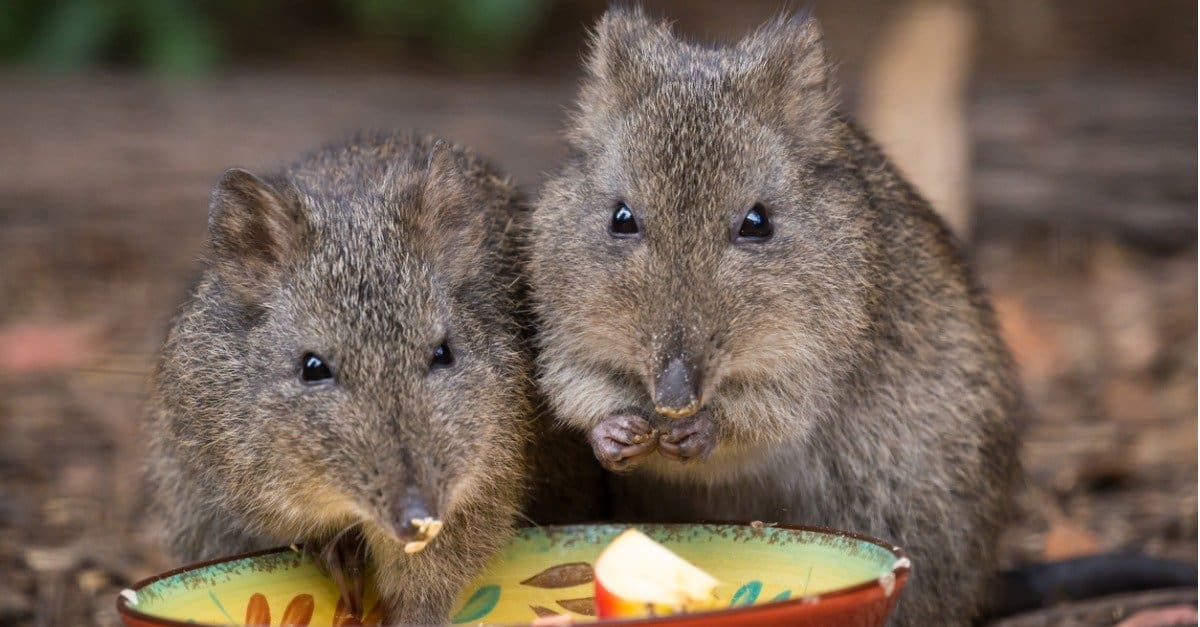
Scientists have found that quokkas have a similar diet to potoroos.
©Martin Pelanek/Shutterstock.com
The research team also compared potoroo scat to that of other similar fungi-eating animals: quokkas, quendas, and bush rats. What they found was incredibly helpful to conservationists making decisions on where to translocate the potoroos. Scientists discovered that these other fungi-eaters are consuming a similar diet to the potoroos. Quah said, “there was some overlap in the diet of the four mammals, and that habitat use between the quokka and potoroo were also really similar.” By focusing on habitats where the other three are currently thriving, conservationists can find suitable environments for Gilbert’s potoroo.
The Importance of Fungi-Eaters
Animals that dig up truffles to eat are known as mycophagous. They help the ecosystem in important ways. By digging in the ground, potoroos turn over soil and disperse fungi spores. Quoh explained, “Fungi have several ecological functions, including having mutually beneficial relationships with plants, so mycophagous mammals are really important in maintaining healthy ecosystems.” Now that more is understood about the diet of the potoroo, conservationists can move forward with translocating the species to other areas.