South America is home to a diverse amount of wildlife. From the Amazon rainforest to the arid deserts of Chile, South America has a variety of habitats and climates that make it one of the most biodiverse areas on the planet. South America is also home to a large variety of snake species, with new species being discovered all the time. But what are the largest snakes in South America? Let’s take a look at some massive (and fascinating) snakes that call South America their home.
10. Fer-de-lance (Bothrops asper)
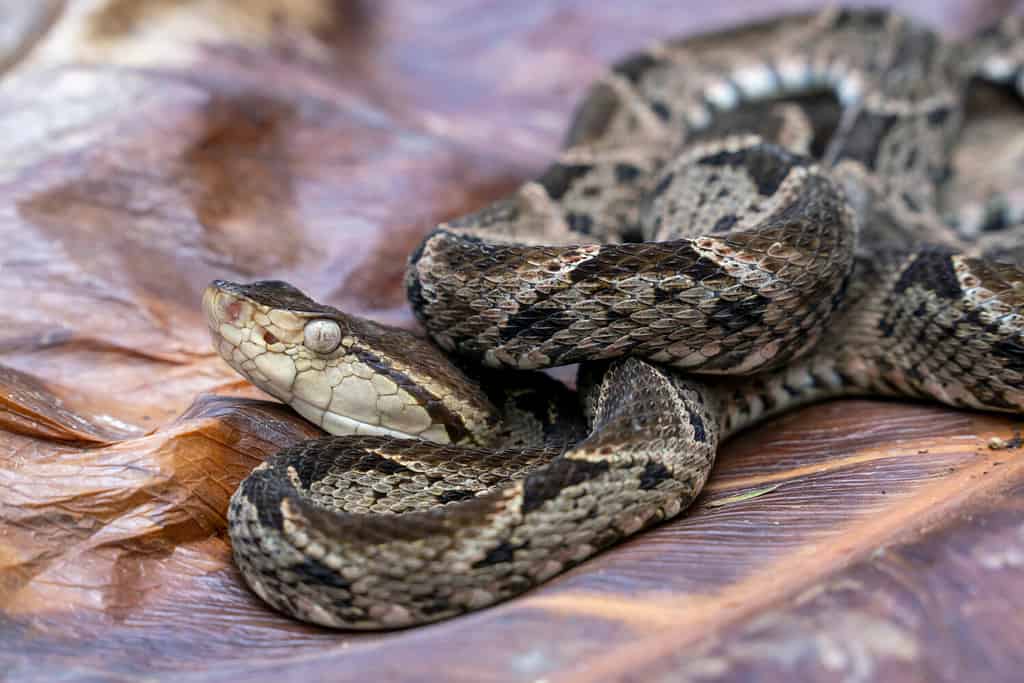
The venomous fer-de-lance is a fast-moving and territorial snake.
©Mark_Kostich/Shutterstock.com
The Fer-de-lance (Bothrops asper) is a venomous species of pit viper with an average length of about four to six feet, although some individuals can grow over eight feet. Fer-de-lances live in northwestern South America, where they are responsible for a large number of snake bites.
Because the fer-de-lance is a pit viper, it’s an ambush predator and stays hidden until it strikes. Pit vipers have heat-sensing pit organs located on their heads. These heat sensors allow the snake to sense its prey and strike quickly with very little warning. Although this snake is not looking to hunt humans, it will bite when threatened and is known as an “irritable snake.”
Its venom is highly potent, and bite symptoms may be severe, requiring immediate medical attention. The primary diet of fer-de-lances is rodents, frogs, and lizards. Fer-de-lances play an important role in the ecosystem by keeping rodent populations in check.
9. False Water Cobra (Hydrodynastes gigas)
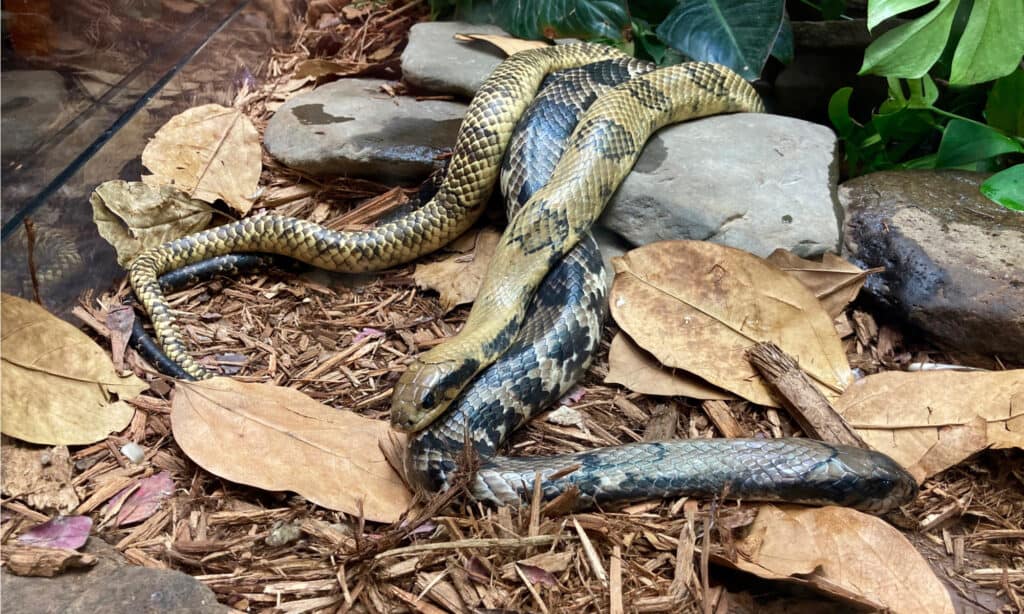
False water cobras are not true cobras but can flatten their necks to appear like one.
©Juli V/Shutterstock.com
The false water cobra (Hydrodynastes gigas), or Brazilian smooth snake, grows an average of six to seven feet but can reach lengths of up to 10 feet. The snake is not a true cobra but can flatten its neck to appear bigger, making it look cobra-like. This snake is semi-aquatic, living in tropical habitats of Brazil, Bolivia, Paraguay, and Argentina.
False water cobras are popular to keep as pets for snake hobbyists. However, care does need to be taken when handling, as false water cobras are venomous. Snake experts don’t recommend this species for beginners. Their venom is not as potent as the fer-de-lance but could cause painful symptoms. This snake plays an important role in its ecosystem as a predator of many types of animals, including fish, frogs, tadpoles, amphibians, reptiles, mammals, and birds. It hunts by constricting its prey and swallows it whole.
8. Amazon Puffing Snake (Spilotes sulphureus)
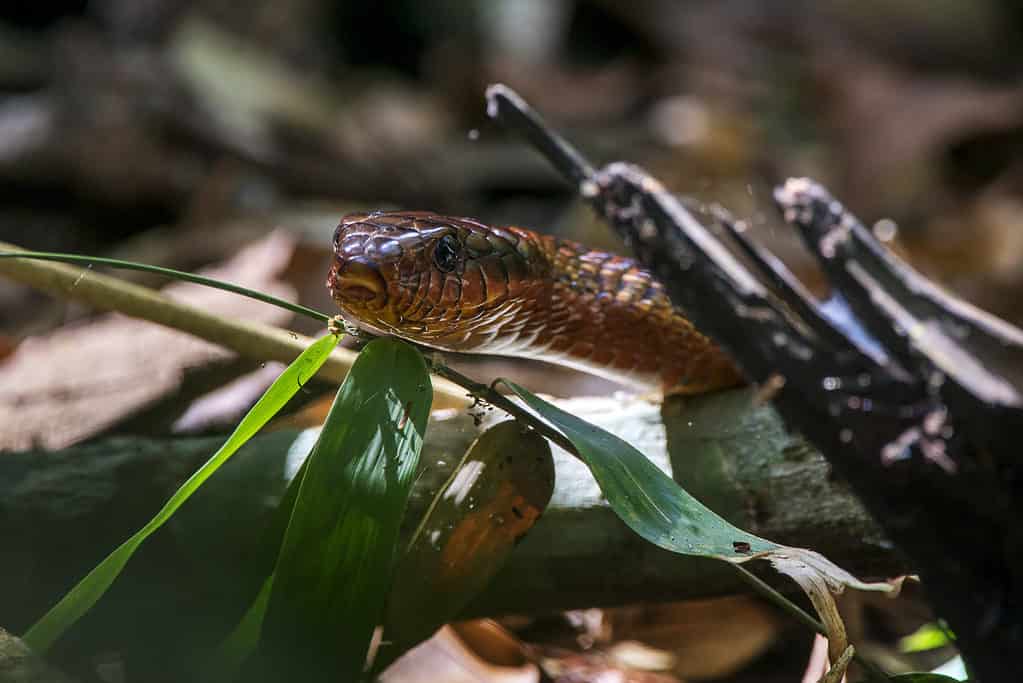
Amazon puffing snakes have two separate types of toxins in their venom.
©Leonardo Mercon/Shutterstock.com
Another of South America’s largest snakes is the Amazon puffing snake (Spilotes sulphureus), also known as the yellow-bellied hissing snake and giant bird snake. These large snakes can reach nearly 10 feet in length. Amazon puffing snakes can be found in trees or basking in the sun on the forest floor. They live in forests throughout South America.
Although Amazon puffing snakes are found throughout the continent, little research has been conducted on this species. They are venomous, but the venom is not strong enough to harm humans. Interestingly, research has shown that puffing snakes have two types of toxins in their venom. One type affects only birds and reptiles, while the other affects only small mammals. These snakes eat a wide variety of animals such as birds, amphibians, reptiles, and small mammals. They are popular as pets, but require large enclosures due to their size and are often bred in captivity.
7. Tiger Rat Snake (Spilotes pullatus)

Chicken snakes, or tiger rat snakes, have been known to grow as long as 14 feet.
©Danita Delimont/Shutterstock.com
Tiger rat snakes (Spilotes pullatus) are also known as chicken snakes or yellow rat snakes. These nonvenomous snakes average around 8 to 10 feet but can grow up to nearly 14 feet long. Their range includes southern Mexico, Central America, Trinidad and Tobago, and north to central South America.
They prefer to live in forested areas near water and may be spotted both in the trees and on the ground. Tiger rat snakes help the ecosystem by keeping down rat populations. They also eat bats, small birds, amphibians, and reptiles.
Tiger rat snakes have an interesting courtship ritual in which males vigorously shake their tails over females and follow them until the female bobs her head to signal agreement. Males may fight with other males for the right to mate with a female by entwining their bodies. The winner is the snake that keeps its head upright and higher than the other.
6. Dark-Spotted Anaconda (Eunectes deschauenseei)

Dark-spotted anacondas are one of the four species of anaconda.
©Public Domain – Original
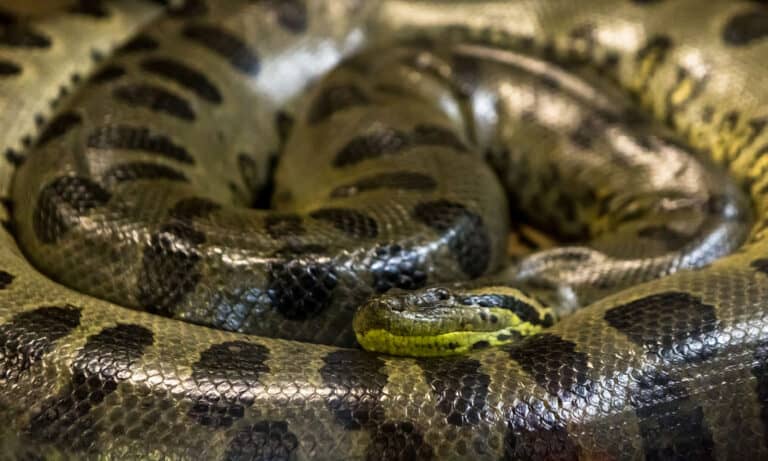
The most well-known type of anaconda species is the green anaconda (which we’ll talk about later). There are actually four different species of anaconda, all of which made our list of South America’s largest snakes. According to LiveScience, these four species are not only genetically different but also live in different regions and grow to varying sizes.
The dark-spotted anaconda (Eunectes deschauenseei) is one of the four anaconda species and can reach about 10 feet in length. Native to South America, dark-spotted anacondas can be found in Brazil and in French Guiana.
Anacondas are members of the boa family and are nonvenomous. Their eyes and nose are on the top of their head, meaning they can be almost fully submerged, floating down the river, but still aware of their surroundings and searching for prey. Dark-spotted anacondas are excellent swimmers and hunt their prey either in the water or from the tree branches above the river. Like all anacondas, dark-spotted anacondas are opportunistic feeders and eat a wide variety of animals, including fish, mammals, amphibians, and reptiles.
5. South American Bushmaster (Lachesis muta)
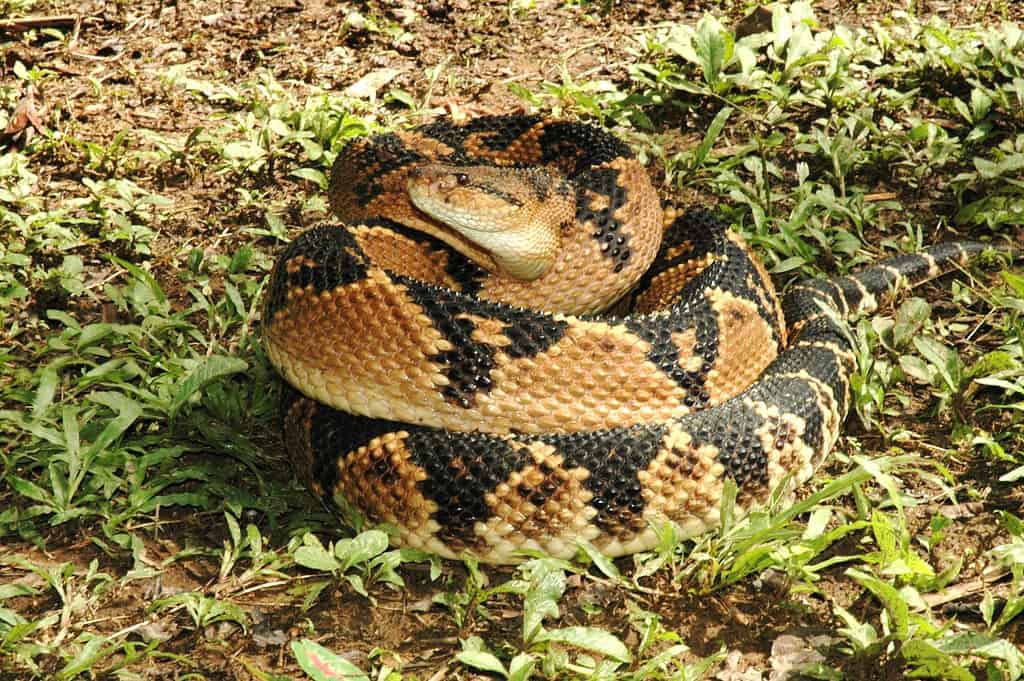
The South American bushmaster is a pit viper that hunts at night.
The South American Bushmaster (Lachesis muta) is a highly venomous pit viper with a bite so potent, it could kill a human. These large snakes grow an average of six to 12 feet long. The scientific name, “Lachesis,” means silent death, while “muta” is Latin for mute. When the bushmaster is threatened, it shakes its tail, much like a rattlesnake, as a warning. But unlike a rattlesnake, the tail shaking is silent.
If you find yourself in the path of a South American bushmaster, it’s best to get out of the way as soon as possible, preferably before the snake begins to shake its tail. The venom from this snake can cause a human severe pain, serious illness, and even death. Fortunately, there is an antivenom available that can neutralize the effects.
Despite its strong venom, the bushmaster prefers to avoid humans and will only attack if provoked or threatened. Bushmaster snakes eat a diet of rodents, small mammals, and other snakes. They’re one of the few snake species that protect their eggs, but the mother leaves the nest as soon as the hatchlings emerge.
4. Boa Constrictor (Boa Constrictor)

A boa constrictor can last for weeks without eating after having a large meal.
©Alfredo Maiquez/Shutterstock.com
Boa constrictors (Boa constrictor) might have a frightening reputation, but they are unlikely to attack a human. They grow to about 13 feet on average, with the longest ever recorded at 18 feet. Boa constrictors can be found throughout much of South America and the islands along the coast. They can live in a variety of habitats, including swamps, beaches, forests, and scrublands. Boa constrictors take shelter inside abandoned animal burrows or hollow logs. Like anacondas, boa constrictors are strong swimmers. However, they tend to be found on the ground more often than in the water.
These massive snakes eat a variety of mammals and birds, including monkeys, wild pigs, and rodents. They are ambush hunters, coming upon their unsuspecting prey without warning. They hold their victim with their sharp teeth and constrict to reduce blood flow, killing the animal by restricting blood to the brain rather than by suffocation.
3. Bolivian Anaconda (Eunectes beniensis)
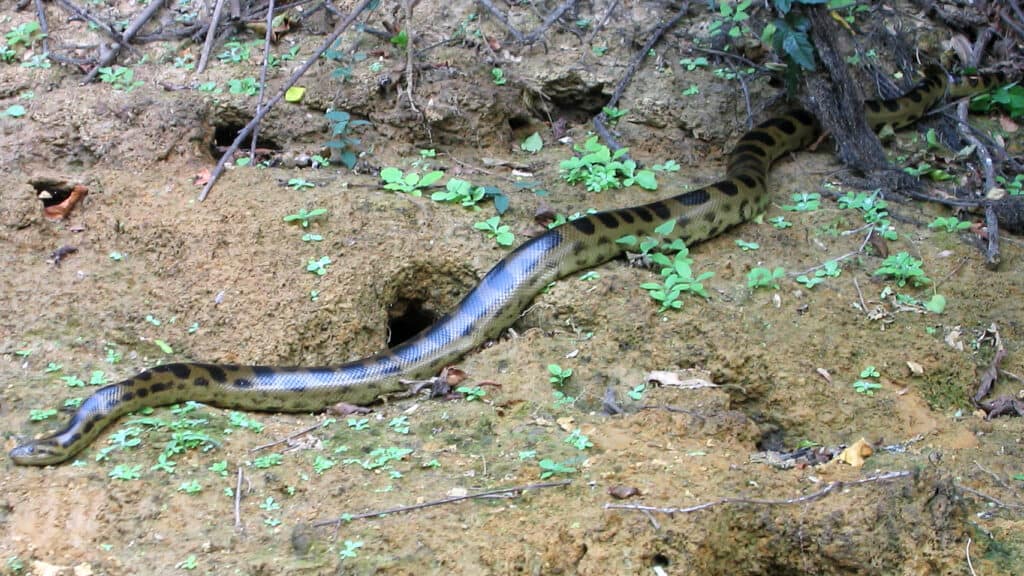
Bolivian anacondas have only been recognized as a distinct species in the past 20 years.
The Bolivian anaconda (Eunectes beniensis), or Beni anaconda, is one of the four species of anacondas. These large snakes can only be found in a small range in the northeastern region of Bolivia. This nonvenomous snake prefers wet habitats, including flooded areas, swamps, and the rainforest.
Bolivian Anacondas grow to around 14 feet long. This large snake has only been recognized as a distinct species of anaconda since 2002. Scientists used to think it was a hybrid between green and yellow anacondas until it was discovered to be its own species.
Not much research has been done about Bolivian anacondas, and there is much we don’t know. They eat a variety of animals, including fish, water birds, and caiman (a small species of crocodile). Bolivian anacondas may not have many predators, but they are often killed by humans. They may be hunted by humans for killing chickens and are also killed for their skin and fat.
2. Yellow Anaconda (Eunectes notaeus)

The largest yellow anaconda ever recorded weighed 110 pounds.
©MattiaATH/Shutterstock.com
The yellow anaconda (Eunectes notaeus), also known as the Paraguayan anaconda, can grow up to 15 feet long. They are mainly found around the Paraguay River and its tributaries in Bolivia, Paraguay, northern Uruguay, western Brazil, and northeastern Argentina. The nonvenomous snake prefers aquatic environments and can be found in marshes, swamps, streams, and slow-moving rivers.
A few yellow anacondas have been found in the wild in Florida, where they were likely released pets. Florida Fish and Wildlife considers them an invasive species, and they are a banned pet in Florida. If yellow anacondas were to become established in Florida, they could harm the ecosystem. They eat a large variety of food, including rodents, birds, turtles, caiman, and fish.
Yellow anacondas are not a threat to humans, despite their impressive size. They will try to flee from threats and only defend themselves if necessary.
1. Green Anaconda (Eunectes murinus)

Green anacondas are the heaviest snakes in the world and can weigh 550 pounds.
©slowmotiongli/Shutterstock.com
Finally, we come to the largest (by weight) snake on our list, and in the world. The green anaconda (Eunectes murinus) is the species most people think of when they hear the word “anaconda.” Scientists have only recently divided the green anaconda into two species. This is the green anaconda (Eunectes murinus) and the northern green anaconda (Eunectes akayima).
The average size of green anacondas is around 15 feet, but they can grow up to 20 or even 30 feet long. It’s not the longest snake in the world, but it is the heaviest. These massive snakes can weigh over 550 pounds. They can be found in aquatic areas, like tropical rainforests, marshes, and slow-moving rivers of the Amazon and Orinoco basins, mainly in northern South America.
The large size of green anacondas means they need to eat large animals to sustain themselves. Green anacondas hunt for a variety of mammals, including wild pigs, turtles, capybara, caimans, and even jaguars. Despite their size and scary reputation as depicted in the movies, green anacondas are not a threat to humans. The biggest threats they face are habitat destruction and being hunted for their skin.