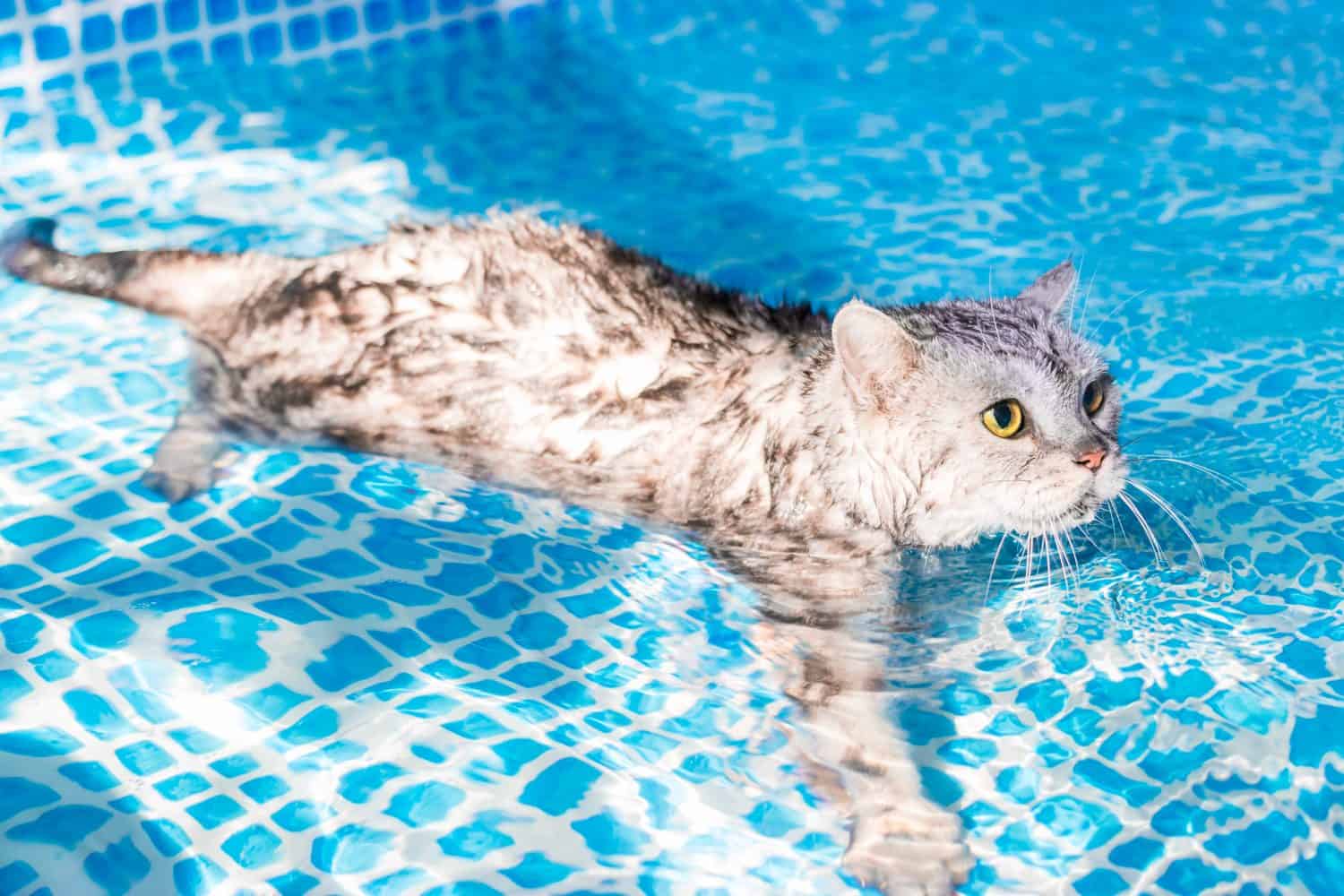

Everyone has heard that cats hate water, but do they really? The statement is a generalization that assumes all cats are the same. However, cats are individuals. Some cats avoid water, while others love it, as shown in this YouTube video. This plucky cat dives right off the side of the boat and begins swimming like an otter, paddling away with its front and back paws. While not every cat is a feline version of Michael Phelps, all cats can swim. So, if they can all do it, why are we so surprised to see it?
Cats and Water Do Mix
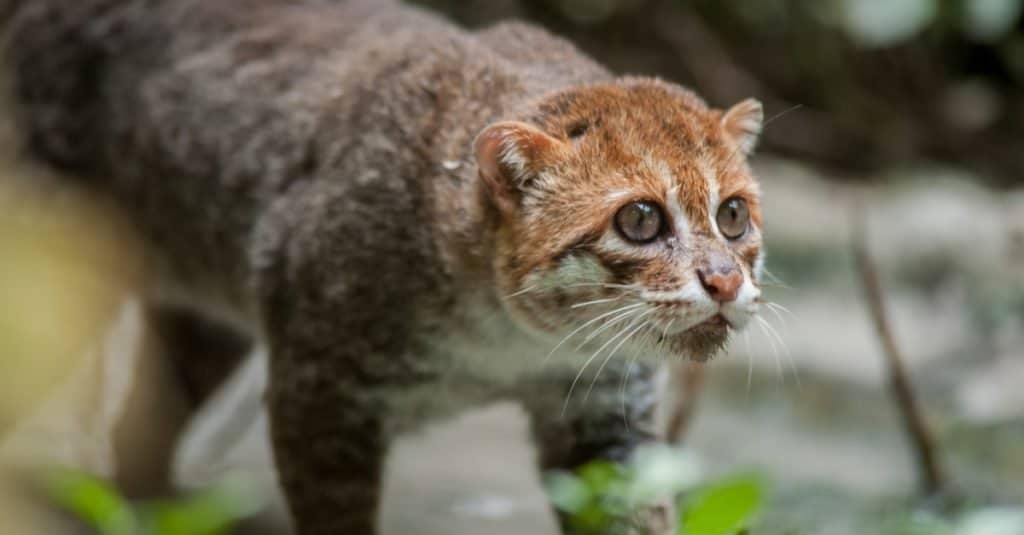
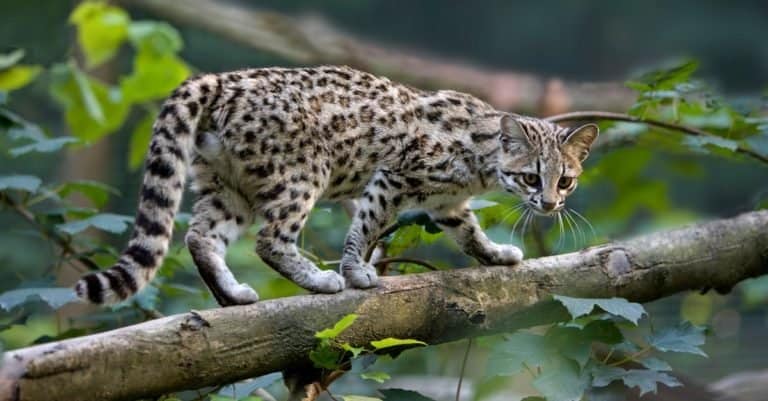
The flat-headed cat’s characteristics and behavior resemble those of semi-aquatic mustelids such as otters.
©Signature Message/Shutterstock.com
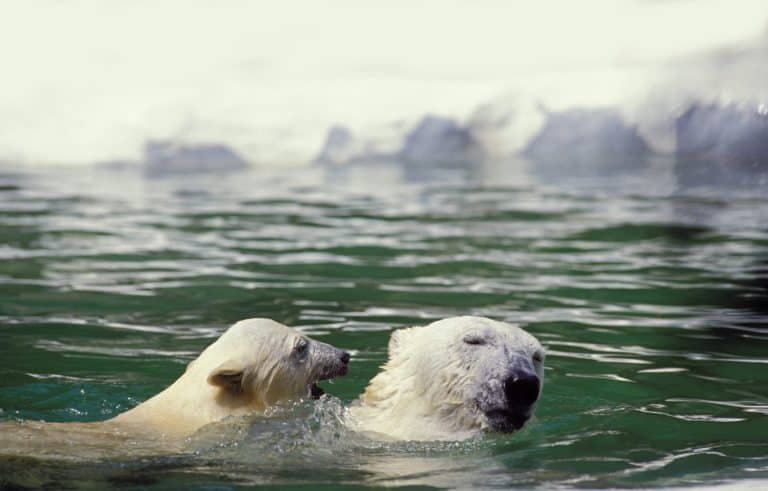
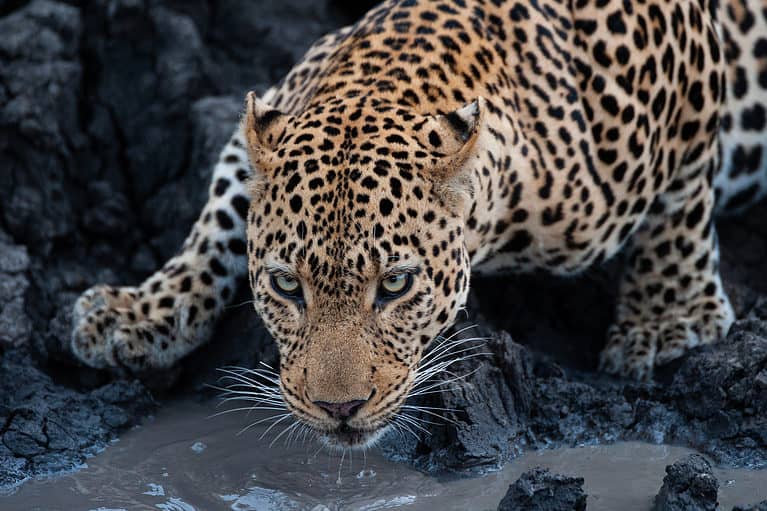
Although their common ancestor lived approximately 10 million years ago, domestic cats and their big cat cousins share several physical and behavioral characteristics. Genome sequencing revealed that house cats and Amur tigers (Panthera tigris altaica), also known as Siberian tigers, actually share 95.6% of their DNA. Another thing domestic cats and big cats share is partially webbed paws. More surface area means they can push more water and propel themselves more efficiently. Tigers, along with jaguars and leopards, are excellent swimmers. Tigers frequently enter the water to cool off, play, or hunt. As the largest of the big cats, tigers’ powerful, muscular bodies can quickly overheat, making access to water a necessity.
There are also smaller wild cats that have adapted to a semi-aquatic lifestyle. The fishing cat (Prionailurus viverrinus) and its relative, the flat-headed cat (Prionailurus planiceps) live in the wetlands and flood plains of Southeast Asia. The fishing cat is about twice as large as a domestic cat. It has partially webbed paws and a thick, layered coat that provides both insulation and water-resistance. The flat-headed cat is about the same size as a domestic cat. Its paws are more flipper-like, and, as the name suggests, it has a flatter head, making it more streamlined in the water. Both cats feed on aquatic animals, although the flat-headed cat’s diet is almost exclusively fish.
Domestic Cats That Like Water
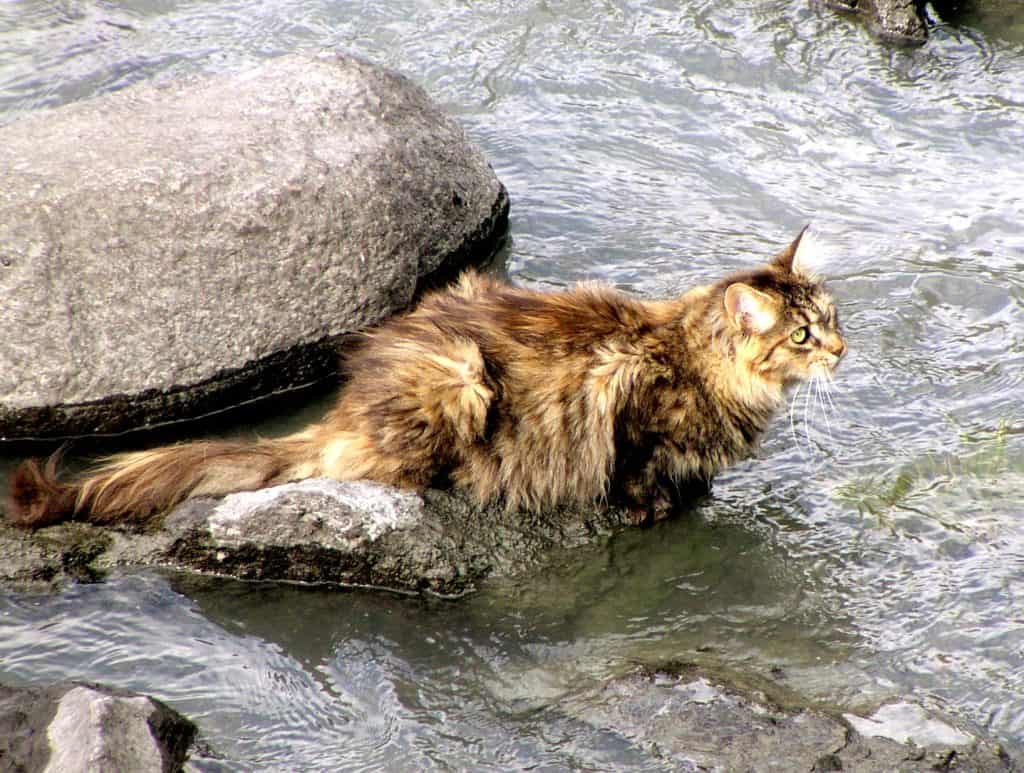
Unlike most domestic cats, Norwegian forest cats have an affinity for water.
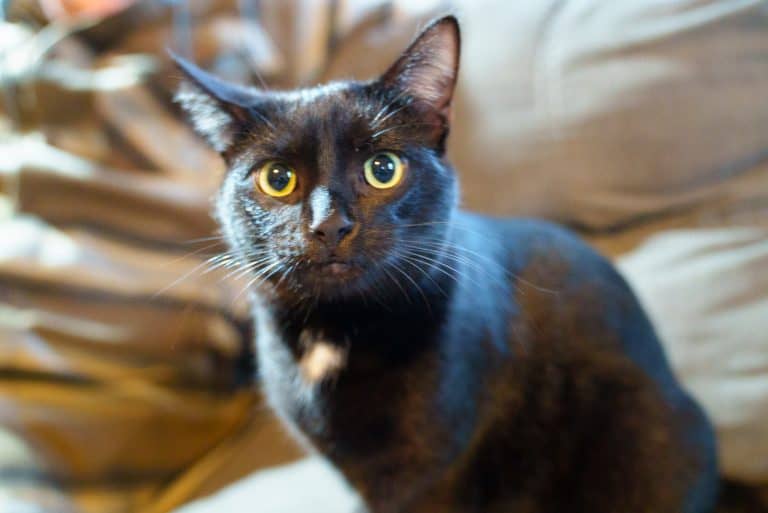
Like their wild cousins, domestic cat breeds also have adaptations that give them advantages in the water. Turkish vans, Maine coons, and Norwegian forest cats are known to be fond of water. These breeds have thick, water-resistant coats that provide them with insulation and keep them from getting waterlogged. Bengal cats also love to swim. They have more prominent webbing between their paws that aids their movement in water. Turkish angoras, Egyptian maus, Abyssinians, and Manxes also have an affinity for water. The cat in the video appears to be a Russian blue mix or a British shorthair, both of which have dense double coats that offer some protection from the water.
Big cats such as tigers can swim distances of around 5 miles. Although domestic cats are agile, flexible, and have strong limbs, they were not designed to be powerful swimmers. Veterinarians warn that they can generally swim only short distances. Also, cats can swim further in a pool than in a river or lake, where they might have to fight currents. The duration depends on the cat’s age and overall condition. However, if a cat shows signs of stress, such as meowing loudly, rapid breathing, or clawing to escape, remove it from the water immediately.
Even cats that dislike being submerged may play in the water in their environment. Experts believe the movement and sound of the water in the sink or shower stimulates their prey drive. Some cats even demand that their owners turn on the faucet for them. Cats often splash in their water bowls or drop their toys in the water. This behavior may be due to curiosity, a desire to test the water’s cleanliness, or simply for amusement.
Why Do Cats Avoid Water?
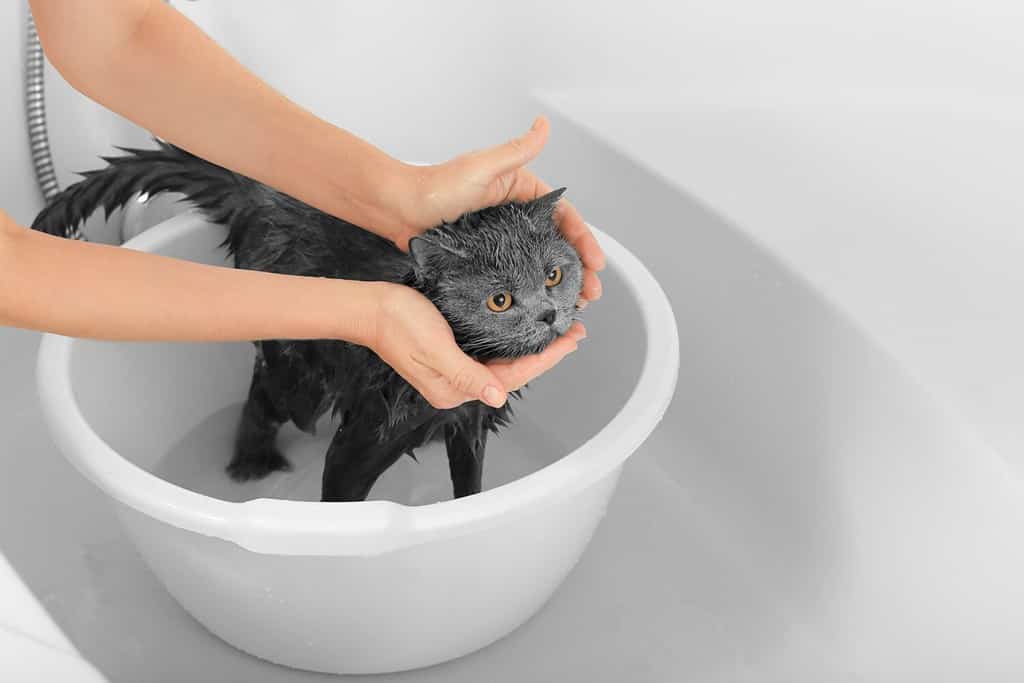
Experts believe one reason cats dislike water is that they were not conditioned to bathing as kittens.
©Zulkarnieiev Denis/Shutterstock.com
Of course, playing in the water is much different than going for a swim. Behaviorists believe one reason most cats avoid water is that they have not been conditioned to bathing, unlike dogs. Cats may be curious, but they are also typically averse to unfamiliar situations where they are not in control. Some speculate that, because domestic cats are directly descended from wild cats in desert climates, they do not naturally gravitate toward water. Cats also use scent to communicate, so they may be reluctant to wash off their scent.
Experts also note that cats have whisker-like hairs on their bodies that provide important sensory information about the environment. Getting their fur and whiskers wet may interfere with the way they perceive their surroundings. Furry mammals also rely on the air in their fur for insulation. Wet fur is not only uncomfortable, but it can also leave cats vulnerable to cold, as their average temperature is between 100.5–102.5.