
Quick Take
- A single broken tooth lodged in a dinosaur's skull told paleontologists something about the attack that bite marks alone never could. See how the tooth was identified →
- The way this Edmontosaurus was positioned when the T. rex struck changes how scientists think a prey animal would respond to the world's most fearsome predator. Explore the face-forward encounter →
- Forensic CT scans of a 66-million-year-old wound narrowed the final moments of this creature down to just two possible scenarios, and both are unsettling. Read the two final scenarios →
- This fossil quietly adds evidence to a debate that has divided paleontologists for decades, though it doesn't settle the argument the way most would expect. Follow the hunter-scavenger debate →
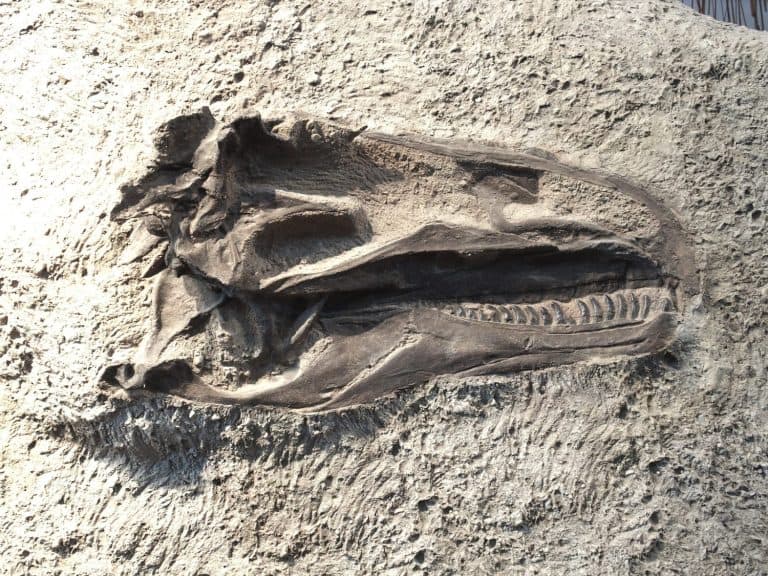
Visitors to the Museum of the Rockies in Montana are greeted by a fossil unlike most others. Nestled in the Hall of Horns and Teeth, an Edmontosaurus skull has become a window into a dramatic prehistoric encounter, thanks to an extraordinary feature, a tyrannosaur tooth embedded in the bone of its face.
Continue reading
This specimen isn’t just a relic. It’s the focus of a recent study led by Montana State University and researchers from the University of Alberta in Canada. For paleontologists, it’s a rare chance to connect the dots between predator and prey, moment by violent moment.
The Last Encounter in Ancient Montana
Around 66 million years ago, what is now eastern Montana teemed with giants. Tyrannosaurus reigned supreme, sharing the landscape with the horned Triceratops and the massive, plant-eating Edmontosaurus. It was in this setting, more specifically, the Hell Creek Formation, that researchers made a stunning discovery in 2005: a nearly complete Edmontosaurus skull on land under the care of the Bureau of Land Management.
While bite marks from carnivorous dinosaurs aren’t unusual, the find stood out immediately. As University of Alberta doctoral student Taia Wyenberg-Henzler explained, “Although bite marks on bones are relatively common, finding an embedded tooth is extremely rare.” That rare signature allowed the research team to act almost like detectives, matching evidence to its perpetrator.
Unraveling a Cretaceous Crime Scene
Having a tooth lodged in bone tells a clear story, according to Wyenberg-Henzler: “The great thing about an embedded tooth, particularly in a skull, is it gives you the identity of not only who was bitten but also who did the biting. This allowed us to paint a picture of what happened to this Edmontosaurus, kind of like Cretaceous crime scene investigators.”
The team compared the tooth with those from every known meat-eating dinosaur in the Hell Creek Formation. Their conclusion was unmistakable: Tyrannosaurus itself had broken off this tooth in the Edmontosaurus. Modern CT scans at Bozeman Health Deaconess Hospital revealed the depth and orientation of the tooth, shedding light on how the attack unfolded.
For John Scannella, curator of paleontology at the Museum of the Rockies, the fossil goes beyond ordinary discovery. “A fossil like this is extra exciting because it captures a behavior: a tyrannosaur biting into this duckbill’s face.” The scene, preserved for millions of years, is more than just evidence of a meal, it’s a record of an ancient struggle with a clear cast of characters.
A Glimpse of the First and Last Moments
No signs of healing appear around the bite wound, a fact that narrows down what might have happened in those last seconds. According to Scannella, this freshness of the wound suggests two possibilities: Edmontosaurus could have died from the bite itself or might already have been dead when the tyrannosaur delivered its blow. In either scenario, the fossil captures a turning point, a life interrupted or ended by a top predator.
Wyenberg-Henzler offered further insight: “Looking at the way the tooth is embedded in the nose of the Edmontosaurus suggests that it met its attacker face-to-face, something that usually happens to an animal that was killed by a predator.” She added that the force needed to snap off a tyrannosaur tooth in bone would have been tremendous, underscoring the violence of the encounter. “For me, this paints a terrifying picture of the last moments of this Edmontosaurus.”
What One Fossil Can Reveal About an Ancient Predator
For years, paleontologists have debated whether Tyrannosaurus was simply a scavenger or an active hunter. Each new fossil discovery adds a piece to the puzzle. This Edmontosaurus skull, with its embedded tooth, preserves not just anatomy but a story of conflict and power.
Encounters like these, caught mid-act by geological chance, remind us how much ancient bones can reveal. Sometimes, a single tooth is all it takes to change how we imagine the world of the dinosaurs.