In the intricate world of insects, few creatures capture the imagination quite like the flatid planthopper waxy nymph. These tiny, sap-sucking insects are more than just delicate figures that look like popcorn on a leaf; they are complex marvels of evolution, outfitted with bizarre, beautiful, and scientifically fascinating waxy decorations. These insects are not to be confused with other insects surrounded in white. The flatid planthopper waxy nymph is the product of millions of years of adaptation, fine-tuned for survival, stealth, and, surprisingly, even flight-like maneuverability.
The Disguise

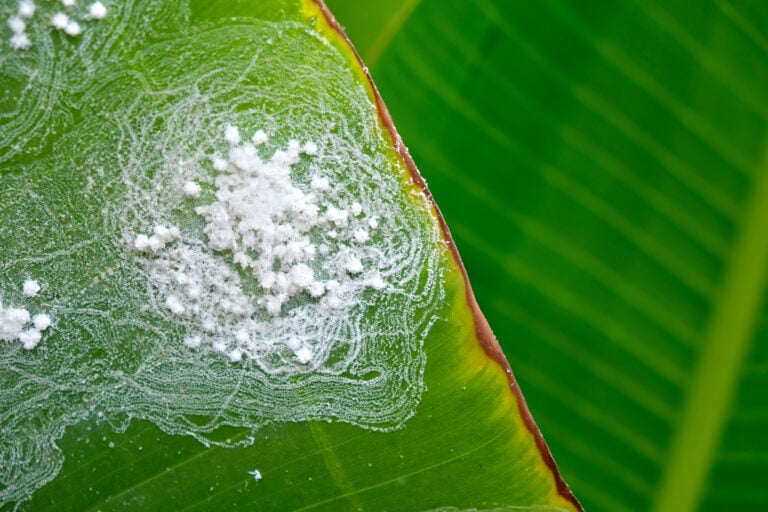
The flatid planthopper waxy nymph looks like a walking piece of popcorn.
©Vinicius R. Souza/Shutterstock.com
The flatid planthopper nymph is a small insect easily recognized by its cotton-like white fluff, a waxy secretion that covers its body. Found in warm and tropical climates across the globe, many flatid planthopper species overwinter as eggs inserted into plant stems by adult planthoppers. In spring, these eggs hatch and the nymphs emerge, ready to feed, grow, and eventually molt into adult planthoppers that remain active throughout summer and into early autumn, though specific life cycles can vary by species and region. But before reaching maturity, these nymphs possess an evolutionary secret weapon: their fluffy wax tails.
Why the Wax?

These insects rely on this layer to repel water on the outside and retain moisture on the inside.
©NuayLub/Shutterstock.com
At first glance, it might seem counterintuitive for an insect to coat itself in an extravagant wax structure, but the benefits are both clear and multifaceted. Wax plays a vital role in every insect’s survival, forming a thin, protective layer over the exoskeleton. The insects rely on this layer to repel water on the outside and retain moisture on the inside, which is an essential balance for such small creatures vulnerable to dehydration.
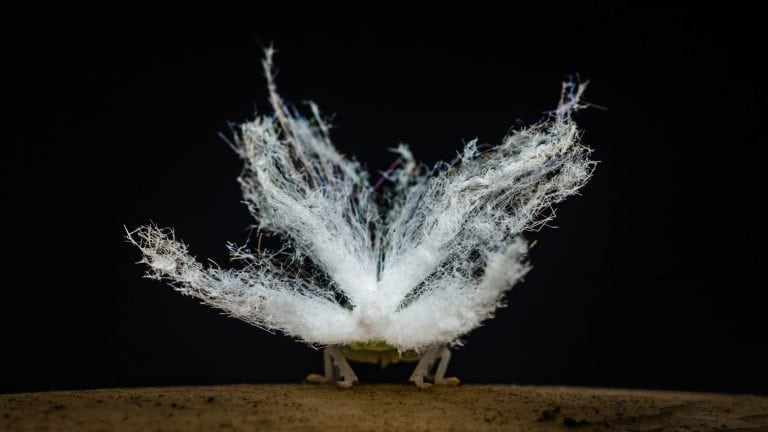
Some insects, like the planthoppers, take it a step further. They go all in. Specialized glands produce elaborate waxy filaments, tufts, and plumes that extend beyond the insect’s body, forming dramatic shapes. The wax decorations serve several purposes. Most importantly, they act as camouflage, helping the nymph blend into the white mold or cottony fibers commonly found on host plants. However, the benefits don’t end there.
Jumping to Safety

The waxy tails of the planthoppers function like tiny parachutes or flight surfaces.
©Jitender kumarj/Shutterstock.com
When threatened, the flatid planthopper nymph can launch itself into the air in a dramatic escape jump, using its strong hind legs to clear impressive distances relative to its body size. It turns out that those fluffy wax tails play a surprising role in this escape. Recent research into the jump trajectories of nymphs with intact wax structures revealed something unexpected. At lower take-off velocities, their aerial path resembles a typical arc. But as the velocity increases, the nymphs’ flight paths shift into what researchers describe as a shape associated with more stable, self-correcting descent. The wax structures act as aerodynamic stabilizers, helping the insect self-right in midair and land with control. This suggests the waxy tails function like tiny parachutes or flight surfaces, offering midair steering and balance. In essence, they allow a wingless insect to achieve controlled aerial movement.
Feeding Time

The waxy nymphs’ feeding behaviors can sometimes put them at odds with gardeners and farmers.
©Vinicius R. Souza/Shutterstock.com
Beneath their fluffy exterior, planthopper nymphs are remarkably efficient feeders. Their mouthparts are highly specialized, featuring a long, needle-like structure capable of piercing plant tissue and drawing up the sugary sap that flows through phloem vessels. It’s a diet rich in carbohydrates but low in other nutrients, which means planthoppers must consume a lot to live. This excess intake results in another byproduct called honeydew, a sticky substance often left behind on leaves. These feeding behaviors can sometimes put planthoppers at odds with gardeners and farmers, particularly when large populations gather on a single plant. However, in most ecosystems, their presence is part of a balanced food web, providing prey for birds, spiders, and other predatory insects.
Wax On

Unlike human grooming habits, planthoppers don’t remove their wax.
©Young Swee Ming/Shutterstock.com
They continually produce and add to the wax as they grow. These structures shift slightly with each molt, becoming more elaborate with every developmental stage. While some of their waxy counterparts in other insect families form dome-shaped coverings or protective shells, the flatid planthopper nymph’s tail-like filaments are among the most dramatic, giving it an almost magical appearance. From a functional perspective, the “never-off” approach to wax coating makes sense. The wax is lightweight, doesn’t hinder movement, and provides numerous benefits, ranging from moisture retention to predator evasion to mid-air stabilization.
Conclusion

The waxy decorations are not just beautiful curiosities; they are multifunctional tools for the planthopper.
©Vinicius R. Souza/Shutterstock.com
The flatid planthopper nymph may only be a few millimeters long, but it offers a world of insight into the intersection of form and function. We are learning more and more about these little popcorn pieces look-alikes, and discovering that what appears to be ornamentation is often sophisticated engineering. In the world of insects, the planthopper nymph stands as a tiny testament to how nature transforms the strange into the sublime.