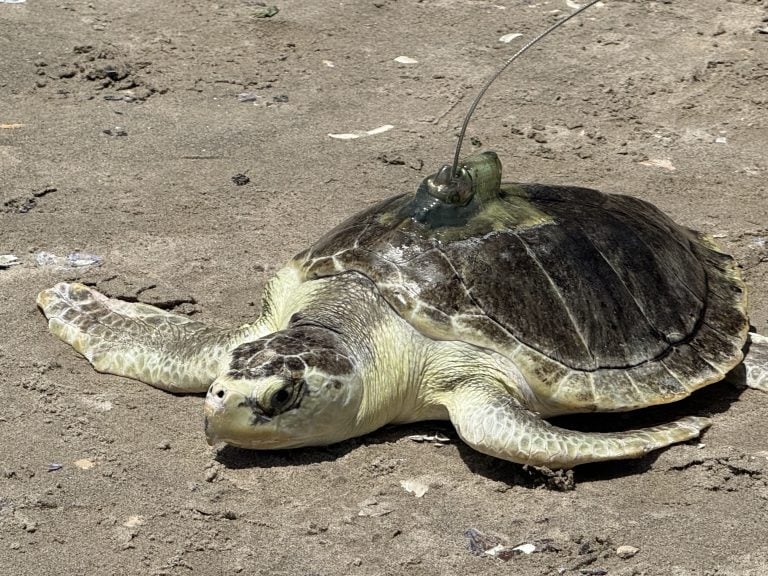
In this wonderful Instagram post, you get to see a very rare creature. It is a pale yellow or cream sea turtle, and, what’s more, this one has survived long enough to grow to a good size. Take a look at this gorgeous creature, then read on to discover why it has this unique coloration and to learn more about its life.
Why Is This Sea Turtle Yellow/White?
The turtle in this clip has a condition called leucism and would have been born with it. No one knows exactly how many sea turtles hatch with leucism, but it is thought to be very rare. Only a few cases are reported each year. Leucism is often mistaken for albinism, and while they both involve melanin (which gives an animal its normal color), they are not the same thing.. In albinism, there is a complete lack of these pigments due to the absence of an enzyme called tyrosinase. In leucism, however, the melanin-producing cells themselves are absent. Albino animals have no pigment at all and have red or pink eyes. As you can see in this clip, the turtle has black eyes and a small amount of pigment.
Surviving at Sea
Life is hard for a regular baby sea turtle, let alone one with leucism. Assuming that they make it from their beach nest to the sea, very few (estimates range from 1 in 1,000 to 1 in 10,000) survive to adulthood. They rely on their green coloration to evade predators, but this individual would have stood out. Hiding under green seaweed is not a great plan when you are bright yellow! Once sea turtles reach maturity, as this one clearly has, they face fewer predators. You can tell from this one’s size that it is a mature adult. Sadly, leucistic turtles are more likely to have other malformations, such as deformations of their carapace (shell), which can reduce their survival chances.
Who Is Hitching a Ride?
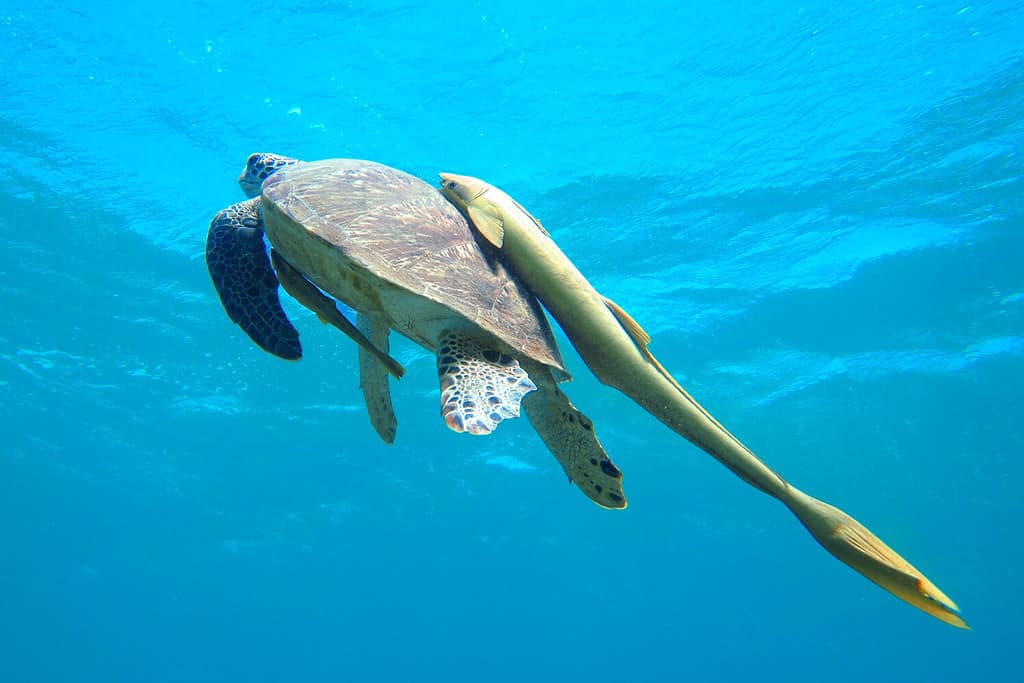
Remora fish hitch a ride with larger sea creatures.
©Nicram Sabod/Shutterstock.com
You can’t help but notice the fish that seem to be hitching a ride with the sea turtle. These are remoras, and they commonly rest on the shells of sea turtles and other larger ocean creatures such as sharks. This is a symbiotic relationship, which means that both creatures get something out of it. The remora fish gets a ride and has to put in less energy to move around while being protected. In return, they pick parasites and dirt from the sea turtle’s shell, so the turtle gets a free cleaning session. Sometimes, the remora pushes the relationship too far by trying to snatch some food from the turtle, but the turtle quickly puts it back in its place with a shove of its flippers.