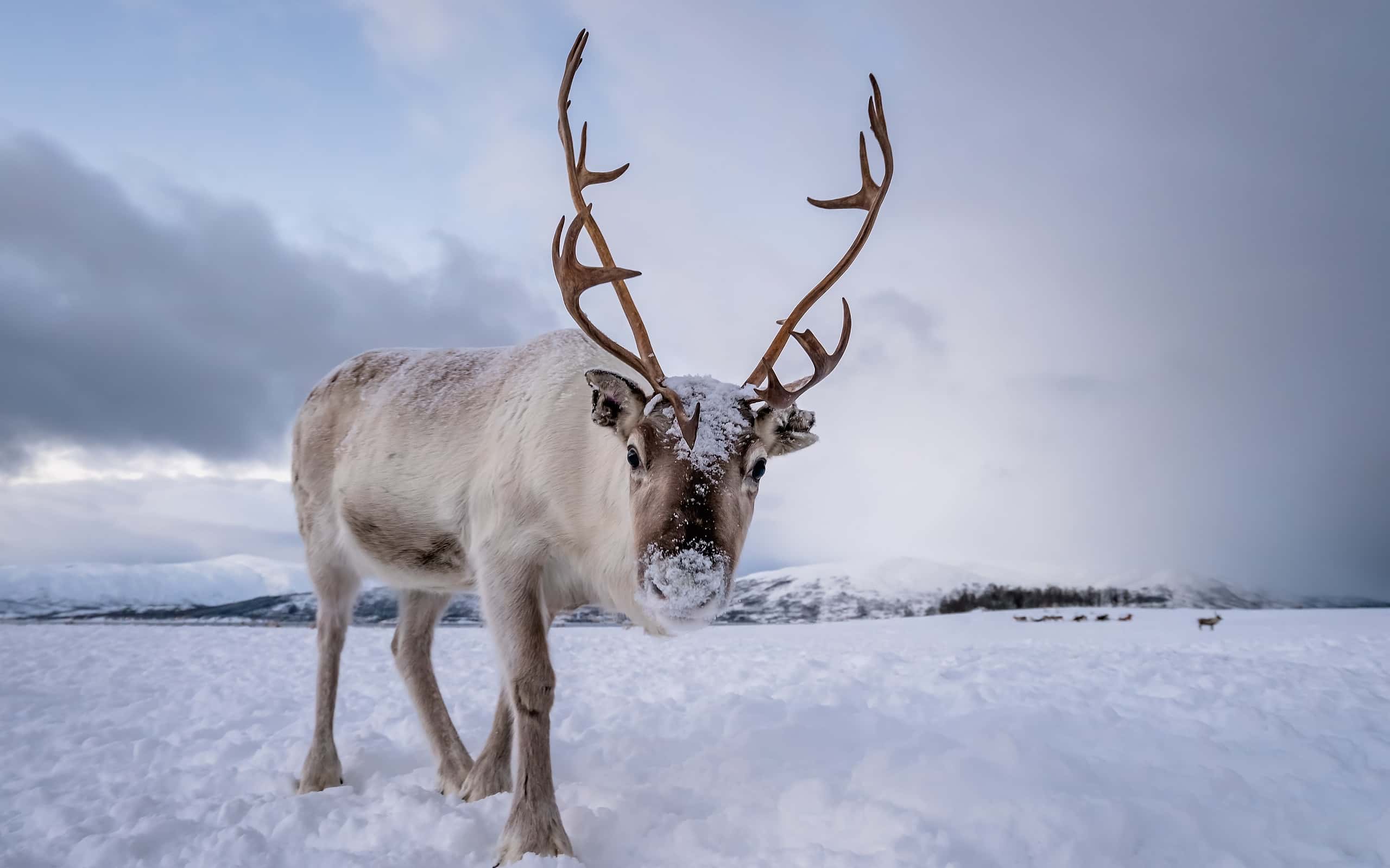

The world is full of animals that tough it out in some of the planet’s harshest environments. While humans prefer the toasty interior of a warm home, wildlife defies the odds by surviving conditions that we could not. Reindeer reign supreme in the Arctic when it comes to rising to this challenge. Not only do they outlast winter’s merciless clutches, but they thrive in its frigid temperatures.
From them, we can learn about perseverance and endurance. However, we can also learn how Mother Nature equips the luckiest of her brood with the tools to survive. In the Arctic tundra, reindeer don’t just outlast every other animal—they overcome.
How Does a Reindeer’s Physiology Help It Survive?
At first glance, reindeer seem nothing more than a holiday icon. They’re portrayed on every postage stamp, included in kids’ cartoons, and are the stars of Rudolph. Beneath it all, there’s a reason why reindeer are traditionally depicted as the only animals capable of pulling Santa’s sleigh. Reindeer are gifted in more ways than one, and that includes their physical anatomy. Without their winter-proof traits, reindeer wouldn’t have a chance of surviving in the Arctic or similar harsh environments.
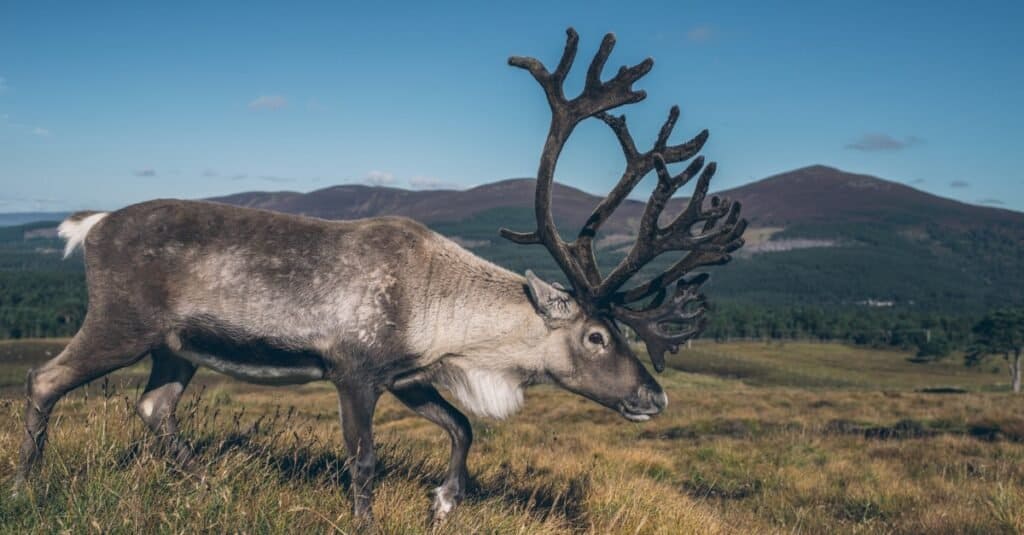
Reindeer, also known as caribou, have strong bodies that are well insulated in winter.
©doliux/Shutterstock.com
The sound of a reindeer’s hooves may have left an impression on everyone reading The Night Before Christmas, but these are an essential part of a reindeer’s genetic makeup. Their hooves resemble those of a horse but are larger and wider, which helps distribute their weight more evenly on snow. In the snow, these splayed hooves are intended for snow travel. This adaptation prevents them from sinking deeply into the snow, allowing reindeer to move across winter terrain more easily. When the season is at its coldest, these hooves also grow harder. A sharp rim protrudes along the outside, providing traction and helping them dig for food.
Built-In Insulation and Natural Defense
As for staying warm, a double-layered coat keeps reindeer insulated. Their undercoat is dense enough to retain heat, while a longer, coarser coat protects them from moisture and the elements. The hairs on this coarse coat are also hollow, which helps them stay afloat in icy water. This is a crucial part of their anatomy that often means the difference between life and death when crossing frozen waterways.
Male and female reindeer have different adaptations that help them survive the winter. While a male’s antlers shed after the summer, females keep theirs. This allows females to defend themselves and their food sources during the harsh winter months. If they are separated from their herd, these antlers serve as one of the first lines of defense against predators such as wolves and other foraging animals.
What’s Happening Inside a Reindeer’s Body?
While its physical features are impressive, the internal workings of a reindeer’s body are even more fascinating. Their fur protects them in sub-zero temperatures, while their hooves keep them upright. But what happens to their bodies between the two? As it turns out, a specialized circulatory system keeps them well-heated. It’s called a countercurrent heat exchanger, and it circulates blood through their legs.
This forces the heat to be recycled, taking the strain off their pumping hearts. Oleic acid in their legs acts as a natural antifreeze, helping to prevent frostbite. While their feet remain just above freezing, their upper bodies are typically much warmer.
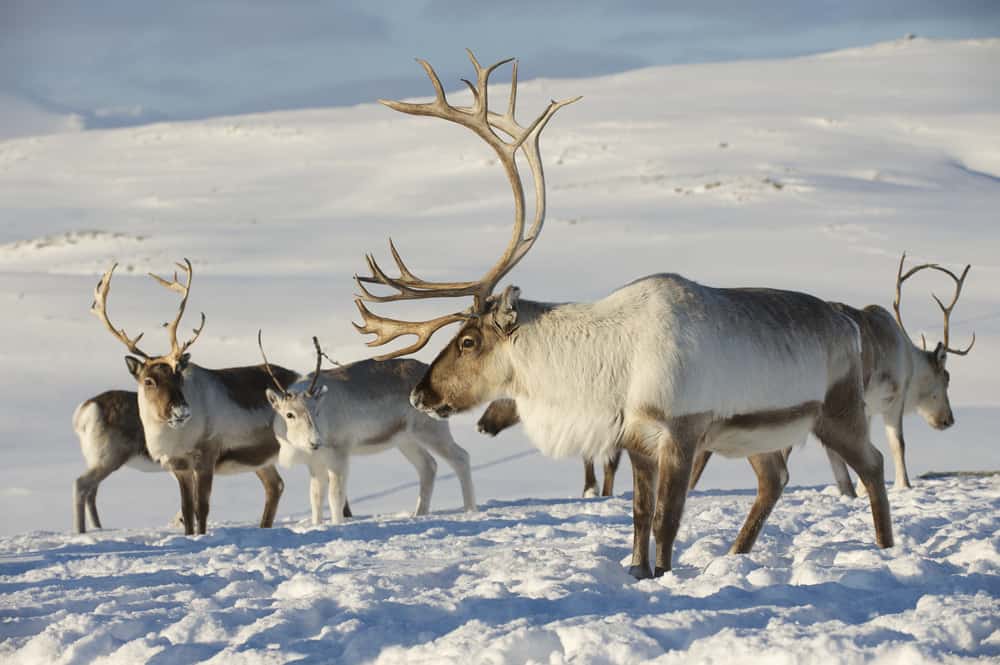
A specialized circulatory system prevents a reindeer’s legs from freezing in harsh temperatures and snowy conditions.
©Dmitry Chulov/Shutterstock.com
A reindeer’s nose hides yet another extraordinary evolutionary trick. Inside their nostrils are tons of blood vessels. As the reindeer inhales cold air, these vessels–full of blood flow–warm the air as it travels to the lungs. Once the air reaches its destination, it’s been sufficiently heated. This keeps the reindeer’s internal temperature constant and prevents cold air from altering its homeostasis. Going a step further, the same blood that circulates in these vessels also circulates in a reindeer’s brain. This functions as an internal HVAC system, heating and cooling as needed.
Reindeer are also sometimes seen panting through their mouths. This behavior allows them to regulate their body temperature in freezing weather. As they pant, evaporative cooling increases heat loss. Although this may seem counterintuitive, it helps reindeer control when and how they lose heat, as well as how that heat is recycled.
Reindeer Have an Eye for Winter Survival
One of the most remarkable traits of a reindeer is its ability to change its eye color with the seasons. In 2011, researchers at University College London discovered that these animals change their eye color with the seasons. This study found that reindeer have evolved to see in harsh Arctic conditions. Whereas some animals have excellent night vision or can detect heat, a reindeer can detect movement thanks to ultraviolet vision.
What makes this so impressive is that the evolutionary trait mirrors that of their number one predator: wolves. Both animals can see during “Blue Hour,” otherwise known as the endless twilight of the Arctic. When wolves go on the hunt during this time, reindeer also forage for lichen. This adaptation allows both reindeer and wolves to scan the horizon and spot each other during the Arctic twilight, giving neither a clear advantage.
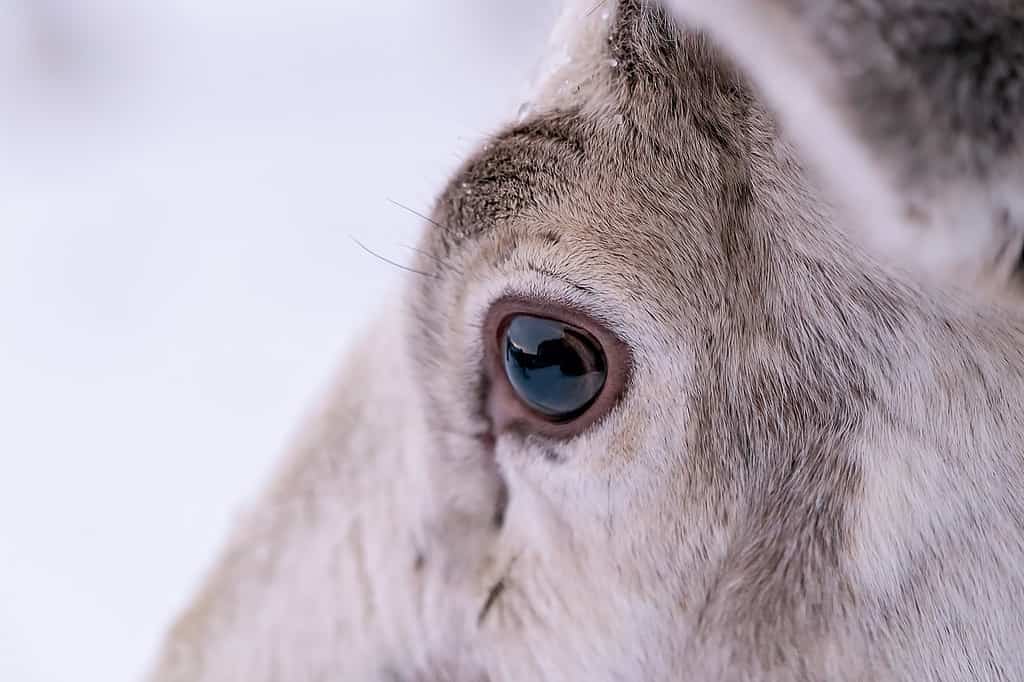
A reindeer’s eyes change color, and in the winter, they adapt to see ultraviolet light.
©pawopa3336/iStock via Getty Images
According to the University College London study, a reindeer’s eyes mirror the blue hues of the Arctic winter. During the summer, their eyes reflect the opposite, appearing gold and/or turquoise. Since lichen and a wolf’s fur stand out against this blue haze, reindeer can easily pick out the two among a pale, snowy landscape. Behind those beautiful eyes lies an intelligent and highly adaptive animal.
How a Reindeer’s Lifestyle Prepares It For Winter
Behavior, diet, and instinct are all part of surviving the Arctic. Reindeer travel in herds, which helps ensure their survival during winter. Moving as a herd not only deters predators but also protects the youngest calves traveling within the pack. The saying “power in numbers” could not be more accurate when a wolf is staring down a herd of several hundred reindeer or caribou. Reindeer are also highly social animals, which means traveling as a herd is as instinctive as it is protective. Members of the same family often group together, forming smaller units within the larger herd migration.
As reindeer herds move across the tundra, they also migrate extremely long distances. The distance traveled varies by herd. Some North American caribou herds have been known to travel up to 3,000 miles in one year, while most Eurasian reindeer migrate much shorter distances, often less than 150 miles annually, and remain within their region.
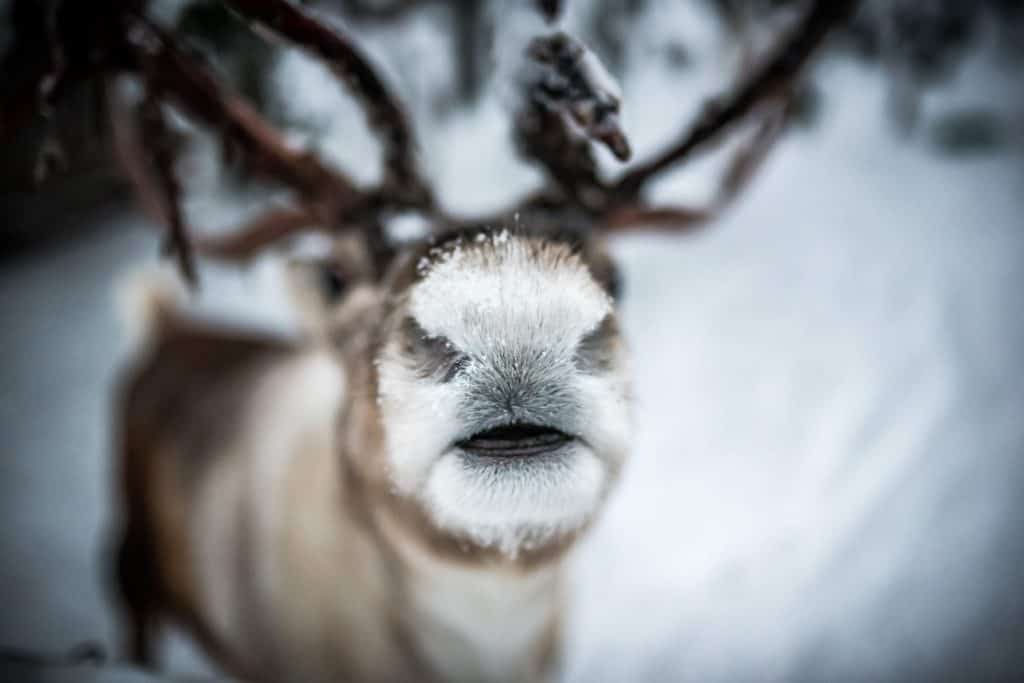
Reindeer primarily consume lichen, but can eat other foliage and even small rodents if food is scarce.
©Julie Meyer/Shutterstock.com
However, it is often the reindeer living in the northernmost territories that migrate thousands of miles in search of food, which becomes scarcer from summer to winter. Many European reindeer, especially in Scandinavia, migrate seasonally from mountainous areas to boreal forests in search of lichen.
This food source, while abundant in many tundra forests, is not always readily available. Reindeer are strong swimmers and can run at speeds up to 50 miles per hour, which helps them cover long distances. Reindeer quickly learn to move efficiently at a young age, which aids in their survival in the Arctic. If migration isn’t enough to support a lichen-only diet, reindeer have one more trick up their hooves. They can also feed on low-hanging or ground foliage, bird eggs, and, in extreme cases, small mammals. Reindeer are built for survival, and a four-chambered stomach ensures they rarely starve.