
Quick Take
- Scientists were confident they'd identified this jellyfish, but DNA results showed that not everything was what it looked like. See how DNA changed everything →
- This species has several physical characteristics that align it with other box jellyfish, including these structures. Explore box jellyfish biology →
- One internal structure sets this newly discovered species apart from its counterparts, and nobody can explain why. Discover the missing canals →
- Another jellyfish in this genus turned up beyond its expected range, and researchers don’t know why. See the range expansion finding →
I remember the first time I was stung by a jellyfish. My family and I had driven to the Jersey Shore to spend a day at the beach. I’ve always been a huge fan of the ocean. So, as soon as we set up our towels, I ran into the water. After spending some time jumping around in the waves, my arms and shoulders began to sting. My dad even had to scrape some of the leftover tentacle off of me with a credit card. For days after, I bore the marks of the jellyfish’s tentacles crisscrossing across my skin. I was surprised by how long the itchy, burning red lines lasted.
While I was admittedly uncomfortable, the outcome wasn’t all that bad compared to some of the more dangerous jellyfish I could have been stung by. For example, a newly discovered box jellyfish species in Singapore has the potential to kill humans with just a single sting. Researchers learned about the new species, named Chironex blakangmati, after collecting box jellyfish around Singapore’s Sentosa Island. If you weren’t already convinced of how deadly these animals can be, know that they were named after Sentosa Island’s other name: Pulau Blakang Mati, which translates to “Island of Death Behind” in Malay.
What Are Box Jellyfish?
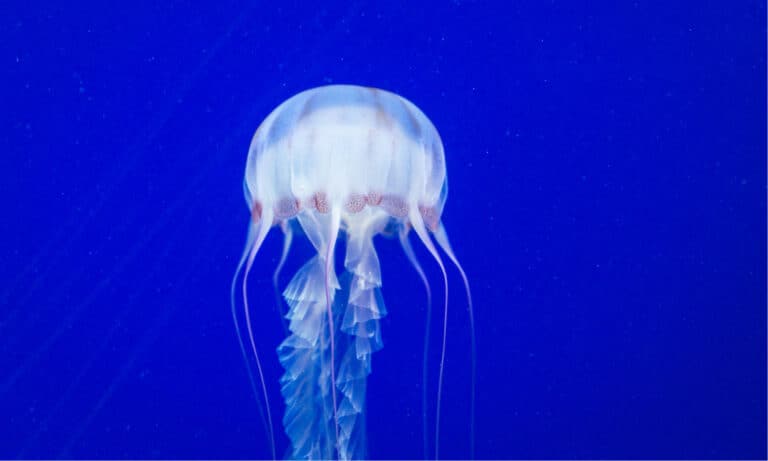
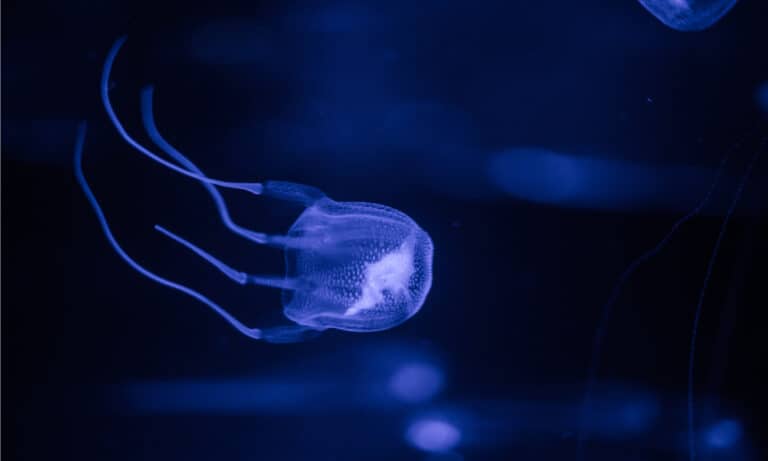
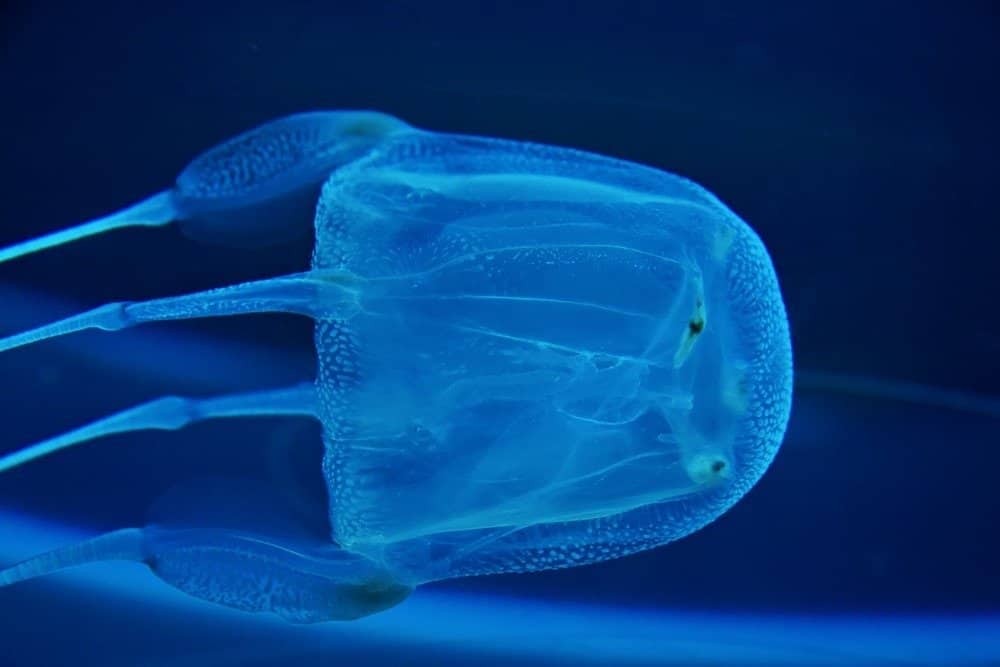
Box jellyfish are a type of jellyfish from the class Cubozoa. If you can’t tell by the name, these jellyfish are defined by their boxy, cube-shaped bells. They’re also unique from other jellyfish because box jellyfish have 24 eyes, whereas many jellyfish don’t have any eyes. Scientists believe that box jellyfish use their eyes to navigate their environments and hunt for prey. Pretty impressive, considering they have no brain!
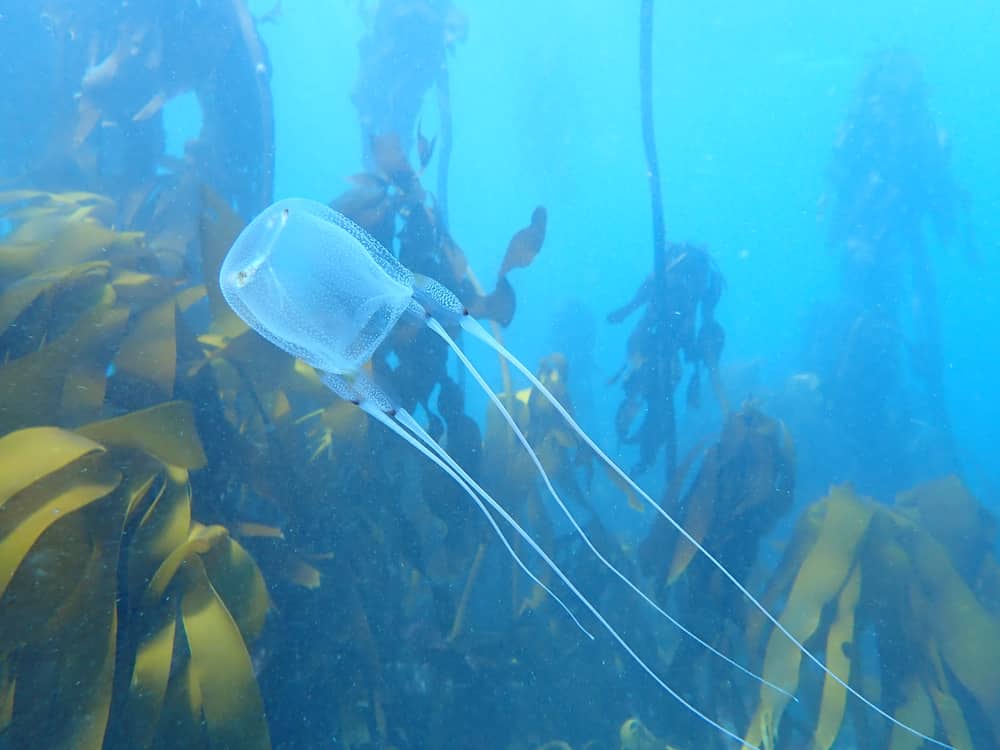
Box jellyfish are found in warm waters across the world, but are most common in Australia and the Indo-Pacific.
©Katherine Wallis/Shutterstock.com
Altogether, an estimated 45 to 50 species of box jellyfish exist. Four of those, including the newly identified C. blakangmati, are part of the Chironex genus. These include C. fleckeri (the Australian box jellyfish), C. yamaguchii (the viper jellyfish), and C. indrasaksajiae (the Thai sea wasp).
Chironex jellyfish are known for their large size, long tentacles, and extremely potent stings. Getting stung by a box jellyfish won’t always kill you, although it can have some nasty side effects. However, severe stings, or stings on children, can lead to cardiac arrest or death.
How Scientists Found a New Chironex Species
In 2020 and 2022, several Chironex jellyfish washed up on the shores of Sentosa Island. After researchers collected these specimens, they photographed and described the jellyfish, dissected them, took tissue samples, and extracted DNA.
At first, the researchers, who hailed from the National University of Singapore and Tohoku University, thought the samples were C. yamaguchii. Apparently, both species look strikingly similar. So researchers were surprised when the genetic analysis showed that they were actually dealing with a different species than they had thought.
This prompted the team to pay more attention to the morphology, or the jellyfish’s physical structure. After lead researcher Cheryl Ames brought a C. yamaguchii sample for comparison, they confirmed that C. blakangmati is its own distinct species.
A few physical characteristics separate C. blakangmati from other Chironex species. First, the research team explains that the bell shape can be conical, or cone-shaped. Other Chironex jellyfish tend to be more cube-shaped than conical. The new species also has a different number of tentacles on its pedalia (the bottom corners of its bell). C. blakangmati has seven tentacles emerging from each pedalium. C. yamaguchii may have anywhere from five to nine per pedalium, while C. fleckeri can have up to fifteen per pedalium.
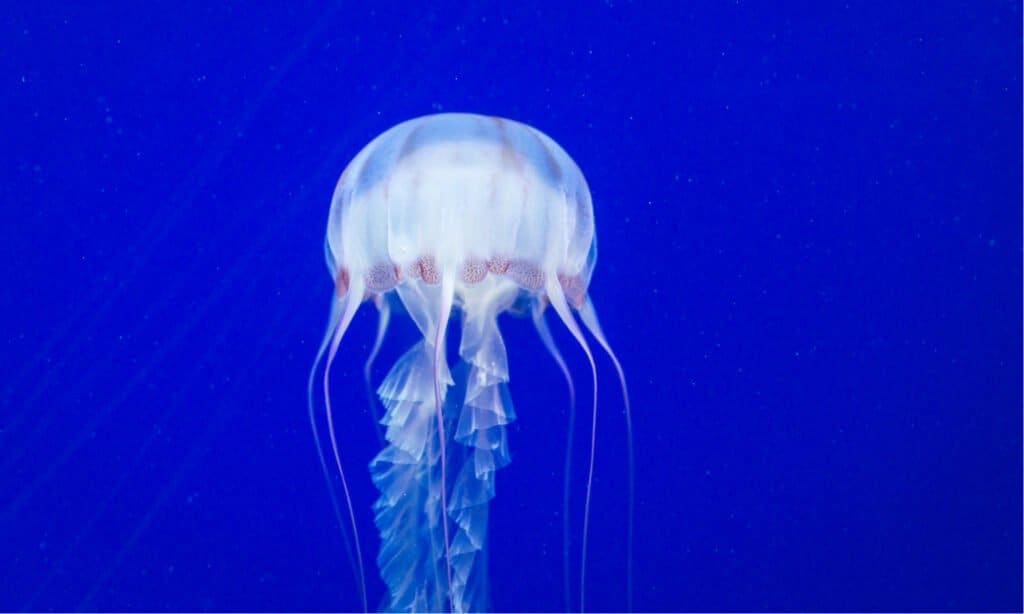
Box jellyfish use their pedalia to help them swim and navigate through the water, since these structures function like oars!
©Danza/Shutterstock.com
The Biggest Biological Difference
Perhaps the biggest separation between C. blakangmati and its fellow Chironex jellyfish is related to a structure called the perradial lappet. I know the language here is going to get a little specialized, but let’s break it down. The perradial lappet is a biological structure. It sits on the bottom of a jellyfish’s bell and supports the muscles that jellyfish use to swim. In the three previously known Chironex species, the perradial lappet has little tubes called the velarial canals. These canals help circulate oxygen and nutrients.
But C. blakangmati doesn’t have any velarial canals in its perradial lappet. Researchers aren’t sure why this might be. One hypothesis is that the sample collected is a juvenile jellyfish and may not have developed these canals yet, as has been seen in C. yamaguchii before. However, researchers can’t concretely determine that unless they can get access to more C. blakangmati samples. At that point, they could figure out whether the absent canals are only a juvenile feature or are also seen in this species’ adult form. But this does suggest that the new species may circulate oxygen or nutrients in a different way, which could be interesting to study.
One Last Finding
During their study, researchers made one more curious finding. They discovered C. indrasaksajiae in Singapore. Historically, this species has been found in shallow coastal waters in Thailand, specifically the Gulf of Thailand. Since Chironex jellyfish can actively move through the water, whereas most other jellyfish are carried by currents, it raises the question of why this jellyfish’s range is expanding.