
Quick Take
- The sunfish's unusual body composition may give orcas an unexpected benefit beyond just breaking it into smaller pieces, and this possibility changes what researchers think the ramming is actually for. See the fragmentation effect →
- Scientists still can't agree on whether this behavior is sophisticated hunting, play, or something else entirely. The answer, it turns out, matters more than it seems. Explore the debate on behavior →
- The same hold-to-ram technique has appeared in a completely different context, one that may connect orca behavior in the Gulf of California to incidents making headlines elsewhere. How the technique was observed →
- A juvenile orca's presence in both filmed events may be the key to understanding why this behavior is spreading, though researchers still need one specific thing to prove it. Why more data is needed →
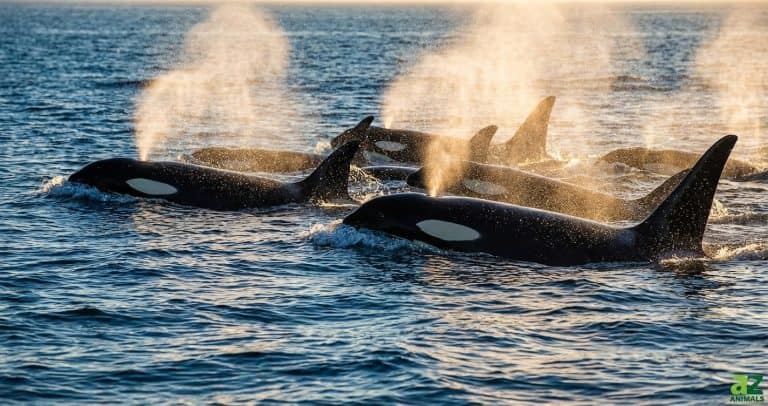
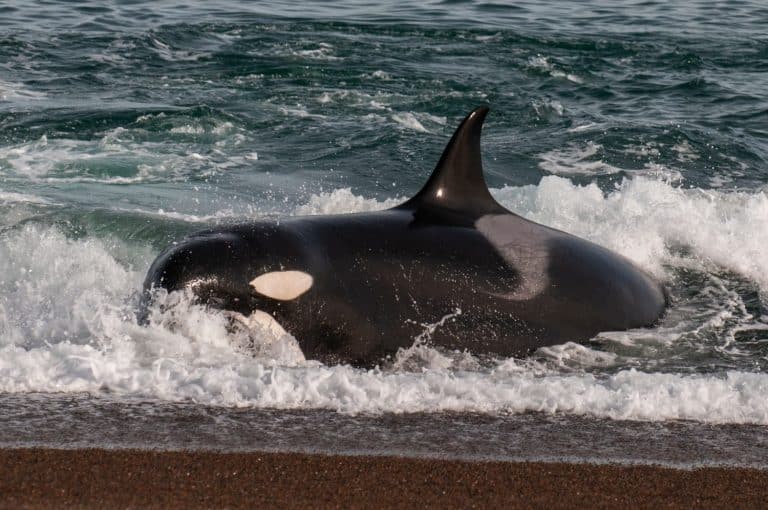
Orcas along the Gulf of California have found new ways to “play” with their food. On July 29, 2024, Kathryn Ayres, a research scientist for the marine conservation nonprofit Beneath the Waves, observed orca behavior she had never seen before. While diving near the coast of San José del Cabo in the Mexican state of Baja California Sur, as a guide with the group Latitude Encounters, Ayres observed a group of orcas: three adult females, one male, and a juvenile. In the video, the female orca is holding a sharptail sunfish by its tail fin, and as the male picks up speed, heading directly into their prey, she releases the fish shortly before impact.
The high-speed ram by the orca caused the sunfish tissue to instantly break apart into multiple pieces, almost like it had been detonated, providing easy-to-eat particles of food for the group of orcas, including the juvenile, which ate the smaller pieces while the adults feasted on what was left of the carcass. (Watch this in the video above.)
A year later, Héctor Franz, a tour operator for Creatures of Baja, recorded a similar hold-to-ram hunting behavior from the orcas in September of 2025.
Known for being innovative hunters, orcas may use the ramming method to help younger orcas feed more easily. In both videos, the sunfish were already deceased, which could also indicate a playful tactic to finish their meal off since they are notorious for playing with their food. Orcas have punted fish into the air with their tail flukes, carried the intestines of seals on their fins, or worn dead salmon on their heads like a hat.
Whether this is a form of breaking food into particles that are more manageable for juveniles or calves, or play for the orcas, is part of the research led by Ayres in a new study published in the journal Frontiers in Ethology.
Innovative Hunters
Orcas feed on a diverse diet at sea, feeding on seals, porpoises, dolphins, narwhals, beluga whales, sharks, and more, along with fish like salmon, halibut, and herring. For each, they also use different highly specialized and coordinated group-herding techniques to catch their prey. Ayres had previously witnessed this hold-to-ram method of hunting, where one animal stabilizes the prey as the other hits it, while observing orcas hunting whale sharks, but she was surprised to see orcas follow a similar hunting pattern with the sharptail sunfish and its aftermath.
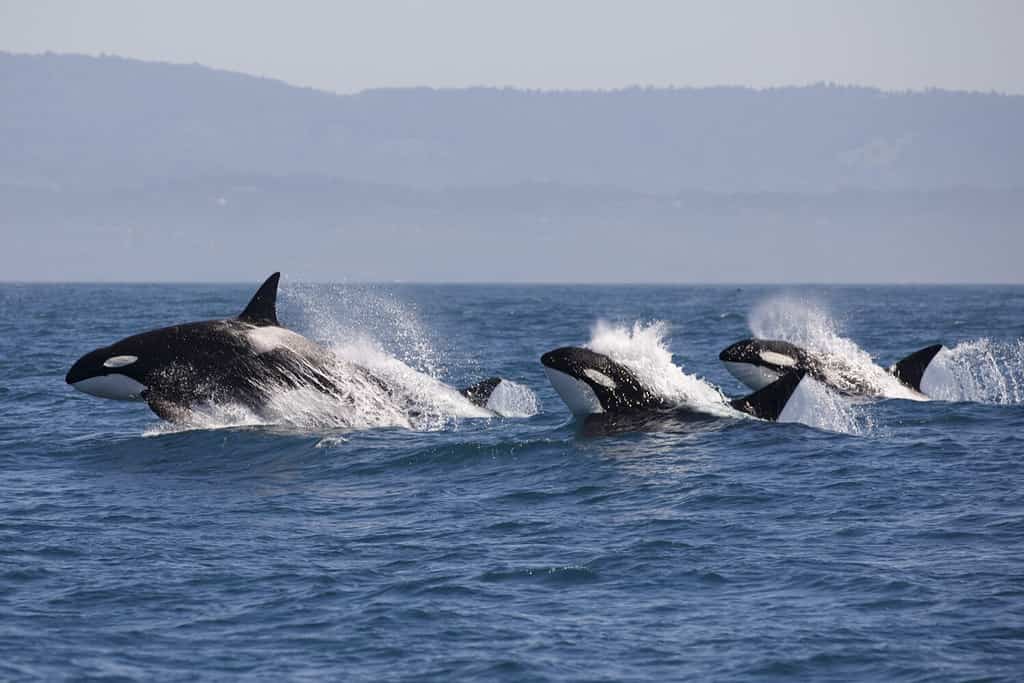
During a hunt, orcas often work together in coordination, swimming in synchrony to generate waves that wash seals off floating ice, or herding large schools of mobula rays for an easier capture.
©Tory Kallman/Shutterstock.com
“It depends on the type of prey the orcas are hunting,” says Ayres. “We have seen this ramming technique before when we witnessed them hunting a whale shark. They tend to use this technique with large prey that they need to immobilize first. The difference in this study was that when they rammed the sunfish, it completely fragmented into pieces, which we had not seen before.”
While orcas are larger than most prey in size, growing 20 to 32 feet and weighing from four to 11 tons, the sharptail sunfish, or mola, still grow to considerable lengths, reaching up to 11 feet and weighing around two tons, but are more vulnerable to predators when they come to the surface of the water to thermoregulate, remove parasites, or rest.
The ramming technique may also be a species-specific tactic, since the body of the sunfish can break apart more easily than other creatures. Sunfish have a gelatinous layer on their skin, the capsule, that once shattered can “alter the nutrient composition,” according to the researchers, which may provide the orca with some nutritional and other benefits.
It’s possible that individuals discovered that ramming could fragment the carcass, but whether the behavior serves a functional purpose, represents play, or both remains unknown.
Kathryn Ayres, Research Scientist, Beneath the Waves
A Team Effort
The cooperative nature of orca hunting is what stands out most to Ayres. “They often work together in remarkably coordinated ways,” she says, “for example, swimming in synchrony to generate waves that wash seals off floating ice, or herding large schools of mobula rays into tighter groups to make them easier to capture.”
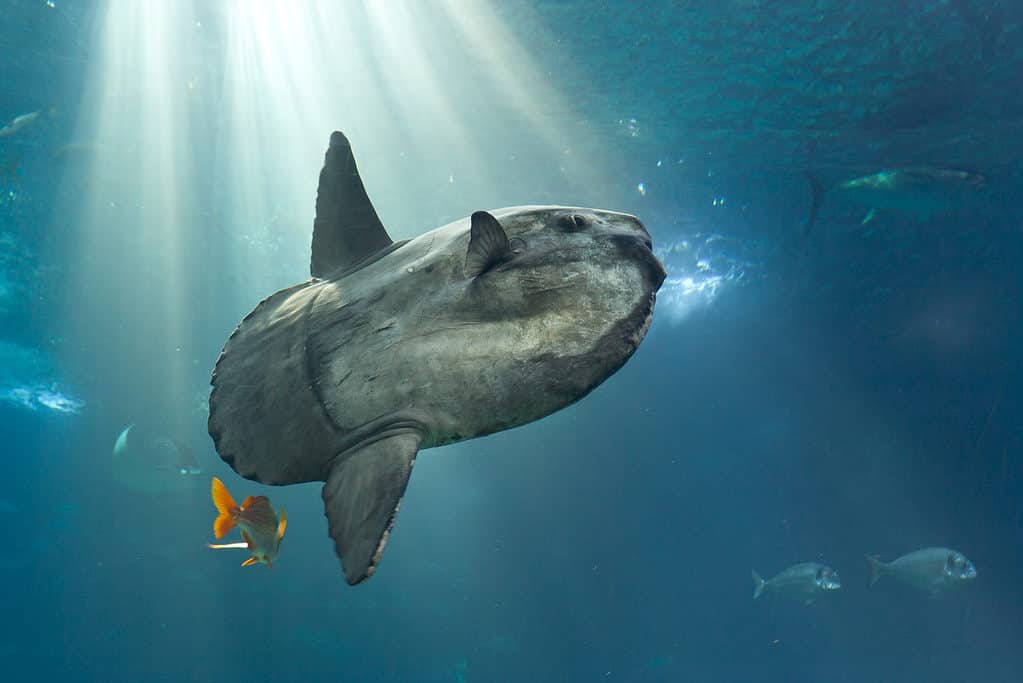
Still one of the most common prey for orcas, sharptail sunfish, or molas, grow to some considerable lengths, growing up to 11 feet and weighing around two tons.
©Rui Manuel Teles Gomes/Shutterstock.com
Though recently documented, Ayres says it’s impossible to know how long orcas have been using this type of hunting or play behavior. Orcas have also showcased similar behavior during recent incidents in Portugal, Spain, and Morocco, where they’ve grouped up and rammed into, disabled, or sunk boats.
“Orcas have likely been using and refining hunting techniques over many generations, with many behaviors thought to be passed on through social learning,” she says. “It’s possible that individuals discovered that ramming could fragment the carcass, but whether the behavior serves a functional purpose, represents play, or both remains unknown.”
Though it’s unclear if the same orcas were involved in both of the filmed ramming events in 2024 and 2025, further research will provide more insight into the characteristics of these animals. For better identification, researchers would need more high-quality footage, including a closer look at the dorsal fins and eye patches of an orca.
“There is still a great deal to learn about orca behavior, particularly in relatively understudied populations such as those in the Gulf of California,” says Ayres. “This region supports an exceptionally diverse range of potential prey, giving orcas many opportunities to develop unique hunting and prey-handling strategies.”
Time, date, and locations of sightings can also help researchers determine the whereabouts of orcas and their navigational patterns. “Without this information, conservation efforts are more difficult,” says Ayres. “We can’t protect areas if we don’t know which ones are important.”
Conservation efforts are also challenging, as orcas continue to face food depletion from overfishing, entanglement in fishing lines, marine pollution, and underwater noise from vessels—all impacting their survival. Ayres is also concerned about the increase in tourism around orcas and swimming with these creatures.
“Seeing orcas is a privilege and a rare experience here,” says Ayres. “Although there are now regulations, one issue that’s emerging is the growing number of boats searching for these animals and trying to get people in the water with them. That simply isn’t always possible, and these apex predators need to be respected.”