Quick Take
- A genetics study found something unexpected about a population this small.
- Scientists almost never look for vaquitas with their eyes. How scientists detect vaquitas →
- A Japanese fishing technique practiced on the other side of the Pacific has become one of the vaquita's most unlikely conservation tools. Alternative fishing techniques →
- A specific biological constraint makes each surviving female far more critical than headcount alone suggests. Why each female matters →
In September 2025, observers working with Sea Shepherd, Pronatura Noroeste, and the Mexican Navy captured drone footage of a mother vaquita (Phocoena sinus) swimming with a calf in the Upper Gulf of California. For a species with fewer than ten individuals estimated to be left in the entire world, this brief sighting means a lot.
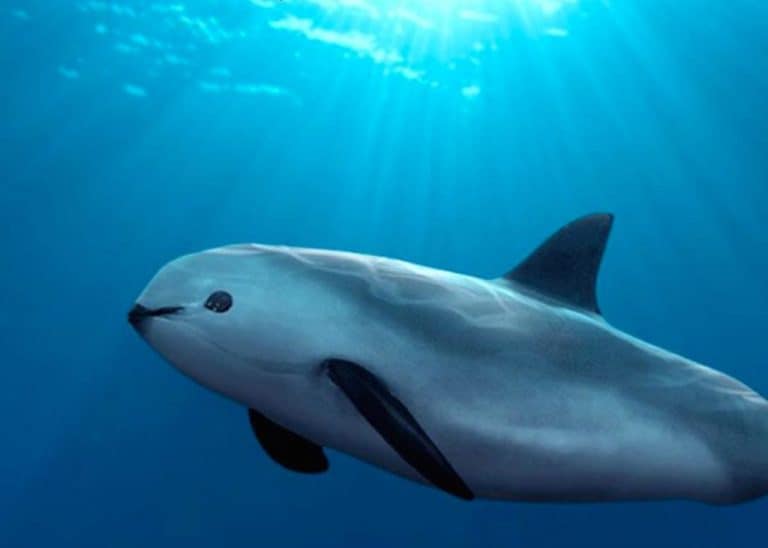
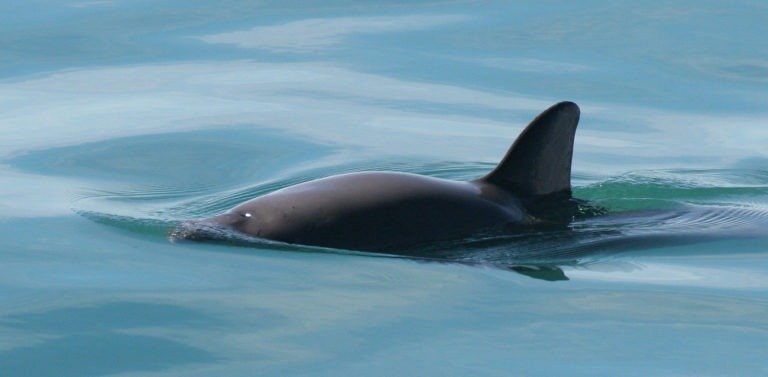
The vaquita is the world’s smallest cetacean, the scientific group that includes whales, dolphins, and porpoises, reaching about 5 feet in length. It is also the most endangered marine mammal known to science. Vaquitas live only in the northern Gulf of California, in an area of about 1,545 square miles. That makes them one of the most geographically restricted cetaceans. The dark patches around their eyes, noted by observers in the footage, are one of their key identifying features. People often compare these markings to eyeliner or tattoos.
The main reason vaquitas have declined is that they get caught and killed in gillnets, which hang in the water and trap animals by their gills or bodies. The biggest threat comes from illegal nets set for totoaba (Totoaba macdonaldi), a large fish whose swim bladder is trafficked to East Asian markets. Sound-based monitoring by CIRVA, the International Committee for the Recovery of the Vaquita, showed the population falling from about 567 animals in 1997 to fewer than 20 by 2018. A 2023 survey by Sea Shepherd and Mexican scientists estimated that a minimum of 10 to 13 vaquitas remained, while a 2024 survey placed the most recent count at 6 to 8 individuals.
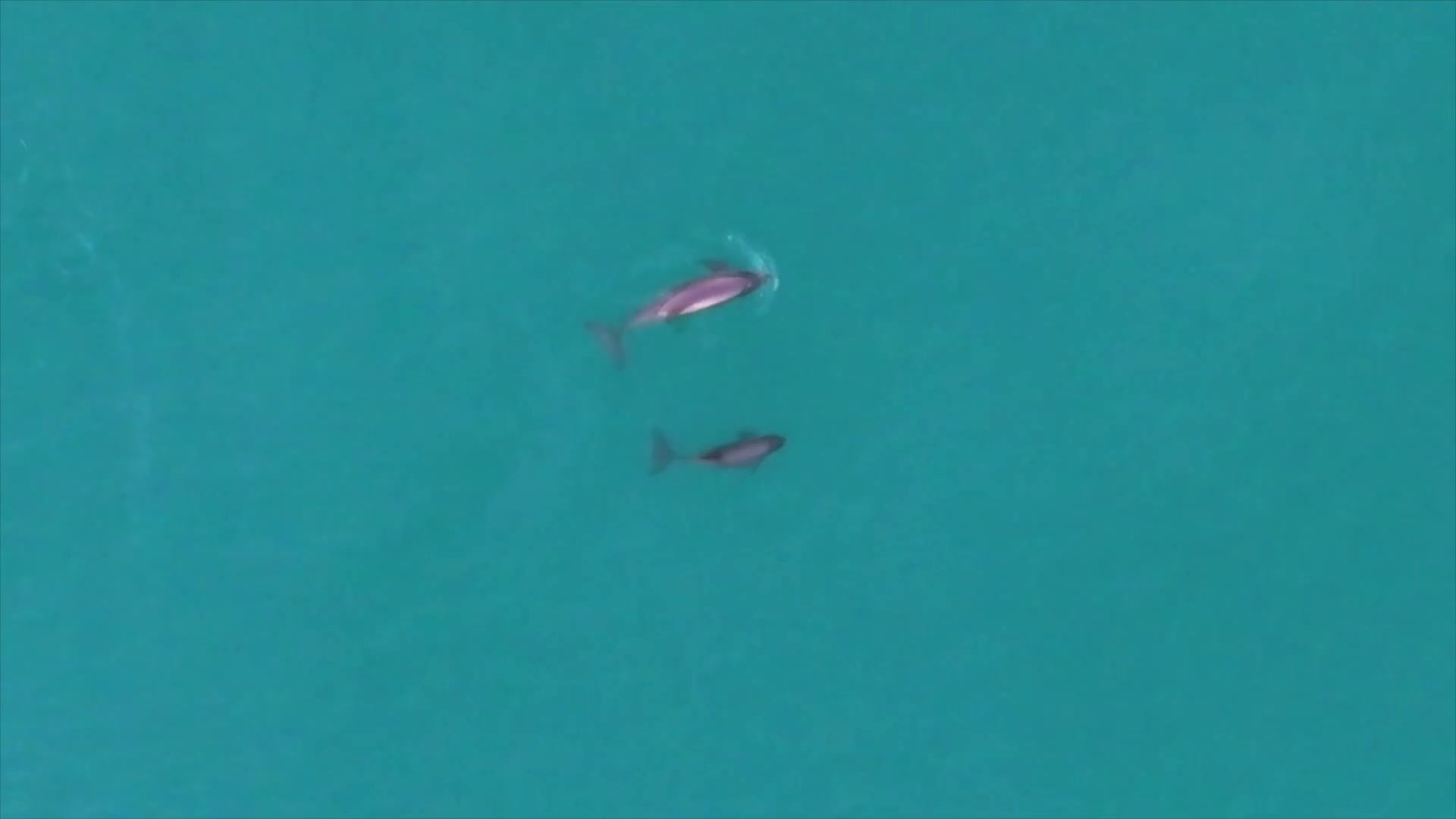
The vaquita mother and her calf
©Sea Shepherd via YouTube — used under fair use – Original / License
The Importance of a Calf Sighting
A calf sighting matters because vaquitas reproduce slowly. Females typically give birth to one calf every one to two years after carrying the baby for around 10 to 11 months. They do not begin having calves until they are about 3 to 6 years old. With so few breeding females left, every successful birth gives the species a real, measurable boost. A 2022 study in Science found that vaquitas do not appear to carry a heavy load of harmful inherited problems. In theory, they could recover from very low numbers if deaths gillnets weren’t an issue.
The footage was taken inside the Zero Tolerance Zone, a protected area within the vaquita refuge where no fishing of any kind is allowed. Sea Shepherd’s Operation Milagro, which has been running since 2015, maintains a constant presence there in coordination with the Mexican Navy. Crews remove abandoned gillnets, also called ghost nets, that can keep killing marine life long after fishermen leave them behind. Recovered nets are shredded at a Navy facility so they cannot be used again. According to Sea Shepherd’s published field reports, hundreds of nets have been removed from the refuge since the program began.
Traditionally Hard to Spot
Vaquitas are very hard to see in the wild. They are shy, come to the surface only briefly, and avoid boats. Scientists often rely on underwater listening equipment to detect their high-pitched clicks, which vaquitas use to both navigate and find food. This has been the main way to track population trends because visual surveys are difficult for animals that are so rare and so hard to spot. Drone footage, like the video captured in September, lets researchers confirm individual animals and check their body condition without the engine noise that can make vaquitas dive and disappear.
The video also shows efforts to train local fishermen in other fishing methods, including the Japanese ikejime technique. This is a precise way of killing fish that can improve the market value of line-caught seafood. Fishermen in San Felipe and Golfo de Santa Clara have long depended on gillnets for shrimp and finfish, so the conservation challenge encompasses both wildlife protection and people’s livelihoods. Programs that pay fishermen more for sustainably caught fish offer one of the few realistic ways to reduce net use in the region.
The vaquita is listed on Appendix I of CITES, the strongest level of international protection against trade. Mexico’s enforcement of the refuge and the Zero Tolerance Zone is the real-world test of that protection. Whether the species survives the decade will depend on whether illegal totoaba fishing can be held down long enough for the remaining females, and any new calves like the one filmed in September, to reproduce again.