
Quick Take
- A calm giraffe bending down for a closer look is still one of the most dangerous animals on the savanna, and this encounter is far more deceptively risky than it appears. See the hidden danger →
- Giraffes have been caught chewing something that has nothing to do with leaves, a behavior scientists still can't fully explain. Discover the strange behavior →
- That famously long tongue does more than reach tall branches. Its real design is built for something far more precise. Explore the tongue's design →
- When the giraffe lowers its head toward the cyclists, it's not necessarily looking for a snack. So what is it actually doing? Watch the approach unfold →
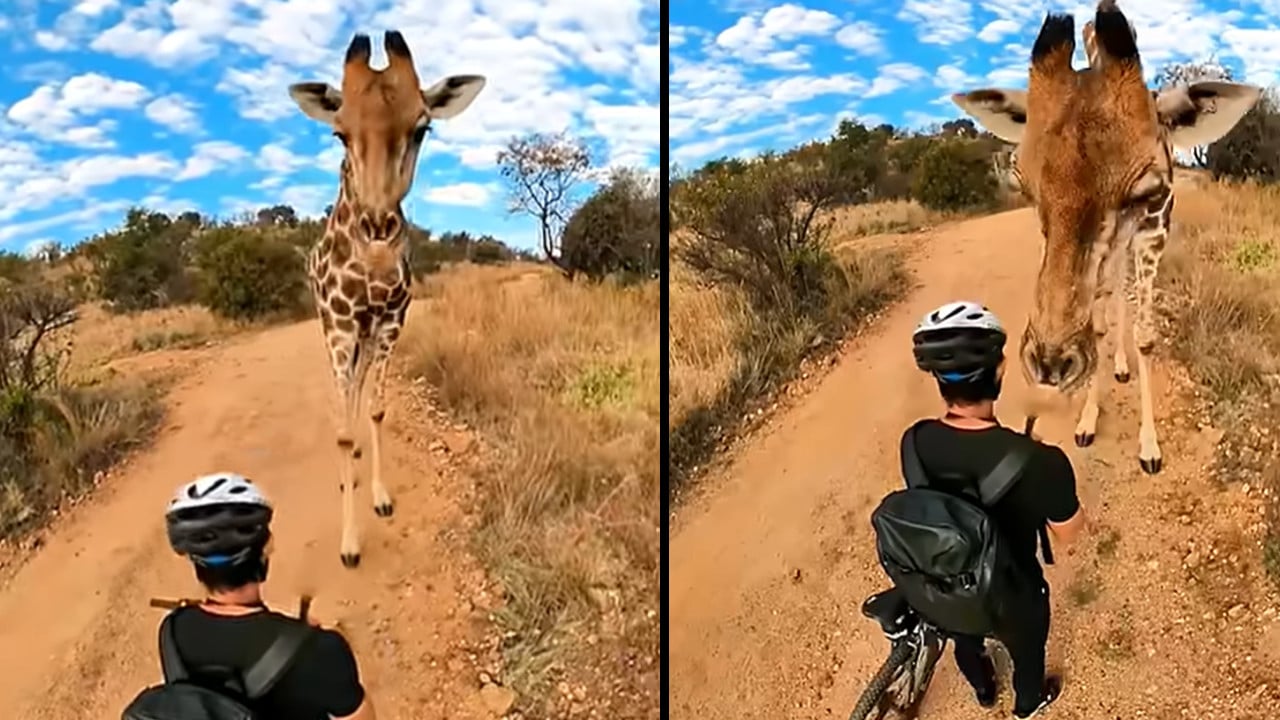
Stopping beside a giraffe is one thing. Watching that giraffe slowly lower its enormous head until it is practically joining your cycling group is something else entirely.
That is exactly what happens in this remarkable encounter. Two cyclists remain still as the towering animal bends down for a much closer inspection, bringing one of the tallest animals on Earth suddenly and very personally into their space.
Quick Take
- The giraffe lowers its head and closely investigates two cyclists and their bikes.
- Giraffes have excellent eyesight and an acute sense of smell.
- Their prehensile tongues can measure roughly 18 to 20 inches long.
- A calm giraffe is still a massive wild animal capable of delivering a dangerous kick.
Watch the Giraffe Come Down for a Closer Look
The cyclists do not have to wonder whether the giraffe has noticed them. The enormous animal lowers its head until its muzzle is close enough to thoroughly inspect the riders and their bikes.
It is tempting to assume the giraffe is searching for a snack, but the video cannot tell us what is motivating the behavior. Giraffes have excellent vision, good hearing, and an acute sense of smell, giving this animal plenty of ways to investigate something unfamiliar without immediately deciding it looks edible.
Its Face Is Built to Investigate Hard-to-Reach Places
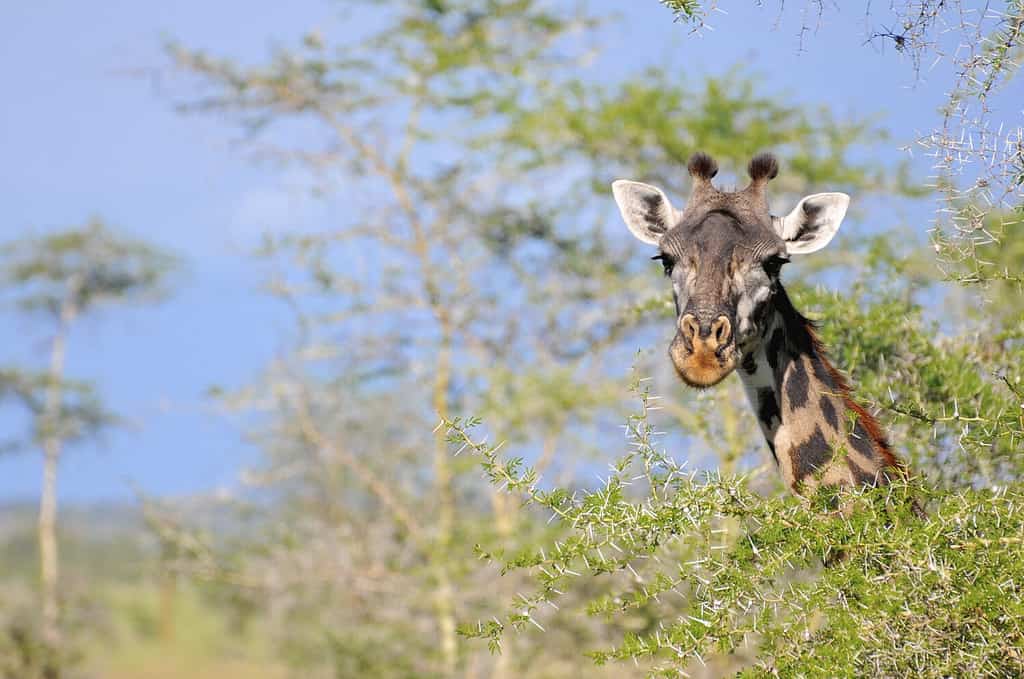
A giraffe’s long neck and prehensile tongue allow it to reach vegetation other herbivores cannot easily access.
©PLANET EARTH/Shutterstock.com
That long face becomes much more impressive at close range. Giraffes have prehensile tongues measuring roughly 18 to 20 inches long, along with flexible lips that help them carefully pull leaves from thorn-covered branches.
The Giraffe Conservation Foundation says leaves and shoots from Vachellia and Senegalia trees, many still commonly called acacias, make up an important part of their diet. They also browse flowers, seedpods, fruit, vines, and other vegetation depending on what is available.
Giraffes Spend Much of the Day Browsing Above Everyone Else
Giraffes are primarily browsers rather than grazers. Their height gives them access to leaves and young shoots far above the feeding range of many other herbivores. San Diego Zoo Wildlife Alliance notes that an adult giraffe may consume up to about 75 pounds of vegetation in a day.
They are also ruminants. After swallowing plant material, giraffes later bring partially digested food back into the mouth and chew it again as cud. Their stomach has four compartments adapted to extracting nutrients from a high-fiber plant diet.
They Sometimes Chew Something Much Stranger Than Leaves
Giraffes are overwhelmingly plant eaters, but researchers have repeatedly observed them picking up and chewing animal bones, a behavior known as osteophagia. That does not mean giraffes have suddenly become predators. They are chewing the bones rather than hunting animals for meat.
The behavior has often been linked to a possible need for minerals such as phosphorus. Interestingly, one study testing that idea found that giraffes may not actually extract much calcium or phosphorus from bone during rumen digestion. So scientists have documented the behavior, but its exact nutritional benefit is not as settled as older explanations sometimes make it sound.
The Gentle Approach Does Not Make This a Tame Animal
The giraffe in this video looks remarkably calm, and the encounter appears peaceful. That should not be confused with domestication. Adult giraffes can stand well over 15 feet tall and weigh more than a ton, and their legs are powerful enough to deliver dangerous kicks in several directions.
That makes the restraint shown by both sides one of the most interesting parts of the clip. The cyclists stay relatively still, the giraffe satisfies its curiosity, and an encounter that could feel intimidating from ground level instead becomes an extraordinary close-up look at one of Africa’s most recognizable animals.