
Quick Take
- Cormorants pay a hidden physical price just to get airborne, a cost that forces them to fly smarter than many other birds. Discover the physical cost →
- Flying in a group isn't just safety in numbers. A precise aerodynamic trick is at play that benefits every bird except one. See the upwash effect →
- The V formation these birds use is not actually fixed, and what it morphs into mid-flight is stranger than you would expect. Explore the shifting formation →
- Cormorants are elite underwater hunters, but that same adaptation makes flight unusually costly. So how do hundreds of them cross the sky together? Learn about their adaptations →
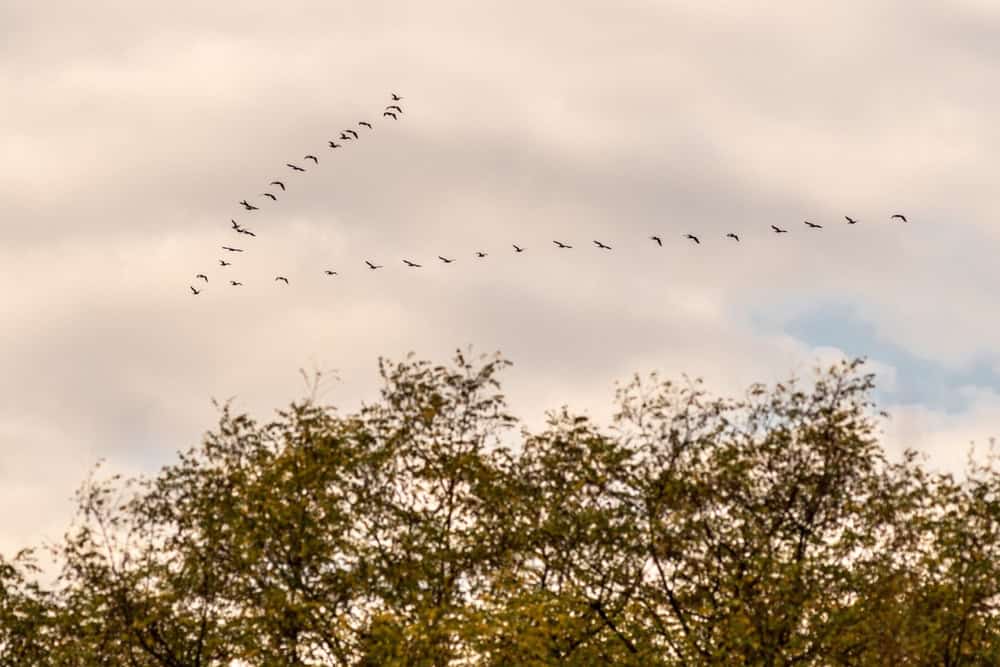
Sometimes nature can coordinate itself just as well as, if not better than, we humans. Take the cormorants in this Instagram post, for example. Hundreds of them are stretched across a pale blue sky, moving in perfect synchronicity. If the Radio City Rockettes became airborne, this is what they would look like! But what exactly are these birds doing, and why is precise positioning so important to them?
All About Cormorants
Cormorants are in the Phalacrocoracidae family of birds. There are many species of cormorants, including northern hemisphere and southern hemisphere species. They are medium to large birds that feed primarily on fish, although some also feed on aquatic creatures like crustaceans and mollusks, and some will even eat water snakes! These birds breed in colonies which can reach thousands of pairs. Cormorants live in coastal areas across much of the world, with the notable exception of the central Pacific islands.
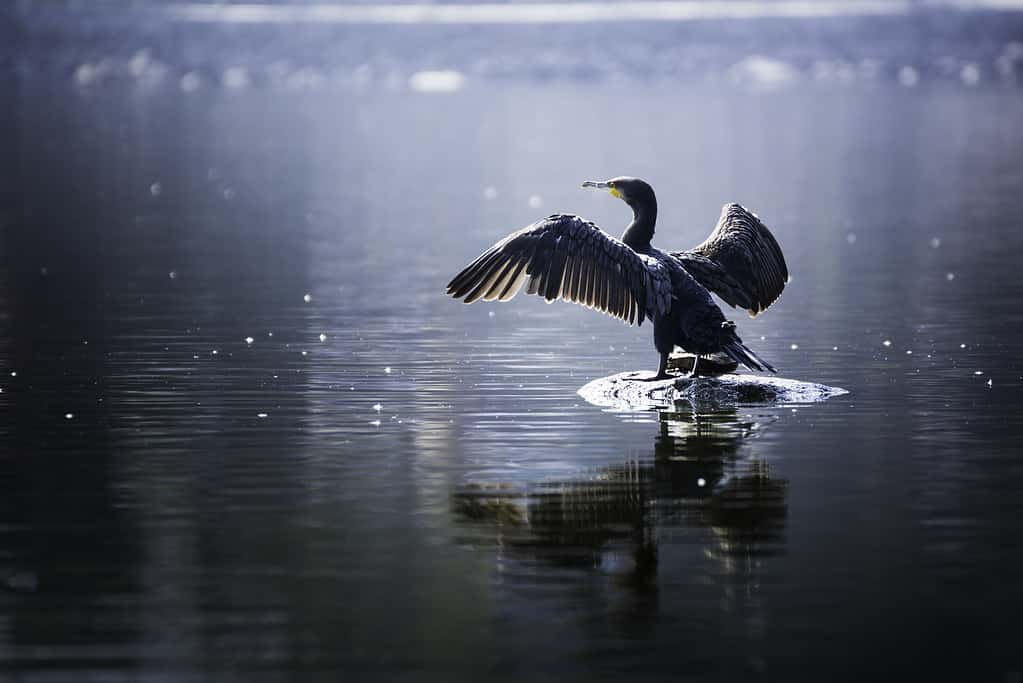
The cormorant’s body is built for both swimming and flying.
©Kumud Parajuli/iStock via Getty Images
Cormorants are excellent divers. They dive from the surface and propel themselves underwater using their feet. Some also plunge-dive from the air. However, these elite diving skills come with a cost. These birds are compact and dense and look like a torpedo under the water. Their relatively short wings make them very agile swimmers, but they have the highest flight cost of any flying bird. This means that they have to use some clever tactics when airborne.
Why Are the Cormorants Flying Like This?
The cormorants are flying in a ragged V formation to master aerodynamics. It is basically an energy-saving strategy. The shape is not fixed but can stretch and condense as the birds move across the sky.
This is how the physics works. When the lead bird flies through the air the space behind and to the side of them experiences an upwash. This means that the air is brought upwards. It’s caused by a vortex created by the bird’s wingtips. This can save the trailing birds up to 32 percent of the mechanical power needed to fly. The birds take it in turns to lead the V formation.
There is no fixed number in a cormorant flying formation, and numbers can vary. Sometimes the V breaks down into an irregularly shaped line. The cormorants do not always fly like this. When they are alone, they fly low over the water.