Quick Take
- Jackals can successfully repel a leopard, a feat requiring a specific social requirement.
- The 16 km/h (nearly 10mph) speed limit of Canis aureus creates a significant disadvantage during hunts.
- Contrary to standard assumptions, Vulpes vulpes maintains a solitary lifestyle despite monogamous bonds.
- Foxes must complete a specific denning process to ensure the survival of their young.
While they both belong to the family Canidae, jackals and foxes occupy different branches of the canine family tree. Distinguishing between them requires looking beyond their pointed ears and bushy tails to their social structures, genetic lineages, and geographic ranges.

The Diversity of Species
The reader’s feedback correctly notes that “jackal” is a broad term. There are three main species:
- Golden Jackal (Canis aureus): Found in Eurasia and North Africa.
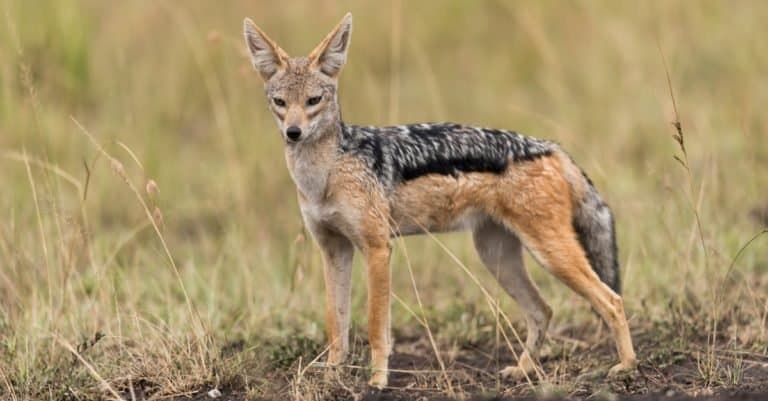
- Black-backed Jackal (Lupulella mesomelas): Common throughout South Africa and East Africa.
- Side-striped Jackal (Lupulella adusta): Found in the scrublands of Central and Southern Africa.
In contrast, the Red Fox (Vulpes vulpes) is the most widely distributed carnivore in the world, found across the Northern Hemisphere and introduced to Australia. While there are 12 “true fox” species, the Red Fox is the standard point of comparison.
Size, Build, and Camouflage
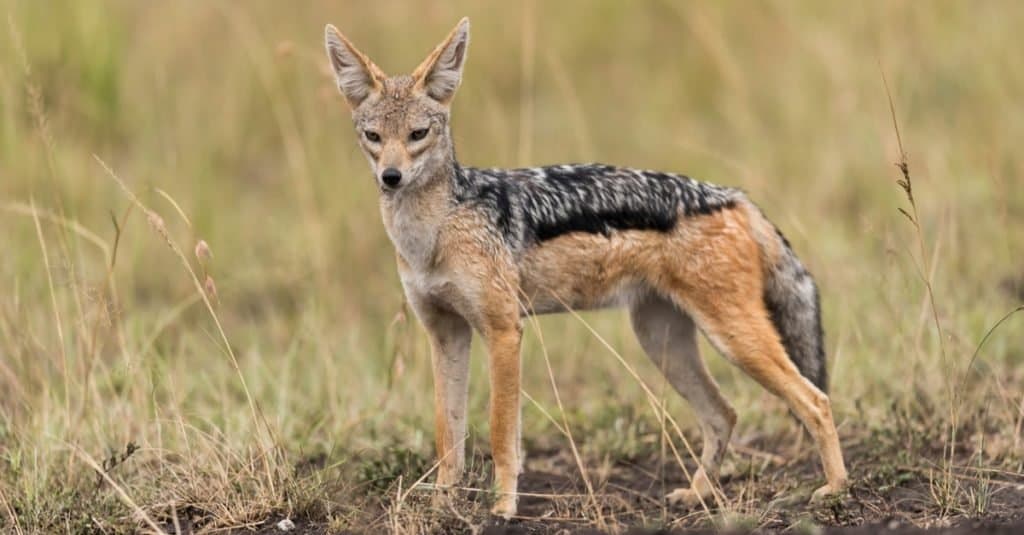
Jackals weigh between 11 and 26 pounds.
©Sharon Haeger/Shutterstock.com
Jackals are generally “leggier” and sturdier than foxes. A jackal stands about 15–20 inches at the shoulder, similar in stature to a medium-sized Terrier. Their coats are typically grizzled—a mix of tan, gold, and silver-black—to blend into the savanna and scrubland.
Foxes are lower to the ground and significantly more agile. Their “cat-like” features include vertical slit pupils (unlike the round pupils of jackals) and the ability to retract their claws slightly. The Red Fox’s iconic coat is complemented by “black stockings” on its legs and a distinctive white tip on its tail, which jackals lack.
Lifestyle: Pack vs. Solitary
The most profound difference lies in their social DNA:
- Jackals are highly social. They form long-term monogamous pair bonds. These pairs are the core of a territory, often assisted by “helpers” (grown offspring from previous years) to raise new pups. This social cohesion allows them to defend kills against larger predators like cheetahs or hyenas.
- Foxes are solitary. While they are often monogamous during the breeding season, they hunt and travel alone for most of the year. They do not form packs. A group of foxes is known as a “skulk” or “leash,” but this is usually limited to a mother and her kits.
Habitat and Range
Jackals are primarily creatures of the Old World, thriving in the deserts of North Africa, the savannas of South Africa, and the warmer regions of Europe and Southern Asia.
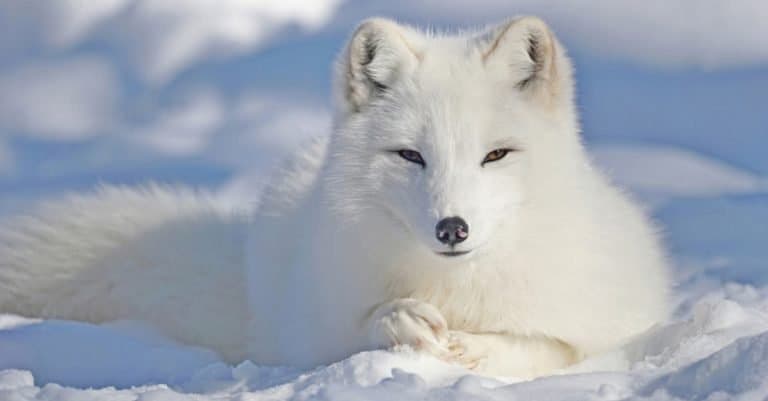
Foxes are the ultimate opportunists, living in every biome from the freezing Arctic (Arctic Fox) to the scorching Sahara (Fennec Fox). They have also adapted more successfully to urban environments than jackals, frequently nesting in city parks and suburban gardens.
Hunting and Diet
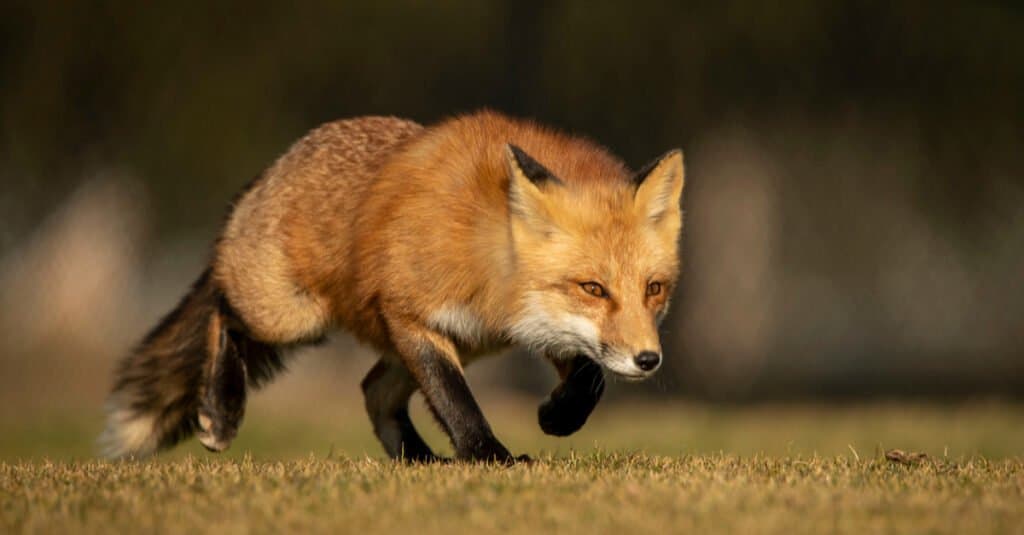
Young red foxes are the primary prey for eagles and coyotes.
©Jackie Connelly-Fornuff/Shutterstock.com
Both animals are opportunistic omnivores.
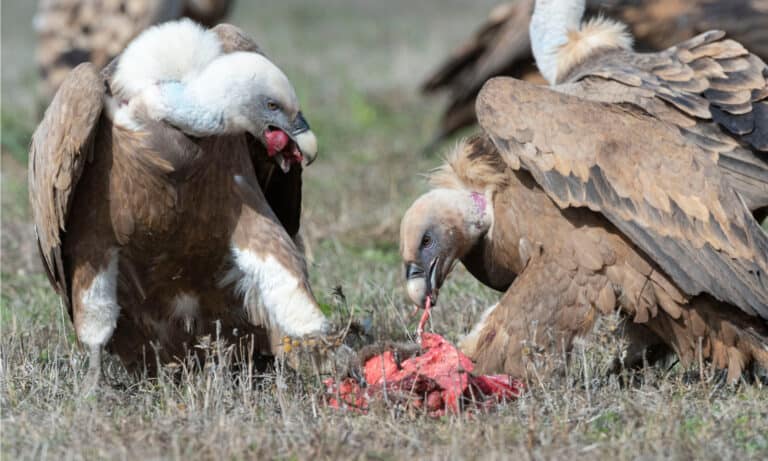
- Jackals are famous scavengers, often following larger predators to finish off carcasses. However, they are also skilled hunters of small antelopes, ground-nesting birds, and reptiles.
- Foxes rely heavily on their hearing to hunt. They can detect the low-frequency sounds of rodents rustling under snow or soil and utilize a “pounce” technique to catch prey. Their diet is supplemented by fruit, insects, and, in urban areas, human refuse.