
The gray fox (Urocyon cinereoargenteus) and the coyote (Canis latrans) are both members of the family Canidae. Both species are native to the Americas and are known for their mix of red and grey fur. Over time, the ranges of the gray fox and coyote have come to overlap, with these species competing for prey; the gray fox is sometimes preyed upon by the coyote. Continue reading to learn about the four main differences between these species.
Size and Appearance
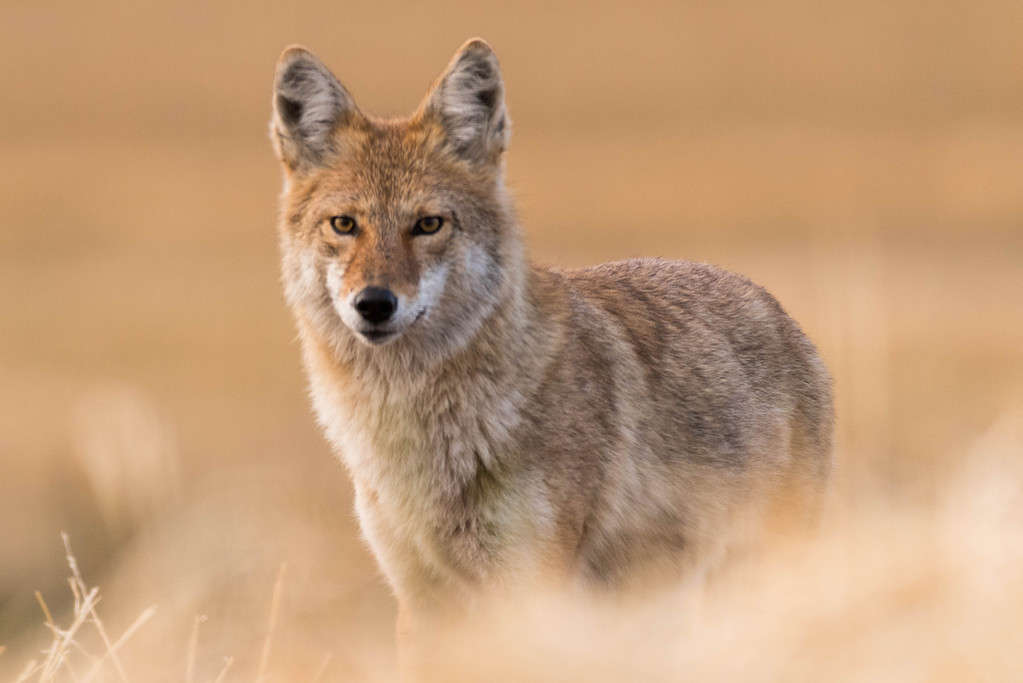
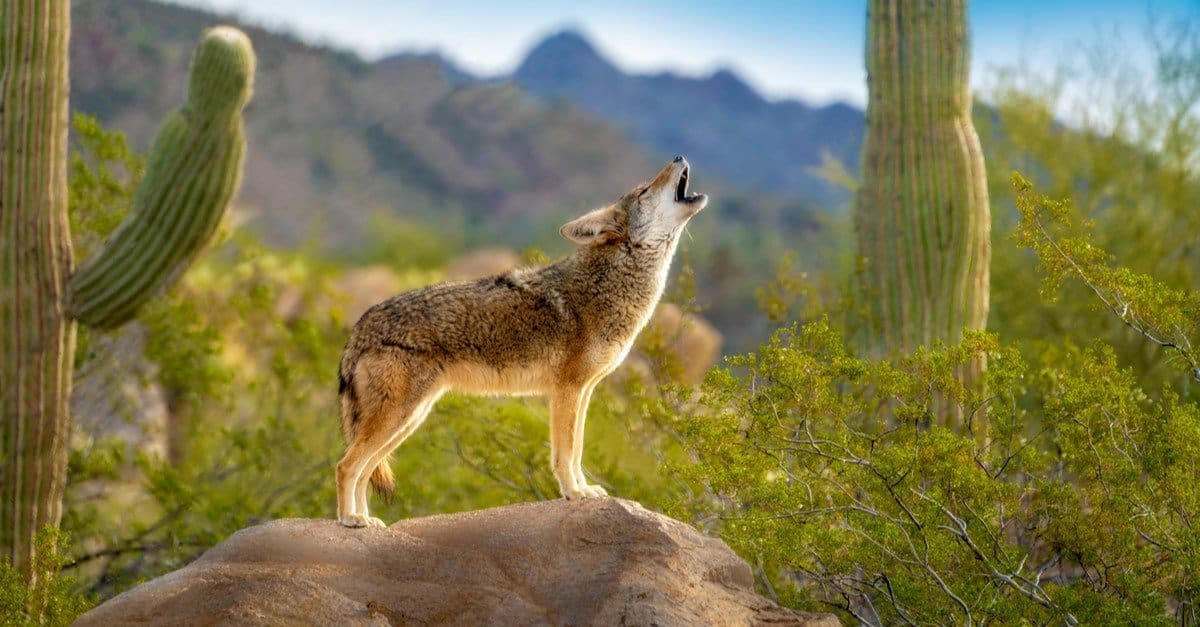
A wild coyote stands on the prairies in Autumn.
©hartmanc10/iStock via Getty Images
The gray fox is a medium-sized canid, measuring 12 to 16 inches tall and weighing 7.9 to 15.4 pounds. They measure 39.9 to 44.3 inches long, and their bushy tails make up as much as 17.4 inches of their total length. Gray foxes are distinguished by their silvery upper body with a vivid black stripe down the middle of their back and tail. The head of a gray fox has U-shaped temporal ridges, and the muzzle and ears are pointed and angular. The paws of the gray fox are oval, with four triangular-shaped toes and longer, more curved claws than the coyote’s, enabling them to climb trees.
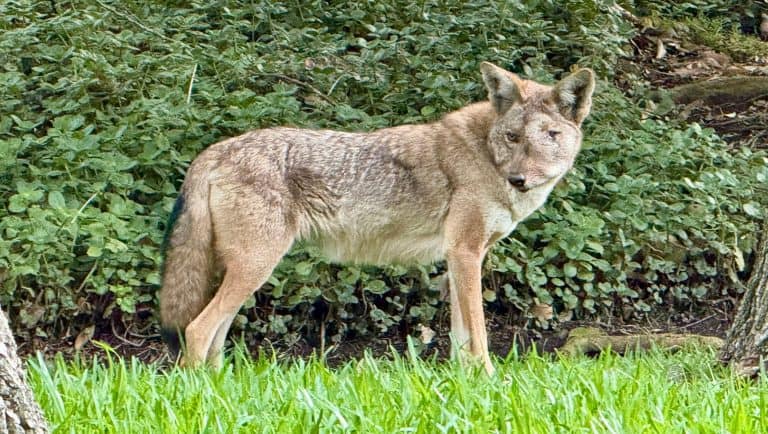
The coyote is much larger than the gray fox, with males measuring 21 to 24 inches tall and weighing 18 to 44 pounds. Female coyotes are smaller and typically weigh 15 to 40 pounds. Coyotes differ in size and color depending on their location or subspecies. Desert coyotes are primarily whitish gray, while those that live in mountain areas are black and gray. Coyotes in other regions are predominantly red and light gray, with some having brown and black spots. Coyotes have longer ears and larger heads than gray foxes. They are thin-framed animals with long legs, faces, and muzzles. Coyote paws are less rounded and more elongated than those of the gray fox.
Where do Gray Foxes and Coyotes Live?
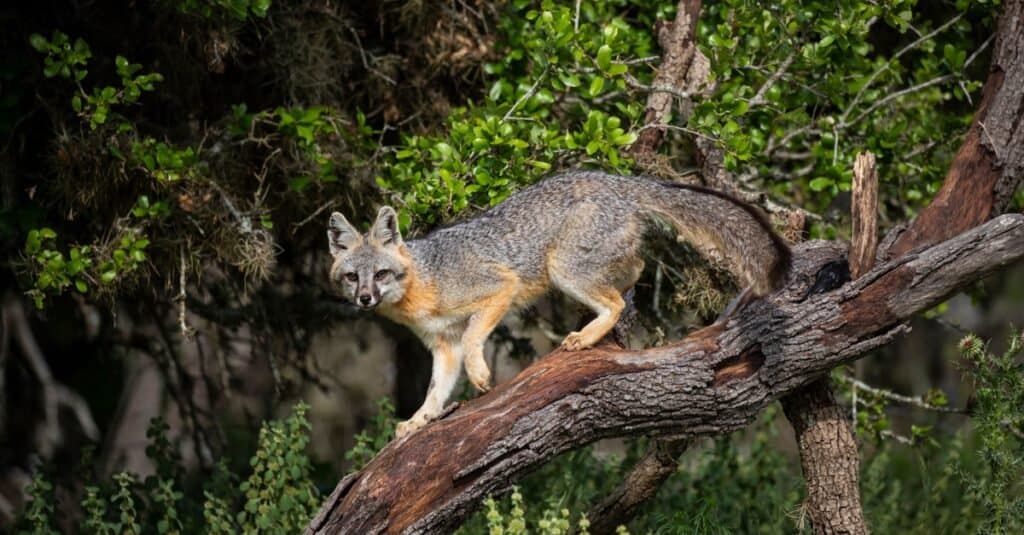
The gray fox is common in North and Central America.
©Danita Delimont/Shutterstock.com
The gray fox is native to the Americas, and is the only canid to have a natural range in both North and South America. Its range extends from Southern Canada to Northern Colombia and Venezuela. They were once the most common foxes throughout the Eastern United States. Unfortunately, deforestation and urbanization have led to habitat loss. However, the gray fox is still the most common fox species in the Great Lakes and the Pacific States. The gray fox primarily lives in wooded areas, ideally deciduous forests, but it can adapt. This adaptability has made it possible for the gray fox to live in suburban environments like Southern Florida.
Coyotes are native to North America, and their range throughout the continent has greatly expanded during the last century. Their range was originally restricted to Southwestern North America and Central and Northern Mexico. Today, their range covers all of the contiguous United States, Mexico, and Central America, and extends north into Canada and Alaska. They are versatile and have adapted well to urban areas. Unlike many other species, coyotes have benefited from deforestation, as grasslands, steppes, and semiarid deserts are their ideal habitats.
Diet
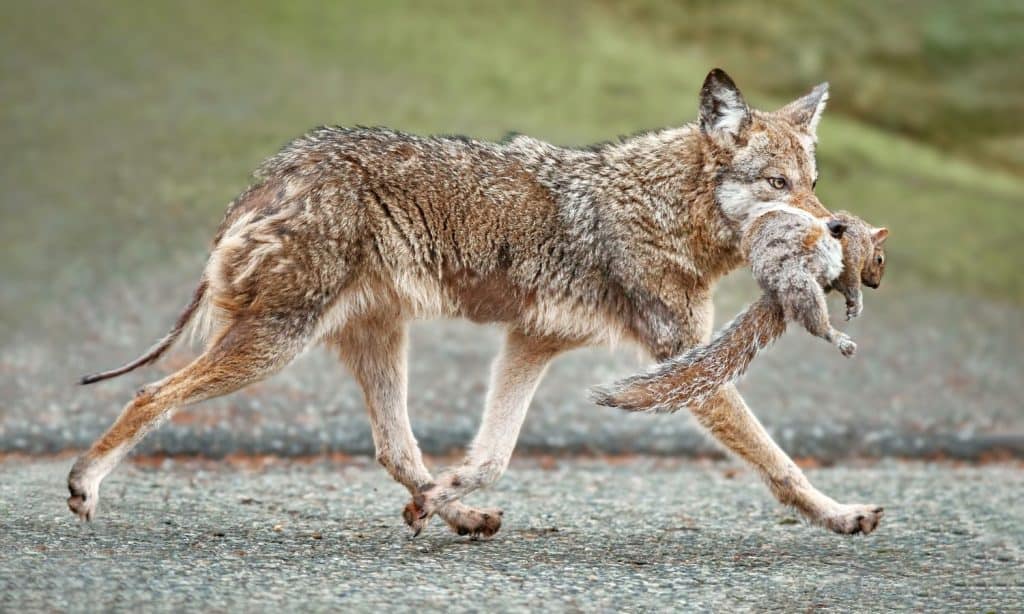
A coyote with its prey.
©RobDemPhoto/Shutterstock.com
The gray fox is a solitary, omnivorous, and opportunistic hunter known to climb trees to raid bird nests. In the Eastern United States, the gray fox primarily hunts voles, mice, birds, and rabbits. In some parts of the western United States, gray foxes have been observed to be insectivorous and herbivorous. They are known to gather fruits and nuts to store in caches.
Coyotes often hunt in pairs or small groups. They are carnivorous and voracious hunters that will also catch small prey on their own. A breeding pair will hunt large animals together, leaving younger, inexperienced pack members out of the hunt. Their prey ranges from mice and squirrels to deer and farm animals. Coyotes are among the most prolific livestock predators in the United States. In 2004, coyotes were responsible for 51.7 percent of the 224,000 sheep deaths caused by predation.
Do Gray Foxes and Coyotes Behave Differently?
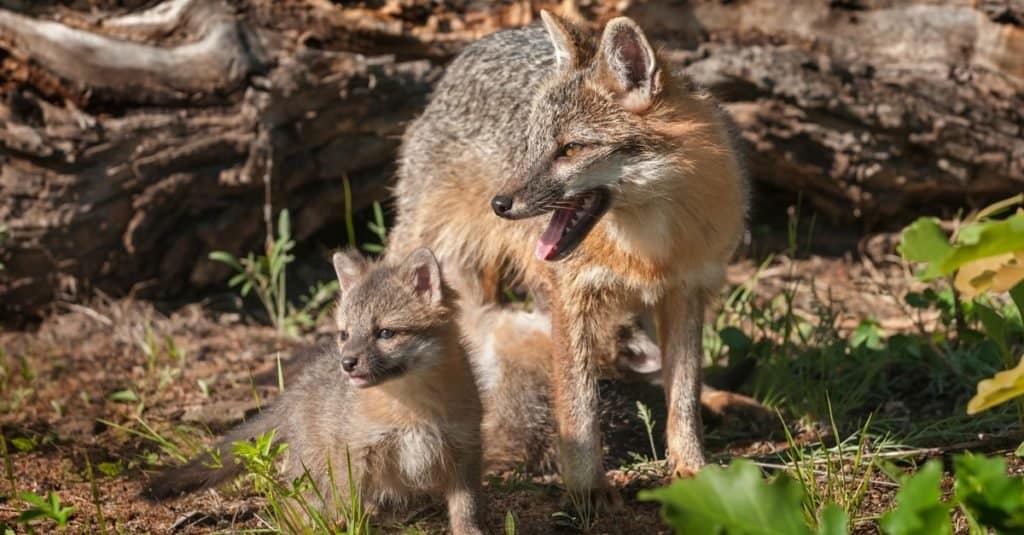
A gray fox mother with her kit.
©Holly Kuchera/Shutterstock.com
Gray foxes are solitary except when they form monogamous pairs to mate and raise their kits. Members of this species are either crepuscular or nocturnal. They are adept climbers that make their dens in hollow stumps and trees. When in hollow trees, these dens can be up to 30 feet above the ground. Because of urbanization and the expansion of coyotes into their habitat, gray foxes have adapted to living near humans, particularly in areas with lots of hardwood trees.
Coyotes live and hunt in packs, primarily family groups with one reproductive female. However, coyote packs often include unrelated individuals that join for companionship or to hunt large prey. Mated pairs establish territories for hunting and den building. They only guard these territories during the denning season in winter; dens are abandoned in the summer. Coyotes typically use the deserted burrows and holes of other animals as their dens. The species is also known to mutualistically hunt rodents alongside American badgers (Taxidea taxus).