
Quick Take
- Being a cold-blooded animal that feeds in frigid ocean water creates a serious biological conflict, and the marine iguana's workaround is stranger than you'd expect.
- Marine iguanas can dive deeper than most people would guess for a lizard, and size plays a surprising role in who gets to dive at all.
- One climate event nearly wiped out the entire Galápagos population, and it did so not through habitat loss or hunting but through a single change to their food supply. See the El Niño impact →
- These lizards colonized one of the most remote island chains on Earth long before humans arrived, and the way their ancestors got there defies expectations.
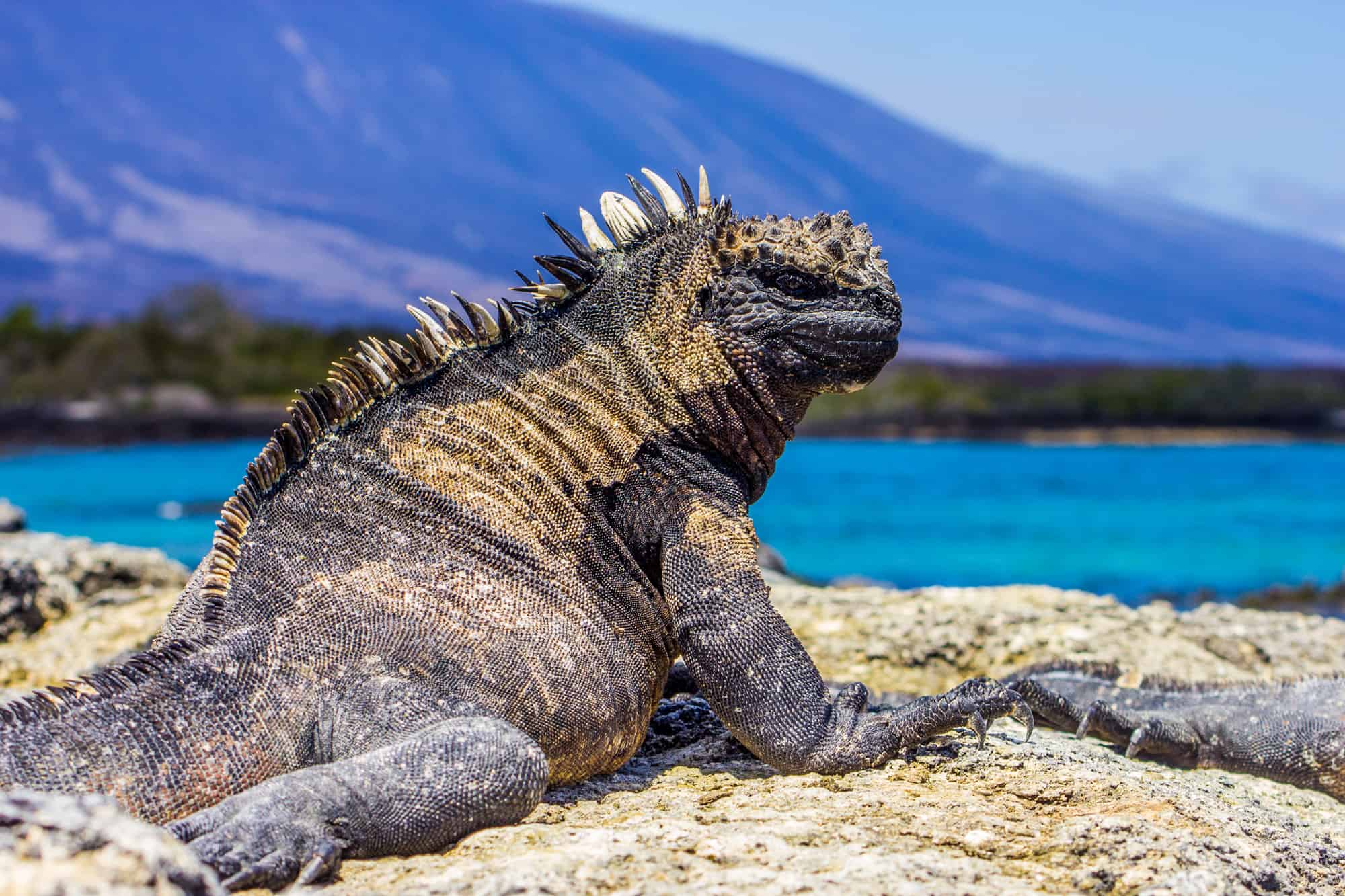
Meet the marine iguana, the only living lizard on Earth that regularly forages in the ocean. These extraordinary reptiles have adapted to take advantage of the rich marine algae growing around the Galápagos Islands. Getting to that food is not always easy. Waves pound the rocky shoreline, currents can be strong, and the surrounding water is surprisingly cold for a place sitting on the equator.
Larger marine iguanas can venture beyond the intertidal zone and dive underwater to feed, while smaller individuals usually graze on exposed rocks during low tide. The biggest adults have been recorded diving to depths of about 98 feet, or 30 meters, although most feeding dives are much shallower and shorter. Their powerful, flattened tails propel them through the water, while their long claws help them grip submerged rocks as they scrape off red and green algae. That is perfectly normal behavior for this unusual iguana.
Marine iguanas are the world’s only marine lizards, and feeding at sea comes with a built-in problem. They are ectothermic reptiles, so the cold water steadily lowers their body temperature. Their muscles become less effective as they cool, which is one reason they spend so much time basking on dark volcanic rocks before and after feeding. Marine iguanas are capable of remaining submerged for 30 minutes or longer under unusual circumstances, but typical feeding dives are considerably shorter. Once they are finished eating, getting back onto those sun-warmed rocks becomes the priority.
Where Do Marine Iguanas Normally Live?
These extraordinary reptiles are found only in Ecuador’s Galápagos Islands, where they live throughout much of the archipelago. Scientists believe the ancestors of today’s Galápagos iguanas reached the islands from the mainland by rafting across the ocean on floating vegetation millions of years ago. Recent genomic research supports the idea that iguanas colonized the Galápagos after land began emerging there roughly 10 million years ago.
Marine iguanas spend most of their time along rocky coastlines and in intertidal areas, where they can reach their marine food supply and bask in the sun between feeding trips. Females also need sandy or other loose-soil areas where they can dig nests and lay their eggs. Young iguanas and eggs can fall prey to native predators, while introduced animals such as cats, dogs, and rats have caused additional problems for some populations. Marine iguanas are especially vulnerable after spending time in cold water because their movement slows until they can warm themselves again.
What Do Marine Iguanas Normally Eat?
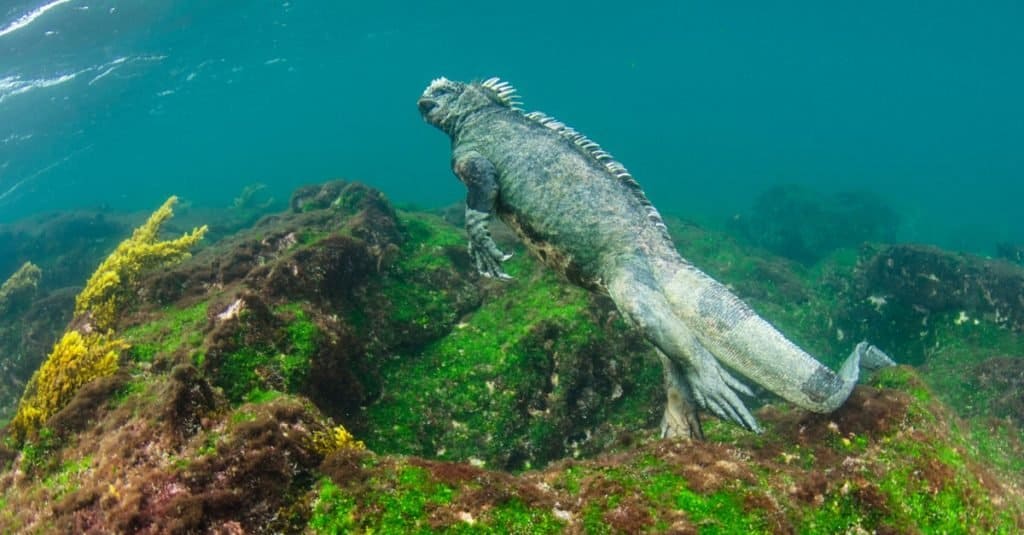
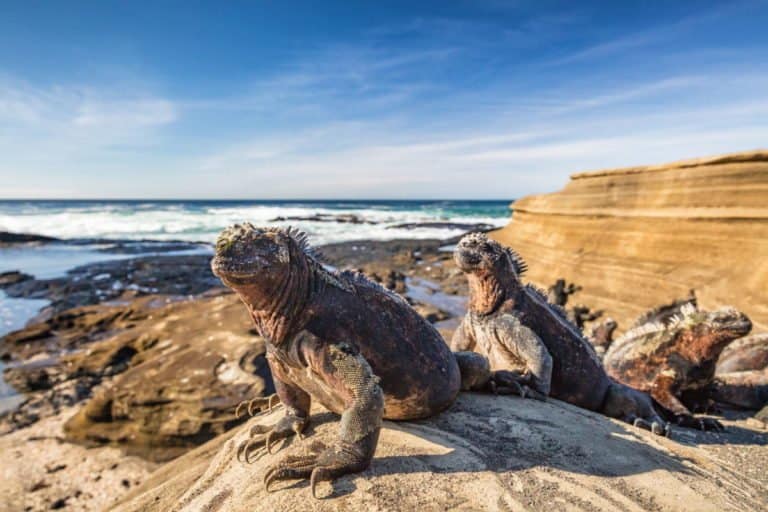
Marine iguanas (Amblyrhynchus cristatus) feed on underwater algae.
©Danita Delimont/Shutterstock.com
Marine iguanas feed almost exclusively on marine algae. Larger individuals can dive below the surface to reach offshore algal beds, while smaller iguanas typically graze in the intertidal zone when the tide goes out. That highly specialized diet also leaves them vulnerable when ocean conditions change. During the severe 1982-83 El Niño, warmer seas and reduced nutrient-rich upwelling caused their preferred red and green algae to decline while less digestible brown algae spread. Researchers with the Charles Darwin Foundation reported that roughly 70% of marine iguanas across the archipelago died during the event, largely from starvation. The species is currently listed as vulnerable by the IUCN, with its overall population trend considered decreasing.