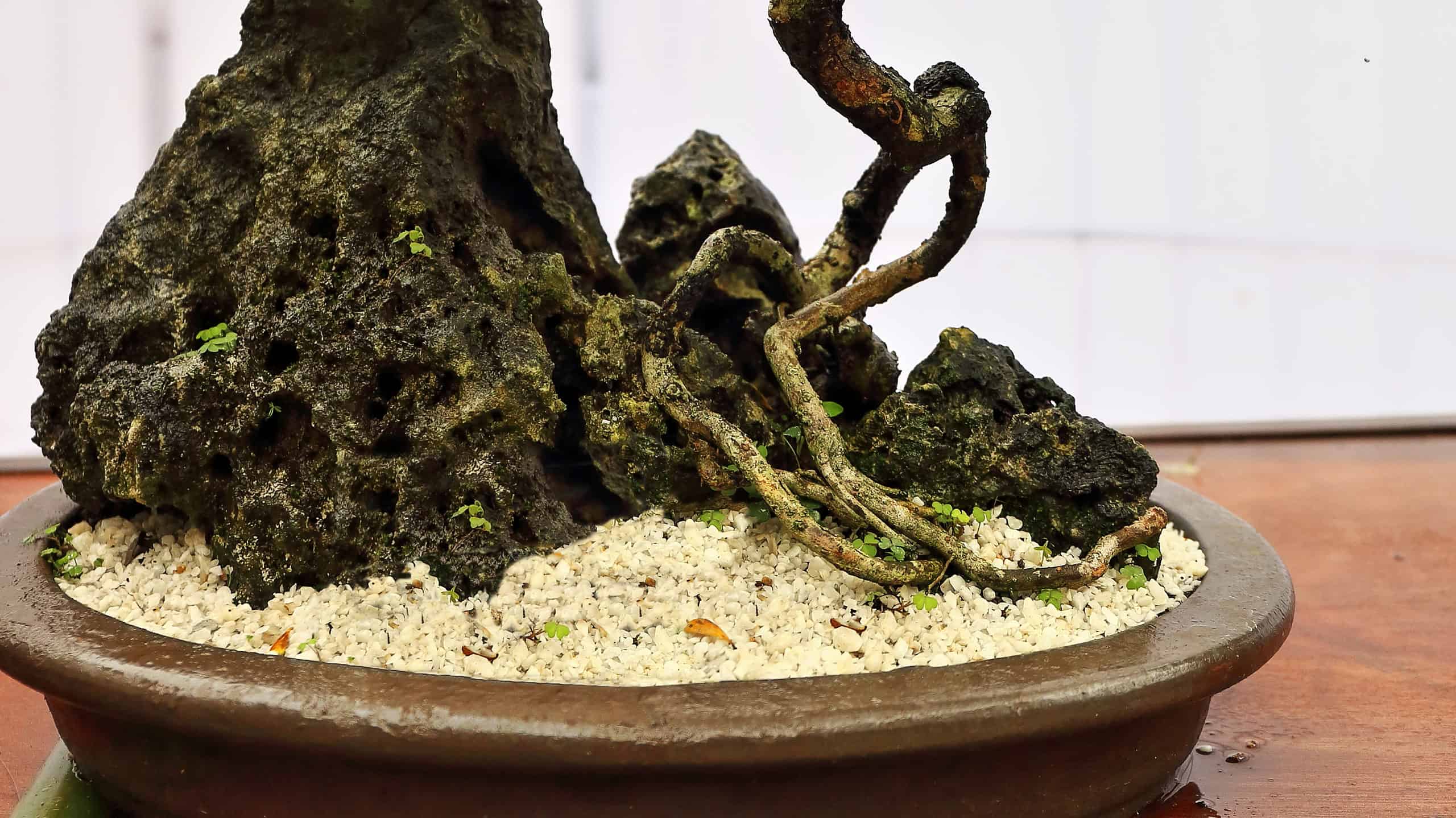

Despite the name, the dwarf black olive or black olive bonsai tree is not a miniature version of the tree that produces those black olives we toss on pizzas and associate with the Mediterranean. They are from a different family and function differently than the fruiting tree most of might be more familiar with. The dwarf tree, though, is perfect for growing as a bonsai tree.
Let’s take a look at this intriguing bonsai species and learn what makes it great for this kind of growing project.
What Makes a Black Olive Tree Good for Bonsai?
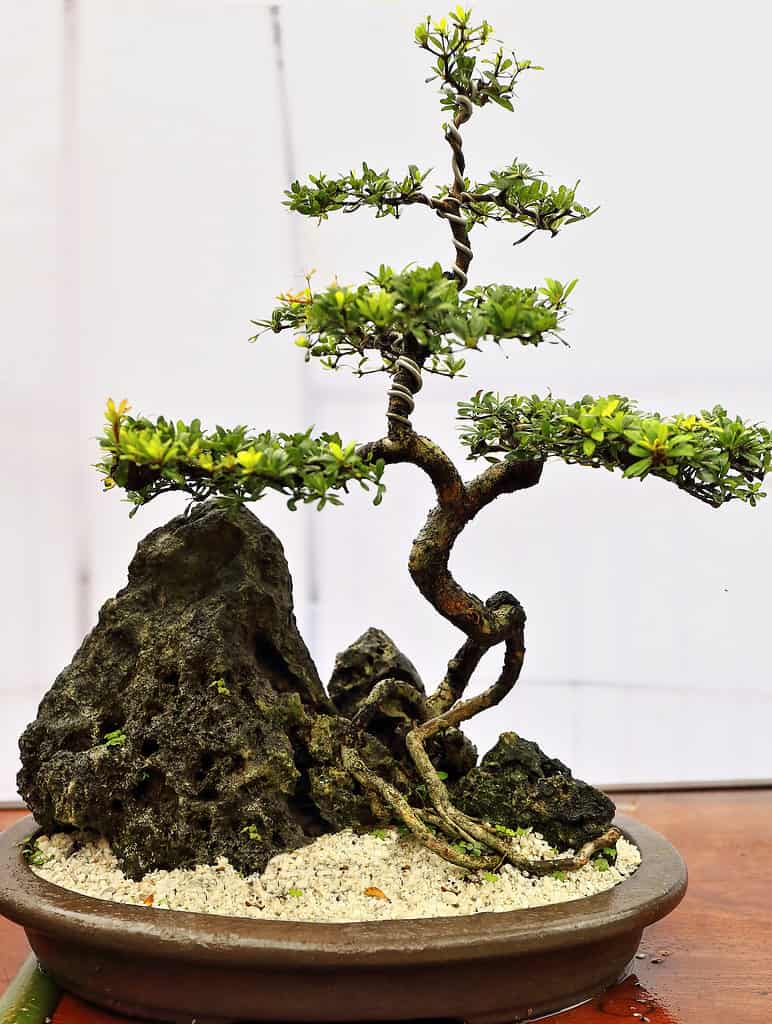
You can clearly see the supportive wiring on the bonsai. This helps support and shape the tree as it grows.
©rweisswald/Shutterstock.com
The Bucida spinosa is a rare, exotic small tree that has become beloved in the art of bonsai. The delicate tree is practically a bonsai all on its own and may be used indoors or outdoors, has a high tolerance for many different climates and zones (include coastal areas with high salt in the air), is incredibly beautiful and unique looking, and can be shaped in just about any bonsai style imaginable. It’s a fairly easy to care for bonsai species as well, making it an excellent choice for beginners and intermediate enthusiasts alike, though some do argue that it is better suited for non-beginners.
Black Olive Classification
The black olive bonsai, or Bucida spinosa, is not actually an olive tree producing edible fruits we think of as olives. The tree is native to the Florida Keys and the Caribbean and produces small seeds pods that look a bit like black olives. The tree is an evergreen, with a smooth gray to brown trunk, with compact foliage and horizontal layers of branches.
The tree is part of the Combretaceae family and is commonly known as either the spiny black olive, the dwarf black olive, or, when in bonsai form, the black olive bonsai. This is not the same family as the fruiting olive trees we are most familiar with. The edible olives we know primarily originate in the Mediterranean, while these trees come from the Caribbean.
Black Olive Description
The Bucida spinosa, when left to naturally grow, may reach heights of 10 feet or taller and produce compact foliage, no matter what size the plant becomes. They’re an evergreen plant that has smooth bark in grays and browns, with horizontal branch layers. The tree is sometimes considered a “natural” bonsai, as they never grow particularly large.
The dwarf black olive produces small, cream-colored or beige flowers during the growing season, and has dark, blue-green leaves that look and feel a bit leathery. There are small thorny spines along the branches, earning it the moniker “spinosa” (spines). The flowers have a mild floral aroma and the leaves turn red to orange before they fall, and new leaves start developing within a week in most cases.
The tree is naturally slow growing, however, so it will not recover if pruned back too severely.
Origins and History of Black Olive Bonsai
This tropical broadleaf evergreen grows natively in Cuba, parts of Florida, and the Bahamas. And while it is less common in the nursery industry, it grows commonly around the islands and throughout the Florida Keys.
Basic Care Notes on Black Olive
Though there is debate on how well beginners may do with black olive bonsai, there are some specific care needs you can keep in mind for best results, no matter your skill level.
Soil Needs
The best soil for black olive bonsai will be amended top soil, using organic peat humus or composted cow manure. The compost should be added to the hole as you plant, rather than blended in. Otherwise, use bonsai-recommended planting media.
When indoors, the black olive should be placed in south- or west-facing windows to receive maximum sun exposure, and when outdoors does best in full locations.
Planting Location
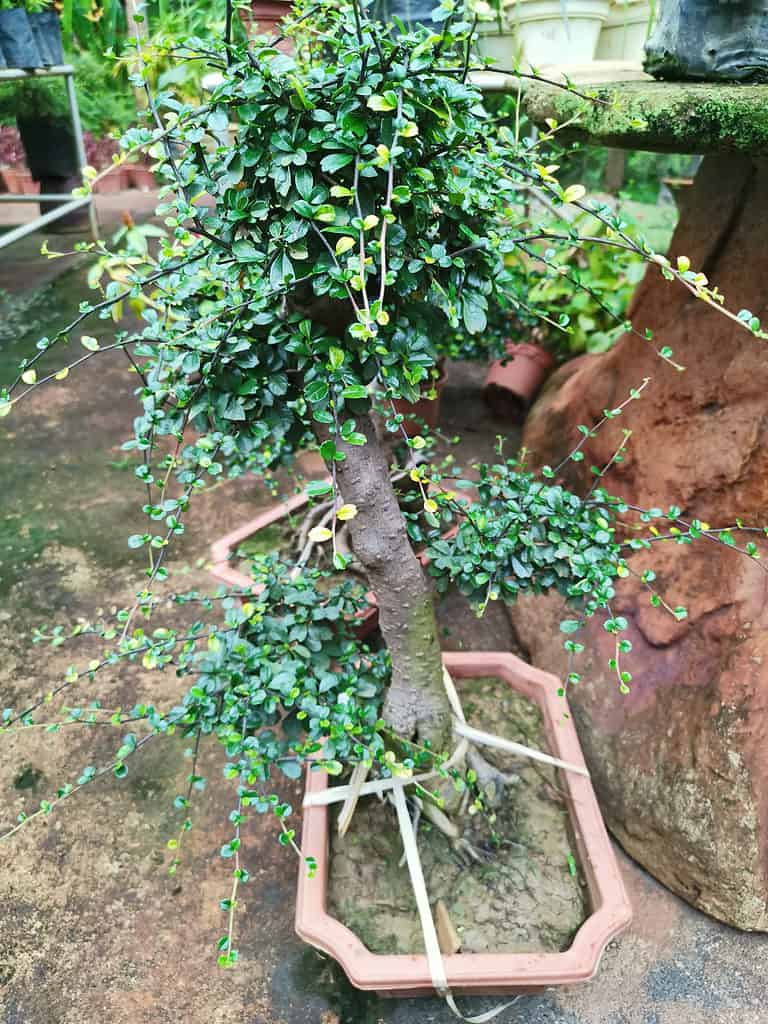
black olive bonsai in pot outdoors
©Young Swee Ming/Shutterstock.com
Because the black olive bonsai is a tropical plant, it needs full sun to really thrive. It should be kept outdoors in summertime and brought indoors when the weather cools off.
When indoors, the black olive should be placed in south- or west-facing windows to receive maximum sun exposure, and when outdoors does best in full locations.
Lighting
Dwarf black olives require a lot of sunlight to thrive, but they do need some protection or reduction of light in particularly hot months. They don’t give the usual warning signs of wilting, either, when they run out of water, so be sure to check on this regularly until you get the placement confirmed. In hot months, they should have afternoon shade.
Temperature & Humidity
The tree requires warm weather to thrive, favoring temperatures above 70 F when night falls. They may be kept outdoors until temperatures drop to about 50 F, though, during spring and autumn evenings, and should be brought indoors at that stage.
Ideally, they will have high humidity spaces with temperatures over 70 F, so many folks use greenhouses and grow tents in winter months to keep them healthy. You can also help improve humidity and moisture for the plant by keeping it in a bathroom with a shower, misting the leaves, and checking the soil frequently.
Watering
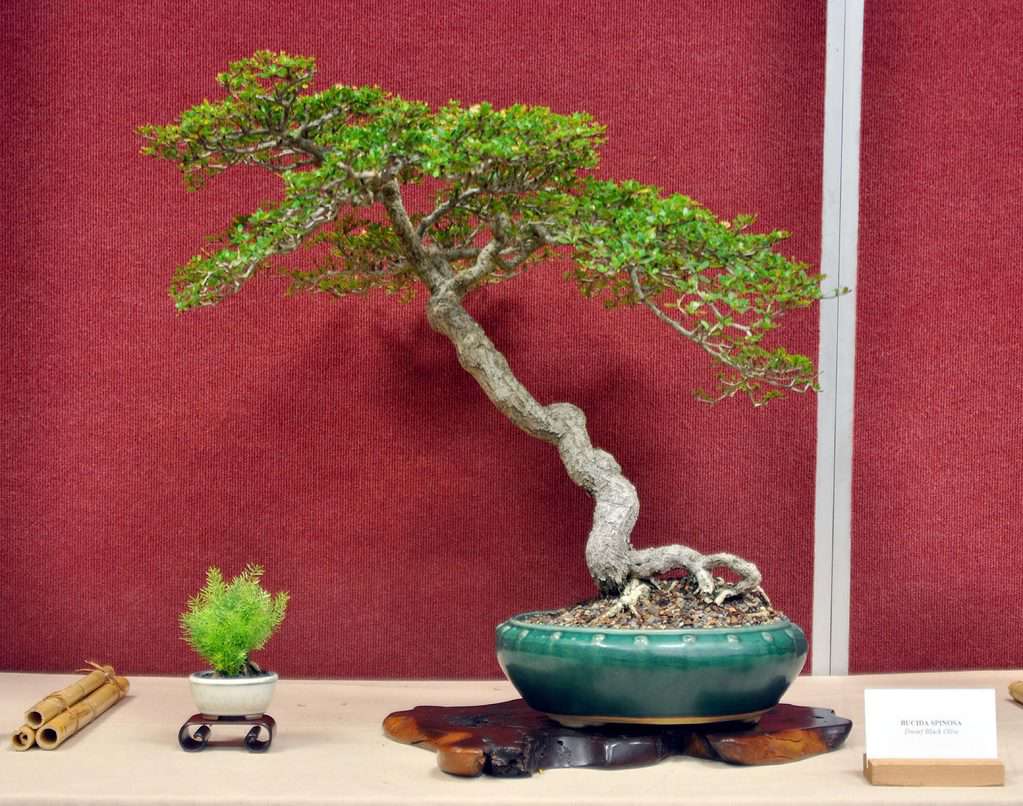
They thrive as indoor/outdoor bonsai.
©
Although they require well-draining soil to prevent root rot, black olive bonsai love their water. They need to be kept in moist soil all the time – and are actually endangered should their soil dry out, even for a day. This is probably the main reason some folks think only those with at least intermediate experience should keep black olive as bonsai.
Experts recommend using a moisture meter for black olive bonsai to ensure they don’t dry out and don’t get over watered, another potential issue for the plant.
Interestingly enough, younger black olive trees use a little less water than mature trees, so as the tree matures, increase the watering practices rather than reducing them, unless you note the soil moisture drops.
Water the plant evenly across the pot for best results, ensuring the pot drains properly and doesn’t collect stagnant water.
Many folks keep their bonsai trees (when indoors) in water trays filled with a layer of gravel with water poured over the gravel. The pots are placed in the trays, allowing the plant to absorb water through the tray when it dries out a little.
Feeding
This species of bonsai thrives with frequent feedings. Liquid bonsai fertilizer is generally considered the best choice for this species, and should be applied every month, save in the wintertime. During the growing season, use nitrogen-rich fertilizers and consider increasing feedings to twice monthly to encourage increased growth in springtime.
Do not apply fertilizer for three months after re-potting.
Pruning
The black olive bonsai is a slow grower and so does not need frequent pruning the way some species do. It’s important to be cautious when pruning, as well, to avoid cutting back too much and discouraging growth.
To encourage leaf production, pinch off the shoots rather than cutting them off, and always leave some new development on the plant. It will not produce new shoots on overly pruned branches.
You should also take great care in your pruning as the bark is delicate and may crack if treated roughly. This is another good reason to pinch – it prevents bark damage.
If the tree is in stage two of growth, allow the branches to elongate and develop into the desire thickness, rather than trimming back. Once it has reached this, then cut it back as far as the taper to find your desired length.
Typically, you’ll prune a mature black olive once annually with modifications only occasionally between.
Shaping
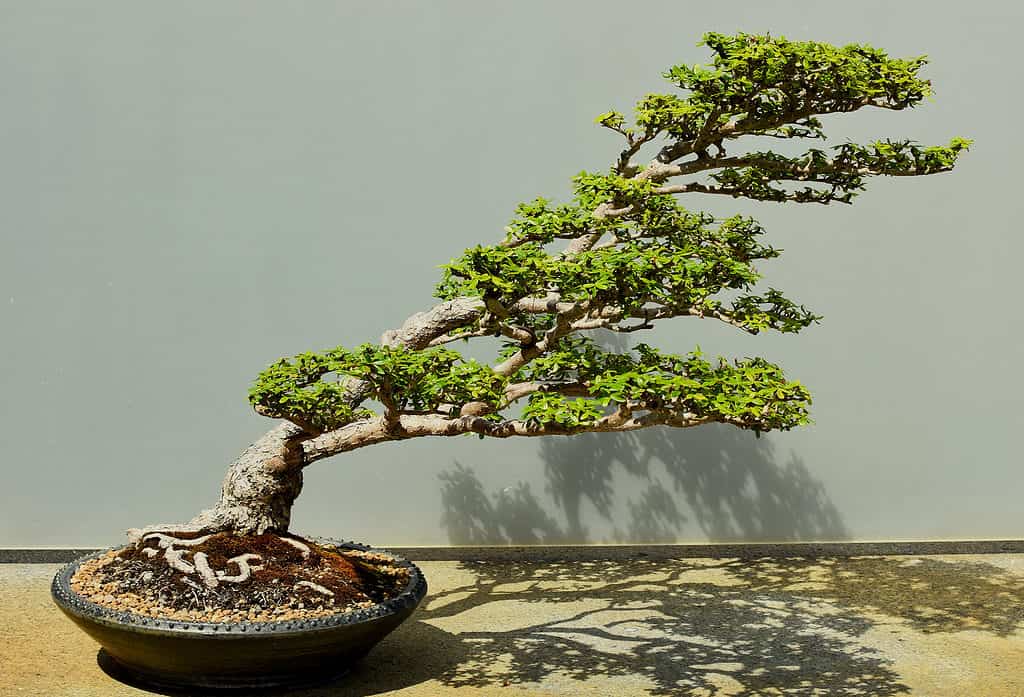
This tree is small, but it’s actually 60 years old! Black olive bonsai are definitely slow-growers.
©john fluent/Shutterstock.com
One of the most popular shaping styles for the black olive is the windswept shape. It easily and happily moves into this shape with gentle coaxing through proper wiring and care.
The tree will grow into other shapes as well, as properly trained, as long as you treat it gently and use aluminum wire (less harsh than copper) and give the tree enough sunlight, water, and time to develop.
Be careful of the bark as you style the tree, though, as it could easily be damaged by stray wire or trimmers. Some folks use raffia to protect the bark while shaping.
Wiring
When the black olive is young, the branches will modify most easily. This is when you should wire the tree, specifically during springtime and early summer only. Use aluminum wire to protect the bark, or if you’re able, protect with raffia and use copper wire for a stronger hold.
Re-potting
You should re-pot your black olive bonsai in early summer for best results. This should be redone every three or four years, while you maintain the plant with proper trimming and shaping, plenty of water and sunshine. If you discover your tree is growing more rapidly than anticipated, you may want to re-pot every two to three years instead.
Do not re-pot a very young black olive bonsai – instead, wait for secondary branch structure to appear.
When you do re-pot, be sure to trim no more than one-third of the roots, else you could irrevocably damage the tree’s delicate root system that’s slow-growing.
Common Problems of Black Olive
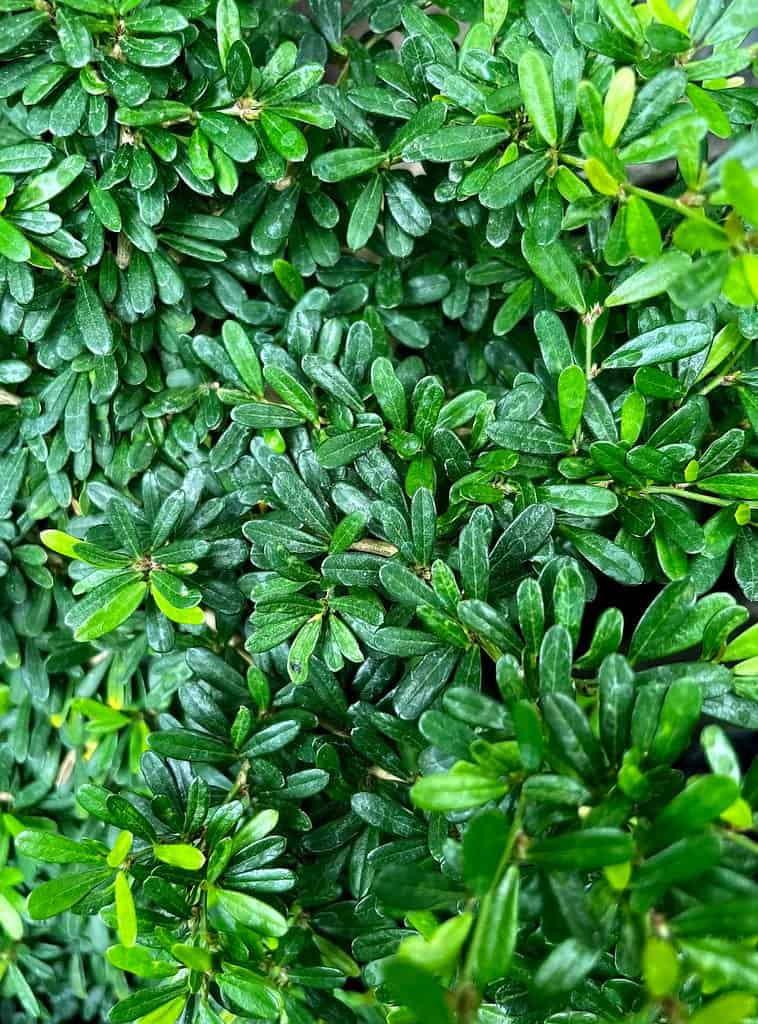
The Bucida spinosa foliage is vibrant and multi-shaded throughout its lifespan.
©SevyStocks/Shutterstock.com
Thankfully, the Bucida spinosa plant is relatively resistant to diseases and pests. There are a few potential issues, though, even if they are rare. Keep an eye out for the signs and treat immediately if you notice any of them.
Ants
Occasionally, black olive bonsai experience ant issues. Gentle insecticides will take care of these.
Aphids and Eryphide Mites
Similarly, bucida spinosa may occasionally have issues with aphid or eryphide mite infestations. A gentle insecticide should easily and quickly wipe them out.
Mold
Occasionally, mold may be a problem for black olive, particularly during rainy seasons and winter months. Use a gentle bonsai-friendly fungicide to treat the mold issue.
How to Propagate Black Olives
It should first be noted that even for experts, propagation of black olive bonsai is extremely difficult. For those who wish to attempt it, you may technically do it from seeds, stem cuttings, or using air layering. Some say that air layering is the easiest method, while others argue for starting from seeds, and yet others claim cuttings are the best method for propagation. For the purpose of this article, the techniques and methods required for propagation are more intricate than we can cover, however, here are some basics:
Seed Propagation
Seed germination rate is low, but if you go this route, you must attempt it during spring and summer months only, when there is plenty of high sunshine to help propagate the plants. The temperature must be above 50 F. If the seeds do sprout, it will be the following spring, as well, so you must maintain care for the seeds in the meantime.
For seed sowing, most folks say its best to drop the seeds into a propagation tray, allowing them to sow naturally. They should be kept indoors under grow lights and/or heat lamps to protect and nurture the seeds.
Cuttings
More commonly, softwood cuttings are used for propagation, per usual propagation methods.
That is:
- Clean cuttings taken from softwood of the tree with sterilized shears
- The cut ends are dipped into growth hormone and placed into soil
- The cuttings are kept in high humidity locales such as greenhouses and grow tents
- The cuttings are kept moist and provided with plenty of light
Black Olive Bonsai FAQs
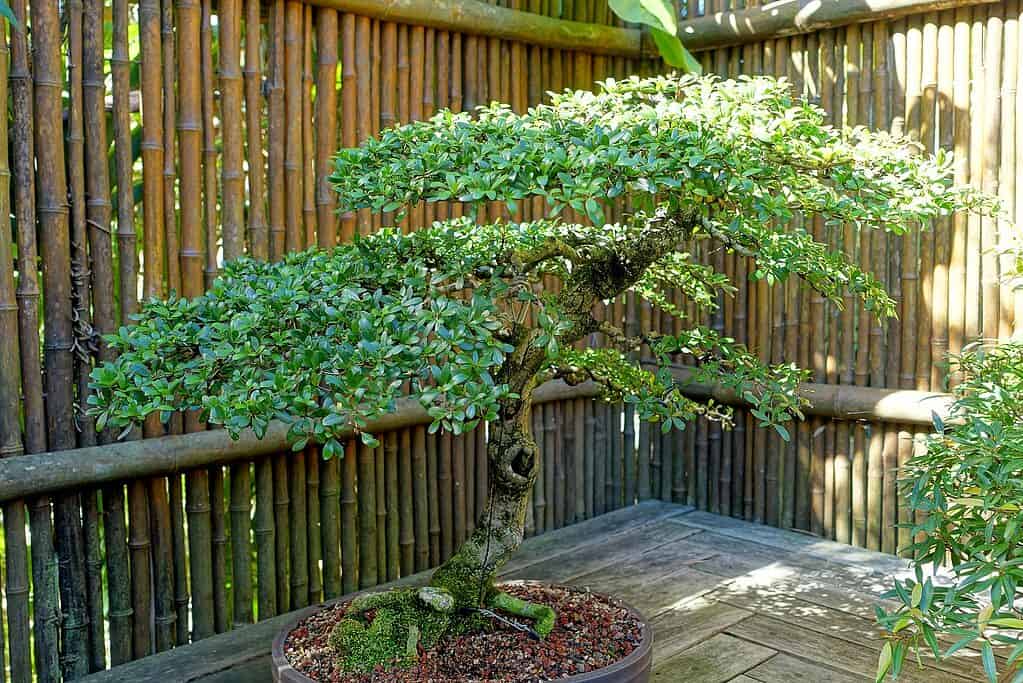
Bucida spinosa, or black olive bonsai, growing outdoors
©
Can you grow bonsai trees outdoors?
Most species of plants used as bonsai actually do better when grown outdoors, save in winter months in many cases. The black olive bonsai thrives in either indoor or outdoor locations, however, making it an excellent choice for most enthusiasts looking for flexible growing.
Are black olive bonsai better kept indoors or outdoors?
As noted above, black olive bonsai may be grown either indoors or outdoors. However, they thrive as a combination plant, living outdoors during the warmer months and living indoors during cooler, winter months.
They also do well in frost-free greenhouses year-round.
How do I find black olive bonsai trees for growing at home?
One of the main challenges with black olive bonsai is that they are actually quite challenging to propagate for non-experts. Instead, they will be found at retailers who specialize in the plant. They are a bit rare and quite exotic, so they will be expensive as well, unfortunately.
Find black olive bonsai in the Caribbean or in certain parts of Florida, or search online to purchase them from specific retailers such as such Etsy, Chinese Bonsai Garden, Gardino Nursery, and the occasional seller on Amazon. Depending on your region, you will find other retailers, as well, but bonsai experts are always the best choices for the highest quality plants.
How much should I prune my black olive bonsai?
Black olive bonsai are slow growers, so it’s important not to over-prune them. If the tree is mature and healthy, you should be able to prune back fairly heavily, leaving behind some growth. Young, less-established trees, however, should be lightly pruned to avoid stunting the plant.
Up Next:
- Discover the 20+ Different Types of Bonsai Trees
- Bonsai Styles: Everything You Need to Know
- The 10 Best Bonsai Trees for Beginners
- Discover the Oldest Bonsai Tree and Where to See It