First evolved 100 million years ago!
Advertisement
Ant Scientific Classification
- Kingdom
- Animalia
- Phylum
- Arthropoda
- Class
- Insecta
- Order
- Hymenoptera
- Family
- Formicidae
- Scientific Name
- Formicidae
Read our Complete Guide to Classification of Animals.
Ant Conservation Status
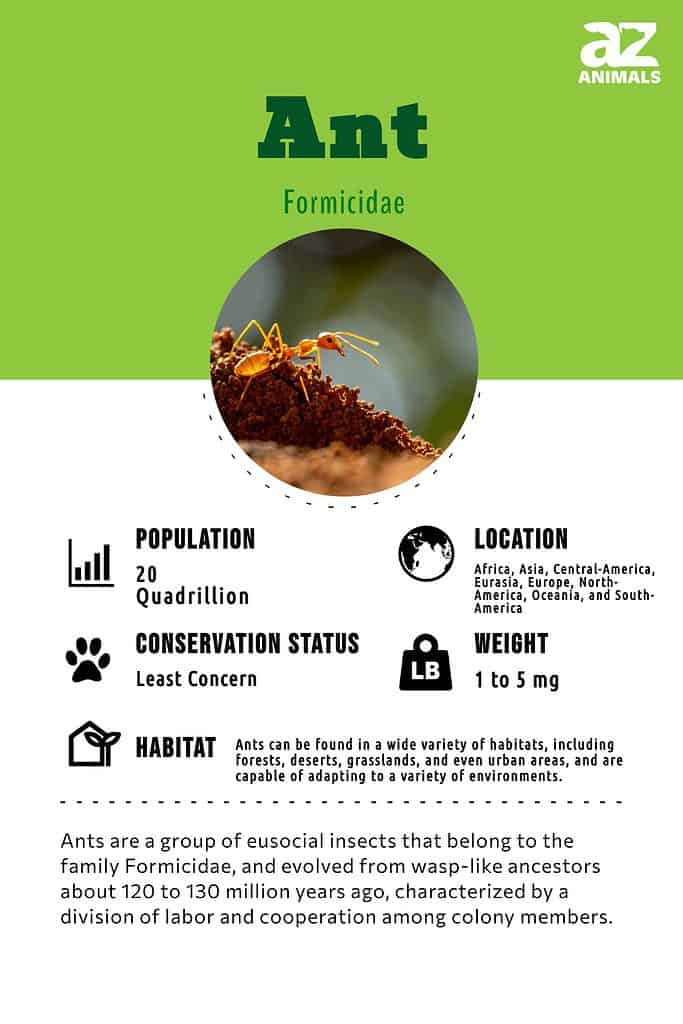
Ant Facts
- Main Prey
- Leaves, Fungi, Insects
- Habitat
- Soil and cavities in wood and plants
- Predators
- Insects, Echidna, Anteater
- Diet
- Omnivore
- Average Litter Size
- 1,000
- Favorite Food
- Leaves
- Common Name
- Ant
- Number Of Species
- 12000
- Location
- Worldwide
- Slogan
- First evolved 100 million years ago!





How to Add Us to Google News


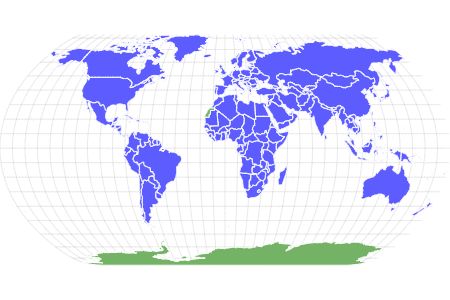
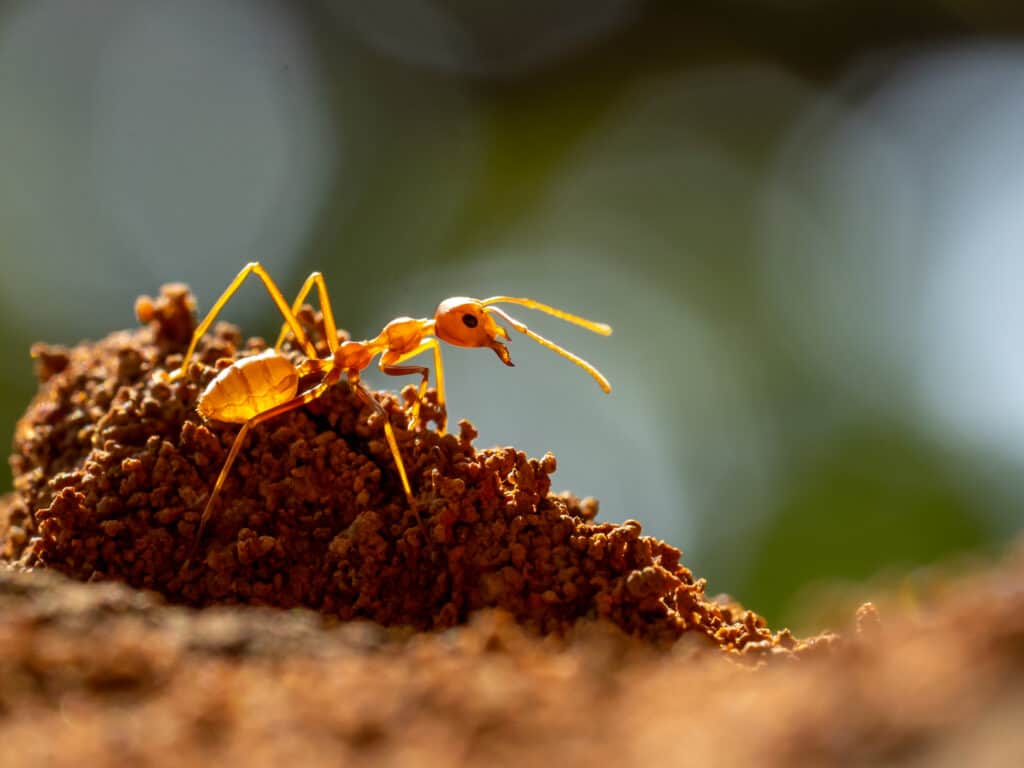
The ant is a small-sized invertebrate that is found all around the world, with the exception of the polar regions including the Arctic Circle and Antarctica. As with many other species of insect, there are numerous ant species inhabiting many different environments all around the world.
Incredible Ant Facts
There is a single “super ant colony” that stretches 3,700 miles along the Mediterranean coast.
©iStock.com/ritthichai
- There is a species of ants found nowhere else on Earth except for between 63rd and 76th streets in New York. Its name: ManhattAnt.
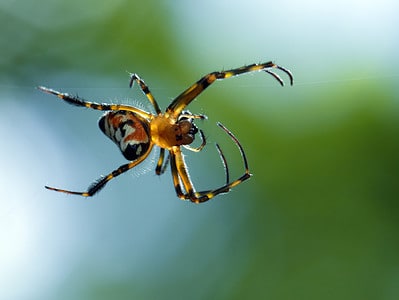
- More than 300 spider species have evolved to disguise themselves as ants as a predatory technique.
- There is a single “super ant colony” that stretches 3,700 miles along the Mediterranean coast.
- The largest ant species in the world is the Giant Amazonian, which can measure more than 1.5 inches in length!
Different Types of Ants
There are more than 12,000 recognized species of ant worldwide, but there are estimated to be nearly 14,000 in total. Ants are thought to have developed from wasp-like creatures 100 million years ago after blooming flowers appeared on Earth.
Bullet Ant (Paraponera clavata)
The bullet ant is known for its incredible sting which has been described as “the world’s most painful.” Pain from their sting is almost instantaneous and feels like a bullet that moves in waves for 12 hours or more.
The sting of bullet ants has long been used by local tribes in puberty rites and has no known long-term impacts.
What makes the bullet ant sting hurt so much? The ant delivers a neurotoxin known as ‘poneratoxin’ that disrupts the ability of nerve cells to send electrical signals, which causes extreme pain.
Bullet ants are found in colonies of 1,000 to 3,000 ants from Central America in the Amazon rainforest.
Argentine Ant (Linepithema humile)
Contrary to its name, the Argentine ant has been introduced across much of the world including the United States, Australia, and Japan. The Argentine ant is best known for its “super colonies” The longest stretching super colony that has been discovered is along the Mediterranean and stretches more than 3,700 miles!
A colony in California stretches more than 500 miles while other “super colonies” exist in places like Japan.
Black Garden Ant (Lasius niger)
The black garden ant is often known as the ‘common ant’ and is found across much of the world. Queens of the species have been recorded living up to 30 years. Colonies of black garden ants will reach up to 40,000 individuals, but more commonly have fewer than 10,000 workers.
Banded Sugar Ants (Camponotus consobrinus)
Banded sugar ants (or, sugar ants) are found across Eastralia’s East coast and is a common ‘pest’ in the environments it lives in. While banded sugar ants (true to their name) prefer sweets, they also are predators of other insects which they disable with a spray of formic acid. The species is mostly nocturnal.
Honeypot Ant (Formicidae)
Honeypot ants are a family (Formicidae) that use their own bodies as storage. The abdomen of ‘repletes’ — or a type of honeypot ant that’s adapted specially to store food — swells and collects nourishment. As the abdomen of repletes grows, they begin to resemble “honey pots.”
During dry seasons, worker ants drain repletes, providing valuable nutrition at a time of lean sustenance. This incredible adaptation makes honeypot ants ideal for desert climates, and they can be found in America’s southwest, the Sahara, and also in Australia.
Additional types include:
- Fire ant
- Carpenter ant
- Black garden ant
- Bullet ant
- Pharaoh ant
- Atta
- Oecophylla smaragdina
- Red wood ant
- Formica
- Yellow crazy ant
- Argentine ant
- Dorylus
- Ochetellus glaber
- Electric ant
- Myrmeciinae
- Meat ant
- Jack jumper ant
- Tetramorium immigrans
- Odontomachus
- Dinoponera
- Little black ant
- Cephalotes
- Messor
- Dolichoderinae
- Red harvester ant
- Myrmicinae
- Lasius
- Messor barbarus
- Formicinae
- Pheidole
- Myrmica rubra
- Yellow meadow ant
- Crematogaster
- Ponerinae
- Saharan silver ant
- Subterranean ant
- Longhorn crazy ant
- Acanthomyops
- Ponera
- Titanomyrma
- Lasius fuliginosus
- Eciton burchellii
- Myrmecocystus
- Brachymyrmex
- Giant forest ant
- Carebara diversa
- Monomorium
- Pseudomyrmex gracilis
- Pseudomyrmex ferruginea
- Harpegnathos venator
- Armania
Evolution and Origins
Ants are a group of eusocial insects that belong to the family Formicidae. They are believed to have evolved from wasp-like ancestors about 120 to 130 million years ago during the early Cretaceous period.
Ants developed eusocial behavior, in which individuals within a colony work together for the benefit of the colony as a whole, early on in their evolutionary history.
This behavior, along with their ability to farm and cultivate other organisms, has allowed ants to become one of the most successful groups of organisms on Earth, with millions of known species and a wide range of ecological roles.
Appearance and Behavior
Ants are found in many different sizes and vary in color depending on the species of ant. Some species of ant even have wings so are able to fly which only extends the range of their territory.
In the more humid environment of the tropical jungles of the Southern Hemisphere, the ants are generally of the bigger species, often reaching more than a few centimeters long.
Ants are extremely sociable insects and have a complex social structure where every ant individual has a purpose (effectively a job).
Ants live in colonies and have a social structure from the worker ants that gather the materials and food, as well as nursing and caring for the ant larvae (the babies), to the queen ant that runs the nest and is the only female that reproduces in her colony.
The queen ant often can live for over a year which is considerably longer than the lives of the worker ants which only really last for a couple of months. The queen ant produces between 800 and 1,500 eggs per day which are fertilized by the sperm of the male ants which is present in the nest.
Remarkably, ant eggs that have not been fertilized will still hatch but produce sterile female ants that become worker ants as they cannot reproduce.
Diet and Predators
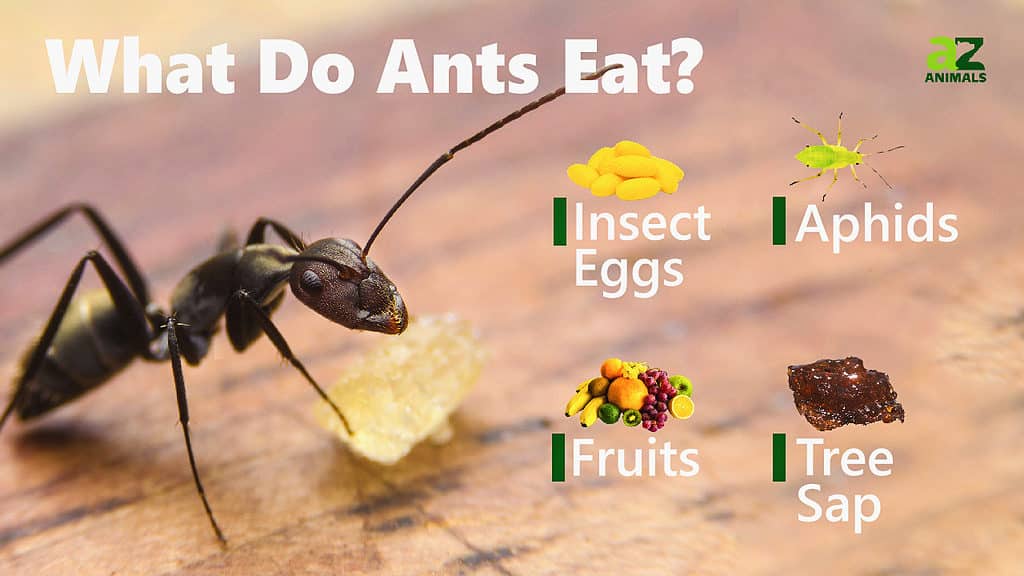
Ants are omnivorous animals and therefore eat a mixture of both plant and animal matter. The diet of the ant primarily consists of leaves, fungi, honey, nectar, small insects, and dead animals, although the exact diet of the ant depends on the species. Some ant species have a more herbivorous diet, whereas other species of ants mainly eat meat.
Due to their abundance and small size, ants have numerous animals that prey on them from tiny insects to reptiles, mammals, and fish, and even certain species of plants have also developed ways in which they can digest them.
An ant is said to be able to lift up to 50 times its own body weight and be able to be pulled more than 30 times its own body weight. This is the equivalent of an average human adult lifting a fully-grown African elephant! For a complete list of foods ants eat, check out our “What Do Ants Eat?” page.
View all 194 animals that start with A How to Add Us to Google News


Ant FAQs (Frequently Asked Questions)
Are Ants herbivores, carnivores, or omnivores?
Ants are Omnivores, meaning they eat both plants and other animals.
What Kingdom do Ants belong to?
Ants belong to the Kingdom Animalia.
What class do Ants belong to?
Ants belong to the class Insecta.
What phylum to Ants belong to?
Ants belong to the phylum Arthropoda.
What family do Ants belong to?
Ants belong to the family Formicidae.
What order do Ants belong to?
Ants belong to the order Hymenoptera.
What type of covering do Ants have?
Ants are covered in Shells.
Where do Ants live?
Ants are found worldwide.
In what type of habitat do Ants live?
Ants live in soil and cavities in wood and plants.
What is the main prey for Ants?
Ants eat leaves, fungi, and insects.
What are some predators of Ants?
Predators of Ants include insects, echidnas, and anteaters.
How many babies do Ants have?
The average number of babies an Ant has is 1,000.
What is an interesting fact about Ants?
Ants first evolved 100 million years ago!
What is the scientific name for the Ant?
The scientific name for the Ant is Formicidae.
How many species of Ant are there?
There are 12,000 species of Ant.
How do Ants have babies?
Ants lay eggs.
Do ants poop?
Yes, ants have an excretory system that makes poop.
What is the difference between a regular ant mound and a fire ant mound?
The most obvious difference is the presence of a nest entry. While other ants have nest entries that allow them to exit and pass into tunnels, fire ants do not have any nest entries on the mound itself.
How to say Ant in ...
Thank you for reading! Have some feedback for us? Contact the AZ Animals editorial team.
Sources
- David Burnie, Dorling Kindersley (2011) Animal, The Definitive Visual Guide To The World's Wildlife
- Tom Jackson, Lorenz Books (2007) The World Encyclopedia Of Animals
- David Burnie, Kingfisher (2011) The Kingfisher Animal Encyclopedia
- Richard Mackay, University of California Press (2009) The Atlas Of Endangered Species
- David Burnie, Dorling Kindersley (2008) Illustrated Encyclopedia Of Animals
- Dorling Kindersley (2006) Dorling Kindersley Encyclopedia Of Animals