E
Species Profile

Emperor Penguin

Aptenodytes forsteri

Winter dads of the Antarctic
Christopher Michel / CC BY 2.0, Flickr

Emperor Penguin Distribution

Click a location to explore more animals from that region

Endemic Species

This map shows coastal regions where Emperor Penguin are found.

Loading map...

Found in 1 country

Size Comparison

Human 5'8"
Emperor Penguin 3 ft 9 in

Emperor Penguin stands at 67% of average human height.

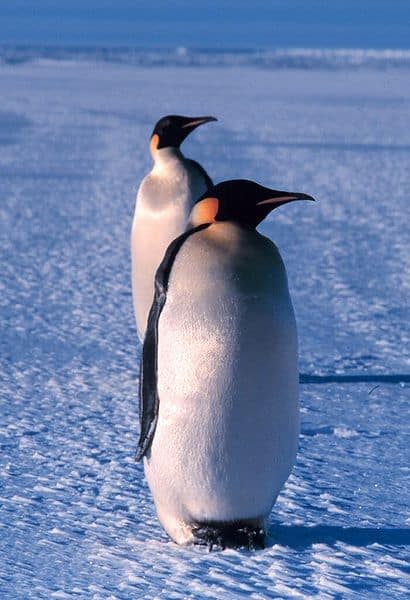
Emperor Penguins of Gould Bay

At a Glance

Wild Species
Also Known As Emperor (informal), Manchot empereur (French), Pingüino emperador (Spanish), Kaiserpinguin (German), Pinguim-imperador (Portuguese)
Diet Carnivore
Activity Cathemeral+
Lifespan 20 years
Weight 45 lbs
Did You Know?

Largest living penguin: adults typically 100-130 cm tall and ~22-45 kg depending on season/condition.

Scientific Classification

The Emperor Penguin is the largest living penguin species, endemic to Antarctica and famous for breeding during the Antarctic winter. It is a flightless seabird adapted for deep diving and extreme cold.

Kingdom
Animalia
Phylum
Chordata
Class
Aves
Order
Sphenisciformes
Family
Spheniscidae
Genus
Aptenodytes
Species
Aptenodytes forsteri

Distinguishing Features

  • Largest penguin species (very large, robust body)
  • Black head with ear patches and yellow-orange shading on neck/upper chest
  • Breeds on sea ice in winter; males incubate eggs on feet under a brood pouch
  • Excellent diver, capable of deep, prolonged dives

Physical Measurements

Males and females differ in size

Height
3 ft 11 in (3 ft 7 in – 4 ft 3 in)
3 ft 7 in (3 ft 3 in – 3 ft 11 in)
Weight
84 lbs (49 lbs – 99 lbs)
66 lbs (49 lbs – 88 lbs)
Tail Length
4 in (3 in – 4 in)
Top Speed
9 mph
Swims up to 15 km/h

Appearance

Primary Colors
Secondary Colors
Skin Type Emperor penguins have a dense waterproof feather coat with overlapping outer feathers and insulating down and thick fat. Exposed skin is mainly bill and feet; feet grip ice and use countercurrent heat exchange.
Distinctive Features
  • Largest living penguin: typical adult height ~110-120 cm; mass varies seasonally ~22-45 kg (heaviest pre-breeding, lightest post-fasting).
  • Flightless seabird with rigid, flipper-like wings and a streamlined, torpedo-shaped body for efficient underwater propulsion.
  • Deep-diving specialist: maximum recorded dive depth 564 m and maximum recorded dive duration 27.6 minutes (Kooyman et al., 1992).
  • Breeds during the Antarctic winter on sea ice (not on subantarctic islands): egg laying typically May-June; hatching mid-winter (commonly July-August), timed to spring/summer feeding opportunities for chick rearing (Stonehouse 1975; Williams 1995).
  • Male-only incubation: the male balances a single egg on the feet under a brood pouch and fasts through incubation for ~64 days on average (reported ~62-67 days in standard species accounts; e.g., Williams 1995).
  • Extreme-cold adaptation behavior: tightly packed huddling (often rotating positions within the huddle) to reduce heat loss during winter storms and temperatures well below 0°C on sea ice.
  • Diet/foraging appearance ecology: primarily feeds on Antarctic fish (e.g., Antarctic silverfish), krill, and squid; foraging trips are conducted at sea from sea-ice breeding colonies (Williams 1995 and later syntheses).
  • Long-lived for a seabird: commonly cited lifespan ~15-20 years; some individuals can exceed this in the wild (species accounts commonly note maxima in the several-decades range).
  • Feet set far back on the body for efficient swimming; upright posture on land/ice with characteristic waddling gait; often toboggans on belly across ice using feet and flippers.

Did You Know?

Largest living penguin: adults typically 100-130 cm tall and ~22-45 kg depending on season/condition.

Extreme divers: maximum recorded dive depth ~564 m and maximum dive duration ~27.6 min (instrumented dive studies; e.g., Kooyman et al.).

Winter breeders: courtship and egg-laying occur on sea ice during the Antarctic winter, when air temps can be below −40 °C with severe wind chill.

Male-only incubation: the male balances a single egg on his feet under a brood pouch for ~64-67 days, fasting through most of that period.

Chick nursery groups: after chicks can thermoregulate better, they often gather in groups while adults forage at sea.

High feather density: penguin plumage is often cited at up to ~15 feathers per cm², forming a tight, insulating, waterproof layer.

Signature prey includes Antarctic silverfish plus krill and squid-diet varies by region and season in Antarctic waters.

Unique Adaptations

  • Cold-proof body design: thick subcutaneous fat and a small bill/fin extremities relative to body size reduce surface-area heat loss.
  • Multi-layer insulation: densely packed, overlapping feathers with air-trapping underplumage plus waterproofing oils maintain a dry insulating boundary layer.
  • Counter-current heat exchange: blood vessels in flippers and legs conserve core heat while allowing extremities to stay cooler, reducing overall heat loss.
  • Respiratory and oxygen stores for deep diving: high myoglobin in muscles and large blood oxygen capacity support long, deep foraging dives (key to exploiting winter prey).
  • Streamlined, rigid "flippers": modified wings act as efficient hydrofoils for powerful underwater propulsion while remaining flightless on land.
  • Behavioral thermoregulation via huddling and posture: individuals can reduce exposed surface area, tuck head/feet, and share a warmer microclimate within the group.
  • Ice-based life cycle timing: breeding on sea ice synchronizes chick growth so fledging occurs in summer when food is more available and daylight increases.

Interesting Behaviors

  • Sea-ice winter breeding: adults commute from ocean feeding areas to stable sea ice for courtship, mating, and incubation during the darkest months.
  • Male fasting and incubation posture: males keep the egg elevated on their feet, covered by a warm brood fold; they minimize movement to prevent egg exposure to ice.
  • Tight huddling ("turtle" formation): adults pack together and continuously rotate positions-outer birds move inward-reducing heat loss and wind exposure during storms.
  • Long-distance mate/parent reunion: adults use vocal individuality (two-voice syrinx calls) to locate mates and chicks within dense colonies.
  • Chick brooding shift: once the female returns from feeding, parents alternate foraging trips, timing returns to the chick's growing energy demands.
  • Porpoising travel: when moving quickly at sea, they may leap in and out of the water to reduce drag and evade predators.
  • Deep foraging strategy: dives often include a rapid descent, active pursuit at depth, then controlled ascent with reduced effort and long surface recovery after the deepest bouts.

Cultural Significance

Emperor penguins (Aptenodytes forsteri) are icons of endurance and parent care. Males incubate eggs during the Antarctic winter. They appear in films like 'March of the Penguins' and are flagship species for Antarctic conservation and climate talks because they need sea ice.

Myths & Legends

Antarctica has no Indigenous human cultures, so there is no documented traditional pre-colonial folklore specifically about emperor penguins; their "mythic" status is largely modern and tied to exploration and media.

Name-origin tradition: the common name "Emperor" reflects 19th-century European naming habits for striking, large animals; the species epithet forsteri honors the naturalist Johann Reinhold Forster (via later taxonomic naming).

Exploration-era anecdote: during early 20th-century British Antarctic expeditions, emperor penguin eggs and embryos were collected as prized scientific specimens-later retold as dramatic tales of hardship and curiosity at the end of the world.

Popular stories often make the emperor penguin, Aptenodytes forsteri, winter march and males' incubation fast sound like a heroic test. They turn real animal behavior into a moral tale about perseverance and family roles.

Conservation Status

NT Near Threatened

Likely to qualify for a threatened category in the near future.

Population Decreasing

Protected Under

  • Antarctic Treaty System (ATS) - establishes Antarctica as a natural reserve devoted to peace and science and provides a framework limiting harmful human activities in the species' range.
  • Protocol on Environmental Protection to the Antarctic Treaty (Madrid Protocol, 1991; in force 1998) - requires environmental impact assessment and strong protections against pollution and ecosystem damage.
  • CCAMLR (Convention on the Conservation of Antarctic Marine Living Resources, 1980) - regulates Southern Ocean fisheries (including krill) and establishes tools such as ecosystem-based management and Marine Protected Areas relevant to emperor penguin foraging habitats.
  • CITES - international trade in penguins is controlled; Aptenodytes forsteri is listed by CITES (trade controls apply even though trade is not a major current threat).

Life Cycle

Birth 1 chick
Lifespan 20 years

Lifespan

In the Wild
15–40 years
In Captivity
20–25 years

Reproduction

Mating System Monogamy
Social Structure Socially Monogamous
Breeding Pattern Seasonal
Fertilization Internal Fertilization
Birth Type Internal_fertilization

Emperor penguins (Aptenodytes forsteri) are seasonal monogamous: pairs form in colonies each season and use calls to find mates. They lay one egg; the female gives it to the male, who keeps it warm on his feet 62–67 days while she feeds at sea. Parents take turns feeding chick.

Behavior & Ecology

Social Colony Group: 10000
Activity Cathemeral, Diurnal
Diet Carnivore Antarctic silverfish (Pleuragramma antarcticum)

Temperament

Very social and tolerant near each other while breeding. They huddle tightly and touch often. They are not very territorial (no fixed nests) and keep space with posture and short threats.
Can be assertive/aggressive in immediate contexts (e.g., protecting the egg/chick on the feet, jostling within huddles/along colony 'traffic lanes'), using pecks, flipper pushes, and threat postures; conflicts are usually brief rather than prolonged fights.
Emperor Penguin (Aptenodytes forsteri) shows strong care: males fast while sitting on eggs, and both parents take many feeding trips to feed chicks. They live about 15–20 years or more.

Communication

Individually distinctive mutual-display and contact calls used for mate recognition and parent-chick reunion in dense colonies; emperor penguins are a classic model for acoustic individual recognition in penguins E.g., Jouventin 1982; Aubin & Jouventin 2002
Courtship 'ecstatic'/trumpeting calls during pair formation and colony display; call structure supports long-range transmission in windy, noisy colony environments Described in penguin behavioral literature: Jouventin 1982; Williams 1995
Chick begging calls and adult-chick contact calls that facilitate feeding and identification when returning from foraging.
Visual displays (upright stance, bill pointing, head-swaying, flipper/wing gestures) in courtship and threat; posture is important at close range because individuals are often packed tightly together in huddles.
Tactile interactions Bill touching, body contact) between mates and in huddles; physical contact is a routine part of thermoregulatory behavior in winter huddling (Stonehouse 1953; Gilbert et al. 2006
Spatial/behavioral coordination in huddles Collective compaction and slow rotation) functioning as a group-level thermoregulation mechanism; participation and intensity vary with ambient conditions and breeding stage (Gilbert et al. 2006

Habitat

Coastal Open Ocean Seabed/Benthic Deep Sea Tundra
Biomes:
Terrain:
Coastal Island
Elevation: Up to 328 ft 1 in

Ecological Role

Upper-level marine mesopredator in Antarctic coastal and pack-ice food webs; transfers energy from mid-trophic prey (fish, krill, squid) to higher predators and to breeding colonies on land/sea ice.

Regulates populations of key mid-trophic prey (notothenioid fish, euphausiids, cephalopods) through predation Biological nutrient transport and local fertilization via guano deposition at colonies (links marine-derived nutrients to terrestrial/sea-ice ecosystems) Serves as an ecological indicator of Antarctic marine conditions (prey availability/sea-ice dynamics reflected in diet and foraging behavior) Provides prey biomass to apex predators (e.g., leopard seals, killer whales), supporting higher trophic levels

Diet Details

Main Prey:
Antarctic silverfish Bald notothen Antarctic notothens Antarctic krill Crystal krill Antarctic glacial squid Giant warty squid Antarctic octopods Ice-associated amphipods +3

Human Interaction

Domestication Status

Wild

Emperor penguin (Aptenodytes forsteri) is fully wild and not domesticated or bred for people. Some have been captured for research or short displays, but long-term captivity is rare because they need constant cold, large saltwater pools, special food, and get stressed easily. Human disturbance at breeding colonies can harm them.

Danger Level

Low
  • Bites/pinches and flipper strikes if handled or cornered (can break skin; risk increases during breeding and molting when stressed).
  • Zoonotic/occupational exposure risks for researchers/handlers (e.g., Salmonella spp., Campylobacter spp., and avian influenza surveillance concerns in captive or high-contact contexts).
  • Environmental hazard dominates: most serious human risks arise from working in emperor penguin habitat (extreme cold, crevasses, sea-ice instability), not from the animal itself.

As a Pet

Not Suitable as Pet

Legality: Emperor penguins (Aptenodytes forsteri) are not legal or practical as private pets. They are protected by the Antarctic Treaty and national laws; handling needs permits for research, conservation, or in approved zoos.

Care Level: Expert Only

Purchase Cost:
Lifetime Cost:

Economic Value

Uses:
Scientific research and monitoring (climate/sea-ice indicator species) Education and outreach (symbolic/flagship species) Wildlife media and documentary production Limited ecotourism value (indirect; emperor colonies are remote and access is constrained)
Products:
  • non-consumptive ecosystem services (public engagement, conservation fundraising value)
  • research outputs (datasets, publications, instrumentation testing in extreme environments)
  • media content (documentaries/photography licensing)

Relationships

Predators 4

Leopard Seal
Leopard Seal Hydrurga leptonyx
Killer Whale
Killer Whale Orcinus orca
South Polar Skua Stercorarius maccormicki
Southern Giant Petrel Macronectes giganteus

Ecological Equivalents 4

Animals that fill a similar ecological role in their ecosystem

Weddell Seal Leptonychotes weddellii Antarctic pack- and fast-ice-associated diver that forages under sea ice, overlapping with emperor penguins in winter sea-ice habitat use and reliance on sub-ice breathing/escape holes. Both are extreme cold-adapted, deep-diving predators in the Southern Ocean.
Southern Elephant Seal Mirounga leonina Southern Ocean deep-diving endotherm that performs long-duration, deep pelagic dives and exploits similar prey fields (fish and squid) in cold waters. Ecologically analogous as a large-bodied, capital-breeding marine predator that forages far from land or ice.
Antarctic Shag Leucocarbo bransfieldensis An Antarctic seabird that forages by pursuit-diving for fish in cold coastal waters. Shares the functional niche of underwater, foot-propelled pursuit predation, though at much shallower depths than emperor penguins.
Crabeater Seal
Crabeater Seal Lobodon carcinophaga Pack-ice specialist that tracks sea-ice dynamics and feeds heavily on krill. Ecologically overlaps with emperor penguins, which also consume euphausiids; both are strongly structured by sea-ice availability and seasonal ice-edge productivity.

“The emperor penguin is the largest penguin species on Earth.”

The emperor penguin is the largest species of penguin in the world and also one of the most unique. Instead of breeding in the warmer summer months like other penguin species, emperor penguins lay and incubate their eggs during the winter in frigid Antarctica, where they live. Due to the fact that emperor penguins breed on the ice, they are believed to be one of the only bird species that can spend their entire life without actually walking on land.

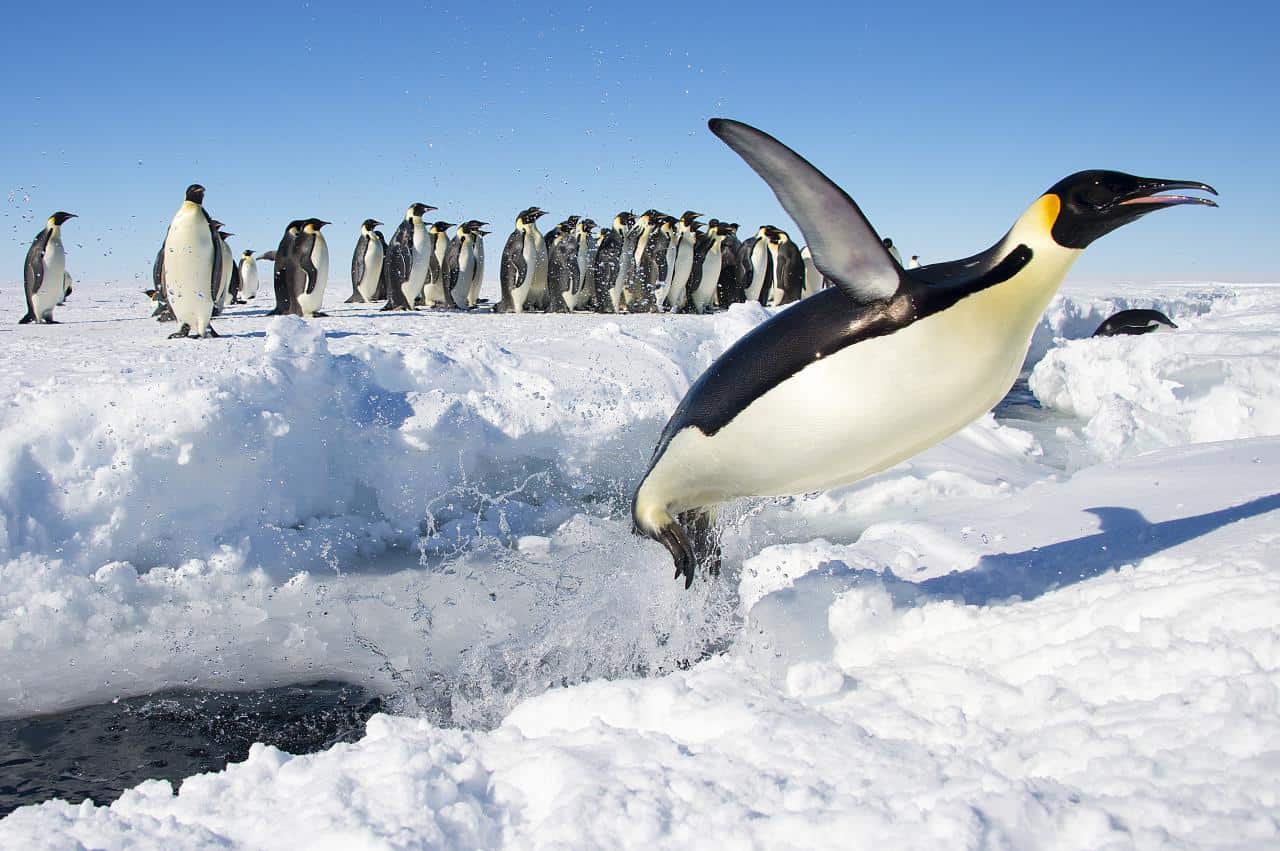
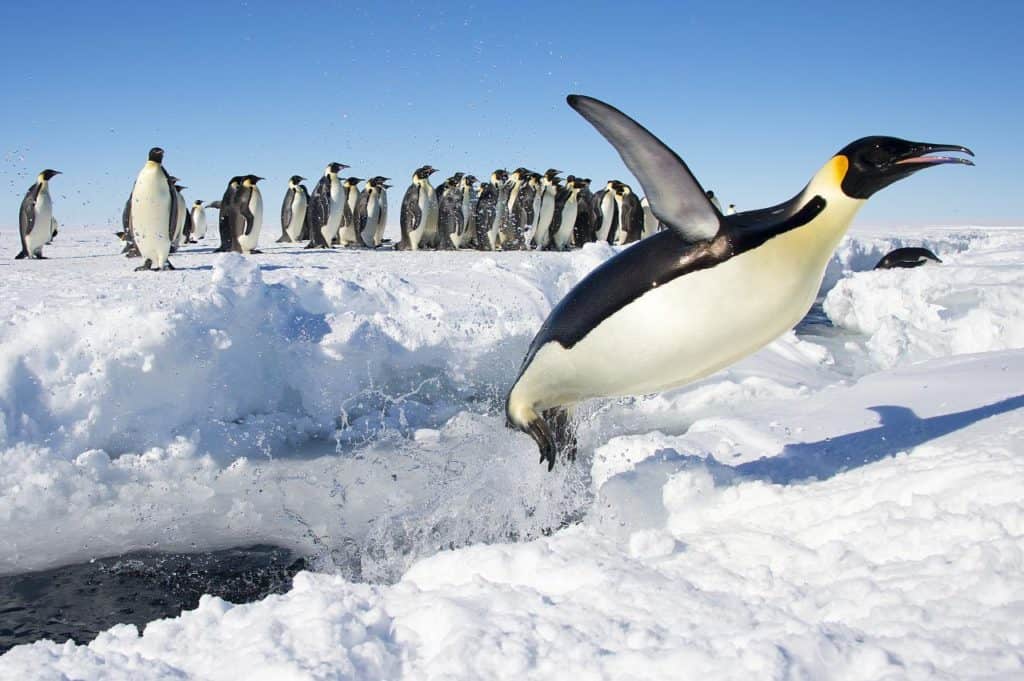
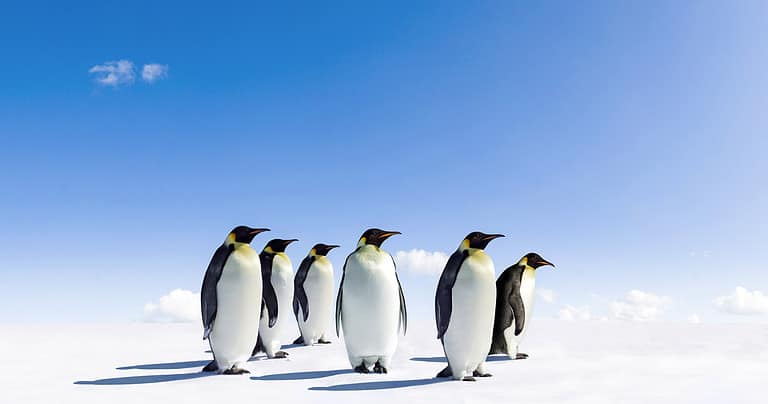
A majestic Emperor penguin stands gracefully on an ice floe in Antarctica, surrounded by stunning icy landscapes under a clear blue sky. Perfect for wildlife and nature themes.

The largest species of penguin, the emperor penguin lives its life in one of the harshest and coldest environments in the world—Antarctica.

Despite having first been recorded by Captain Cook in the late 1790s, the first emperor penguin colony wasn’t discovered until 1902. Because they dwell in such extreme southern climes that are difficult to reach, new colonies were still being discovered as late as 1986.

Anatomy and Appearance

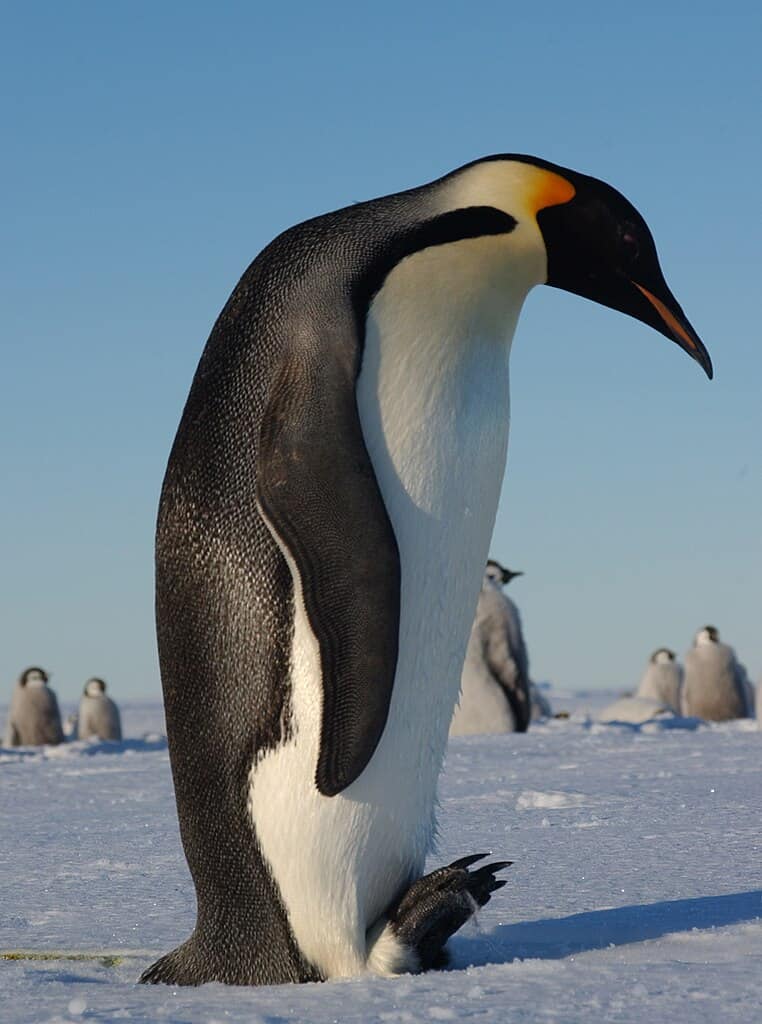
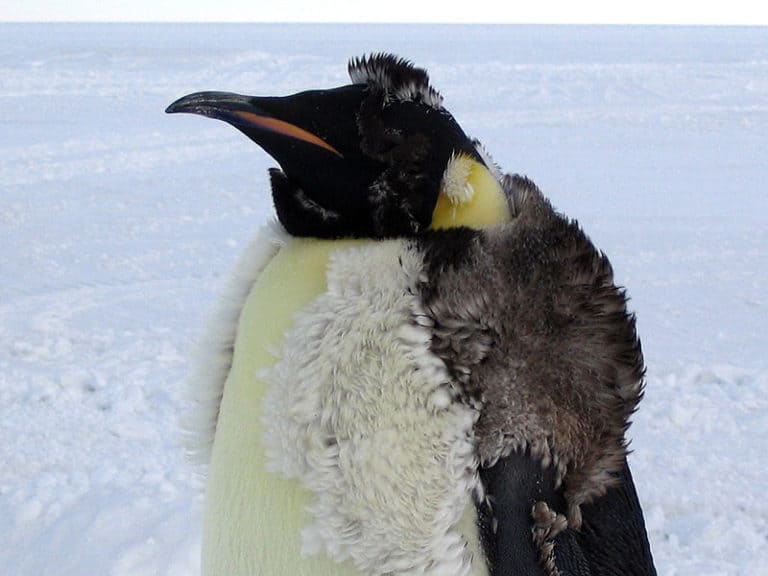
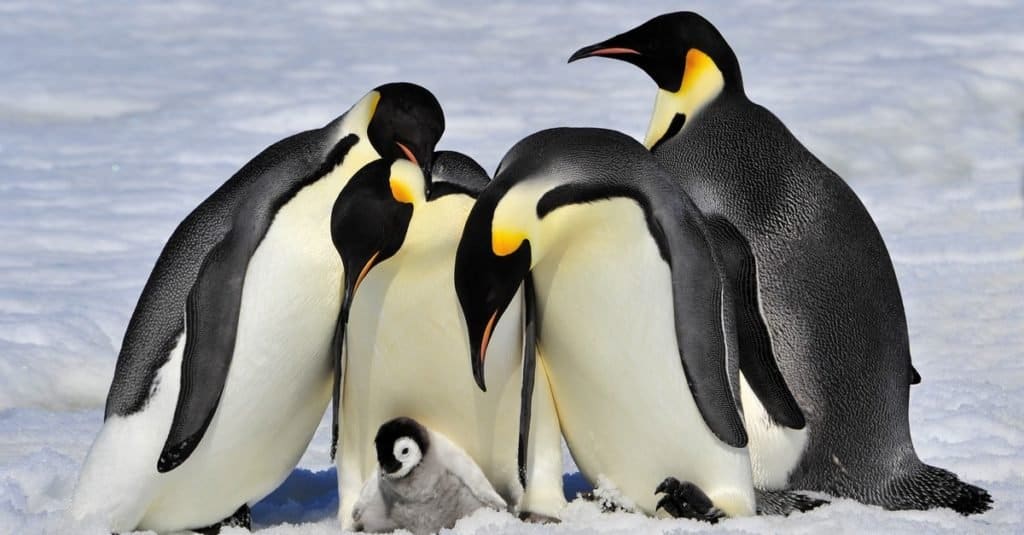
Emperor penguins are large birds that stand around 4 feet high and weigh up to 100 pounds. They have black feathers on the back, white feathers on the front, a yellow patch on the neck and an orange stretch along their beak. The black and white coloring is thought to be particularly important for camouflaging the emperor penguin from predators while they swim in the ocean. They also have webbed feet, which help with swimming but provide little assistance when traveling on land. They seemingly find it easier to slide along on their bellies. In order to keep themselves warm in such hostile conditions, they have a triple layer of dense, oily, and waterproof feathers and a thick layer of blubber under their skin. They are also well-adapted for swimming with their streamlined bodies gliding through the water, propelled by their small, rigid wings.

Evolution

Fossil records indicate that emperor penguins’ earliest common ancestor lived as long as 60 million years ago — soon after the dinosaur extinction. Later penguin ancestors are believed to have originated in New Zealand and Australia around 22 million years ago. Changes in climate and ocean currents enabled penguins to spread across the Southern Hemisphere. The modern emperor penguin likely evolved much later within the last few million years to adapt to the harsh arctic climate.

Distribution and Habitat
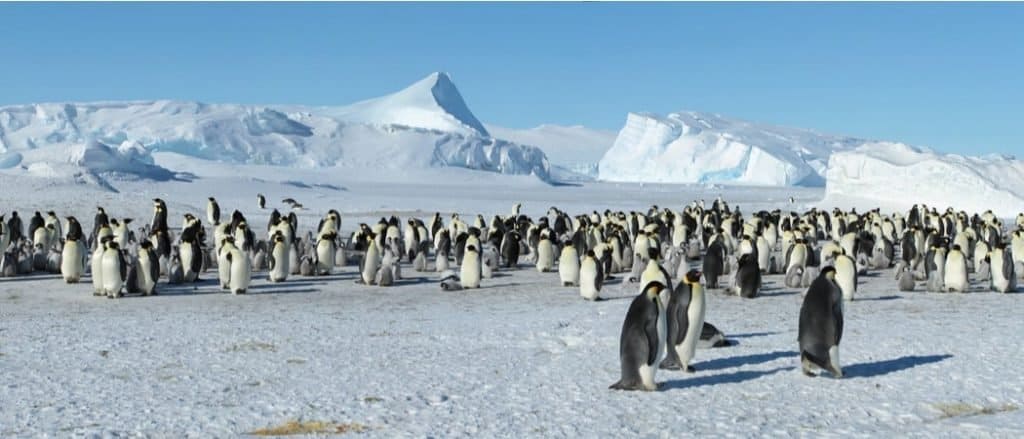
Animals in Antarctica

Emperor penguins can travel distances up to 125 miles across the ice to reach their breeding colony.

Emperor penguins inhabit the compacted ice along the coast of Antarctica with some colonies established up to 11 miles inland. Unlike a number of other penguin species that may visit the continent from time to time, the emperor penguin does not migrate north and instead spends the whole year deep in the Antarctic Ocean.

Behavior and Lifestyle

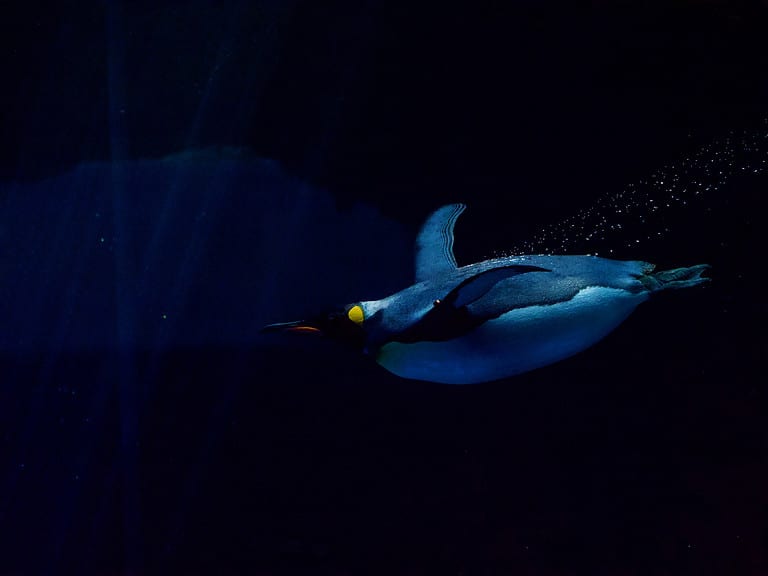
Emperor penguins are incredibly sociable birds that live together in colonies containing thousands of individuals. After finding a mate, emperor penguins remain true to each other for life and use vocal calls to find each other again when they return to the breeding site. They are excellent swimmers known to leap out of the water when traveling at a high speed in the same way dolphins do. Known as “porpoising,” it allows the emperor penguin to breathe without having to slow down.

Emperor penguin in Natarctica standing and walk on snow

Penguins are excellent swimmers capable of “porpoising” to the surface for a quick breath of air.

Emperor penguins are also known to dive to depths of more than 1,640 feet (500 meters) making them the deepest diving birds in the world, where they are able to hold their breath for up to 20 minutes at a time. Usually traveling at speeds up to 6.2 mph but capable of swimming nearly 15 mph, emperor penguins can travel as far as 621 miles on a foraging trip.

Reproduction and Nesting

Emperor penguins breed during the cold, dark, harsh winter months. They begin arriving in their breeding colonies between March and April and once having found their mate, the females will lay a single egg sometime from May to June. The egg is quickly transferred to the male who rests it on his feet to keep it off the frozen ground. He covers it with a warm brood pouch that keeps the egg warm. Female emperor penguins then leave for the open ocean, where they forage for food for two whole months, leaving the males to look after the eggs during the winter months.
Animal Facts: Penguins

Emperor penguins are heavy birds with layers of blubber to protect them against the icy climate.

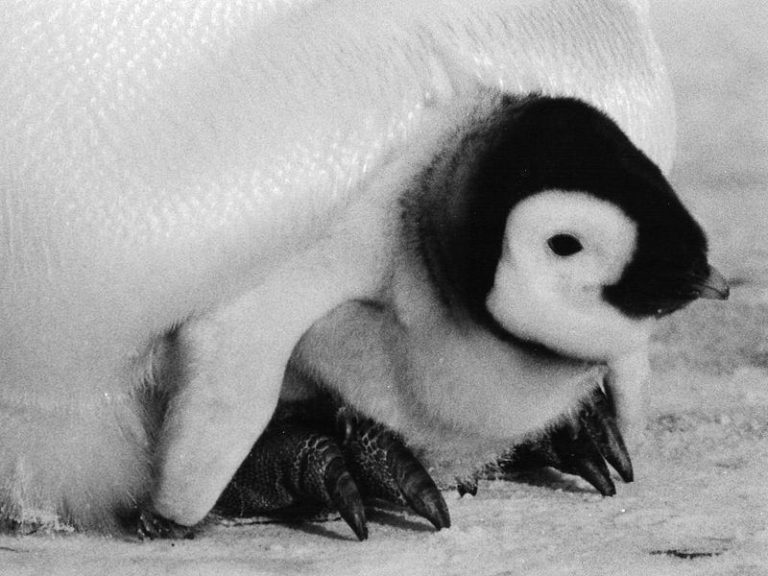
Temperatures can reach -76°F. With winds of up to 100 mph, the male emperor penguins huddle together for warmth, alternating between the outskirts and the middle to ensure all members of the colony keep warm. The eggs hatch in spring after approximately 70 days. This coincides with the return of the females, who feed the young and keep them warm using their brood pouch on their tummies, while the males then head off to find food.

Diet and Prey

The emperor penguin is a carnivorous animal that only hunts and eats animals in the surrounding water in order to survive. Emperor penguins eat mostly fish but also supplement their diets with krill, other crustaceans, and squid. Like other penguin species, emperor penguins are equipped with a spiky tongue for help when eating slippery fish. Chicks rely on their parents to collect food for them. Males and females feed the fast-growing chick by regurgitating a fishy paste from their stomachs into the chick’s mouth.

Predators and Threats

Emperor penguins are preyed upon by a number of large, marine carnivores, but their exact predators vary between geographic locations. Vulnerable emperor penguin chicks are preyed upon by the enormous Southern Giant Petrel, an animal thought to be responsible for more than 30% of chick deaths. Adult emperor penguins and chicks alike are preyed upon by leopard seals and killer whales.
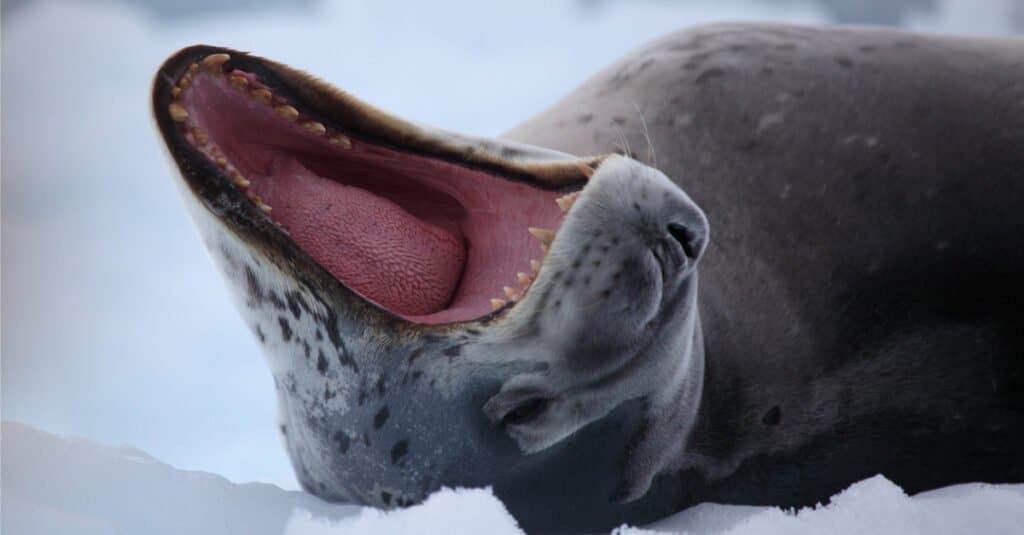
Leopard Seal Teeth - Leopard Seal

Leopard seals prey on adult emperor penguins.

Conservation Status

Today, the emperor penguin is listed by the IUCN as a species that is Near Threatened to becoming extinct in the wild in the near future. There are thought to be around 595,000 emperor penguins in the Southern Ocean and although populations are relatively stable, they are being increasingly affected by the rapidly melting ice and the higher levels of human activity around Antarctica. The IUCN projects a 27% decrease in the population of emperor penguins over the next 61 years with all colonies living north of 67°S disappearing by 2052 due to the melting of sea ice.

View all 185 animals that start with E
How to say Emperor Penguin in ...
Bulgarian
Императорски пингвин
Catalan
Pingüí emperador
Czech
Tučňák císařský
Danish
Kejserpingvin
German
Kaiserpinguin
English
Emperor Penguin
Esperanto
Imperiestra pingveno
Spanish
Aptenodytes forsteri
Estonian
Keiserpingviin
Finnish
Keisaripingviini
French
Manchot empereur
Hebrew
פינגווין קיסרי
Croatian
Carski pingvin
Hungarian
Császárpingvin
Indonesian
Penguin Kaisar
Italian
Aptenodytes forsteri
Japanese
コウテイペンギン
Dutch
Keizerspinguïn
English
Keiserpingvin
Polish
Pingwin cesarski
Portuguese
Pinguim-imperador
English
Pinguin imperial
Slovenian
Cesarski pingvin
Swedish
Kejsarpingvin
Turkish
İmparator penguen
Chinese
皇帝企鹅

Sources

  1. David Burnie, Dorling Kindersley (2011) Animal, The Definitive Visual Guide To The World's Wildlife / Accessed August 24, 2009
  2. Tom Jackson, Lorenz Books (2007) The World Encyclopedia Of Animals / Accessed August 24, 2009
  3. David Burnie, Kingfisher (2011) The Kingfisher Animal Encyclopedia / Accessed August 24, 2009
  4. Richard Mackay, University of California Press (2009) The Atlas Of Endangered Species / Accessed August 24, 2009
  5. David Burnie, Dorling Kindersley (2008) Illustrated Encyclopedia Of Animals / Accessed August 24, 2009
  6. Dorling Kindersley (2006) Dorling Kindersley Encyclopedia Of Animals / Accessed August 24, 2009
  7. Christopher Perrins, Oxford University Press (2009) The Encyclopedia Of Birds / Accessed August 24, 2009
  8. Emperor Penguin Facts / Accessed August 24, 2009
  9. Emperor Penguin Information / Accessed August 24, 2009
  10. Emperor Penguin Conservation / Accessed August 24, 2009
Abby Parks

About the Author

Abby Parks

Abby Parks has authored a fiction novel, theatrical plays, short stories, poems, and song lyrics. She's recorded two albums of her original songs, and is a multi-instrumentalist. She has managed a website for folk music and written articles on singer-songwriters, folk bands, and other things music-oriented. She's also a radio DJ for a folk music show. As well as having been a pet parent to rabbits, birds, dogs, and cats, Abby loves seeking sightings of animals in the wild and has witnessed some more exotic ones such as Puffins in the Farne Islands, Southern Pudu on the island of Chiloe (Chile), Penguins in the wild, and countless wild animals in the Rocky Mountains (Big Horn Sheep, Mountain Goats, Moose, Elk, Marmots, Beavers).
Connect:

Thank you for reading! Have some feedback for us?


Emperor Penguin FAQs (Frequently Asked Questions)

The two largest species of penguins are emperor penguins and king penguins. The key differences between the two are that emperor penguins are larger and have a more hooked beak than king penguins.