G
Species Profile

Gentoo Penguin

Pygoscelis papua

White-capped speedster of the South
Arne Beruldsen/Shutterstock.com

Gentoo Penguin Distribution

Click a location to explore more animals from that region

This map shows coastal regions where Gentoo Penguin are found.

Loading map...

Size Comparison

Human 5'8"
Gentoo Penguin 2 ft 7 in

Gentoo Penguin stands at 46% of average human height.

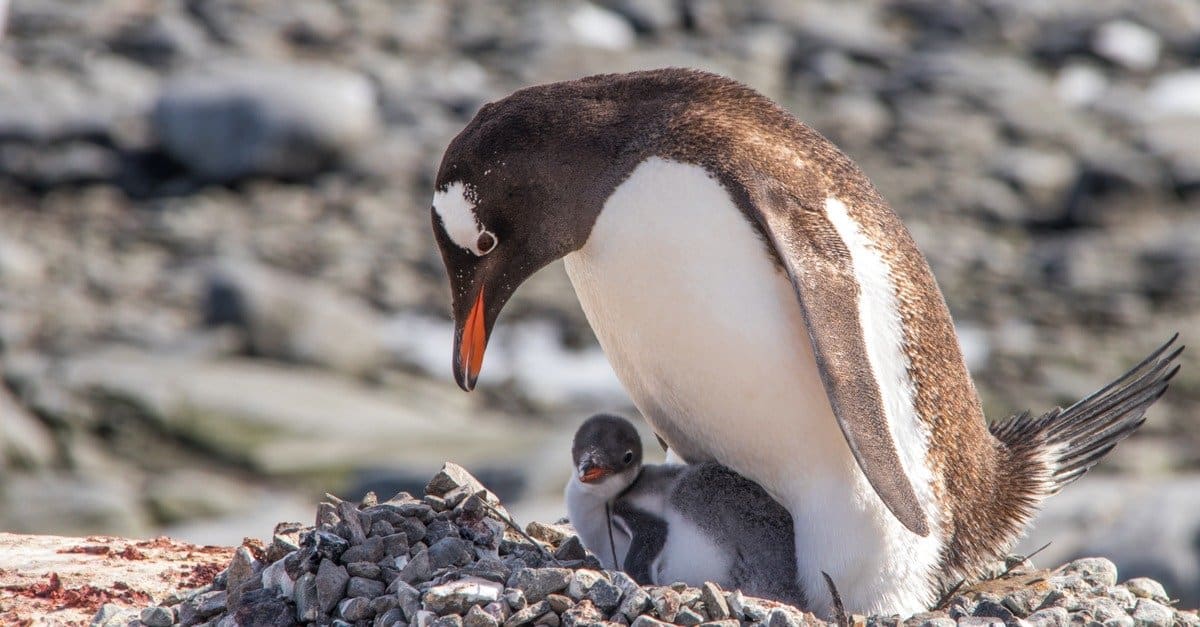
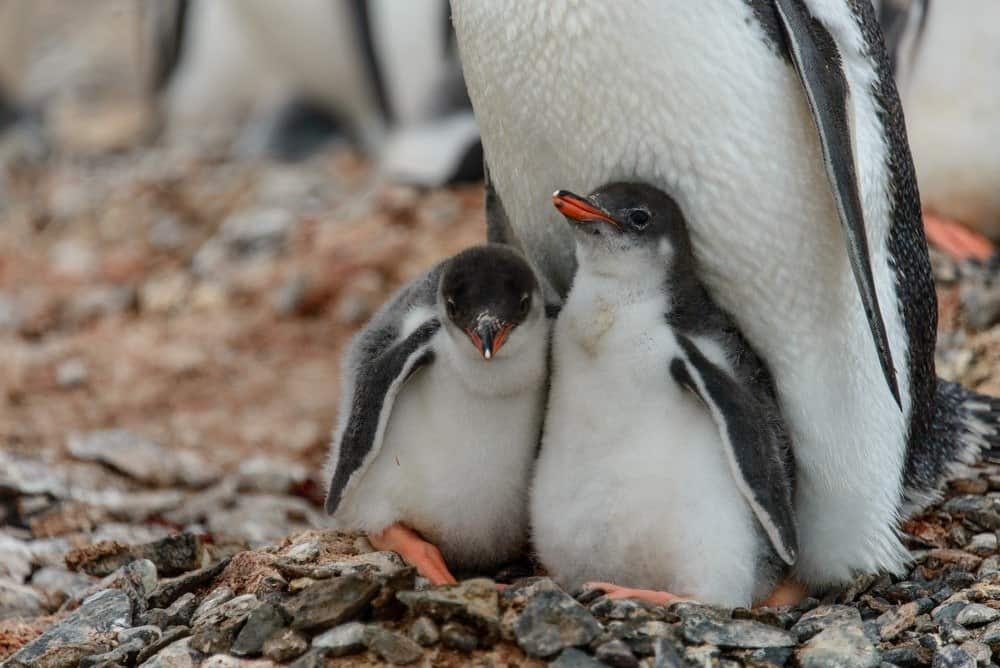
A Mother Gentoo Penguin and Her Baby Chick in Antarctica

At a Glance

Wild Species
Also Known As Papua penguin, Gentoo
Diet Carnivore
Activity Diurnal+
Lifespan 13 years
Weight 8.5 lbs
Status Least Concern
Did You Know?

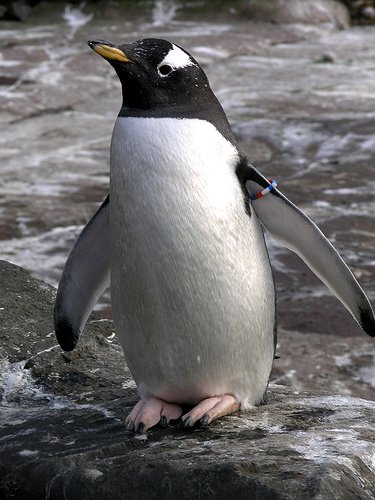
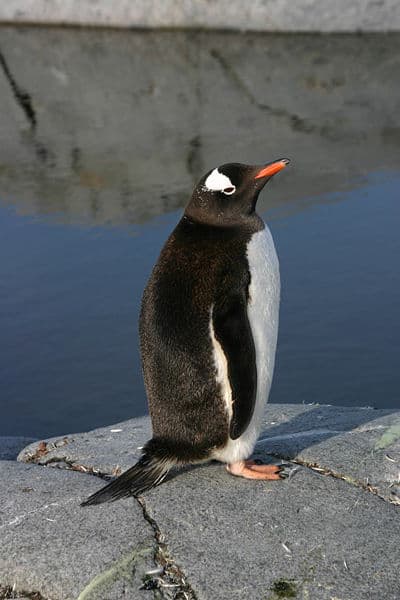
ID marks: the broad white head patch (a "bonnet" stripe) and bright orange bill make adults distinctive in the field (Pygoscelis papua).

Scientific Classification

The Gentoo Penguin (Pygoscelis papua) is a medium-to-large penguin species known for its bright orange bill, white head patch, and long-tailed, fast-swimming build. It is widely distributed across the subantarctic and Antarctic Peninsula region and is among the most northerly breeding penguins.

Kingdom
Animalia
Phylum
Chordata
Class
Aves
Order
Sphenisciformes
Family
Spheniscidae
Genus
Pygoscelis
Species
papua

Distinguishing Features

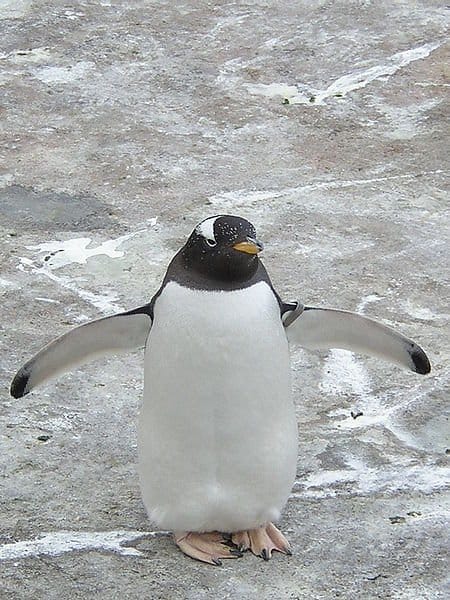
  • Broad white ‘bonnet’/head patch extending over and behind the eye
  • Bright orange to reddish bill
  • Pale whitish eye (often appearing light)
  • Relatively long tail for a penguin and a more ‘streamlined’ look
  • Often nests in colonies using stones; breeds on ice-free ground

Physical Measurements

Males and females differ in size

Height
2 ft 5 in (2 ft 2 in – 2 ft 7 in)
Length
2 ft 5 in (2 ft 2 in – 2 ft 7 in)
Weight
14 lbs (11 lbs – 19 lbs)
12 lbs (10 lbs – 14 lbs)
Tail Length
6 in (5 in – 7 in)
6 in (6 in – 7 in)
Top Speed
22 mph
Burst speed ~36 km/h

Appearance

Primary Colors
Secondary Colors
Skin Type Gentoo Penguin (Pygoscelis papua) has a feathered, dense waterproof coat; a bare bill made of keratin that is bright orange, and pink bare skin on webbed feet. Legs set far back for swimming.
Distinctive Features
  • Broad white head patch/band across the crown connecting above the eyes (diagnostic for Gentoo Penguin).
  • Bright orange bill, commonly with a darker/blackish tip; bill appears relatively stout compared with Adélie and chinstrap penguins.
  • Relatively long tail for a penguin; often held slightly raised when walking, contributing to a 'long-tailed' silhouette.
  • Gentoo penguins (Pygoscelis papua) are fast, agile underwater hunters, reaching burst speeds around 36 km/h (≈10 m/s), as measured in multiple studies and species references.
  • Breeds largely on ice-free ground in subantarctic islands and the Antarctic Peninsula region; nests are typically built from stones (pebble nests), and adults show strong nest-site fidelity in colonies (widely reported in long-term colony studies).
  • Diet often dominated by krill and fish (with regional/seasonal variation; squid can be included), consistent with subantarctic/peninsula foraging ecology.

Sexual Dimorphism

Sexual dimorphism is subtle and mainly size-based (males averaging larger/heavier with slightly more robust bills). Plumage patterning and coloration are essentially the same in both sexes, so sexing by appearance alone is unreliable without measurements.

  • On average larger body size and mass than females (reported across colonies; size overlap is substantial).
  • Bill often slightly longer/deeper and more robust in males (a common morphometric difference used in field studies).
  • On average slightly smaller/lighter than males, with a relatively slimmer bill; otherwise same plumage and key identifiers (white head band and orange bill).

Did You Know?

ID marks: the broad white head patch (a "bonnet" stripe) and bright orange bill make adults distinctive in the field (Pygoscelis papua).

Size: adults are typically ~70-90 cm tall and ~4.5-8.5 kg (season- and sex-dependent) (Williams, 1995; Stonehouse, 1975).

Speed: often cited as the fastest penguin underwater, reaching about 36 km/h in burst swimming (widely summarized by National Geographic and BBC sources).

Breeding: usually lays 2 eggs in a pebble/stone nest; incubation is about 34-37 days, with chicks fledging roughly 75-90 days after hatching (Williams, 1995).

Diving: most foraging dives are relatively shallow (often <100 m), but maximum recorded dives are ~200 m in some studies, varying by colony and prey (e.g., Croxall et al.; Williams, 1995 syntheses).

Range: breeds from the Falkland Islands and South Georgia through subantarctic islands (e.g., Kerguelen/Crozet/Prince Edward/Heard) to the Antarctic Peninsula and nearby archipelagos, typically on ice-free coasts (IUCN species account).

Diet: commonly krill plus fish and squid; prey mix shifts with location and season, reflecting local oceanography and competition (Williams, 1995; regional diet studies).

Unique Adaptations

  • Hydrodynamic build: relatively long tail and streamlined body aid fast, agile pursuit-diving; the tail also helps with balance and steering on land and in water.
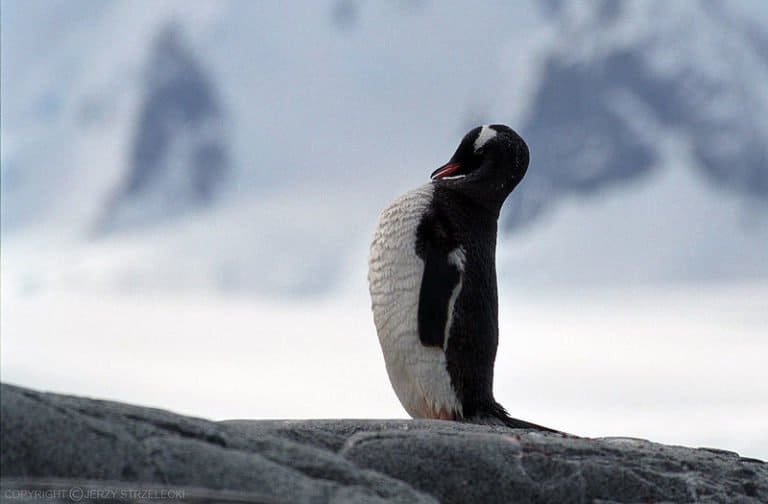
  • Dense, overlapping waterproof feathers plus a thick subcutaneous fat layer provide insulation in near-freezing seas; preening maintains feather structure and water repellency (general penguin physiology summarized in Williams, 1995).
  • Countershading: dark back and white belly camouflage the bird from above and below while swimming (anti-predator/foraging advantage).
  • Salt-excreting glands: supraorbital glands remove excess salt from seawater ingestion, allowing long marine foraging trips without freshwater.
  • Ice-free breeding specialization: compared with more ice-dependent penguins, gentoos readily breed on exposed, snow-free ground and can shift colony micro-sites when snow conditions change.
  • Efficient oxygen management for diving: elevated myoglobin and blood oxygen stores (typical of penguins) support repeated dives while hunting schooling prey (comparative diving physiology literature).

Interesting Behaviors

  • Stone-nest building and "pebble economy": pairs collect and frequently steal stones to improve nests; stone possession can affect mate interactions and nest quality (classic observations summarized in Williams, 1995).
  • Strong site fidelity: many adults return to the same breeding area (and often the same nest site) in subsequent seasons when conditions allow (Williams, 1995).
  • Porpoising: rapid, repeated leaps out of the water when traveling-thought to reduce drag and help evade predators like leopard seals.
  • Colony commuting: birds often use well-worn "penguin highways" between nests and the shoreline, reducing travel cost across rocky/tussock terrain.
  • Biparental care: both parents typically share incubation and chick-guarding duties, then alternate foraging trips to provision chicks (Williams, 1995).
  • Vocal recognition: loud trumpeting/pebbling displays help mates and chicks locate each other within dense colonies.
  • Flexible foraging: can switch between krill-dominated feeding and more fish/squid depending on local availability, and often targets nearshore waters from ice-free colonies.

Cultural Significance

The Gentoo penguin (Pygoscelis papua) is well-known in subantarctic and Antarctic Peninsula tourism, used in education as a visible warning of ecosystem change, inspired the Gentoo Linux name for speed, and called 'Johnny penguin' in the Falklands.

Myths & Legends

'Gentoo' likely came from an old sailor word, maybe Portuguese for 'gentile' (non-Christian). European sailors used it for the Gentoo Penguin (Pygoscelis papua), showing how names used on ships became folk names.

Naming oddity: Gentoo Penguin (Pygoscelis papua) has the species name 'papua' from an old mix-up by early naturalists — an Antarctic bird oddly given a name tied to distant Papua in the tropics.

In the Falkland Islands, people long used the nickname "Johnny penguin" for bold, curious penguins that often come to shoreline near settlements and landing beaches; it's a local tale, not a single formal myth.

Exploration-era journals often called Gentoo Penguins reliable landmarks of ice-free shores and part of the everyday sounds at landings. These stories helped make penguins symbols of the far south in English polar tradition.

Conservation Status

LC Least Concern

Widespread and abundant in the wild.

Population Increasing

Protected Under

  • Antarctic Treaty (1959) and the Protocol on Environmental Protection to the Antarctic Treaty / Madrid Protocol (1991) - framework limiting environmental impacts and enabling protected area designations in Antarctica
  • CCAMLR (Convention on the Conservation of Antarctic Marine Living Resources, 1980) - ecosystem-based management of Southern Ocean fisheries (relevant to krill/forage resources used by gentoos)
  • CITES - penguins are listed under CITES (international trade controls apply; gentoos occur under the family listing)
  • Site-based protections across the range, including colonies within national parks/nature reserves and Antarctic Specially Protected Areas (ASPAs) where designated (protection intensity varies by site and jurisdiction)

Life Cycle

Birth 2 chicks
Lifespan 13 years

Lifespan

In the Wild
5–20 years
In Captivity
10–30 years

Reproduction

Mating System Monogamy
Social Structure Socially Monogamous
Breeding Pattern Long Term
Fertilization Internal Fertilization
Birth Type Internal_fertilization

Behavior & Ecology

Social Colony Group: 4000
Activity Diurnal, Cathemeral
Diet Carnivore Antarctic krill (Euphausia superba)

Temperament

Gentoo penguins are very social in colonies but very territorial at nests: they stand tall, point their bills, swing heads, peck, and chase neighbors, especially during nest building and to guard stones.
Generally tolerant in transit/at sea (rafting and group commuting) with low-cost spacing behaviors; aggression is context-dependent and peaks at nest boundaries and during mate/stone competition.
Gentoo penguins often return to the same nesting spots, which keeps colony neighborhoods stable, but attendance and nesting density change with local ice, prey availability, and human or predator disturbance.
Gentoo Penguin (Pygoscelis papua) eggs incubate about 34–37 days; chicks fledge in about 75–90 days. Social care (guarding vs. nursery groups) and foraging follow these stages. Wild lifespan ~10–15 years.

Communication

Ecstatic display call Advertisement/territorial and mate-directed; often given with head and body pumping at the nest
Mutual display calls between mates Pair-bond maintenance and coordination at nest changeovers
Contact calls between adults and chicks Parent-offspring recognition and reunions in dense colonies); penguin vocal signals can encode individual identity, supporting recognition in crowded breeding sites (Jouventin, 1982; Aubin & Jouventin, 2002
Agonistic calls during disputes Short, harsh calls associated with pecking/chasing and nest defense
Visual displays: bill-pointing, head swinging, bowing, and flipper postures used for territory defense and pair interactions; synchronized mutual displays at the nest are prominent Jouventin, 1982
Tactile signals: allopreening between mates (pair-bond reinforcement) and chick brooding/guarding contact.
Spatial/behavioral cues: consistent nest location and repeated approach paths aid mate/chick reunions in dense colonies; rafting and synchronized departures/returns function as group-coordination signals at the colony edge Williams, 1995

Habitat

Coastal Beach Rocky Shore Cliff/Rocky Outcrop Open Ocean Seabed/Benthic Kelp Forest +1
Biomes:
Terrain:
Coastal Island Rocky Sandy
Elevation: Up to 656 ft 2 in

Ecological Role

Mid-trophic marine mesopredator in subantarctic/Antarctic coastal food webs; links lower-trophic crustaceans and small fishes/cephalopods to higher predators and transfers marine-derived nutrients to terrestrial colony sites.

Regulation of local prey populations (krill and small fish/cephalopods) through predation Prey base support for apex predators (e.g., leopard seals and killer whales) via penguin biomass in the food web Biotransport of marine nutrients to land via guano deposition, enriching soils and nearshore ecosystems around breeding colonies Bioindicator function: foraging shifts and breeding performance reflect regional changes in prey fields and ocean conditions

Diet Details

Main Prey:
Antarctic krill Ice krill Nototheniid fishes Antarctic silverfish Squid

Human Interaction

Domestication Status

Wild

Gentoo Penguin (Pygoscelis papua) is fully wild with no domestication history. Humans interact by research, regulated tourism, and in accredited zoos/aquaria for education/research (not domestication). Adults are 75–90 cm long and 4.5–8.5 kg. Wild life is ~10–15 years (20+ in care). Fast swimmers (30+ km/h), dive ~200 m, and may bite or strike with flippers when defending nests.

Danger Level

Low
  • Bites and lacerations from the bill during handling or nest defense (most likely during breeding)
  • Bruising/scratches from flipper strikes and claws when restrained
  • Zoonotic/occupational health risks for handlers (e.g., Salmonella spp., Campylobacter spp., avian influenza exposure risk in outbreak contexts)
  • Slip/fall hazards for people moving near colonies due to guano-covered rocks/terrain

As a Pet

Not Suitable as Pet

Legality: Gentoo Penguin (Pygoscelis papua) is not legal as a pet in most places. Trade is tightly controlled under CITES (often Appendix I) and national laws. Antarctic Treaty limits taking. Legal possession only for research, licensed rehab, or accredited zoos.

Care Level: Expert Only

Purchase Cost:
Lifetime Cost: $300,000 - $1,200,000

Economic Value

Uses:
Ecotourism (wildlife viewing cruises/landings) Education/exhibit value (accredited zoos and aquaria) Scientific research value (indicator species for marine ecosystem change) Ecosystem services (nutrient transport via guano; local colony effects on soils/vegetation)
Products:
  • Non-consumptive tourism revenue (guided viewing permits, cruises, local services)
  • Institutional exhibit/education programming (tickets, outreach) in regulated facilities
  • Research outputs (data products from tagging/bio-logging; conservation monitoring)

Relationships

Predators 6

Leopard Seal
Leopard Seal Hydrurga leptonyx
Killer Whale
Killer Whale Orcinus orca
Southern Giant Petrel Macronectes giganteus
South Polar Skua Stercorarius maccormicki
Brown Skua Stercorarius antarcticus
Kelp Gull Larus dominicanus

Ecological Equivalents 5

Animals that fill a similar ecological role in their ecosystem

“The Gentoo Penguin is known to be the fastest swimming penguin in the world”

Gentoo Penguins are, much like the other penguin species, dressed for dinner in tuxedo feathers of black coats and starched white chests. They sport a jaunty white stripe from eye to eye across the tops of their heads and flamboyant orange-red beaks – dashing figures against a bleak arctic landscape.

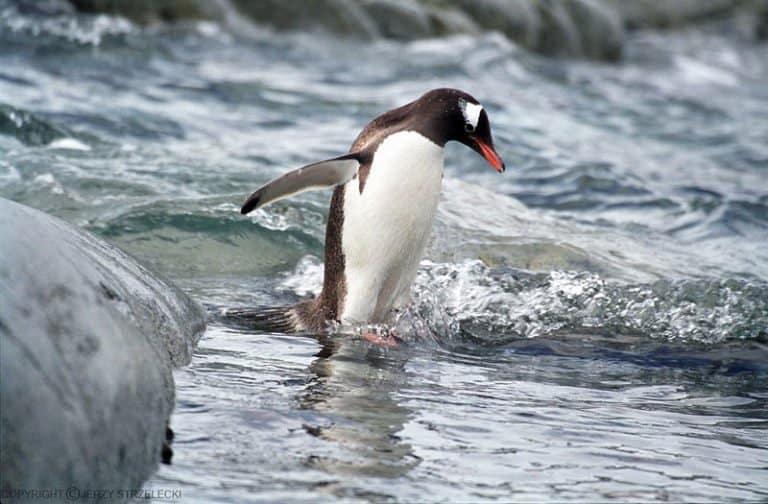
Clumsy waddlers on land, Gentoo Penguins are graceful athletes in the water and are the fastest diving bird – reaching speeds of 22 mph. They are rarely aggressive and mostly keep their cool, however, they are known to get loud and rowdy during their nesting period.
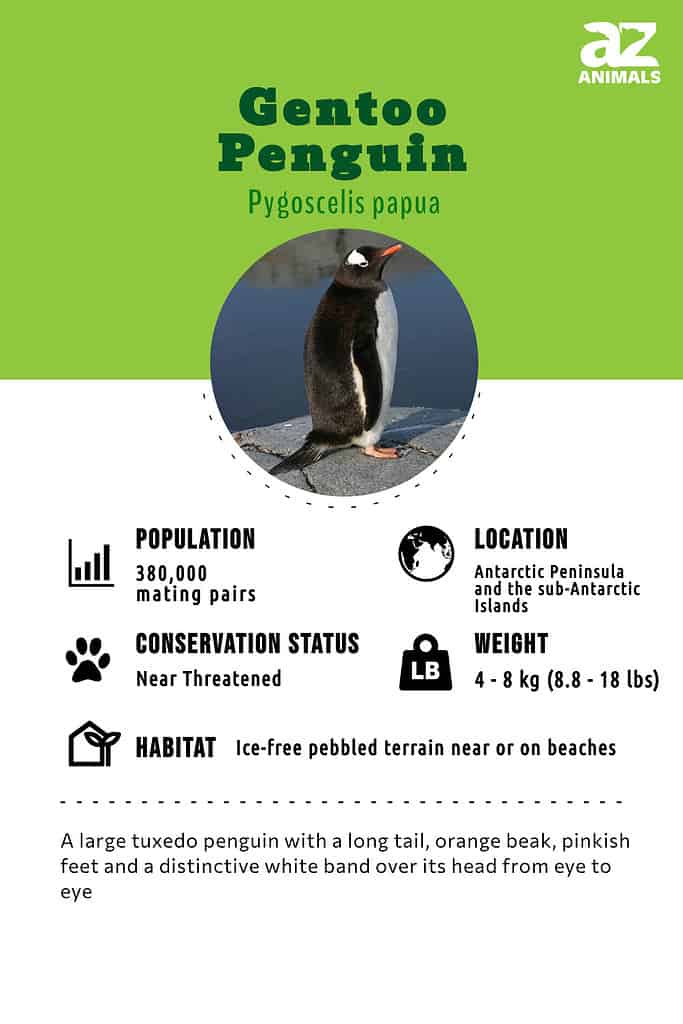
Incredible Facts About Gentoo Penguins!

  • Gentoo Penguins are the third-largest penguins in the world – after the emperor and king penguins.
  • Gentoo Penguins, when diving in deep waters, can control and reduce their heartbeat considerably. It can very well go from 80 to 100 to 20 heartbeats per minute.
  • They are the fastest swimming penguins in the world and learn to swim without any help from their parents.
  • Gentoo penguins are very relaxed creatures and are rarely ever aggressive.
  • They use a variety of materials during their nesting period ranging from molten feathers to pebbles.
  • Males and females mate for life and share parenting duties – including incubating their eggs.
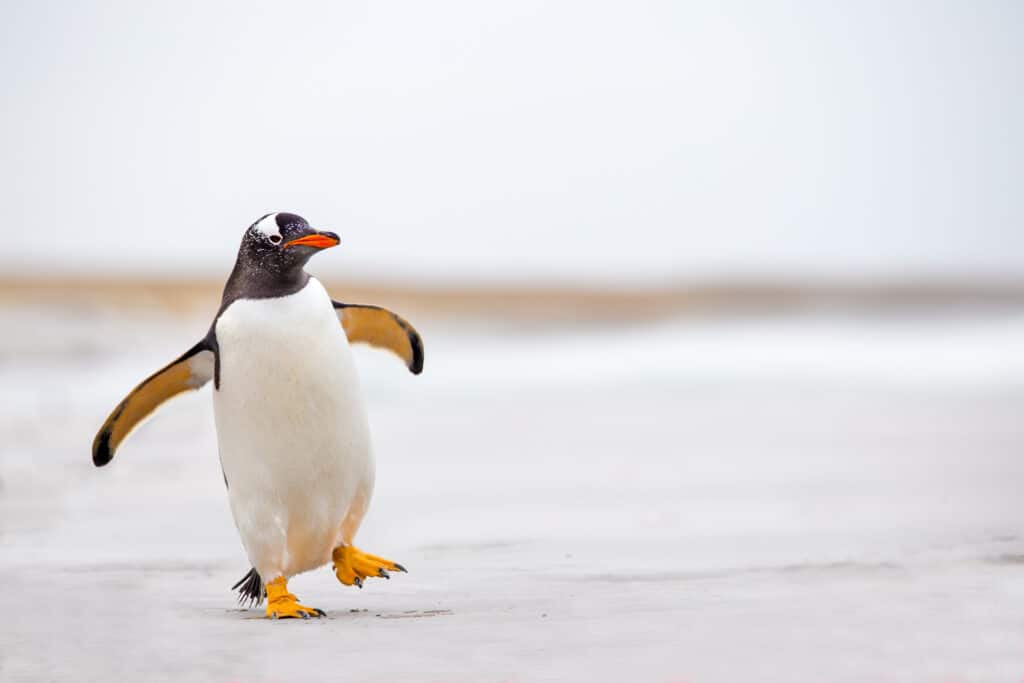
Penguin waddling

Gentoo penguins waddle when they walk and swish their long tails from side to side.

Scientific name

The scientific name of the Gentoo Penguin, belonging to the genus Pygoscelis, is Pygoscelis papua. Their genus got this name, Pygoscelis because their prominent tails swish from side to side when they walk. Pygoscelis means “rump-tailed.”

However, the origin of the word Gentoo has so far been unclear. Some say that the word was used by the Anglo-Indians to distinguish between Hindus and Muslims. Another theory states that the name might have come from some turban-related term as the white patch on the penguin’s head is said to be a semblance to a turban.

Species

Gentoo Penguins can further be divided into four subspecies. Before 2021, only two subspecies were recognized, but a 2020 study suggested otherwise. After some debate over whether there were four separate species or subspecies – The International Ornithological Congress determined in 2021, that there are four subspecies of Pygoscelis papua.

  • Northern Gentoo Penguin, Pygoscelis papua papua – the larger Gentoo penguins with varied habitats including the Falkland Islands, Martillo Island, and Isla de los Estados, Argentina.
  • Southern Gentoo Penguin, Pygoscelis papua ellsworth – the smaller Gentoo penguins that live and breed on the coasts of the Antarctic Penninsula, the South Orkney Islands, South Shetland Islands, and South Sandwich Islands.
  • Eastern Gentoo Penguin, P.p. taeniata – inhabits the Crozet Islands, Prince Edward Islands, Kerguelen Islands, Heard Island, and Macquarie Island.
  • South Georgia Gentoo Penguin, P. p. poncetii – can only be found on South Georgia Island.

Evolution

Fossil records indicate that all penguin’s common ancestors lived as long as 40 million years ago and were around five feet tall. They are believed to have originated in Antarctica, which was covered in forests at that time and connected to what would become New Zealand, Australia, South America, and surrounding islands. These ancient ancestors of penguins had diverged from the ancestors of petrels and albatrosses around 71 million years ago.

The arrival of the ice age 35 million years ago brought brutal changes to the ancient ancestors of the penguin. The continents of Australia and South America drifted away from Antarctica while ocean currents encircles it. This cooling climate likely killed the older penguins – leaving them to compete with whales for the same prey.

While most of the ancient penguins became extinct, others, like the macaroni penguin, swam to warmer waters to found new lineages. Species like the emperor penguin stayed in Antarctica and evolved adaptations suited to live in the cold environment. The Gentoo penguins ventured as far as subantarctic islands with some staying on the continent.

Appearance and Behavior
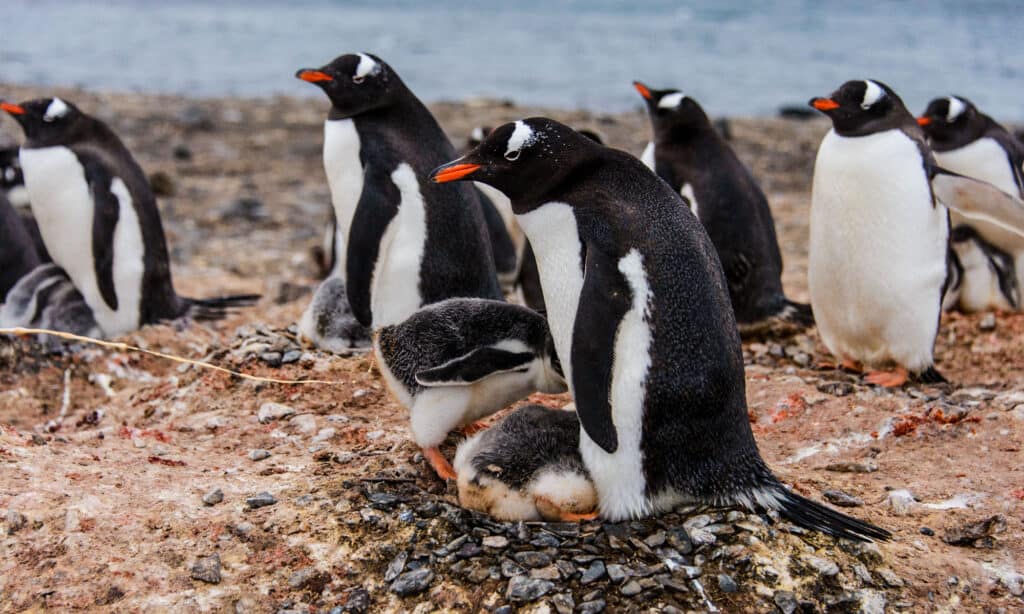
penguin's chicks poops

Gentoo penguins have long tails and are the only penguin with a bright red-orange bill and white cap.

From the back to the head, the Gentoo Penguins are black with a white patch on their belly. They also have a white stripe that runs from their eye to eye at the top of their head. This is referred to as a bonnet or turban and is distinctive to the Gentoo.

Gentoo penguins have pinkish webbed feet and a tail that is considered to be the longest amongst the Penguin family. The underside of their flippers matches their feet. The Gentoo Penguins are the only penguins with a bright orange bill.

The adults have very distinct eye patches while the younger ones have relatively dull patches that grow more defined. Upon birth, baby gentoos are grey and slowly turn to white within a week. Adult Gentoos are usually 30 – 35 inches in height and can weigh up to 18 pounds. Birds from the north average 1.5 pounds heavier than their southern counterparts. All Gentoos – male and female – lose weight while taking care of their babies and can weigh as little as 9.9 pounds during that time.

Behavior-wise, these penguins are usually laid back and are hardly ever aggressive. They are also known to be shy and usually do not make any effort to mark and/or defend their territories.
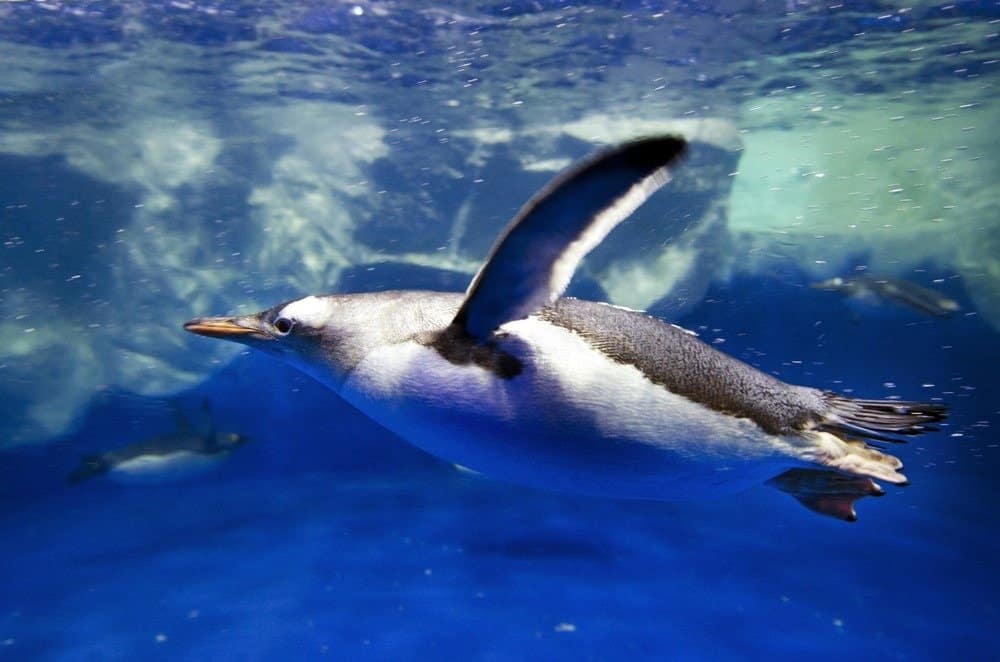
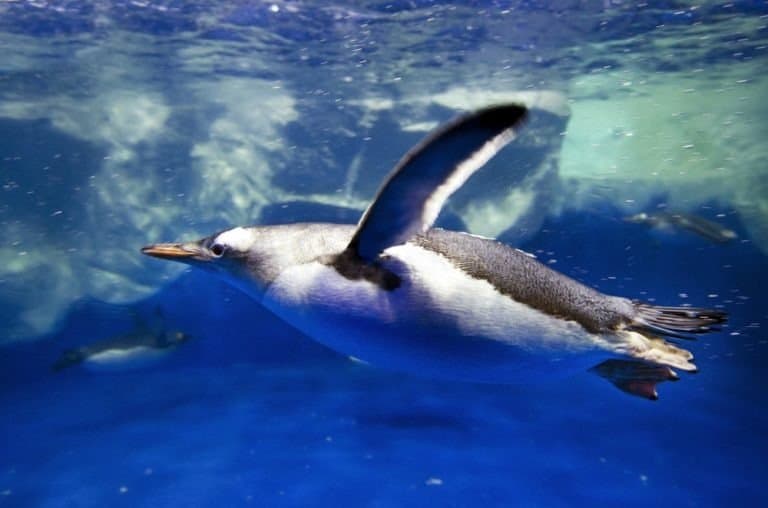
Gentoo Penguins swimming underwater of the Southern Arctic ocean

Gentoos are the fastest-swimming marine bird with a top speed of 22 mph.

Habitat

Gentoo Penguins can be found in a variety of regions in the Southern Hemisphere. The Antarctic Peninsula and the sub-Antarctic Islands are home to the largest numbers. They are partial to ice-free areas like coastal plains, sheltered valleys, and cliffs. Some gentoos prefer pebbled beaches or twig-laden areas. Breeding settlements are sometimes located near the shoreline but can also be inland. Colonies in South Georgia breed further inland than other Gentoos, where they nest in grassy areas.

Diet
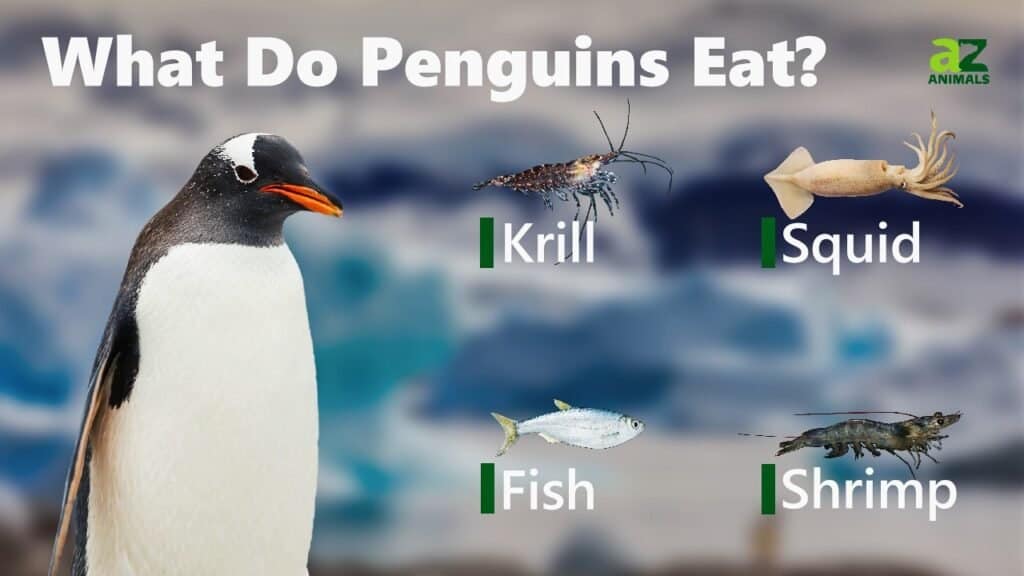
What Do Penguins Eat
Penguins primarily eat fish, with other seafood like crustaceans and krill added to the mix.

The Gentoo Penguin diet includes fish, squid as well as crustaceans. Adults spend the entire day hunting, usually close to shore but sometimes miles away. They can remain below water for up to seven minutes and dive as deep as 655 feet.

Gentoo diets are high in salt because they eat animals with about the same salinity as seawater. Like other marine birds, they have developed a salt gland above their eyes that takes the high concentration of sodium within the body and produces a highly saline solution that drips out from the tip of their beaks.

Predators and threats
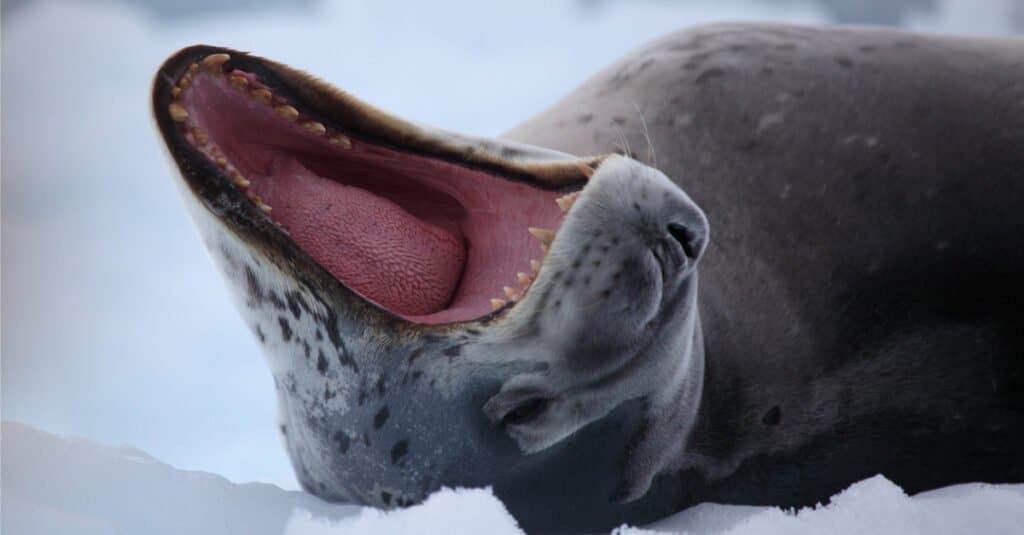
Leopard Seal Teeth - Leopard Seal

Leopard seals prey on Gentoo penguins.

Usually, leopard seals, orcas, and sea lions are the main creatures that prey on penguins. However, this is the case only near or in the water. On land, these penguins have few threats except that from humans. Mankind has often hunted them and is affected by pollution and climate change. Several birds also like to prey on Gentoo penguin chicks including Skuas, giant petrels, kelp gulls, and the snowy sheathbill.

Reproduction, Babies, and Lifespan
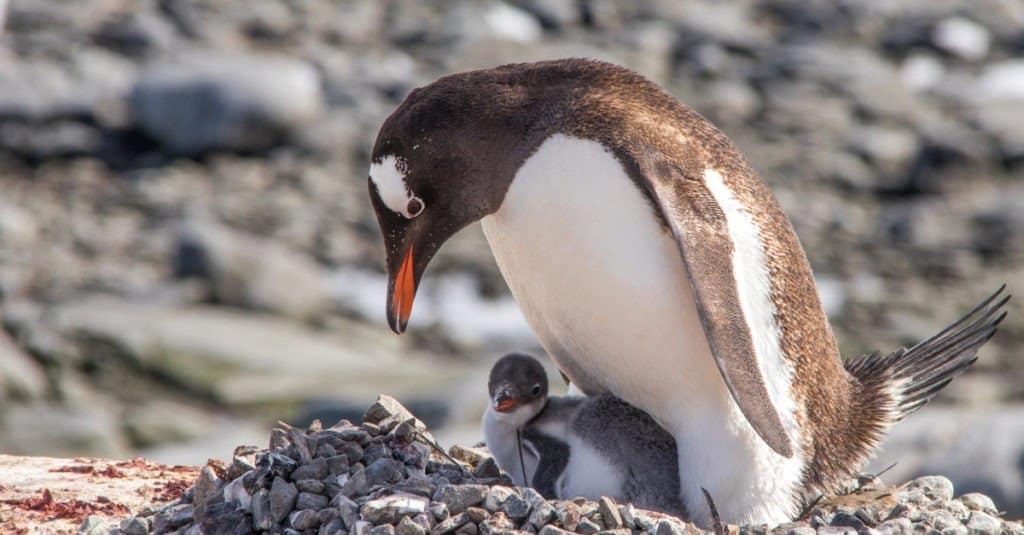
Gentoo penguin with chicks in the nest

Gentoo penguin parents are monogamous and share chick-raising responsibilities.

Gentoo penguins are monogamous and usually mate for life. Monogamy is so important to them that infidelity is often punished by banishment from the colony. Gentoos fashion nests out of pebbles and are known to be quite particular about it. A male Gentoo can win the favor of a female during courtship by presenting her with a beautiful rock. Nests are made from a circular pile of carefully selected stones and are guarded with the utmost attention. Many fights occur over these prized pebbles during nesting season – a time when the usually laid-back birds bristle with energy and seem aware of the important task they are undertaking.

Two eggs are laid into the perfectly prepared nest. Both parents share incubation duties by taking turns daily. The eggs, the second of which is always smaller than the first, usually hatch five weeks after they are laid. Then, active parenting begins as the penguin couple works together to protect and feed their little chicks. Gentoo parents are very protective and nurturing for the month that the babies stay in the nest – and after, when the chicks graduate to creches – nursery schools within the colony where they will spend their childhoods.

Usually around January, around three months after they are born, the chicks start developing their adult feathers and going out on their own. They usually go out to sea at around 80 to 100 days after their birth.

However, sadly, their survival often depends on food availability. If ever, a situation relating to the lack of food arises, the parents might have to decide to feed the stronger of their babies while making a tough choice to sacrifice their relatively weaker baby.

The lifespan of Gentoo Penguins is a total of 13 to 15 years. Surprisingly, the most brutal battle for life is often fought within their first year, with only about 30 to 50 percent chances that they will make it to the next.
A Mother Gentoo Penguin and Her Baby Chick in Antarctica

Newly hatched gentoos are gray and turn black within a week.

Population

Gentoo penguins are now listed as near threatened by the IUCN because of significant population declines. According to sources, the breeding population of the Gentoo penguins currently stands at over 380,000 pairs.

In the Zoo

Gentoo Penguins can often be kept in zoo environments and can often easily blend with minimal problems. Sources suggest that as of now, there are more than 750 Gentoo Penguins that live in zoos all around the world.

View all 261 animals that start with G

Sources

  1. David Burnie, Dorling Kindersley (2011) Animal, The Definitive Visual Guide To The World's Wildlife / Accessed August 3, 2010
  2. Tom Jackson, Lorenz Books (2007) The World Encyclopedia Of Animals / Accessed August 3, 2010
  3. David Burnie, Kingfisher (2011) The Kingfisher Animal Encyclopedia / Accessed August 3, 2010
  4. Richard Mackay, University of California Press (2009) The Atlas Of Endangered Species / Accessed August 3, 2010
  5. David Burnie, Dorling Kindersley (2008) Illustrated Encyclopedia Of Animals / Accessed August 3, 2010
  6. Dorling Kindersley (2006) Dorling Kindersley Encyclopedia Of Animals / Accessed August 3, 2010
  7. Christopher Perrins, Oxford University Press (2009) The Encyclopedia Of Birds / Accessed August 3, 2010
  8. National Geographic / Accessed October 27, 2020
  9. Oceanwide Expeditions / Accessed October 27, 2020
  10. Wikipedia / Accessed October 27, 2020
  11. Seaworld Parks & Entertainment / Accessed October 27, 2020
  12. Travel Wild Expeditions / Accessed October 27, 2020
  13. Animal Diversity Web / Accessed October 27, 2020
  14. Australian Antarctic Program / Accessed October 27, 2020
Lisha Pace

About the Author

Lisha Pace

After a career of working to provide opportunities for local communities to experience and create art, I am enjoying having time to write about two of my favorite things - nature and animals. Half of my life is spent outdoors, usually with my husband and sweet little fourteen year old dog. We love to take walks by the lake and take photos of the animals we meet including: otters, ospreys, Canadian geese, ducks and nesting bald eagles. I also enjoy reading, discovering books to add to my library, collecting and playing vinyl, and listening to my son's music.

Thank you for reading! Have some feedback for us?


Gentoo Penguin FAQs (Frequently Asked Questions)

Gentoo Penguins are creatures that are a part of the penguin families and are known as the fastest swimming penguins. They are distinguished by a white stripe that suns from their eye to eye.