Honey Bee
 Verified by: AZ Animals Staff
There are only 8 recognized species!
Advertisement
Honey Bee Scientific Classification
Read our Complete Guide to Classification of Animals.
Honey Bee Conservation Status

Honey Bee Facts
- Main Prey
- Nectar, Pollen, Honey
- Fun Fact
- There are only 8 recognized species!
- Habitat
- Sheltered forests and meadows
- Diet
- Herbivore
- Average Litter Size
- 200
- Favorite Food
- Nectar
- Common Name
- Honey Bee
- Number Of Species
- 8
- Location
- Worldwide
- Slogan
- There are only 8 recognized species!

 © Dmitri Gomon/Shutterstock.com
View all of the Honey Bee images!



How to Add Us to Google News


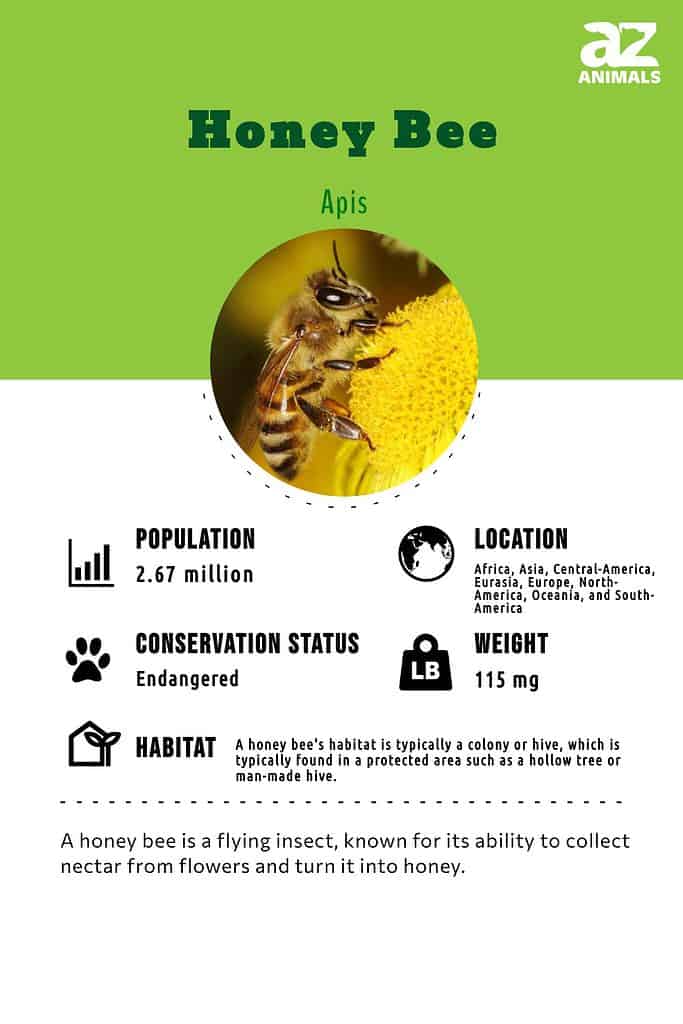
The small honey bee, long a symbol of hard work and cooperation, has one of the most complex social arrangements and caste systems in the entire animal kingdom.
The defining characteristic of this insect is the ability to construct large colonial nests from wax and then convert nectar into sweet honey. Both the wax and the honey they produce are exploited by humans for our own personal uses. But bees also play a very important role in the environment by transporting pollen between flowers.
4 Incredible Honey Bee Facts!
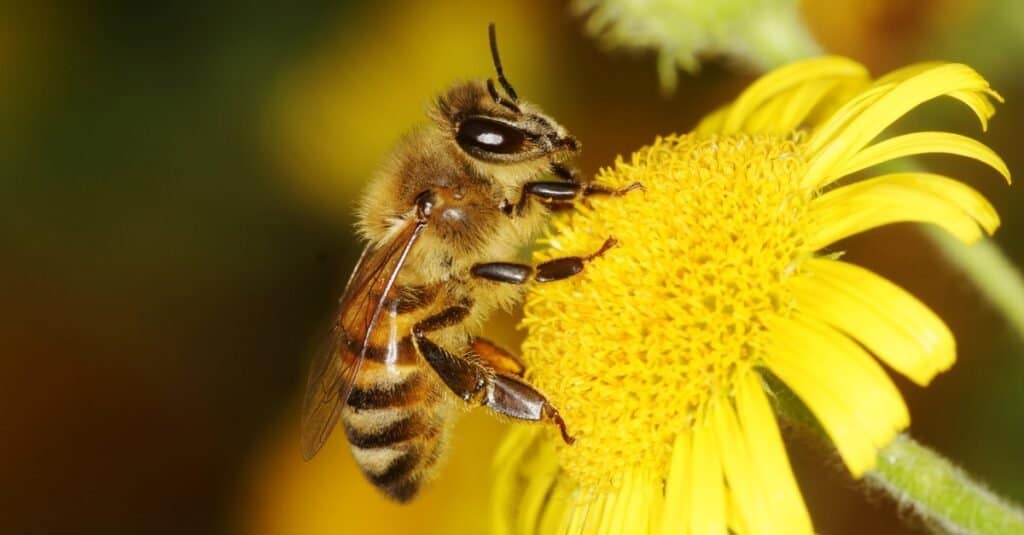
A honey bee sitting on a beautiful flower. The honey bee is the only insect that produces food eaten by man.
©Maciej Olszewski/Shutterstock.com
- A single colony can contain up to 80,000 bees at a time.
- These bees secrete wax between plates on the underside of the abdomen. This wax creates the comb-like structure in which the larvae reside.
- It is believed that these bees can communicate important information to each other (including the location of food) through a complicated dance. Learn about the smartest animals on earth here.
- Since the dawn of the 21st century, these bee colonies are mysteriously collapsing in some parts of the world, and it’s not clear why.
Species, Types, and Scientific Names
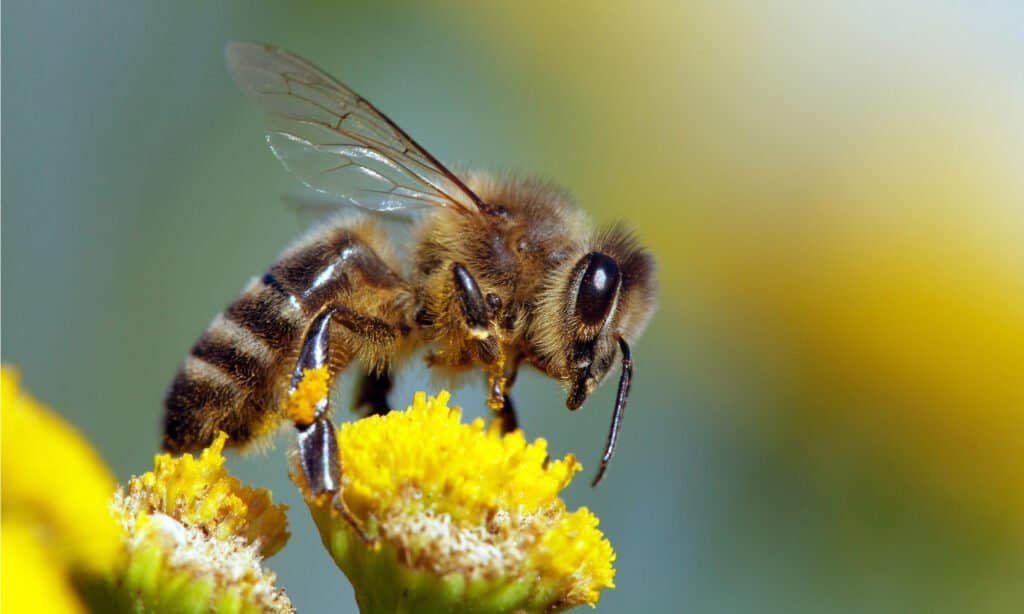
The scientific name for this bee is Apis (a Latin word that simply means bee).
©Daniel Prudek/Shutterstock.com
The scientific name for this bee is Apis (a Latin word that simply means bee). Compared to the 20,000 species of bees, this bee genus contains at least eight different species. The western honey bee is by far the most common, especially for the purpose of making domesticated honey.
Here’s a full list of them:
- Western Honey Bee – Apis mellifera
- Eastern Honey Bee – Apis cerana
- Philippine Honey Bee – Apis nigrocincta
- Koschevnikov’s Honey Bee – Apis koschevnikovi
- Giant Honey Bee – Apis dorsata
- Himalayan Giant Honey Bee – Apis laboriosa
- Black Dwarf Honey Bee – Apis andreniformis
- Dwarf Honey Bee – Apis florea
Evolution and Origins
Honey bees are believed to have evolved from hunting wasps, which developed a taste for nectar and changed their diet to become vegetarian. The process of their evolution began between 80 and 150 million years ago, during the Cretaceous Period.
Recent research has shown that honey bees are derived from an ancient lineage of cavity-nesting bees that arrived from Asia around the same time. These bees developed physiological and behavioral adaptations to efficiently collect and transfer pollen from flower to flower, making them the primary pollinators of plants today.
Why are Honey Bees Important?
Honeybees are important for a variety of reasons. One of the most significant is their role in pollination. They pollinate many of the fruits, vegetables, and nuts that make up a significant portion of our diet, including apples, almonds, and blueberries.
Additionally, honey bees help to pollinate plants that provide habitat and food for other wildlife. They also produce honey and beeswax, which are used in a wide range of food and non-food products.
They are also used as model organisms in scientific research to study topics such as learning, memory, and social behavior.
In recent years, honey bee populations have been in decline due to factors such as habitat loss, disease, and pesticide exposure, which highlights the need to protect and conserve them.
Appearance: How to Identify the Honey Bee
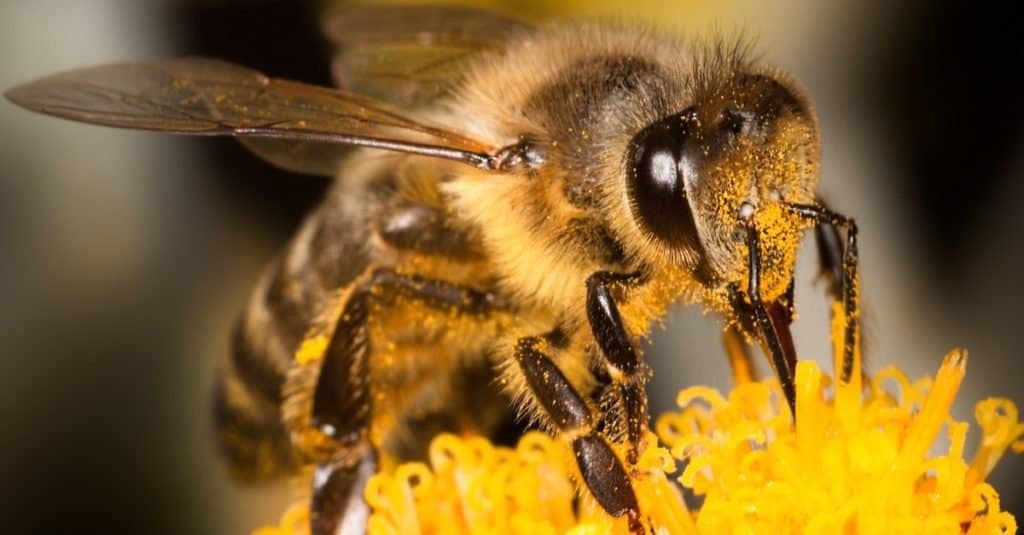
These bees are small, flying insects with long, segmented bodies divided into the head, the thorax (essentially, the mid-section), and the abdomen from which a long and sharp stinger emerges.
©Dancestrokes/Shutterstock.com
These bees are small, flying insects with long, segmented bodies divided into the head, the thorax (essentially, the mid-section), and the abdomen from which a long and sharp stinger emerges. The body is covered in alternating bands of yellow/reddish brown and dark bands, which serve as a warning against potential threats. It also has two wings, six legs, and small hair over its body. A typical bee is only about half an inch long, or the size of a paper clip.
The bee colony has a complex social arrangement comprised of three different classes. The male drones only serve one basic purpose: reproduction. During the winter months, they are expelled from the colony to save resources, and most end up dying.
Female bees make up the entirety of the workforce. They forage for food, build up the hive, and protect it from threats. However, they are incapable of sexual reproduction. The queen, of which only one usually exists at a time, has sole reproductive duties and also guides the activity of the entire hive. If one queen dies, then the colony can create another one by feeding a female larva a special elixir.
Honey Bee vs. Bumble Bee
The bumble bee has a very similar appearance and social structure to the honey bee. The main differences are the larger body, thicker coat of hair, and a darker set of wings. It also forms smaller colonies and does not produce honey.
Habitat
These bees are actually endemic to South and East Asia and parts of Africa. Only the western bee (as a result of human domestication) is found in almost every ecosystem around the world except for the most extreme climates. With a few exceptions, they construct nests in protected areas such as tree cavities or the underside of buildings.
Diet
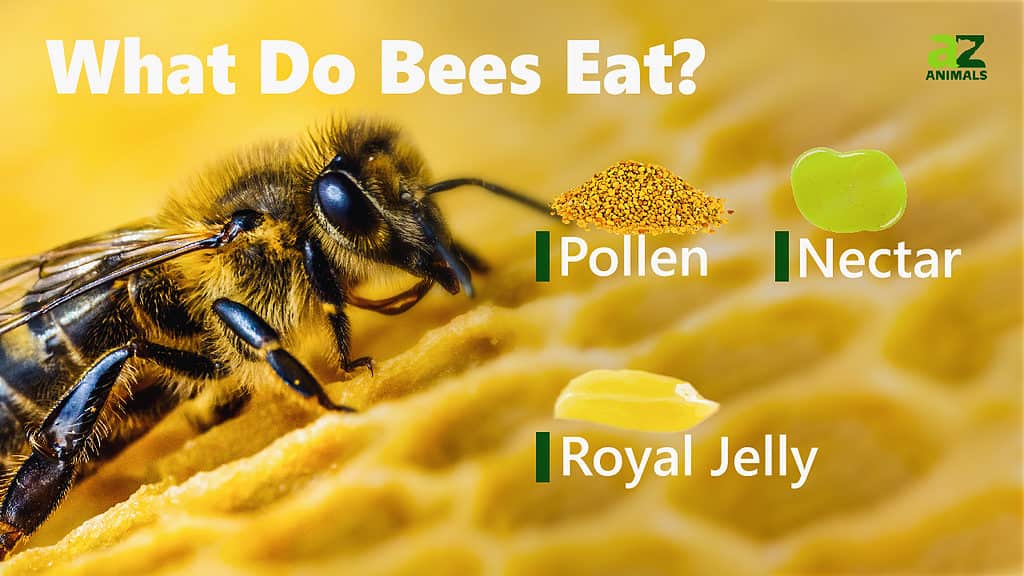
These insects get all of their nutrients from pollen and nectar, which are both products of plants. Pollen provides most of the protein, while nectar provides most of the carbohydrates and water. In order to survive the coldest months, the workers store up food reserves for the winter in their honeycombs. They create honey by processing the nectar inside of their bodies and then regurgitating it. For a complete list of foods bees eat, check out our “What Do Bees Eat?” page.
Prevention
The most effective way to get rid of these insects is to use some kind of repellent or bee spray, including insecticides, citronella candles, garlic spray, vinegar, ultrasonic insect repellents, and insect repellent plants. You can also buy or create your own bee trap and lure them inside. It is not recommended to handle a hive yourself.
View all 104 animals that start with H How to Add Us to Google News


Honey Bee FAQs (Frequently Asked Questions)
Are Honey Bees herbivores, carnivores, or omnivores?
Honey Bees are Herbivores, meaning they eat plants.
What Kingdom do Honey Bees belong to?
Honey Bees belong to the Kingdom Animalia.
What phylum to Honey Bees belong to?
Honey Bees belong to the phylum Arthropoda.
What class do Honey Bees belong to?
Honey Bees belong to the class Insecta.
What family do Honey Bees belong to?
Honey Bees belong to the family Apidae.
What order do Honey Bees belong to?
Honey Bees belong to the order Hymenoptera.
What genus do Honey Bees belong to?
Honey Bees belong to the genus Apis.
Where do Honey Bees live?
Honey Bees are found worldwide.
In what type of habitat do Honey Bees live?
Honey Bees live in sheltered forests and meadows.
What is the main prey for Honey Bees?
Honey Bees eat nectar, pollen, and honey.
What are some predators of Honey Bees?
Predators of Honey Bees include birds, rodents, reptiles, and insects.
How many babies do Honey Bees have?
The average number of babies a Honey Bee has is 200.
What is an interesting fact about Honey Bees?
There are only 8 recognized species of Honey Bee!
How many species of Honey Bee are there?
There are 7 species of Honey Bee.
Are honey bees dangerous?
The sting of the honey bee may be painful, but it only poses a danger to the small number of people who are allergic to the venom, which can cause nausea and fainting. Deaths from honey bees are exceedingly rare, however. According to the CDC, less than 100 people die from any hornet, wasp, or bee sting every year, and the honey bee only makes up a small fraction of stings.
How many legs does the honey bee have?
The honey bee has a total of six legs.
How do you identify honey bees?
The honey bee can be identified by its small body, alternating yellow and dark bands, and translucent wings. The massive, humming colonies which produce honey are also clear giveaways.
How do you get rid of honey bees?
Sprays, repellents, or traps should be sufficient to get rid of any unwanted bees. If you don’t want to handle it yourself, then you can also call an exterminator. But unlike many other insects that are scattered about, the honey bees cannot survive without the centralized colony, which makes them easier to destroy.
What are the predators of honey bees?
Honey bees are preyed upon by all kinds of predators, including small mammals, birds, and even other insects.
Do honey bees sting?
Yes, the honey bee has a sharp barb laced with venom that produces a painful reaction. They will sting most often in direct defense of the colony rather than for their own protection. In an act of self-sacrifice, honey bees do, in fact, die after stinging.
What does a honey bee look like?
The honey bee is a flying insect with a long multi-segmented body, small hairs, and alternating bands of yellow and black. The typical worker is about half an inch in size.
How much honey does a honey bee make?
A single worker can make about a single tablespoon of honey in its lifespan.
What do honey bees eat?
Honey bees consume nectar and pollen. They also create and store honey for the winter months.
What is the difference between worker bees and queen bees?
Although queen bees and worker bees are female honey bees, they have very different roles in the hive. Worker bees earned their name because they are responsible for almost every job inside the colony, except for one thing –reproduction. Bees are oviparous, but while all worker bees are females, they are not fertile and cannot lay eggs. Only the queen bee is responsible for mating with drones and laying eggs.
What is the difference between a drone and a worker bee?
All drones are male honey bees, while all worker bees are female. Don’t get fooled by their names, though, because drones and worker bees are changing and breaking the traditional gender roles. For most animals, male and female counterparts differ only in sex organs. But in honey bees, gender plays a more significant role. While worker bees are all female, they do almost every work inside the beehive.
What is the difference between a killer bee and a honey bee?
The main differences between a killer bee and a honey bee include their size, colonies, hive defense, how often they swarm, and their nesting site preferences. To the untrained eye, the physical difference between the two is nearly undetectable.
What is the difference between a honey bee and a Mason bee?
The main differences between a Mason bee and a honey bee include their appearance, habitat, pollination, sting, and lifecycle.
Do, honey bees poop?
Yes, honey bees poop. However, honey bee poop looks a lot different than human poop.
Thank you for reading! Have some feedback for us? Contact the AZ Animals editorial team.
Sources
- National Geographic, Available here: https://www.nationalgeographic.com/animals/invertebrates/h/honeybee/
- Orkin, Available here: https://www.orkin.com/stinging-pests/bees/honey-bees
- World Birds, Available here: https://www.worldbirds.org/how-to-get-rid-of-bees/