Horse
Equus caballus
 Verified by: AZ Animals Staff
Has evolved over 50 million years!
Advertisement
Horse Scientific Classification
- Kingdom
- Animalia
- Phylum
- Chordata
- Class
- Mammalia
- Order
- Perissodactyla
- Family
- Equidae
- Genus
- Equus
- Scientific Name
- Equus caballus
Read our Complete Guide to Classification of Animals.
Horse Conservation Status

Horse Facts
- Main Prey
- Grass, Fruit, Leaves
- Habitat
- Small forests and grassland
- Predators
- Human, Wolf, Bears
- Diet
- Herbivore
- Average Litter Size
- 1

 © Millie Bond - Copyright A-Z Animals


How to Add Us to Google News


An animal with a 50-million-year long evolutionary process
Over the course of 50 million years, horses evolved from small, many-toed animals to the majestic, single-toed equines we know today. Some wild horses remain, but most are domestic animals used by humans for a variety of reasons. Transportation and battle have been historically important uses of the domesticated horse into the modern era.
Incredible Horse facts!
- Although there are only one species of the domestic horse, there are 350 different breeds around the world.
- Horses have made an indelible mark on human civilization.
- Horses have bigger eyes than any other land mammal.
- Horses are able to sleep while standing up! Horses can “power nap” while standing up to stay alert. For longer rests, they can lie down and reach REM cycles.
Scientific name
The scientific name of this animal is Equus caballus. Equus has a literal meaning of horse in Latin. Caballus is another word meaning horse in Latin, but for the longest time was only used by poets.
Evolution and Origins
The horse family tree spans millions of years, with the earliest known horses evolving 55 million years ago. For much of this time, multiple horse species lived at the same time, often side by side. Around 10 million years ago, up to a dozen horse species roamed the Great Plains of North America, coming in many shapes and sizes.
The horse family first appeared in North America. For most of their history, they remained small forest browsers. However, changing climate conditions allowed grasslands to expand, and about 20 million years ago, many new species rapidly evolved. Some of these new species became larger and had the familiar hooves and grazing diets that we associate with horses today. Only these species survived to the present, but in the past, small and large species lived side by side.
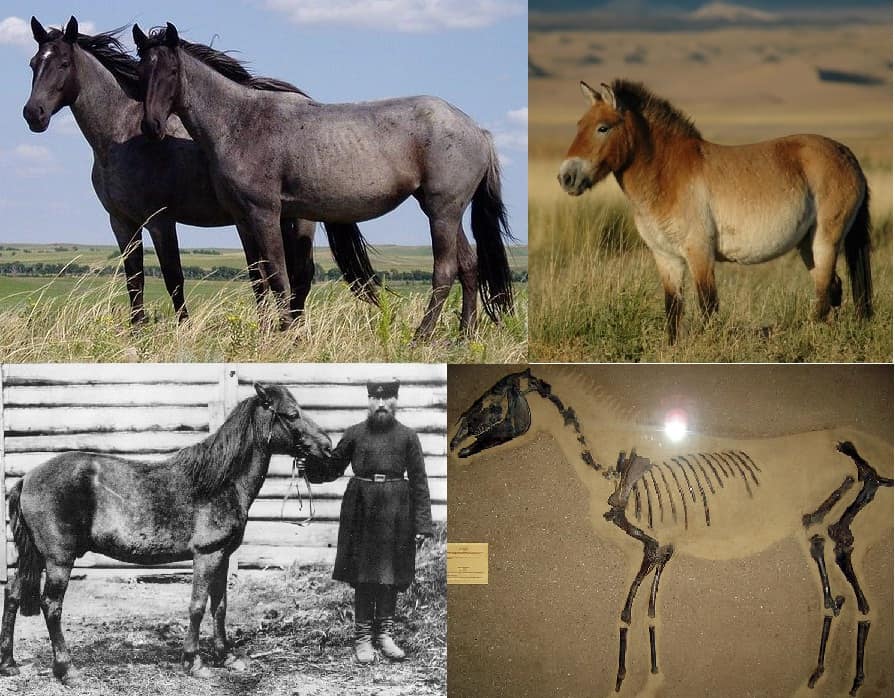
The horse family tree spans millions of years, with the earliest known horses evolving 55 million years ago.
©Alborzagros / CC BY-SA 4.0 – License
Appearance
The size and weight of these animals vary greatly from one breed to another. However, they all have the same general characteristics. The height is measured in hands instead of in inches. One hand equals the same as about 10cm or 4 inches.
All horses have long necks that hold up their large, long heads. They have big eyes and ears, which are well-adapted to many environments. A mane of long hair grows down along their necks, and their short tails are covered in coarse hairs, too. They come in a variety of colors because they have been bred for so long for different traits.
These animals are famously hoofed mammals with one large ‘toe’ at the end of each leg. Their hooves consist of horn material which comes in different colors. Black is the most common hoof color, but horses with white feet often have white hoofs. White hooves are actually more brittle than pigmented ones. Appaloosa horses have a beautiful mixture of multiple colors. These types of painted horses often have striped hoofs that include both pigmented and white hoof material.
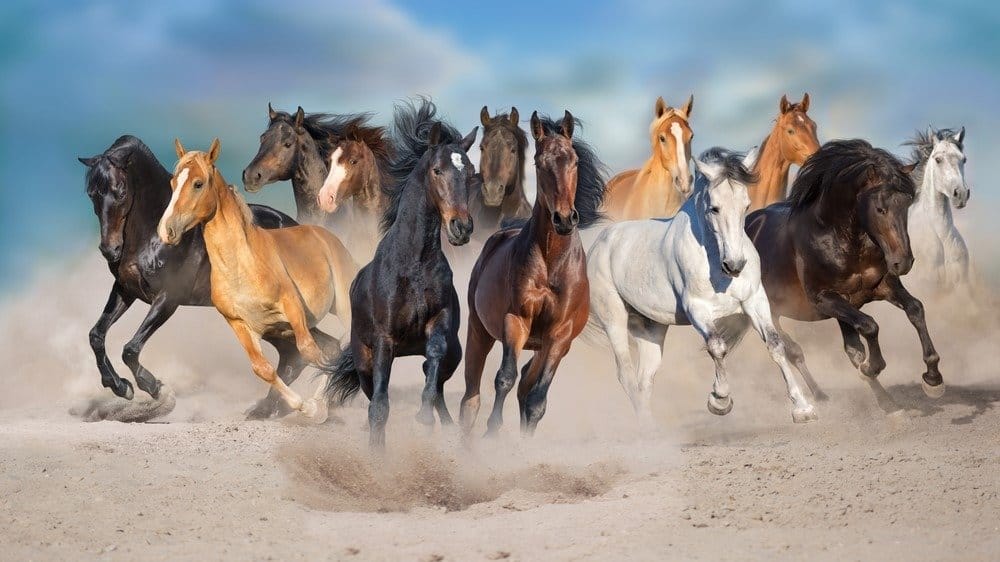
Horses are large mammals with one tow on each of their four feet, long necks, and large heads.
©Kwadrat/Shutterstock.com
Physical Traits
These animals have remarkable hearing due to their large ears perched high atop their heads. Their sense of smell is better than that of a human, but they tend to rely more on vision than smell. Their field of monocular vision is almost 360 degrees, with a narrower field of binocular vision in front and slightly to the sides. The animal has a blind spot directly in front of the nose and directly behind it. For this reason, it is better to approach from the side. Whether they can see color is inconclusive. They do have much better night vision than humans.
These animals have an advanced sense of taste which allows them to sort through grasses and grains to find the things that they would most like to eat. These animals generally will not eat plants that are poisonous, but when the horse cannot find more adequate food, they will eat plants that contain toxins. Its gut is designed to have food flowing through it almost continually, and they graze most of the day if allowed.
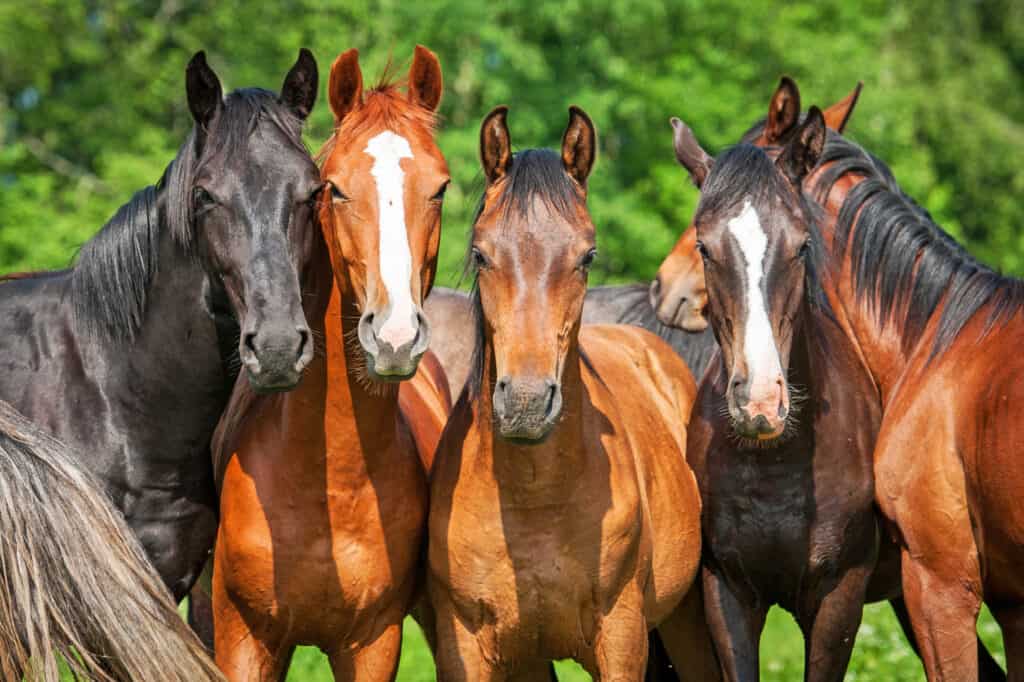
Horses graze continually throughout the day.
©Rita_Kochmarjova/Shutterstock.com
Behavior
Horses are social animals that enjoy being around other horses. They engage in activities like playing and grooming each other. They also exercise their senses by smelling each other and their surroundings. In a natural setting, horses graze and use their senses of smell, sight, and hearing to stay safe and find food.
Horses that live together communicate with each another mainly through body language. Horses have developed subtle and obvious signals in order to communicate with one another.
Horses that live in herds have many advantages, such as being able to take turns being on the lookout for predators and having more sets of eyes and ears to detect them. Horses that are kept alone are more likely to be stressed due to a lack of companionship.
Horses are reactive animals by nature and will run at the first sign of danger. However, with proper training, this behavior can be overcome to make horses and riders/handlers safer. It’s important to remember that if a horse feels trapped, it may resort to kicking, striking, or biting if it can’t escape. When handling a horse, try to read its body language and avoid putting pressure on the animal to the point where it feels it needs to escape or defend itself.
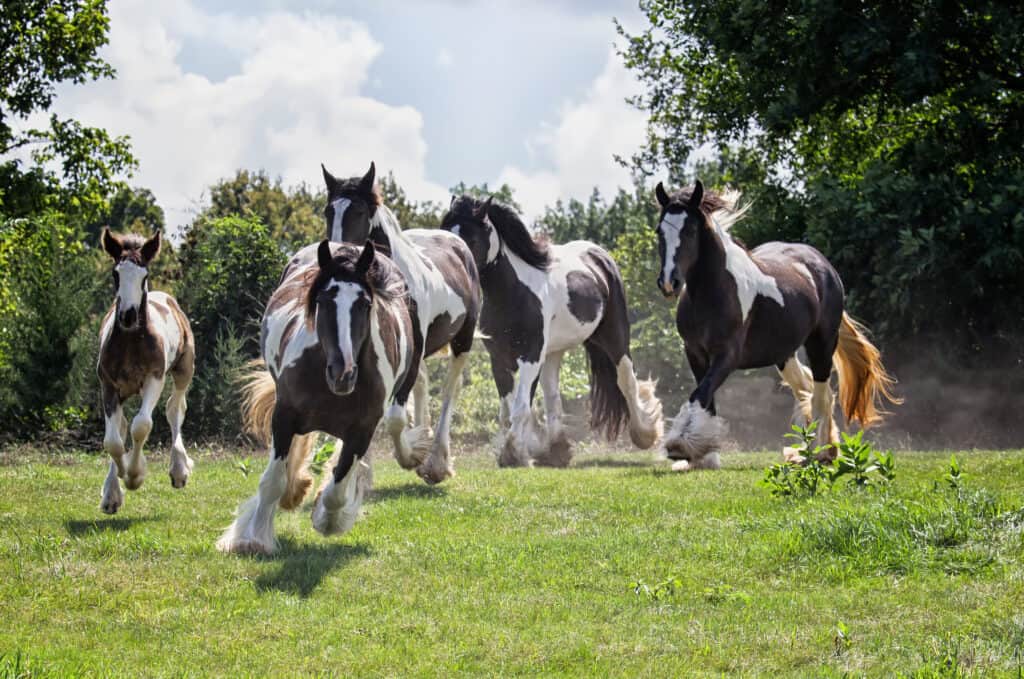
Horses that live together communicate with each another mainly through body language. Horses have developed subtle and obvious signals
©critterbiz/Shutterstock.com
Habitat
These animals are well-suited to all kinds of environments and climates. Domestic horses can live almost anywhere as long as they have shelter, food, and space to run. Some of them are still wild, like North American mustangs. These animals roam freely and comfortably along the prairies and plains of the western area of North America.
Diet
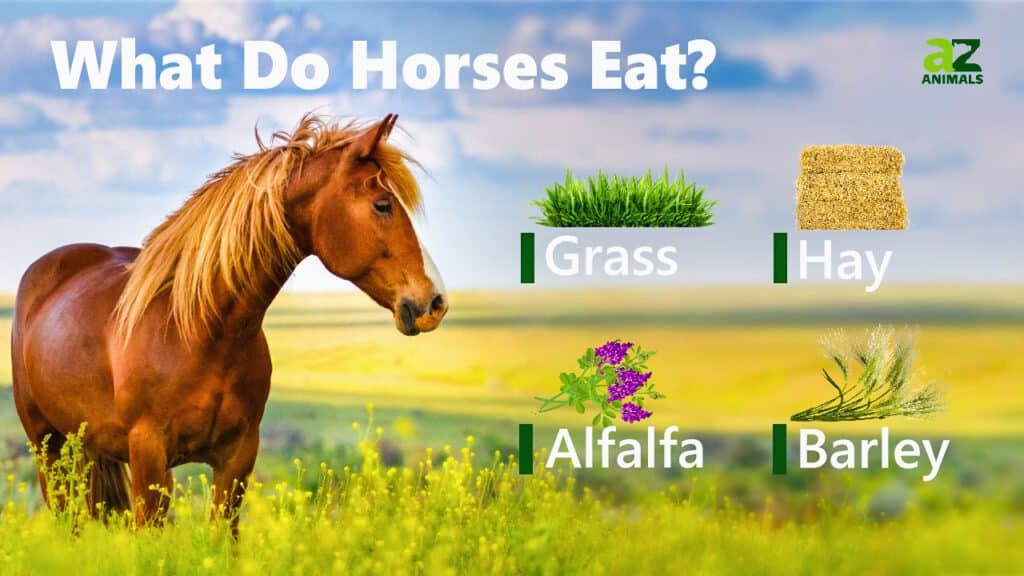
These animals are herbivores, which means they eat a lot of vegetation, including grass and hay. Grass is the most common part of their diet and helps keep their digestive system running well. Hay is the most popular substitute in cooler months when grass is not available freely in pastures. These animals also enjoy fruits and vegetables, like cut-up apples and carrots. Salt, in the form of a salt lick or block, is also a great treat. A well-rounded equine diet will consist of a mixture of these types of foods. For a complete list of foods horses eat, check out our “What Do Horses Eat?” page.
Predators and threats
Domestic horses are protected by the shelter of their homes. In the wild, they are most in danger from attacks by large carnivores. Large cats or wolves pose the greatest threat to old, young, or sick animals. These animals will try to protect themselves by biting and kicking.
Reproduction, Babies, and Lifespan
In the wild, these animals have polygynous mating systems. One adult male, or stallion, would herd a group of adult females, or mares, during the mating season. Stallions defend their mares from other males in the area in an intensive process similar to rutting in deer species. Domestic horses, however, are more selectively bred. This type of artificial selection has given rise to the many different breeds, sizes, uses, and colors of the modern-day horse.
An unborn foal spends about 11 months being carried by its mother. A baby that has not yet been weaned is called a foal and usually can stand and run a short time after it is born. After it is weaned from its mother, a young female is known as a filly, and a young male is known as a colt. A full month after one foal is born, a mare can be mated again. However, horses that are castrated or spayed are known as geldings and cannot have offspring.
Domestic horses live anywhere from 25 to 30 years on average. However, the oldest recorded animal died in 2007 at the remarkable age of 56 years old. The longest-living wild horse is believed to be 36 years old before its death. Someone who works with these animals can tell their age by the pattern of tooth wear.
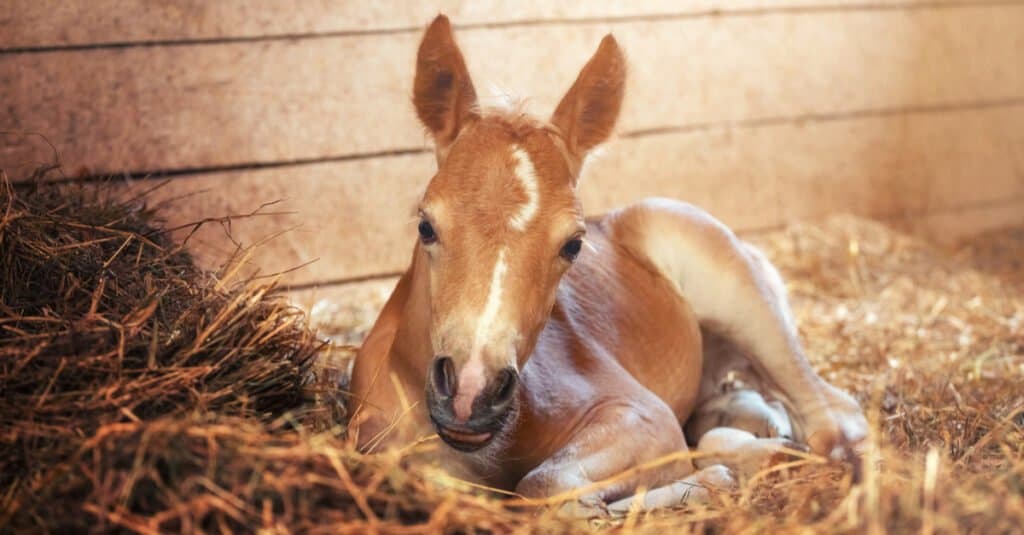
Horses most commonly have one baby at a time. They are pregnant for 11 months.
©Alla-Berlezova/Shutterstock.com
Population
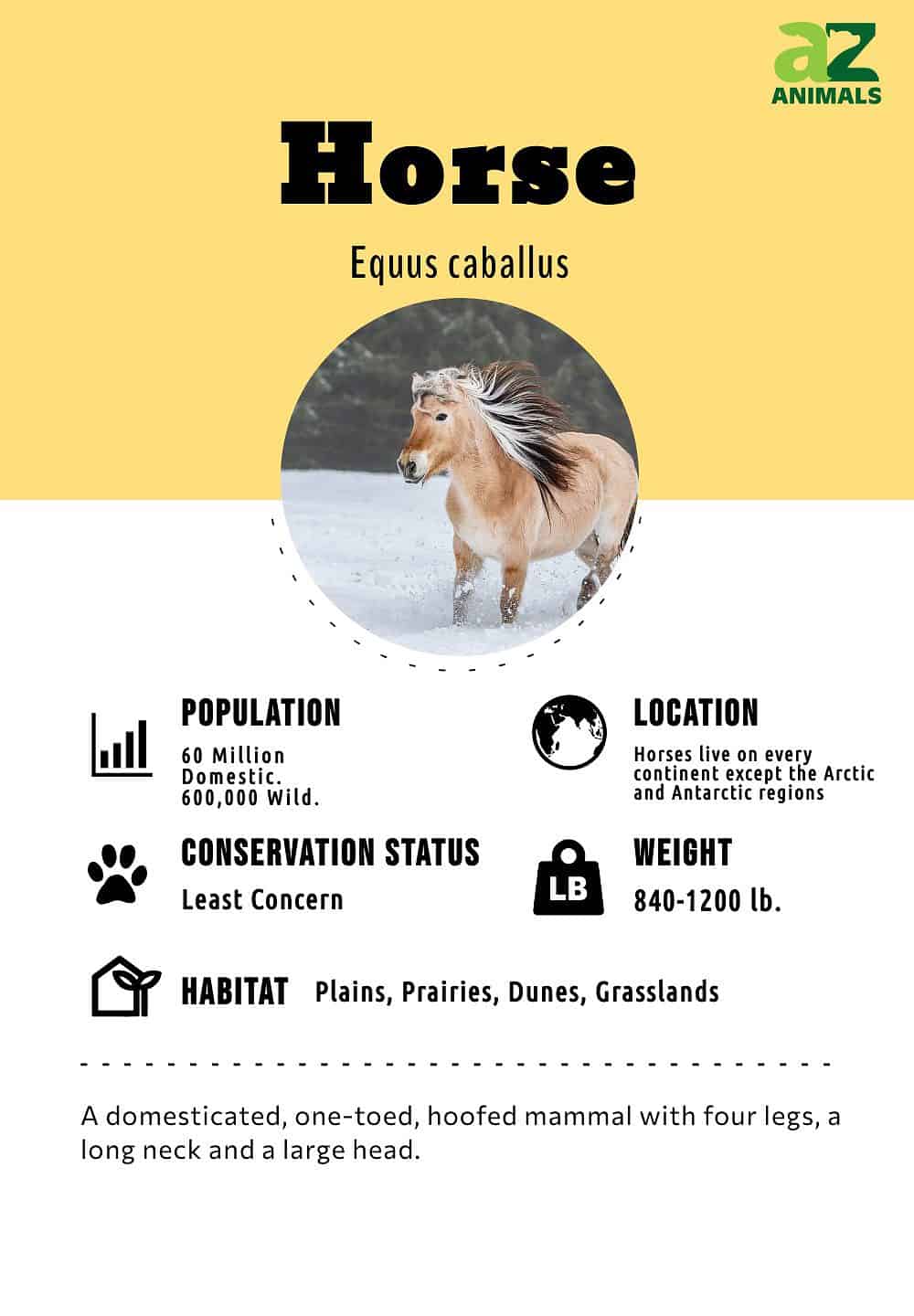
There are 60 million domesticated horses worldwide and 600,000 wild horses. There are thought to be more than 350 different breeds of these animals found around the world today, each being bred for a purpose. Enormous draft horses such as Clydesdales pull heavy wagons, lighter saddle horses are for riding, and pony breeds are suitable for children and small adults. Miniature animals (30″ and under) are primarily pets, though some have been used to guide blind people. Thoroughbreds are a breed that is most famously associated with racing activities. Just like most breeds, you can find thoroughbreds almost anywhere in the world.

There are 60 million domesticated horses worldwide and 600,000 wild horses.
©Canon_photographer/Shutterstock.com
Horses In the Zoo
Horses of all sizes and sorts are part of petting zoos and other attractions, but the most famous ones to live in zoos today are Przewalski’s horses. You can see this animal at the Smithsonian National Zoo. The Przewalksi, or Asian wild horse, is actually the last surviving wild subspecies of the domestic animal. Many zoos participate in conservation efforts. Przewalski’s horse is famous for its shaggy, dark-colored mane and tail.
Types of Horses
The Equus ferus caballus is the only species of horse alive today. However, it has many breeds that are based on their purpose or use. This means that the characteristics and traits a horse will have are dependent on how it was bred and what it needs to be able to do. For example, an Andalusian was developed as a riding horse with advanced dressage skills due to its powerful body and refined features.
Meanwhile, draft horses such as Clydesdales were bred for demanding farm work like pulling heavy wagons. Other breeds have been developed for light agricultural tasks (Belgian), carriage pulling (Cleveland Bay), sports disciplines (Akhal Teke), or kept as pets (Shetland pony). All in all, there are between 350-400 different types of horses depending on who you ask – each breed being specialized with certain purposes in mind.
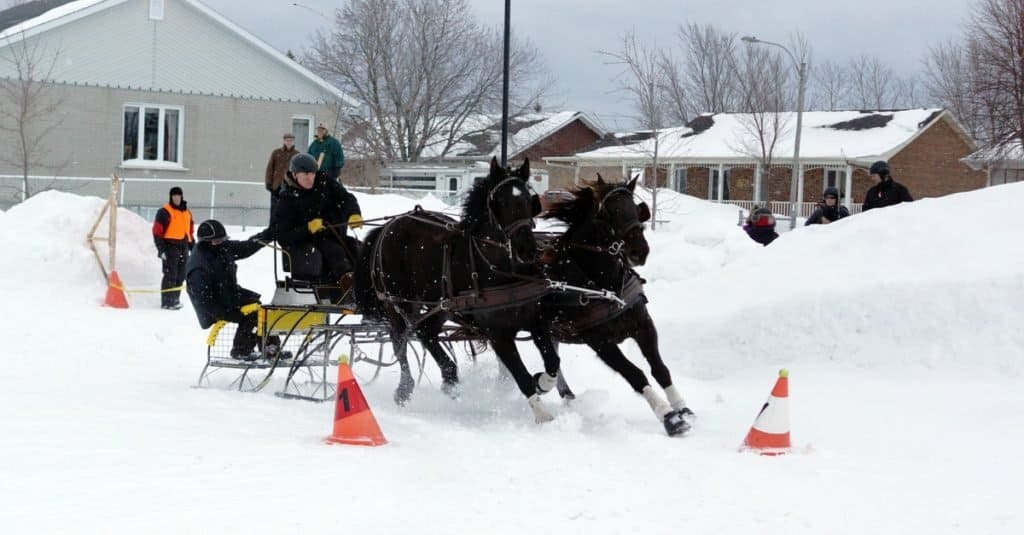
Canadian horse pulling a sleigh in winter obstacle cone driving. This breed is a strong, muscled light horse, generally used for riding and driving.
©Sylvie Bouchard/Shutterstock.com
Even More Information About Horses
If you’re still craving some additional information about horses, such as which breeds are the smallest, fastest, and most expensive, check out these articles:
- The Top 13 Biggest Horses in the World
- How Long Do Horses Live?
- Top 9 Fastest Horses
- Most Expensive Horses in the World
- 8 Smallest Horses in the World
- 10 Prettiest Horses in the World
- Why Do Horses Need Horseshoes?
- How Much Does it Cost to Board a Horse?
- Meet the Sagittarius Spirit Animals
Think you know Horses? Take our brand new Horse Quiz.
View all 104 animals that start with H How to Add Us to Google News

Horse FAQs (Frequently Asked Questions)
What's the difference between a horse and a donkey?
Horses and donkeys come from the same family, however, they have very notable differences. First, horses are significantly faster than donkeys. They’re also much larger as well. Finally, donkeys tend to live in pairs while horses live in large herds.
Quarter horses vs Thoroughbreds
Horses are bred specifically for athletic capabilities. Two types of horses known for their racing prowess are quarter horses and thoroughbreds. The main difference between the two is that quarter horses have been bred for maximum speeds at a quarter mile or less while thoroughbreds have been bred to race for longer distances.
What's the difference between a horse and a zebra?
Zebras and horses have many similar features but are also different species. Horses are generally faster and heavier than zebras. In addition, they’ve been widely domesticated while the same can’t be said for zebras.
What is the scientific name for the horse?
The scientific name for the horse is Equus caballus. Both its genus and species name means horse, but caballus is a Latin word more associated with poetry and grandeur.
What type of animal is a horse?
Horses fall into the Equus genus, which comprises animals similar to the domestic horse. Asses and zebras are members of this genus because they are equine creatures. All of these animals are large ungulate mammals, which means that they have hoofs.
How long do horses live?
Domestic horses live between 25 and 30 years. Free-roaming horses might live less due to threats from other wild animals.
How much do horses weigh?
Horses vary greatly in size between different breeds. They can average anywhere between 840 and 2200 lbs. Thoroughbreds, for example, average between 1000 and 1200 lbs. Stallions will sometimes weigh more than mares.
How many breeds of horses are there?
There are approximately 400 different breeds of horses. The diversity in horse breeds is the result of selective breeding over centuries to emphasize certain characteristics that are well-suited to different tasks, such as farming, battle, racing, and transportation.
How do horses show affection?
Horses show affection to humans and other horses in many ways. They might show affection towards a human by turning their attention towards them, including their ears. A horse may nuzzle the mane of another horse.
What is the smoothest riding horse?
The Peruvian horse is considered to have one of the smoothest gait. It is a breed that shows a lot of pride, from the top of its head down to its jaunty tail.
Are Horses herbivores, carnivores, or omnivores?
Horses are Herbivores, meaning they eat plants.
What Kingdom do Horses belong to?
Horses belong to the Kingdom Animalia.
What phylum to Horses belong to?
Horses belong to the phylum Chordata.
What class do Horses belong to?
Horses belong to the class Mammalia.
What family do Horses belong to?
Horses belong to the family Equidae.
What order do Horses belong to?
Horses belong to the order Perissodactyla.
What type of covering do Horses have?
Horses are covered in Hair.
What genus do Horses belong to?
Horses belong to the genus Equus.
In what type of habitat do Horses live?
Horses live in small forests and grasslands.
What is the main prey for Horses?
Horses eat grass, fruit, and leaves.
What are some predators of Horses?
Predators of Horses include humans, wolves, and bears.
How many babies do Horses have?
The average number of babies a Horse has is 1.
What is an interesting fact about Horses?
The Horse has evolved over 50 million years!
How fast is a Horse?
A Horse can travel at speeds of up to 40 miles per hour.
What is the difference between a horse and a mule?
The most distinctive difference between mules and horses is the mule’s status as a genetic hybrid. Like most hybridized animals, mules are sterile. This is because mules have sixty-three chromosomes, and animals with odd numbers of chromosomes often cannot reliably reproduce.
What are the key differences between miniature horses and ponies?
The key differences between miniature horses and ponies are appearance, temperament, and behavior.
Thank you for reading! Have some feedback for us? Contact the AZ Animals editorial team.
Sources
- David Burnie, Dorling Kindersley (2011) Animal, The Definitive Visual Guide To The World's Wildlife
- Tom Jackson, Lorenz Books (2007) The World Encyclopedia Of Animals
- David Burnie, Kingfisher (2011) The Kingfisher Animal Encyclopedia
- David Burnie, Dorling Kindersley (2008) Illustrated Encyclopedia Of Animals
- Dorling Kindersley (2006) Dorling Kindersley Encyclopedia Of Animals
- David W. Macdonald, Oxford University Press (2010) The Encyclopedia Of Mammals
- National Geographic, Available here: https://www.nationalgeographic.com/animals/mammals/h/horse/
- Animal Diversity Web, Available here: https://animaldiversity.org/accounts/Equus_caballus/
- Spana, Available here: https://spana.org/blog/what-do-horses-eat/
- Tree of Life, Available here: http://tolweb.org/treehouses/?treehouse_id=4223
- Wikipedia, Available here: https://en.wikipedia.org/wiki/Equus_(genus)