Sea Urchin
Echinoidea
 Verified by: AZ Animals Staff
Can live for up to 200 years!
Advertisement
Sea Urchin Scientific Classification
- Kingdom
- Animalia
- Phylum
- Echinodermata
- Class
- Echinoidea
- Order
- Echinoida
- Scientific Name
- Echinoidea
Read our Complete Guide to Classification of Animals.
Sea Urchin Conservation Status
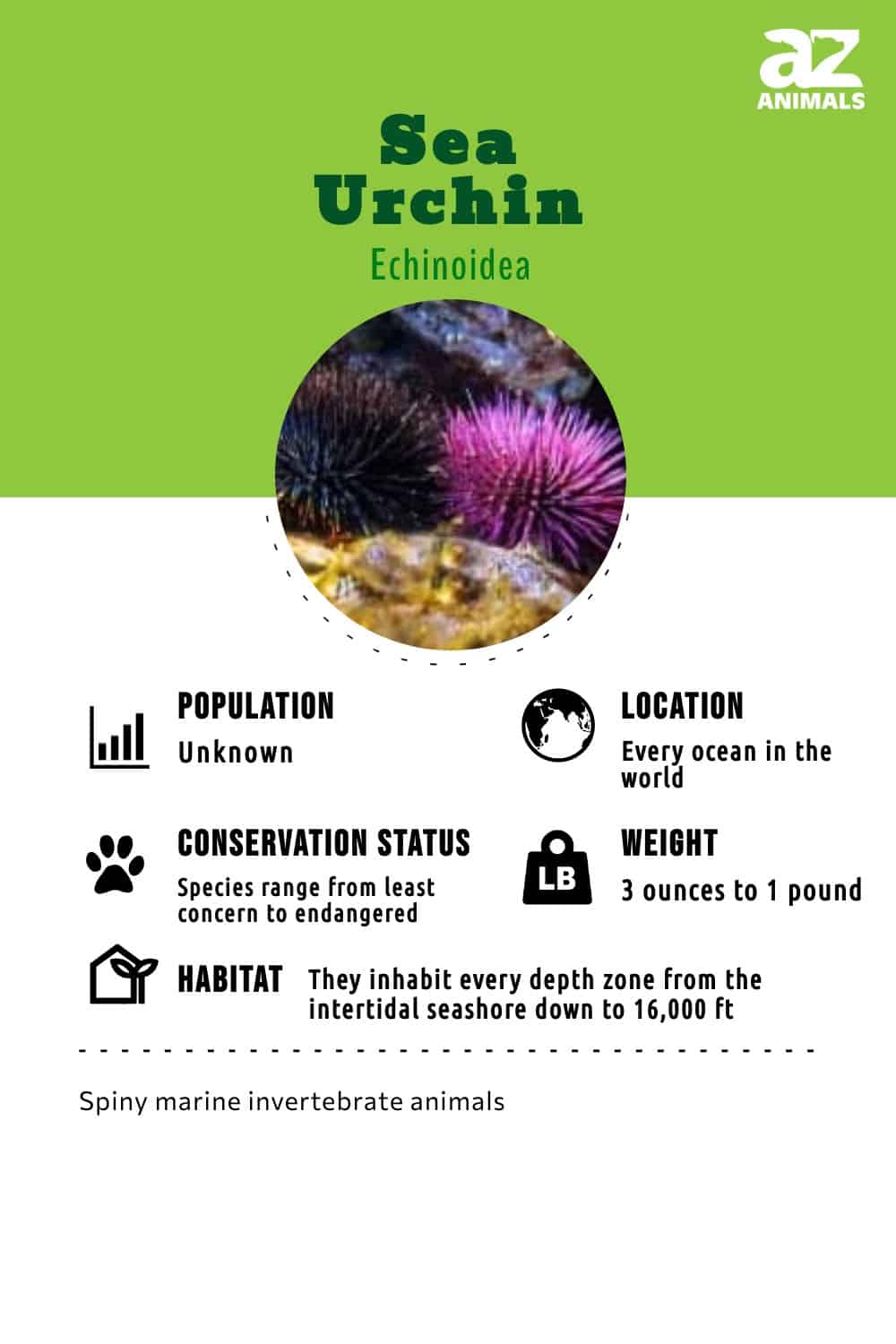
Sea Urchin Facts
- Main Prey
- Algae, Fish, Barnacles
- Optimum pH Level
- 6.0-9.0
- Habitat
- Rocky ocean floor and coral reefs
- Predators
- Fish, Birds, Crabs, Sea Otter
- Diet
- Omnivore
- Favorite Food
- Algae
- Common Name
- Sea Urchin
- Average Clutch Size
- 2000000
- Slogan
- Can live for up to 200 years!

 © Lacen - Public Domain
View all of the Sea Urchin images!



How to Add Us to Google News


Sea urchins are also called sea hedgehogs, sand dollars, and sea biscuits.
Sea urchins are animals that are typically small, spiny, and round. They live in all the earth’s oceans, at depths ranging from the tide line to 15,000 feet. Because they cannot swim, they live on the sea floor. Their main defense against more agile predators like eels and otters is their hard, spiny shell called a ‘test.’
3 Sea Urchin Facts
- Secret weapon: The carrier crab uses a sea urchin like a suit of armor for extra protection from predators.
- Five-fold symmetry: The bodies of mature sea urchins contain five symmetrical sections, unlike mammals, which have two.
- Shy of the spotlight: They have no detectable eyes, but experts suspect their entire body is a compound eye that is sensitive to light.
Classification and Scientific Name
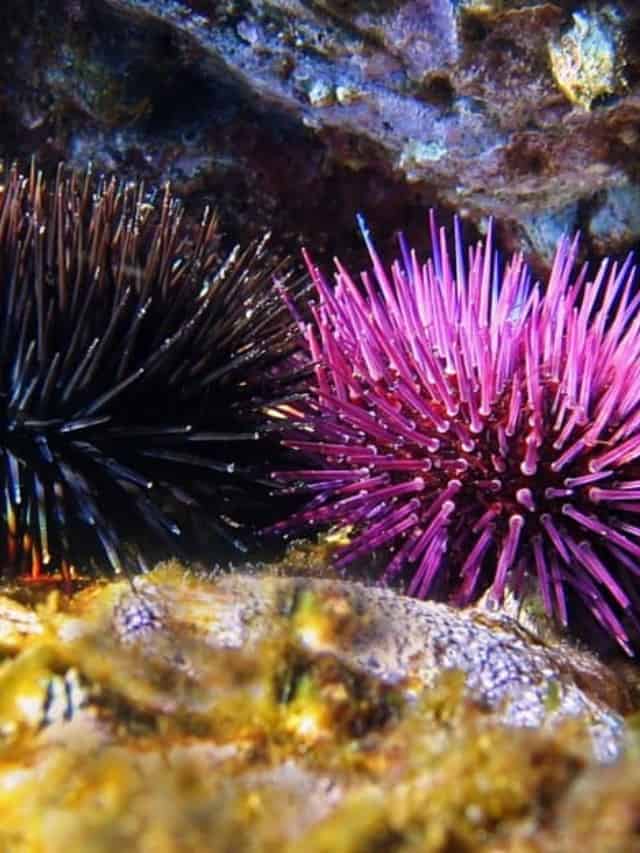
Sea urchin’s scientific name is Echinoidia
©iStock.com/Damocean
Sea urchins are in the Echinodermata phylum. The scientific name is Echinoidia, which is also the name of their class. They are in the Camarodonta order, and some belong to the Echinidae family. This family contains genera including Strongylocentrotus and Lytechinus.
History and Origins

Sea urchins form colonies in the ocean for a specific purpose. When they spawn, males release sperm, and females release eggs that then fertilize when they meet. This is why larger colonies are advantageous, as they have a better chance of producing more embryos. Sea urchins have been around for an astounding 465 million years, constantly adapting to environmental changes in order to survive. It’s remarkable that such a creature with no brain can stay alive for so long.
Sea urchin fossils have been found dating as far back as 465 million years ago during the Middle Ordovician period. The hard calcite plates of these creatures are well-preserved in rocks from this time period, with some specimens even having spines. Isolated spines are also commonly found as fossils. Some of the Cidaroida from the Jurassic and Cretaceous periods had club-shaped spines that were quite heavy.
Fossils of sea urchins from the Paleozoic era are often incomplete and consist of spines and pieces of crushed individuals. Estonia is well-known for its Ordovician and Silurian period shallow-water limestones featuring sea urchins. These ancient sea urchins likely lived in calmer waters, as their thin shells would not have been able to withstand being in more turbulent seas like some present-day species. During the Paleogene and Neogene periods, 66 to 1.8 million years ago, sand dollars emerged with flattened shells and small spines that were adapted for life in shallow water or even under the sand. These fossils are common in southern European limestones and sandstones.
Species
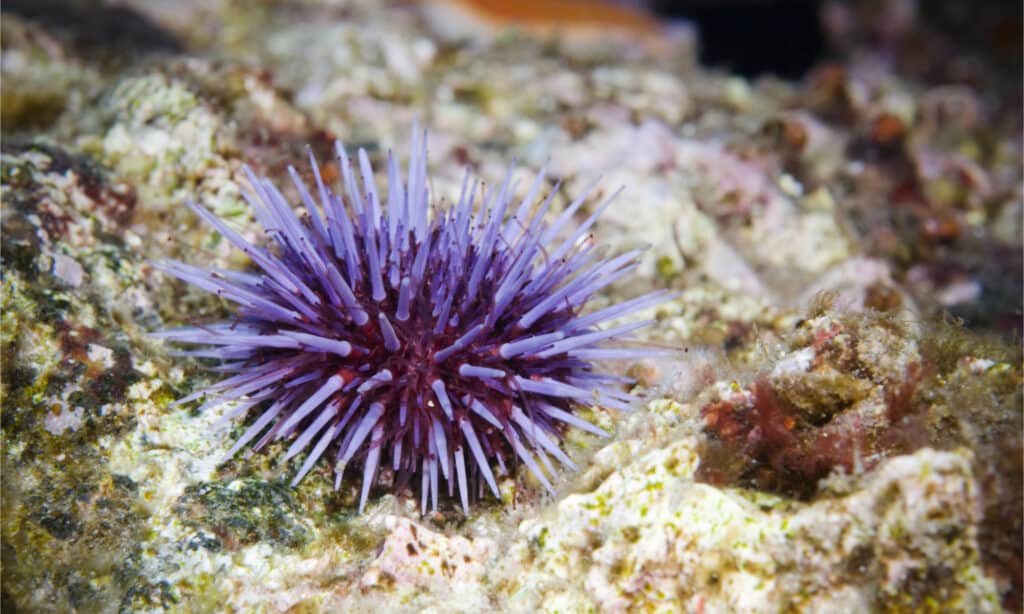
There are hundreds of species of sea urchins.
©NatalieJean/Shutterstock.com
Some of the more interesting types of the 950 species include:
- Strongylocentrotus purpuratus, the Pacific purple sea urchin, is a key ingredient in uni sushi.
- The inky black Diadema sea urchin helps keep Caribbean coral reefs healthy by keeping plant growth down.
- Toxopneustes pileolus, whose common name is flower urchin, is among the most toxic. It inhabits the warm oceans of the Western Indo-Pacific region.
- The giant red sea urchin, or Mesocentrotus franciscanus, is the largest species, with their test averaging about 18 centimeters (seven inches) across and spines eight centimeters (three inches) in length. It inhabits the coastal Pacific waters of North America.
- Heterocentrotus mamillatus, the slate pencil urchin, lives in tropical Indo-Pacific oceans. It has stubby spines with rounded, striped ends that can bore into rock.
- Echinarachnius parma, known by the common names of sand dollar, sea cookie, or pansy shell, is a flat sea urchin that has short spines called cilia for burrowing into the sand. It lives in seas throughout the Northern Hemisphere.
- The green sea urchin, Strongylocentrotus droebachiensis, is one of the 18 edible species. Processors harvest the gonads, glands within the shell, primarily for use in Japanese uni sushi. Green sea urchins live in Northern Atlantic waters.
Appearance
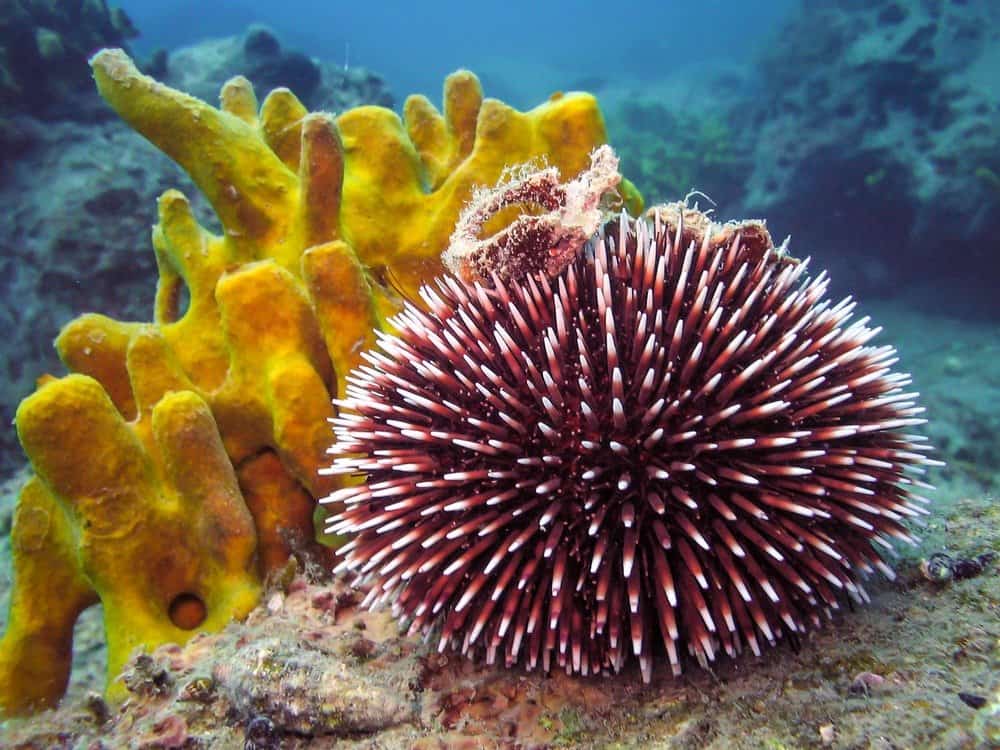
Sea urchins are animals.
©JGA/Shutterstock.com
Sea urchins are small sea animals that have spherical shells called tests that are typically covered in spines similar to those of a porcupine. Very small tube-shaped feet among the spines help them move slowly along the ocean floor. They come in just about every color, from black to white, red, orange, green, brown, purple, pink, yellow, blue, and gray. They range in size from about an inch in diameter up to 14 inches. On average, they weigh about one pound.
Because there are nearly one thousand types of sea urchins, these animals can vary significantly in appearance. You can easily identify most of them by their spiny exteriors, but some, like sand dollars, have only short hairs all over their bodies. Others, like pencil sea urchins, have rounded-off spines that are not sharp like typical urchin spines.
Distribution, Population, and Habitat
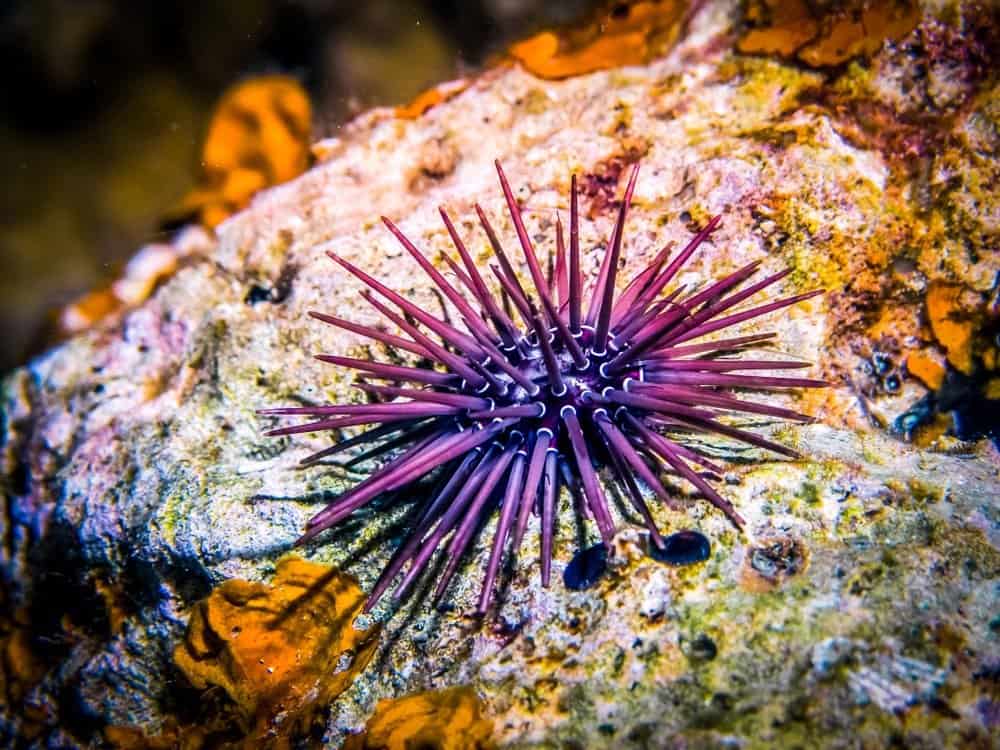
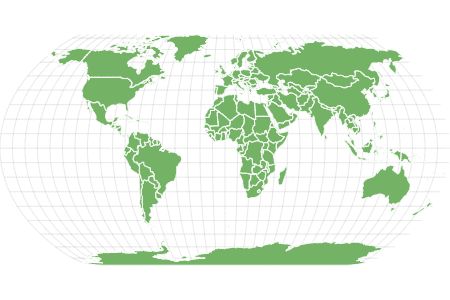
Sea urchins live in every ocean in the world.
©HotFlash/Shutterstock.com
Sea urchins live in oceans throughout the world. Arctic or tropic, shoreline or deepest sea trenches, you can find them there. Because they cannot swim, the ocean floor is their home. Some, like the shingle urchin, live in the shallows near beaches where the sun shines. Others, like the ones in the Pourtaleslidae family, live so deep below the surface they are in total darkness.
Barren underwater areas have dense populations of these creatures, and populations nearer to the shore are the densest by far. While they live throughout the world, the greatest numbers live in temperate and tropical ocean habitats in the shallows up to ten meters down, where the plants they eat are plentiful.
With so many types and such a wide-ranging habitat, it is impossible to know for sure. However, a recent marine study in Oregon estimated that the purple species population on just one coastal reef numbered around 350 million, a figure that represented a 10,000-fold increase in just a few years, putting them in the least concern conservation category. Researchers attributed the exponential expansion of this Pacific coast class of urchins to a marine ecosystem that is out of balance.
Meanwhile, in the Mediterranean, the purple sea urchin population is currently in a near-threatened state. Factors that have decimated the species include warming sea temperatures and invasive fish that eat algae, depriving the urchins of a diet staple. Again, the underlying cause is an imbalance in the ecosystem.
However, scarcity of food does not necessarily mean the species is headed for extinction. Purple urchins can go dormant and survive with no food for years at a time. With such extraordinary persistence, these populations may ebb, but they also flow.
Predators and Prey
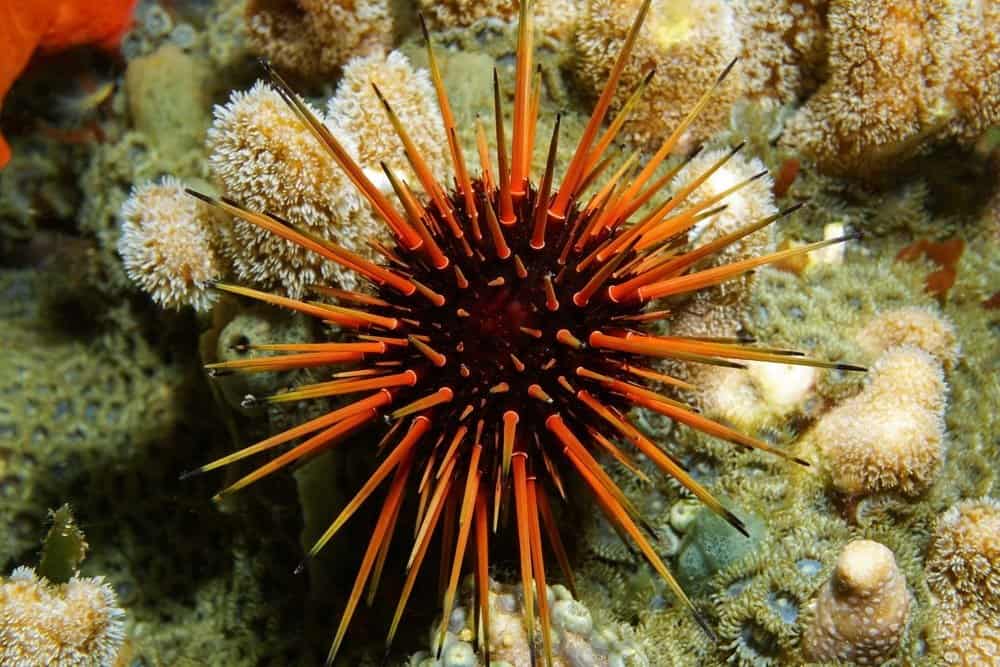
Sea urchins are vulnerable to bacterial diseases.
©Damsea/Shutterstock.com
Despite their inborn resiliency, sea urchins are subject to threats from disease as well as predators. A 1981 bacterial disease nearly wiped out the Hemicentrotus pulcherimus and Pseudocentrotus depressus species in Japan. Bald sea urchin disease, another bacterial illness, threatens some sea urchin populations, causing the animals’ spines to fall out and leaving them defenseless against predators.
What Eats Sea Urchin?
Shellfish like crabs and lobsters are among these creatures’ natural predators. Triggerfish and wrasse are two fish that prey on them. The wolf eel is specially equipped to hunt and eat those in the Northern Hemisphere. Sea otters in regions like British Columbia help maintain ecological balance by keeping urchins from overpopulating.
Although they are slow-moving, sea urchins do have some means of protecting themselves. Their sharp spines are often enough to discourage some predators. A few urchin species are venomous too.
What Do Sea Urchin Eat?
Sea urchin mainly eat marine vegetation like algae and kelp. They also prey on sessile, or immobile, sea creatures such as coral and sea sponges.
Reproduction and Lifespan
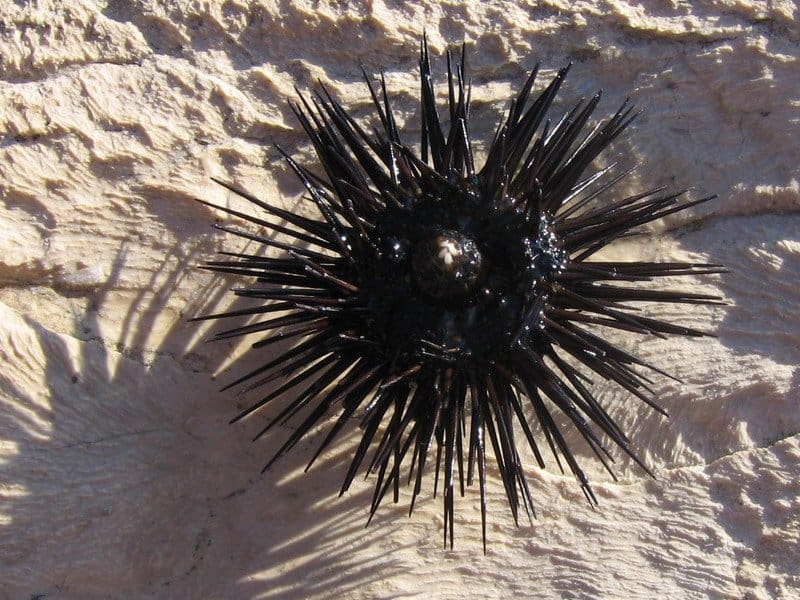
Sea Urchins eat sea vegetables.
©Lacen – Public Domain
Females of the species produce eggs. Most release these eggs into the sea for fertilization by the sperm that males have released. The females of a few species hold their eggs among their spines rather than let them float freely.
Once fertilization occurs, it takes only about 12 hours for the egg to become an embryo. Soon thereafter, the embryo becomes a larva with cilia that can collect microscopic food to nurture its growth. It takes several months for the larva to transform into a fully developed sea urchin. It will grow for a few more years to reach adulthood. Depending on the species, they live a number of years. For example, the purple species has a life expectancy of around 20 years.
Fishing and Cooking
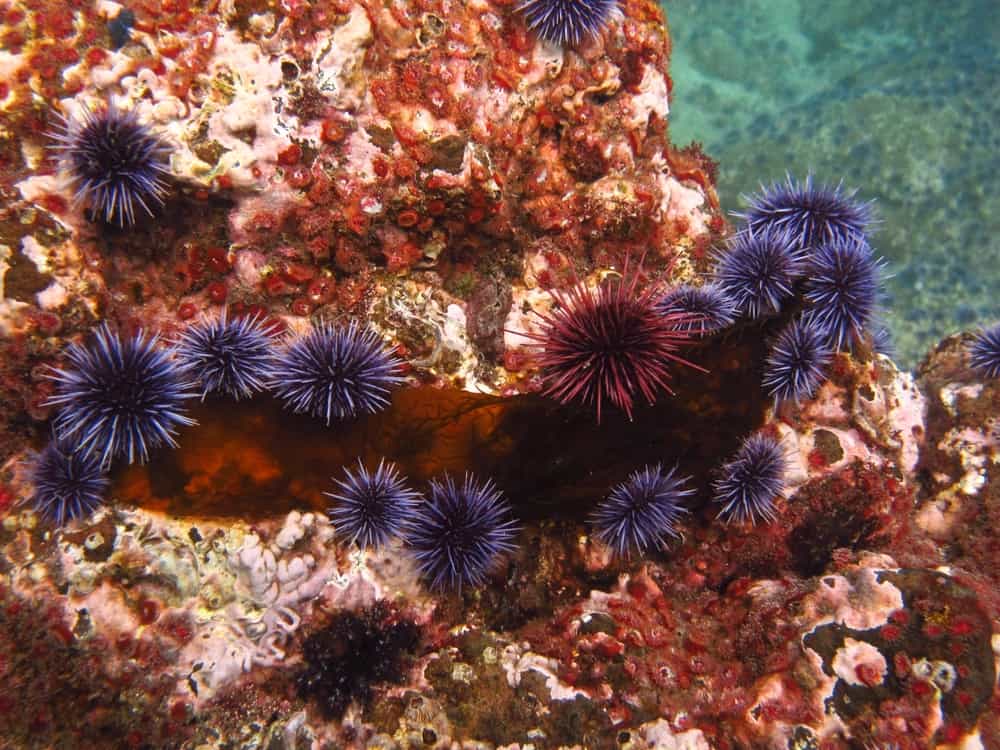
Purple and red sea urchins eat a piece of kelp.
©Brandon B/Shutterstock.com
In many international cuisines, from Alaska to New Zealand, the gonads, or roe, are a delicacy. Typically, people eat them raw with lemon juice or olive oil. In other regions, chefs incorporate the roe in gourmet sauces, omelets, and soups.
The Japanese enjoy the roe in uni sushi. They consume about 50,000 tons of urchin roes per year, which amounts to approximately 80 percent of the world’s commercially processed supply.
950 Types of Sea Urchins
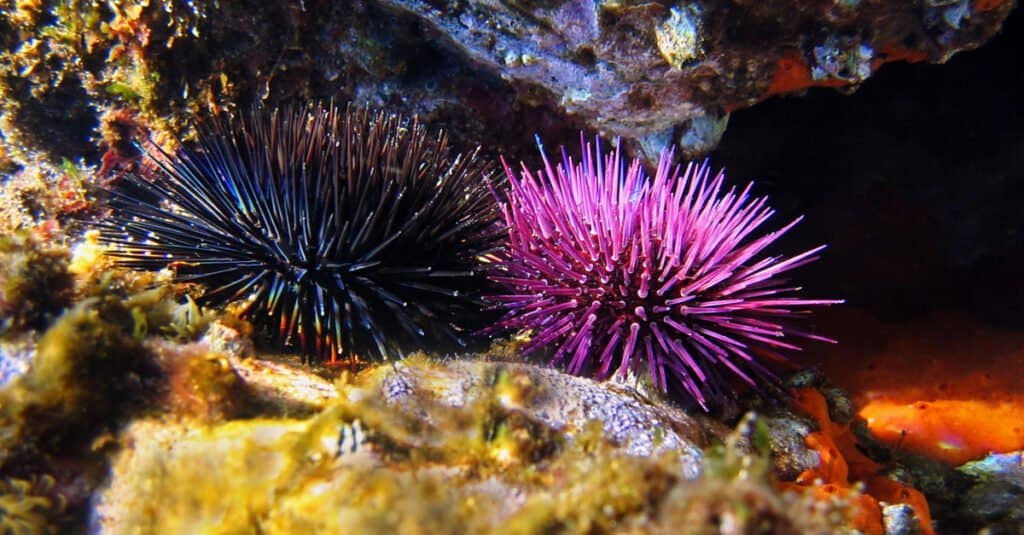
Sea urchins use their spiked shells to protect themselves from predators.
©Damsea/Shutterstock.com
| Sea Urchin Scientific Name |
|---|
| Aarchaeocidaris |
| Aarchaeocidaris strawberryensis |
| Abatus (Pseudabatus) |
| Abatus (Pseudabatus) nimrodi |
| Abatus agassizii |
| Abatus australis |
| Abatus beatriceae |
| Abatus bidens |
| Abatus cavernosus |
| Abatus cavernosus bidens |
| Abatus cavernosus cavernosus |
| Abatus cavernosus var. bidens |
| Abatus cordatus |
| Abatus curvidens |
| Abatus elongatus |
| Abatus gallegosensis |
| Abatus ingens |
| Abatus kieri |
| Abatus koehleri |
| Abatus nimrodi |
| Abatus philippi |
| Abatus philippii |
| Abatus shackletoni |
| Abelleicidaris |
| Abelleicidaris borjnadorensis |
| Abertella |
| Abertella aberti |
| Abertella cazonensis |
| Abertella cazonesensis |
| Abertella complanata |
| Abertella dengleri |
| Abertella floridana |
| Abertella gualichensis |
| Abertella habanensis |
| Abertella kewi |
| Abertella miskellyi |
| Abertella palmeri |
| Abertella pirabensis |
| Abertellidae |
| Absurdaster |
| Absurdaster hungaricus |
| Absurdaster meriani |
| Absurdaster puezensis |
| Acanthechinopsis |
| Acanthechinus |
| Acanthechinus dixiei |
| Acanthocidaris |
| Acanthocidaris curvatispinis |
| Acanthocidaris hastigera |
| Acanthocidaris hastingeria |
| Acanthocidaris maculicollis |
| Acanthotrema |
| Acanthotrema siculum |
| Aceste |
| Aceste annandalei |
| Aceste bellidifera |
| Aceste ovata |
| Aceste purpurea |
| Aceste sibogae |
| Aceste weberi |
| Acestina |
| Acestina annandalei |
| Acestina weberi |
| Acriaster |
| Acriaster sergipensis |
| Acrocidaris |
| Acrocidaris arginensis |
| Acrocidaris borissiaki |
| Acrocidaris cazioti |
| Acrocidaris crenulata |
| Acrocidaris marocense |
| Acrocidaris nicolleaui |
| Acrocircus |
| Acrocladia |
| Acrocladia blainvillei |
| Acrocladia blainvillii |
| Acrocladia cuspidata |
| Acrocladia hastifera |
| Acrocladia mamillata |
| Acrocladia mammillata |
| Acrocladia planispina |
| Acrocladia planissima |
| Acrocladia serialis |
| Acrocladia trigonaria |
| Acrocladia violacea |
| Acroechinoidea |
| Acrolusia |
| Acrolusiidae |
| Acromazus |
| Acropeltidae |
| Acropeltis |
| Acropeltis atlantica |
| Acrosalenia |
| Acrosalenia (Acrosalenia) |
| Acrosalenia (Milnia) |
| Acrosalenia angularis |
| Acrosalenia arabica |
| Acrosalenia basseae |
| Acrosalenia bowersi |
| Acrosalenia dhrumaensis |
| Acrosalenia gananensis |
| Acrosalenia gauthieri |
| Acrosalenia hemicidaroides |
| Acrosalenia jauberti |
| Acrosalenia koenigi |
| Acrosalenia Koenigii |
| Acrosalenia lamarckii |
| Acrosalenia lycetti |
| Acrosalenia marratensis |
| Acrosalenia mathildae |
| Acrosalenia microstoma |
| Acrosalenia mideltensis |
| Acrosalenia miliaria |
| Acrosalenia minuta |
| Acrosalenia pentagona |
| Acrosalenia smelliei |
| Acrosalenia somaliensis |
| Acrosalenia spinosa |
| Acrosalenia termieri |
| Acrosalenia wylliei |
| Acrosalenia zararensis |
| Acrosaleniidae |
| Acrosaster |
| Acrotiaris |
| Actapericulum |
| Actapericulum bicarinatum |
| Actinocidaris |
| Actinocidaris thomasi |
| Actinophyma |
| Actinopsis |
| Adelcidaris |
| Adelopneustes |
| Adelopneustes ernsti |
| Adelopneustes montainvillensis |
| Adelostellata |
| Adetaster |
| Aeolopneustes |
| Aerope |
| Aërope |
| Aerope fulva |
| Aerope rostrata |
| Aërope rostrata |
| Aeropsidae |
| Aeropsis |
| Aeropsis fulva |
| Aeropsis rostrata |
| Aeropsis sibogae |
| Aeropsis weberi |
| Agarites |
| Agassisia |
| Agassizia |
| Agassizia (Agassizia) |
| Agassizia (Agassizia) powersi |
| Agassizia (Anisaster) |
| Agassizia (Anisaster) arabica |
| Agassizia (Anisaster) mossomi |
| Agassizia (Anisaster) wilmingtonica |
| Agassizia (Anisaster) wilmingtonica inflata |
| Agassizia æquipeta |
| Agassizia aequipetala |
| Agassizia algarbiensis |
| Agassizia alveari |
| Agassizia avilensis |
| Agassizia camagueyana |
| Agassizia caobaensis |
| Agassizia caribbeana |
| Agassizia cyrenaica |
| Agassizia cyrenaica pseudoclevei |
| Agassizia cyrenaica pseudoinflala |
| Agassizia cyrenaica var. pseudoclevei |
| Agassizia cyrenaica var. pseudoinflala |
| Agassizia eugeniae |
| Agassizia excavata |
| Agassizia excentrica |
| Agassizia flexuosa |
| Agassizia guanensis |
| Agassizia lamberti |
| Agassizia lamberti oligocenicus |
| Agassizia lamberti var. oligocenicus |
| Agassizia ovulum |
| Agassizia pinarensis |
| Agassizia regia |
| Agassizia scrobiculata |
| Agassizia scrobiculata persica |
| Agassizia scrobiculata var. persica |
| Agassizia subrotunda |
| Aguayoaster |
| Aguayoaster aguayoi |
| Aguayoaster schickleri |
| Airaghia |
| Albertechinus |
| Albertechinus devonicus |
| Albertechinus montanus |
| Alexandraspis |
| Alexandria |
| Aliaster |
| Allaster |
| Allaster rotundatus |
| Allobrissus |
| Allocentrotus |
| Allocentrotus fragilis |
| Allocentrotus japonicus |
| Allomma |
| Allomma kalon |
| Allomma wrighti |
| Allotoxaster |
| Almucidaris |
| Almucidaris durhami |
| Alomma |
| Alpicidaris |
| Alternechinus |
| Alternocidaris |
| Ambipleurus |
| Ambipleurus quaylei |
| Ambipleurus rotundatus |
| Ambipleurus viladensis |
| Amblypneustes |
| Amblypneustes corrali |
| Amblypneustes elevatus |
| Amblypneustes elevatus elevatus |
| Amblypneustes elevatus ruber |
| Amblypneustes formosus |
| Amblypneustes grandis |
| Amblypneustes griseus |
| Amblypneustes griseus pachistus |
| Amblypneustes griseus ruber |
| Amblypneustes griseus var. rubra |
| Amblypneustes grossularia |
| Amblypneustes inflatus |
| Amblypneustes leucoglobus |
| Amblypneustes ovum |
| Amblypneustes ovum grandis |
| Amblypneustes ovum pachista |
| Amblypneustes ovum pachistus |
| Amblypneustes pachistus |
| Amblypneustes pachistus ruber |
| Amblypneustes pallidus |
| Amblypneustes pallidus subglobosus |
| Amblypneustes pallidus var. subglobosus |
| Amblypneustes pentagonus |
| Amblypneustes pulchellus |
| Amblypneustes purpurascens |
| Amblypneustes scalaris |
| Amblypneustes serialis |
| Amblypneustes textilis |
| Amblypneustes triseriatus |
| Amblypygus |
| Amblypygus (Amblypygus) |
| Amblypygus (Paramblypygus) |
| Amblypygus (Paramblypygus) houphoueti |
| Amblypygus checchiai |
| Amblypygus depressus |
| Amblypygus douvillei |
| Amblypygus moriensi |
| Amblypygus moriensis |
| Amblypygus ratiparensis |
| Ambuloasteroidea |
| Ammotrophinae |
| Ammotrophus |
| Ammotrophus arachnoides |
| Ammotrophus crassus |
| Ammotrophus cyclius |
| Ammotrophus platyterus |
| Amoraster |
| Amoraster paucituberculata |
| Amoraster tuberculata |
| Amphidetus |
| Amphidetus ampliflorus |
| Amphidetus capensis |
| Amphidetus cordatus |
| Amphidetus flavescens |
| Amphidetus gibbosus |
| Amphidetus kurtzii |
| Amphidetus kürtzii |
| Amphidetus laevigaster |
| Amphidetus lymani |
| Amphidetus mediterraneus |
| Amphidetus mortenseni |
| Amphidetus novae zealandiae |
| Amphidetus novæ zelandiæ |
| Amphidetus novaezelandiae |
| Amphidetus ovatus |
| Amphidetus pennatifidus |
| Amphidetus roseus |
| Amphidetus zealandicus |
| Amphidotus |
| Amphidotus cordatus |
| Amphidotus roseus |
| Amphiope |
| Amphiope (Tetrodiscus) |
| Amphiope (Tetrodiscus) auritus |
| Amphiope arcuata |
| Amphiope bioculata |
| Amphiope bioculata bentivegnae |
| Amphiope bioculata pelatensis |
| Amphiope bioculata var. bentivegnae |
| Amphiope bioculata var. pelatensis |
| Amphiope caupianensis |
| Amphiope dallonii |
| Amphiope doderleini |
| Amphiope döderleini |
| Amphiope doederleini |
| Amphiope fuchsi |
| Amphiope labriei |
| Amphiope miocenica |
| Amphiope nuragica |
| Amphiope pedemontana |
| Amphiope truncata |
| Amphipneustes |
| Amphipneustes bifidus |
| Amphipneustes brevisternalis |
| Amphipneustes davidi |
| Amphipneustes koehleri |
| Amphipneustes lorioli |
| Amphipneustes marsupialis |
| Amphipneustes mironovi |
| Amphipneustes mortenseni |
| Amphipneustes rostratus |
| Amphipneustes similis |
| Amphipneustes tumescens |
| Amphisalenia |
| Amphisternata |
| Amplaster |
| Amplaster alatus |
| Amplaster coloniensis |
| Amplaster ellipticus |
| Anabrissus |
| Anabrissus damesi |
| Anametalia |
| Anametalia grandis |
| Anametalia regularis |
| Anametalia sternaloides |
| Ananchites |
| Ananchites argentinus |
| Ananchites austriaca |
| Ananchitis |
| Ananchothuria |
| Ananchytes |
| Ananchytes tuberculatus |
| Anapesus |
| Anapesus blainvillei |
| Anapesus carolinus |
| Anapesus semituberculatus |
| Anaster |
| Anaulocidaris |
| Anaulocidaris tuberculata |
| Anaulocidaris vinassai |
| Ancyclocidaris |
| Ancylocidaris |
| Ancylocidaris spenceri |
| Angusticlypeus |
| Animalia |
| Anisaster |
| Anisaster arabica |
| Anisocidaridae |
| Anisocidaris |
| Anisocidaris leberti |
| Anisopetalus |
| Anisopetalus brodermanni |
| Anisopetalus caobaense |
| Anisopetalus cookei |
| Anisopetalus ellipticus |
| Anisopetalus oliveirai |
| Anochanus |
| Anochanus sinensis |
| Anomalanthus |
| Anomalanthus elevatus |
| Anomalanthus gigas |
| Anomalanthus guadalupense |
| Anomalanthus oligocenicus |
| Anomalanthus rojasi |
| Anomalanthus tumidus |
| Anomalanthus zanoletti |
| Anomocidaris |
| Anomocidaris japonica |
| Anomocidaris tenuispina |
| Anorthopygidae |
| Anorthopygus |
| Anorthopygus arabicus |
| Anorthopygus orbicularis |
| Anorthopygus paradoxus |
| Anorthopygus riveroi |
| Anorthopygus texanus |
| Anorthoscutum |
| Anorthoscutum oregonense |
| Anorthoscutum oregonense quaylei |
| Anothopygus |
| Anthechinus |
| Anthechinus roseus |
| Anthobrissus |
| Anthocidaris |
| Anthocidaris crassispina |
| Anthocidaris delalandi |
| Anthocidaris homalostoma |
| Anthocidaris purpurea |
| Antillaster |
| Antillaster albeari |
| Antillaster arnoldi |
| Antillaster bagmanovi |
| Antillaster bonairensis |
| Antillaster brachypetalus |
| Antillaster cartagensis |
| Antillaster depressus |
| Antillaster estenozi |
| Antillaster expansus |
| Antillaster giganteus |
| Antillaster guevarai |
| Antillaster herrerae |
| Antillaster jaumei |
| Antillaster lamberti |
| Antillaster mortenseni |
| Antillaster rojasi |
| Antillasteridae |
| Antipneustes |
| Antipneustes brevisternalis |
| Antipneustes marsupialis |
| Antipneustes rostratus |
| Antipneustes tumescens |
| Antiqubrissus |
| Antiquobrissus |
| Antiquobrissus suemegensis |
| Antiquobrissus sümegensis |
| Antrechinus |
| Antrechinus drygalskii |
| Antrechinus drygalskii drygalskii |
| Antrechinus drygalskii perfidus |
| Antrechinus mortenseni |
| Antrechinus nordenskjoldi |
| Antropygus |
| Apatopygidae |
| Apatopygus |
| Apatopygus gaudensis |
| Apatopygus mannumensis |
| Apatopygus occidentalis |
| Apatopygus recens |
| Apatopygus vincentinus |
| Apatoypgus |
| Aphanophora |
| Aphanophora bassoris |
| Aphanopora |
| Aphanopora echinobrissoides |
| Aphelaster |
| Aphelaster serotinus |
| Aplocidaris |
| Aplodiadema |
| Aplolampas |
| Aplospatangus |
| Aporocidaris |
| Aporocidaris antarctica |
| Aporocidaris eltaniana |
| Aporocidaris fragilis |
| Aporocidaris incerta |
| Aporocidaris milleri |
| Aporocidaris usarpi |
| Apoxypetalum |
| Apoxypetalum chenjafra |
| Aptilechinus |
| Aptilechinus caledonensis |
| Arachniopleurus |
| Arachniopleurus istrianus |
| Arachnoides |
| Arachnoides placenta |
| Arachnoides tenuis |
| Arachnoides zelandiae |
| Arachnoides zeylandiae |
| Arachnoididae |
| Arachnoidinae |
| Araeolampas |
| Araeolampas atlantica |
| Araeolampas fulva |
| Araeolampas glauca |
| Araeolampas hastata |
| Araeolampas rostrata |
| Araeosoma |
| Araeosoma alternatum |
| Araeosoma anatirostrum |
| Araeosoma bakeri |
| Araeosoma belli |
| Araeosoma bidentatum |
| Araeosoma brunnichi |
| Araeosoma coriacea |
| Araeosoma coriaceum |
| Araeosoma coriaceum coriaceum |
| Araeosoma coriaceum indicum |
| Araeosoma coriaceum var. indicum |
| Araeosoma eurypatum |
| Araeosoma fenestratum |
| Araeosoma gracile |
| Araeosoma hystrix |
| Araeosoma leppienae |
| Araeosoma leptaleum |
| Araeosoma migratum |
| Araeosoma mortenseni |
| Araeosoma owsteni |
| Araeosoma owstoni |
| Araeosoma owstoni bicolor |
| Araeosoma owstoni nudum |
| Araeosoma owstoni owstoni |
| Araeosoma owstoni var. nudum |
| Araeosoma parviungulatum |
| Araeosoma paucispinum |
| Araeosoma pellucidum |
| Araeosoma pyrochloa |
| Araeosoma splendens |
| Araeosoma tertii |
| Araeosoma tessellatum |
| Araeosoma tessellatum carinatum |
| Araeosoma tessellatum tessellatum |
| Araeosoma tessellatum var. carinatum |
| Araeosoma thetidis |
| Araeosoma violaceum |
| Arbacea |
| Arbacea punctulata |
| Arbacia |
| Arbacia (Echinocidaris) |
| Arbacia (Echinocidaris) nigra |
| Arbacia (Echinocidaris) spatuligera |
| Arbacia (Tetrapygus) |
| Arbacia (Tetrapygus) nigra |
| Arbacia abiquaensis |
| Arbacia aequituberculata |
| Arbacia alternans |
| Arbacia australis |
| Arbacia crassispina |
| Arbacia crenulata |
| Arbacia dufresnii |
| Arbacia Forbesii |
| Arbacia grandinosa |
| Arbacia incisa |
| Arbacia lixula |
| Arbacia lixula africana |
| Arbacia lixula lixula |
| Arbacia nigra |
| Arbacia punctulata |
| Arbacia pustulosa |
| Arbacia rivuli |
| Arbacia schythei |
| Arbacia spatuligera |
| Arbacia stellata |
| Arbacia waccamaw |
| Arbaciella |
| Arbaciella elegans |
| Arbaciidae |
| Arbaciidae incertae sedis |
| Arbaciidae incertae sedis bipatellis |
| Arbaciidae incertae sedis rotularis |
| Arbaciidae incertae sedis sphaeroides |
| Arbacina |
| Arbacina blancheti |
| Arbacina emmae |
| Arbacina forbesiana |
| Arbacina hugueti |
| Arbacina nitida |
| Arbacina pallaryi |
| Arbacina pareyni |
| Arbacina ruba |
| Arbacina variabilis |
| Arbacioida |
| Arbia |
| Arcaechinus |
| Arcaechinus auraduensis |
| Archaechinus |
| Archaechinus auraduensis |
| Archaeocidaridae |
| Archaeocidaris |
| Archaeocidaris aliquantula |
| Archaeocidaris apheles |
| Archaeocidaris barroisi |
| Archaeocidaris brownwoodensis |
| Archaeocidaris cowleyi |
| Archaeocidaris diadematoides |
| Archaeocidaris faassi |
| Archaeocidaris fraxinensis |
| Archaeocidaris hamata |
| Archaeocidaris harteiana |
| Archaeocidaris hemispinifera |
| Archaeocidaris immanis |
| Archaeocidaris manhattanensis |
| Archaeocidaris meurevillensis |
| Archaeocidaris mosquensis |
| Archaeocidaris propinqua |
| Archaeocidaris schreteri |
| Archaeocidaris schréteri |
| Archaeocidaris setosa |
| Archaeocidaris subwortheni |
| Archaeocidaris triserialis |
| Archaeocidaris whatleyensis |
| Archaeodiadema |
| Archaeopneustes |
| Archaeopneustes hemingi |
| Archaeopneustes hystrix |
| Archaeopneustes moorefieldi |
| Archaeopneustes niasicus |
| Archeopneustes |
| Archeopneustes hystrix |
| Archiacia |
| Archiacia hungarica |
| Archiacia lorioli |
| Archiacia magna |
| Archiaciidae |
| Argopatagus |
| Argopatagus aculeata |
| Argopatagus multispinus |
| Argopatagus planus |
| Argopatagus vitreus |
| Arialopsis |
| Arnaudaster |
| Arnaudaster colombianus |
| Arnaudaster cylindriformis |
| Asaphechinus |
| Asaphechinus murrayensis |
| Asaphechinus princeps |
| Asaphechinus singletoni |
| Asaphechinus tasmanensis |
| Aspidocidaris |
| Aspidodiadema |
| Aspidodiadema (Plesiodiadema) |
| Aspidodiadema (Plesiodiadema) microtuberculatum |
| Aspidodiadema africanum |
| Aspidodiadema annulatum |
| Aspidodiadema antillarum |
| Aspidodiadema arcitum |
| Aspidodiadema hawaiiense |
| Aspidodiadema intermedium |
| Aspidodiadema jacobyi |
| Aspidodiadema meijerei |
| Aspidodiadema meijerei keiense |
| Aspidodiadema meijerei var. keiense |
| Aspidodiadema microtuberculatum |
| Aspidodiadema montanum |
| Aspidodiadema nicobaricum |
| Aspidodiadema nicobaricum meijerei |
| Aspidodiadema nicobaricum var. meijerei |
| Aspidodiadema sinuosum |
| Aspidodiadema tonsum |
| Aspidodiadematidae |
| Aspidodiadematoida |
| Asterechinus |
| Asterechinus elegans |
| Asterinidae |
| Asterobrissus |
| Asterocidaris |
| Asterocidaris besairiei |
| Asterocidaris granulosa |
| Asterocidaris nodoti |
| Asterocidaris ragoti |
| Asterodaspis |
| Asteroidea |
| Asteropsis |
| Asteropyga |
| Asteropyga denudata |
| Asteropyga radiata |
| Asterostoma |
| Asterostoma dickersoni |
| Asterostoma irregularis |
| Asterostoma jimenoi |
| Asterostoma pawsoni |
| Asterostoma subcircularis |
| Asterostomatidae |
| Asterozoa |
| Asthenosoma |
| Asthenosoma belli |
| Asthenosoma bicolor |
| Asthenosoma coriacea |
| Asthenosoma coriaceum |
| Asthenosoma dilatatum |
| Asthenosoma gracile |
| Asthenosoma grubei |
| Asthenosoma heteractis |
| Asthenosoma hystrix |
| Asthenosoma ijimai |
| Asthenosoma intermedium |
| Asthenosoma marisrubis |
| Asthenosoma marisrubri |
| Asthenosoma owstoni |
| Asthenosoma pellucidum |
| Asthenosoma periculosum |
| Asthenosoma pyrochloa |
| Asthenosoma reynoldsi |
| Asthenosoma reynoldsii |
| Asthenosoma striatissimum |
| Asthenosoma tessellata |
| Asthenosoma tessellatum |
| Asthenosoma thetidis |
| Asthenosoma urens |
| Asthenosoma varium |
| Asthenosoma varium album |
| Asthenosoma varium varium |
| Astriclypeidae |
| Astriclypeus |
| Astriclypeus elegans |
| Astriclypeus manni |
| Astriclypeus manni ambigenus |
| Astriclypeus manni minoensis |
| Astriclypeus mannii |
| Astriclypeus mannii ambigenus |
| Astriclypeus mannii minoensis |
| Astriclypeus miaoliensis |
| Astriclypeus pitouensis |
| Astriclypeus waiwulunemsis |
| Astriclypeus yeliuensis |
| Astrodapsis |
| Astrodapsis altus |
| Astrodapsis altus antiquus |
| Astrodapsis altus var. antiquus |
| Astrodapsis antiselli |
| Astrodapsis armstrongi |
| Astrodapsis arnoldi |
| Astrodapsis auguri |
| Astrodapsis bajasurensis |
| Astrodapsis blakei |
| Astrodapsis brewerianus |
| Astrodapsis brewerianus bitterensis |
| Astrodapsis brewerianus emergens |
| Astrodapsis brewerianus junior |
| Astrodapsis brewerianus var. bitterensis |
| Astrodapsis brewerianus var. emergens |
| Astrodapsis brewerianus var. junior |
| Astrodapsis cierboensis |
| Astrodapsis cierboensis branchensis |
| Astrodapsis clarki |
| Astrodapsis cutleri |
| Astrodapsis davisi |
| Astrodapsis desaixi |
| Astrodapsis diabloensis |
| Astrodapsis diabloensis superior |
| Astrodapsis diabloensis var. superior |
| Astrodapsis elevatum |
| Astrodapsis englishi |
| Astrodapsis galei |
| Astrodapsis goudkoffi |
| Astrodapsis gregerseni |
| Astrodapsis gregerseni fragilis |
| Astrodapsis gregerseni var. fragilis |
| Astrodapsis gregerseni var. varians |
| Astrodapsis gregerseni varians |
| Astrodapsis hertleini |
| Astrodapsis hootsi |
| Astrodapsis isabellae |
| Astrodapsis israelskyi |
| Astrodapsis johnsoni |
| Astrodapsis johnsoni simile |
| Astrodapsis kewi |
| Astrodapsis major |
| Astrodapsis major parens |
| Astrodapsis major var. parens |
| Astrodapsis nipponicus |
| Astrodapsis ovalis |
| Astrodapsis perrini |
| Astrodapsis quaylei |
| Astrodapsis reedi |
| Astrodapsis salinasensis |
| Astrodapsis schencki |
| Astrodapsis schencki mirandaensis |
| Astrodapsis schencki var. mirandaensis |
| Astrodapsis schucherti |
| Astrodapsis schucherti affinis |
| Astrodapsis schucherti var. affinis |
| Astrodapsis woodringi |
| Astrodaspis |
| Astrodaspis ilyinensis |
| Astrolampas |
| Astropyga |
| Astropyga calamaria |
| Astropyga depressa |
| Astropyga desorii |
| Astropyga dubia |
| Astropyga elastica |
| Astropyga freudenbergi |
| Astropyga japonica |
| Astropyga magnifica |
| Astropyga major |
| Astropyga mossambica |
| Astropyga nuptialis |
| Astropyga pulvinata |
| Astropyga pulvinata var. venusta |
| Astropyga radiata |
| Astropyga spinosissima |
| Astropyga subularis |
| Astropyga venusta |
| Astropygaulus |
| Astropygaulus trigonopygus |
| Atactus |
| Atelospatangus |
| Atelospatangus (Semipetalion) |
| Atelospatangus (Semipetalion) anomon |
| Atelospatangus magnus |
| Atelostomata |
| Atlasaster |
| Atlasaster jeanneti |
| Atlasaster termieri |
| Atopechinidae |
| Atopechinus |
| Atopechinus cellensis |
| Atrapus |
| Aulacocidaris |
| Aulacopygus |
| Aulechinus |
| Aulechinus grayae |
| Auloclypeus |
| Aulodonta |
| Aurelianaster |
| Australanthus |
| Australidiadema |
| Australidiadema alexanderi |
| Austrocidaris |
| Austrocidaris canaliculata |
| Austrocidaris canaliculata var. lorioli |
| Austrocidaris gigantea |
| Austrocidaris lorioli |
| Austrocidaris mortenseni |
| Austrocidaris nutrix |
| Austrocidaris operta |
| Austrocidaris pawsoni |
| Austrocidaris platyacantha |
| Austrocidaris seymourensis |
| Austrocidaris spinulosa |
| Authoeidaris |
| Authoeidaris Erassispina |
| Bahariya |
| Bahariya teetotumensis |
| Balanocidaris |
| Balanocidaris besairiei |
| Balanocidaris clubis |
| Balanocidaris darderi |
| Balanocidaris fusiformis |
| Balanocidaris japonica |
| Balanocidaris migliorinii |
| Balanocidaris subdorsata |
| Balanocidaris tingitana |
| Bandelicyphus |
| Bandelicyphus qenaensis |
| Barnumia |
| Barnumia browni |
| Baronechinus |
| Baronechinus baroni |
| Basseaster |
| Basseaster rostratus |
| Batheritiaris |
| Bathyovulaster |
| Bathyovulaster disjunctus |
| Bathysalenia |
| Bathysalenia cincta |
| Bathysalenia gaezana |
| Bathysalenia goesiana |
| Bathysalenia phoinissa |
| Bathysalenia scrippsae |
| Bathysalenia sculpta |
| Bathysalenia skylari |
| Bathysalenia unicolor |
| Baudhuinipygus |
| Baueria |
| Baueria angelae |
| Baueria tessieri |
| Besairiecidaris |
| Besairiecidaris ankarensis |
| Biarritzella |
| Bichordites |
| Bichordites monastiriensis |
| Blaviaster |
| Bolbaster |
| Bolbaster argentinensis |
| Bolbaster compressus |
| Boletechinus |
| Boletechinus delawaricus |
| Boletechinus mcglameryae |
| Boletechinus rowei |
| Boletechinus rowei anglicus |
| Boletia |
| Boletia granulata |
| Boletia heteropora |
| Boletia maculata |
| Boletia picta |
| Boletia pileolus |
| Boletia polyzonalis |
| Boletia radiata |
| Boletia roseus |
| Boletia viridis |
| Bonaireaster |
| Bonaireaster rutteni |
| Bothriocidaridae |
| Bothriocidaris |
| Bothriocidaris eichwaldi |
| Bothriocidaris kolatai |
| Bothriocidaris maquoketensis |
| Bothriocidaris parvus |
| Bothriocidaris solemi |
| Bothriocidaris vulcani |
| Bothriocidaroida |
| Bothriolampas |
| Bothriopygus |
| Bothryopneustes |
| Bothryopneustes arabica |
| Bothryopneustes besairiei |
| Bothryopneustes dhrumaensis |
| Bothryopneustes galhauseni |
| Bothryopneustes inflate |
| Bothryopneustes kauffmani |
| Botriopygus |
| Botriopygus baconicus |
| Botriopygus jesusmariae |
| Botriopygus lamberti |
| Botriopygus latipetalus |
| Botriopygus millosevichi |
| Botriopygus neoataxensis |
| Botriopygus ovalis |
| Botriopygus pappi |
| Botriopygus pappi elongatus |
| Botriopygus pappi kutassyi |
| Botriopygus petalodes |
| Botriopygus petalodes planus |
| Botriopygus royoi |
| Botriopygus subquadratus |
| Botriopygus suemegensis |
| Botriopygus sümegensis |
| Botriopygus variabilis |
| Botriopygus vinassai |
| Botula |
| Brachybrissus |
| Brachysternaster |
| Brachysternaster chesheri |
| Bramus |
| Brangema |
| Brangema brangeri |
| Braunechinus |
| Breynella |
| Breynella baixadoleitensis |
| Breynia |
| Breynia australasiae |
| Breynia australasiae aroensis |
| Breynia australasiae var. aroensis |
| Breynia birmanica |
| Breynia cordata |
| Breynia crux andreae |
| Breynia crux-andreae |
| Breynia cruxandreae |
| Breynia desori |
| Breynia desorii |
| Breynia elegans |
| Breynia neanika |
| Breynia sirtica |
| Breynia testudinaria |
| Breynia vredenburgi |
| Breyninæ |
| Brightonia |
| Brightonia macfadyeni |
| Brisaster |
| Brisaster (Schizaster) |
| Brisaster (Schizaster) fragilis |
| Brisaster antarcticus |
How to Add Us to Google News

Sea Urchin FAQs (Frequently Asked Questions)
What do sea urchins eat?
Mainly, they eat the plants around them, including kelp, algae and phytoplankton, which is made up of microscopic plant matter. Sea urchins also eat zooplankton, made of tiny animal life, and small, non-mobile animals like sea sponges and periwinkles that they can easily catch.
What is a sea urchin?
A sea urchin is a small marine animal in the Echinodermata phylum that is spherical in shape and covered in spines or cilia. There are 950 species of sea urchins. Some are irregular, meaning their appearance or anatomy varies from the majority of the species.
Where do sea urchins live?
Sea urchins live in oceans throughout the world. They live on ocean floors from zero depth to the deepest trenches.
Are sea urchins poisonous?
A few of the 950 species of sea urchins are poisonous. Some carry poison in their spines while others have venom in their tubular feet. Urchins in tropical environments are more likely to be poisonous. When you step on a poisonous sea urchins and the venom enters a puncture in the skin, you feel an immediate burning sensation. This can last for many hours. Other symptoms that may develop from a sea urchin sting include nausea, vomiting, difficulty breathing and muscle weakness. However, even the venom of the most poisonous species, the flower sea urchin, is rarely fatal.
What Kingdom do Sea Urchins belong to?
Sea Urchins belong to the Kingdom Animalia.
What phylum do Sea Urchins belong to?
Sea Urchins belong to the phylum Echinodermata.
What class do Sea Urchins belong to?
Sea Urchins belong to the class Echinoidea.
What order do Sea Urchins belong to?
Sea Urchins belong to the order Echinoida.
What type of covering do Sea Urchins have?
Sea Urchins are covered in Plates.
What are some predators of Sea Urchins?
Predators of Sea Urchins include fish, birds, crabs, and sea otters.
What is the average clutch size of a Sea Urchin?
Sea Urchins typically lay 2,000,000 eggs.
What is an interesting fact about Sea Urchins?
One of the incredible facts about sea urchins is that they can live for up to 200 years!
What is the scientific name for the Sea Urchin?
The scientific name for the Sea Urchin is Echinoidea.
What is the lifespan of a Sea Urchin?
Sea Urchins can live for 15 to 200 years.
What is the optimal pH for a Sea Urchin?
The optimal pH for a Sea Urchin is between 6.0 and 9.0.
How do Sea Urchins have babies?
Sea Urchins lay eggs.
Thank you for reading! Have some feedback for us? Contact the AZ Animals editorial team.
Sources
- , Available here: http://catalinaop.com/Wholesale/sea-urchin-live-2/#.X7bp3i05ST8
- Wikipedia, Available here: https://en.wikipedia.org/wiki/Sea_urchin
- , Available here: https://www.whoi.edu/science/B/people/kamaral/SeaUrchins.html
- The Guardian, Available here: https://www.theguardian.com/environment/2019/oct/24/sea-urchins-california-oregon-population
- Britannica, Available here: https://www.britannica.com/animal/sea-urchin#:~:text=Sea%20urchin%2C%20any%20of%20about,the%20test%20(internal%20skeleton)
- , Available here: https://sicb.burkclients.com/rer/PoppeJAP.pdf
- National Geographic, Available here: https://www.nationalgeographic.com/search?q=sea+urchin
- , Available here: http://biology.fullerton.edu/biol317/murray/fall97/sea_urchin.html
- , Available here: https://oceana.org/marine-life/corals-and-other-invertebrates/pacific-purple-sea-urchin
- , Available here: https://www.scubadiving.com/why-sea-urchins-are-important-in-caribbean
- , Available here: https://www.ncbi.nlm.nih.gov/books/NBK536934/