Quick Take
- Bats have heterodont dentition like humans, including incisors, canines, premolars, and molars.
- Bats have between 20 and 38 highly specialized teeth, depending on their diet.
- Scientists have determined that the number of teeth is generally associated with the size of a bat’s jaw.
- Bats that consume fruit and nectar have smaller incisors and canines because they do not need to capture live prey.
Bats are the only mammals on Earth that can really fly. There are around 1,500 bat species, inhabiting caves, trees, and other sheltered areas in every part of the world but the extreme polar regions. Bats are generally divided into two groups: Megachiroptera and Microchiroptera. Megachiroptera, or mega bats, are medium- to large-sized bats with large eyes and excellent vision. Most eat fruit, nectar, pollen, seeds, leaves, and bark, but some species consume small mammals, birds, or fish. Microchiroptera, or microbats, are small bats that primarily use echolocation for navigation and hunting. These bats mostly eat insects, but some microbats also eat nectar, fruit, or even blood.
With so many different species and different diets, bats have evolved adaptations that allow them to take advantage of specific food sources. In addition to changes in jaw and face shape, these dietary adaptations also include differences in tooth size, number, shape, and position. Keep reading to learn more about the different types of bat teeth.
Bat Dentition
Bats may have customized teeth, but like most mammals (including humans), they have heterodont dentition. This means they have different types of specialized teeth. Bats have all four types of teeth that humans do, including incisors, canines, premolars, and molars.
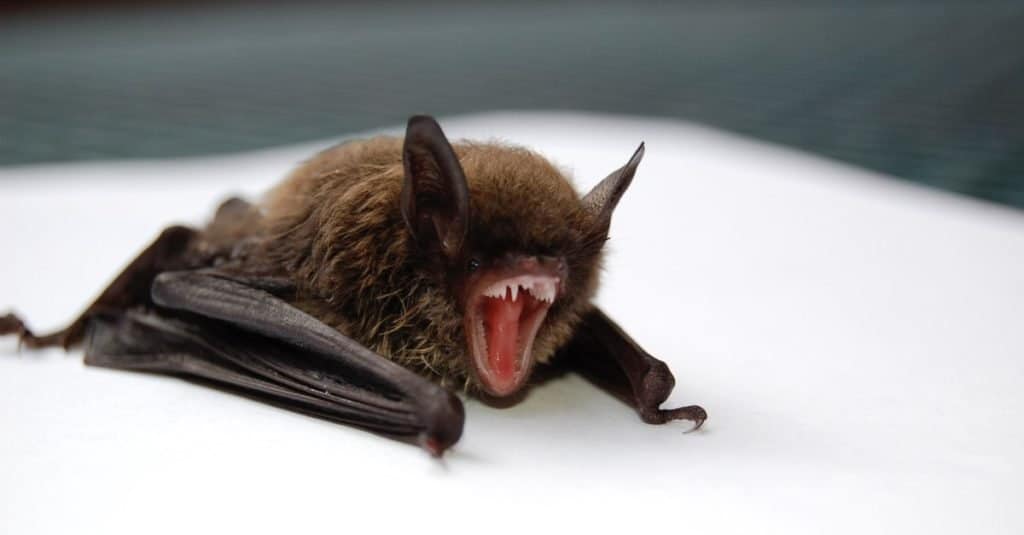
Bats are heterodonts with four types of specialized teeth like humans and most other mammals.
©Daily-Images/Shutterstock.com
If a bat’s incisors are more pointed, they are used for piercing. If their incisors are more blade-like, they are used for slicing. Long, pointed, slender, and often edged canines are sometimes referred to as fangs. These teeth are useful in capturing and piercing food sources. Premolars and molars are used for crushing and grinding.
How Many Teeth Do Bats Have?
Although the number varies by species, bats have between 20 and 38 teeth. The common vampire bat (Desmodus rotundus) has the fewest teeth, with just 20 total. (Some sources suggest they may only have 18 teeth, which may not account for very small or vestigial back teeth.) The dental formula is I 1/2, C 1/1, P 1/2, M 1/1, meaning they have 1 upper and 2 lower incisors, 1 upper and 1 lower canine, 1 upper and 2 lower premolars, and 1 upper and 1 lower molar on each side of the jaw. Since vampire bats feed with their tongues and do not chew their food, they do not require as many teeth as other species do.
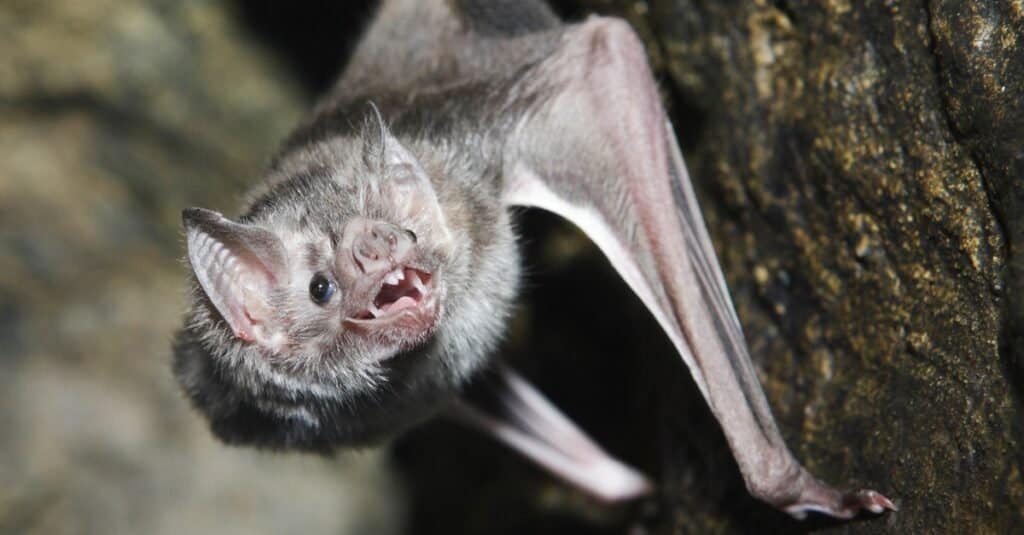
Vampire bats have the fewest number of teeth since they do not need to chew their food.
©Michael Lynch/Shutterstock.com
The largest number of teeth that any bat species has is 38. Various insect-eating species, including those in the widely distributed Myotis genus, have 38 teeth. The common dental formula for bats with 38 teeth is I 2/3, C 1/1, P 3/3, M 3/3, meaning they have 2 upper and 3 lower incisors, 1 upper and 1 lower canine, 3 upper and 3 lower premolars, and 3 upper and 3 lower molars on each side of the jaw.
Specialized Teeth for Specialized Diets
As mentioned above, bats have evolved adaptations in both face and jaw shape, as well as in their dentition. For example, researchers have found that bats with short snouts have stronger jaws to bite through the exteriors of tough fruits. Other species have long snouts that enable them to reach the nectar in flowers.
Scientists have determined that the number of teeth is generally associated with the size of the bat’s jaw. Nectar feeders with long jaws and insect-eaters with medium-length jaws have been shown to have three premolars and three molars on both sides of their jaws. However, bats with short jaws, like most fruit-eating bats and vampire bats, often lacked the middle premolar, the back molar, or both, because there is no room for these teeth in their mouths. Bats with shorter jaws also frequently have wider front molars. Scientists theorize that these teeth grow larger because there is no space for additional molars to erupt. The following sections provide an in-depth look at how bats’ teeth are adapted to their specific diets.
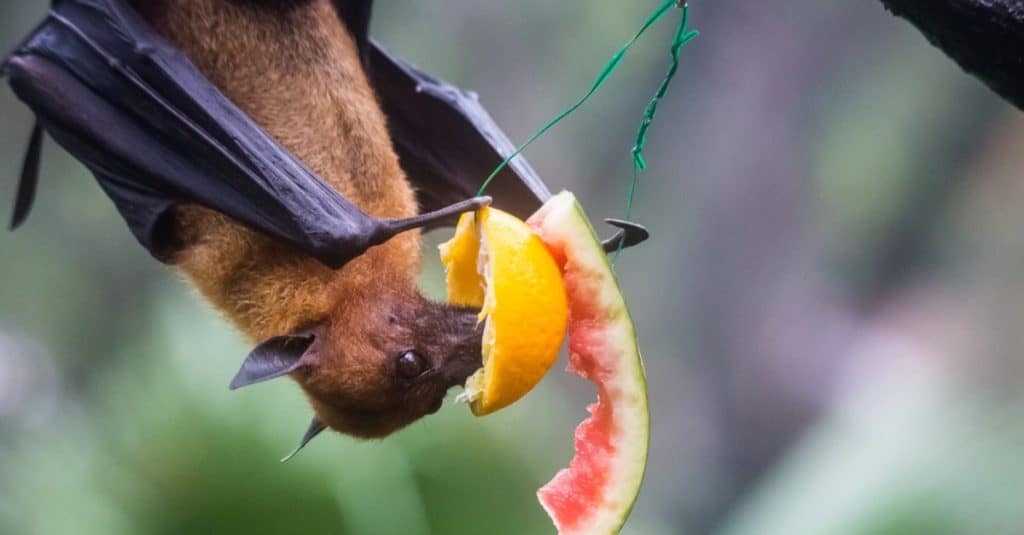
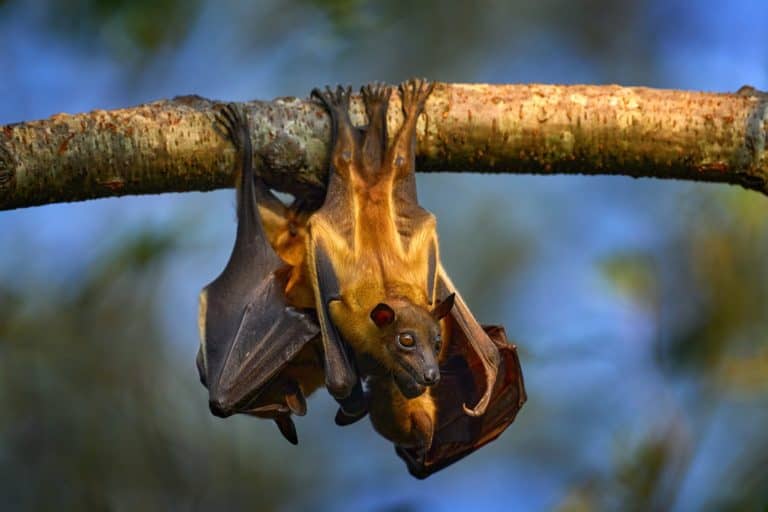
Fruit bats, also known as flying foxes, tend to have smaller incisors and canines because they do not need to capture live prey.
©Natalia Golovina/Shutterstock.com
Frugivores
Bats that primarily consume fruit or nectar tend to have smaller incisors and canines, as they are not trying to capture struggling prey. The sides of the teeth closest to the lips form a cutting edge that goes around almost the entire palate. The lower teeth fit inside the cutting edge of the upper teeth like a cookie cutter, aiding in cutting the skin of fruits. The molars also have sharp edges and large surfaces with indentations for grinding pulp. Fruit-eating species also tend to have wide palates to help grind their food.
Insectivores/Carnivores
Insectivores and carnivores have larger, more robust teeth to capture and hold live prey. Their long, slim, sharply-edged canines help them catch, pierce, and process insects with exoskeletons. The canines of more predatory bat species also occupy more space in their mouths than the canines of fruit-eating bats. They have enlarged lower molars that align with their upper teeth like a pair of scissors. Their molars are less complex than those of frugivores, likely because smoother surfaces are better suited for shearing.
Sanguivores
The upper incisors and canines of vampire bats are wide, flat, razor-sharp blades. These teeth do not have enamel so they remain sharp and do not wear down from use. Vampire bats make an incision in the animal’s skin and use their specialized tongues with grooves on the sides to lap up the blood. Their teeth are so sharp the animals usually do not realize they have been bitten, but vampire bat saliva also has special proteins that act as painkillers.