Quick Take
- One cardinal look-alike shares the same family name, though it is mostly gray rather than red. Meet the desert cardinal →
- A bird nicknamed after cardinals in Spanish has one feature that instantly exposes it as an impostor. See the flycatcher impostor →
- Two of these look-alikes belong to the exact same family as the cardinal, though you would never guess it from their bills. Explore the tanager relatives →
- One impostor's bill is so bizarre it gives away the disguise the moment you look at its face. Spot the crossed bill →
Of the many species of cardinals, the best-known is the northern cardinal (Cardinalis cardinalis). However, there are a number of birds that look like, sound like, or otherwise resemble cardinals. Given that, how can you know that the bird in your backyard is a true cardinal? If you want to know whether a bird is a cardinal lookalike or a true cardinal, you’re in the right place. In this article, we’ll discuss birds that look like cardinals or sound like them and help you figure out how to differentiate these mimics from actual cardinals.
Vermilion Flycatcher
The vermilion flycatcher (Pyrocephalus rubinus or Pyrocephalus obscurus, depending on the taxonomic authority) is a small species of flycatcher in the Tyrannidae family. is a small species of flycatcher in the Tyrannidae family. Like the cardinal, it lives in North and Central America, but rarely ranges north of the southwestern United States. It gets its name from its bright red color and habit of catching insects in midair.

The vermilion flycatcher sports red and gray plumage similar to a cardinal’s.
©iStock.com/jocrebbin
A vermilion flycatcher differs from a northern cardinal in several ways. First, while a vermilion flycatcher’s throat is red, a cardinal’s is black. Second, cardinals sport a large crest on their head, whereas the crest on a flycatcher is much smaller. While they both eat grains and insects, the vermilion flycatcher’s diet relies more heavily on insects than on grains. Also, their vocalizations sound quite different. The vermilion flycatcher emits a trilling sound like ching-tink-a-le-tink. Meanwhile, the cardinal makes a clear, two-part whistle followed by a slower trill.
Scarlet Tanager
The scarlet tanager (Piranga olivacea) belongs to the same family, Cardinalidae, as the northern cardinal. However, it belongs to a different genus, Piranga, which is composed of tanagers in the cardinal family. Scarlet tanagers breed throughout eastern North America, including the eastern United States and Canada, and overwinter in South America.
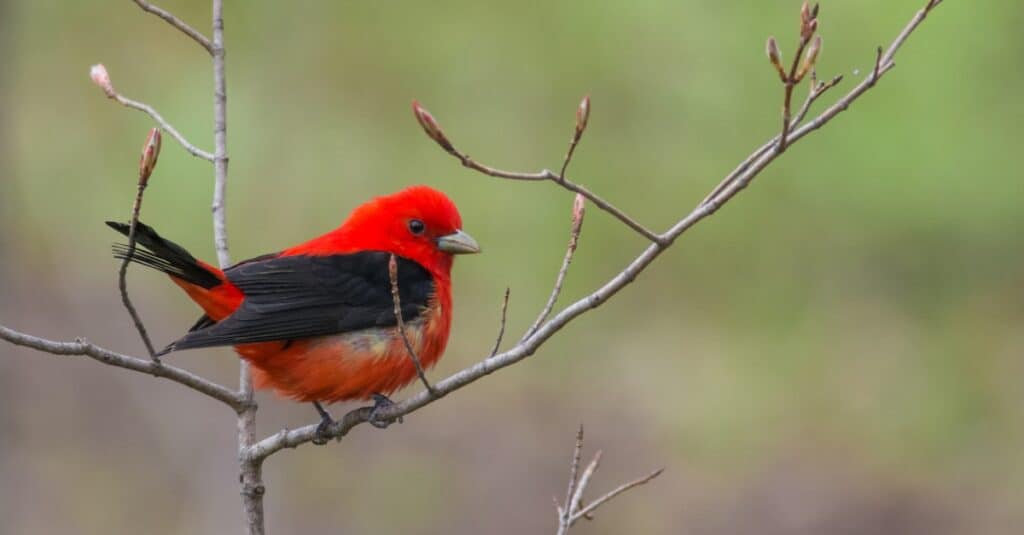
The scarlet tanager does not sport the northern cardinal’s distinctive black face mask.
©iStock.com/bookguy
Unlike the northern cardinal, the scarlet tanager primarily feeds on insects, especially bees. You can tell the two birds apart by comparing their bills. While the cardinal has a thick, conical bill suitable for eating seeds, the scarlet tanager’s bill is much thinner. Scarlet tanagers also lack the distinctive black face and throat markings of a northern cardinal. The red coloring of a scarlet tanager is generally darker than that of a cardinal. Also, cardinals tend to grow slightly larger, measuring 8.3 to 9.1 inches compared to the 6.3 to 6.7-inch-long scarlet tanager.
Red Crossbill
Also known as the common crossbill, the red crossbill (Loxia curvirostra) belongs to the finch family, Fringillidae. Red crossbills range throughout North America, Europe, and Asia, which means you can encounter them in the same regions as northern cardinals. Compared to a northern cardinal, the red crossbill’s color is more rosy than red. While the red crossbill primarily feeds on conifer seeds, the northern cardinal eats a wider variety of foods, including insects and berries.
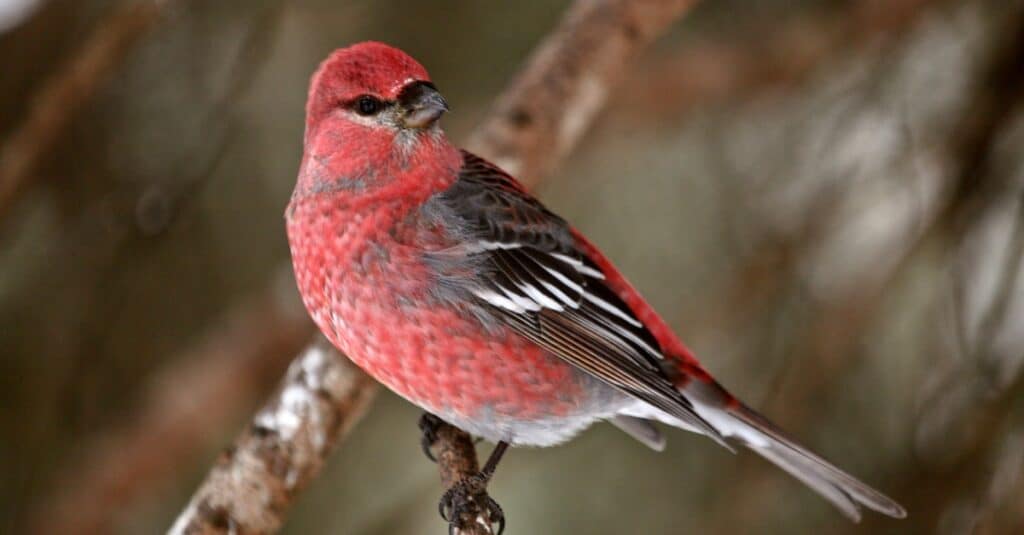
The red crossbill has a bill that overlaps, while the northern cardinal’s bill is thick and conical.
©iStock.com/bobloblaw
The main difference between red crossbills and northern cardinals lies in the shape of their bills. The northern cardinal sports a thick, conical bill that enables it to eat fruits and insects. Meanwhile, the red crossbill possesses a crossed bill, with one half overlapping the other. This allows them to effectively break open hard conifer seeds and is the origin of their name, crossbill. Just by looking at their faces, you can easily tell the two apart.
Summer Tanager
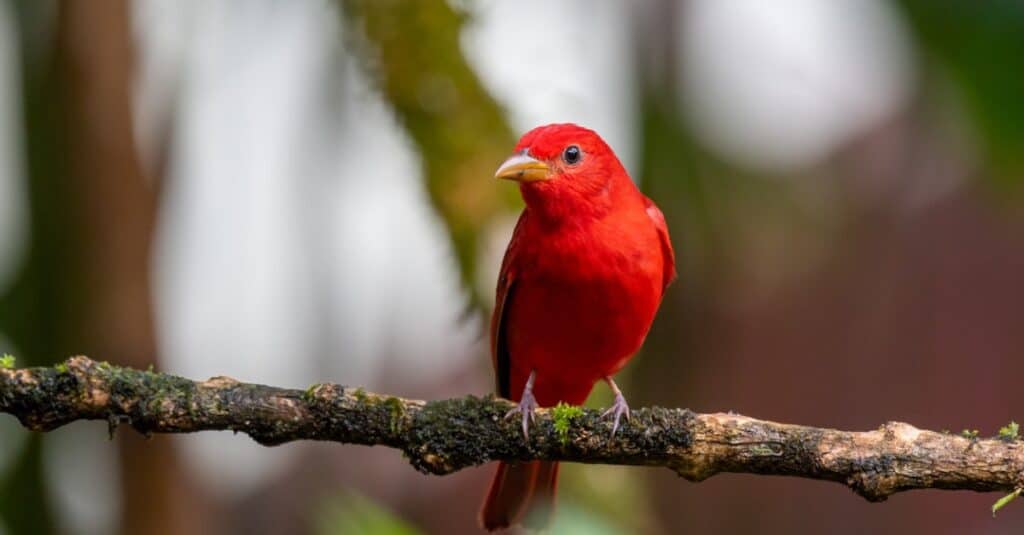
Like scarlet tanagers, summer tanagers (Piranga rubra) belong to the Cardinalidae family. Their range includes most of the Central and Southern United States, as well as Mexico, Central America, and South America. While their colors vary, summer tanagers typically have brilliant red feathers, similar to the vibrant red color of the northern cardinal.
©iStock.com/Dave Kempe Photography
Unlike the northern cardinal, the summer tanager primarily eats bees, although it also eats berries. Its vocalization is more similar to an American robin’s than to a cardinal’s, which can help you distinguish the two birds by song. Compared to the northern cardinal, the summer tanager’s bill is stouter and more pointed. This makes it better adapted to eating insects, whereas the cardinal’s bill is designed to crack open seeds.
Pine Grosbeak
The pine grosbeak (Pinicola enucleator) is another member of the finch family, Fringillidae, and the only member in the genus Pinicola. Its name comes from its large beak, which it uses to break apart the shells of pine seeds.
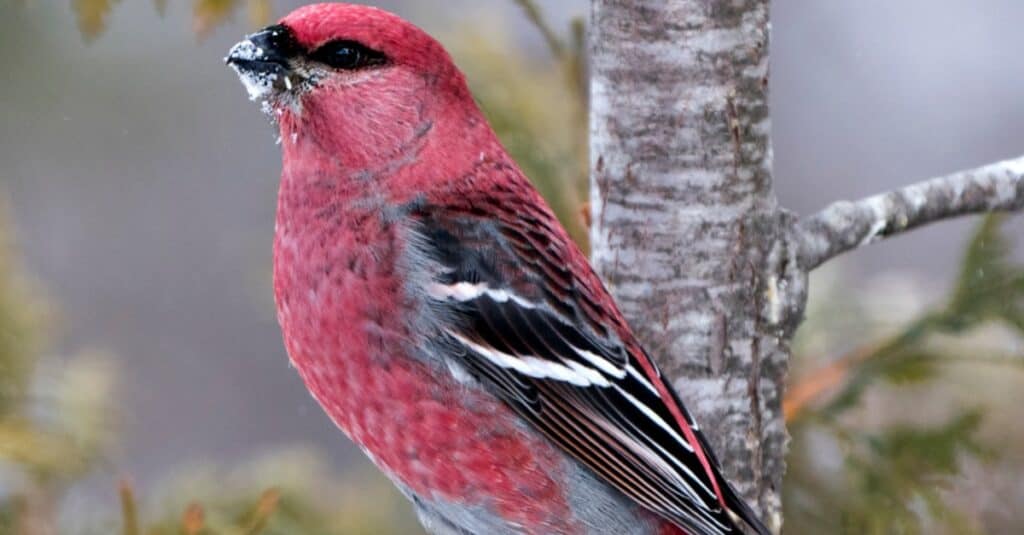
The pine grosbeak features white bars on its wings, unlike the northern cardinal.
©iStock.com/Rejean Bedard
Pine grosbeaks are distributed throughout Alaska, as well as northern Canada, Europe, and Russia. While the northern cardinal eats a varied diet, the pine grosbeak subsists mainly on fruits and seeds. Pine grosbeaks make their homes in coniferous forests, while cardinals thrive in a variety of habitats.
Unlike the northern cardinal, pine grosbeaks do not feature a black face mask or throat. Furthermore, they feature white bars on their wings, which are absent on northern cardinals.
Desert Cardinal
The desert cardinal (Cardinalis sinuatus), also called the pyrrhuloxia, is one of the best examples of birds that look like cardinals. It’s part of the same family and genus as the northern cardinal, making it a close relative. The pyrrhuloxia gets its name from the Greek words pyrrhos, meaning reddish-orange, and loxos, meaning oblique. In males, red plumage appears only on the breast, throat, and eye mask; the rest of the plumage is gray.
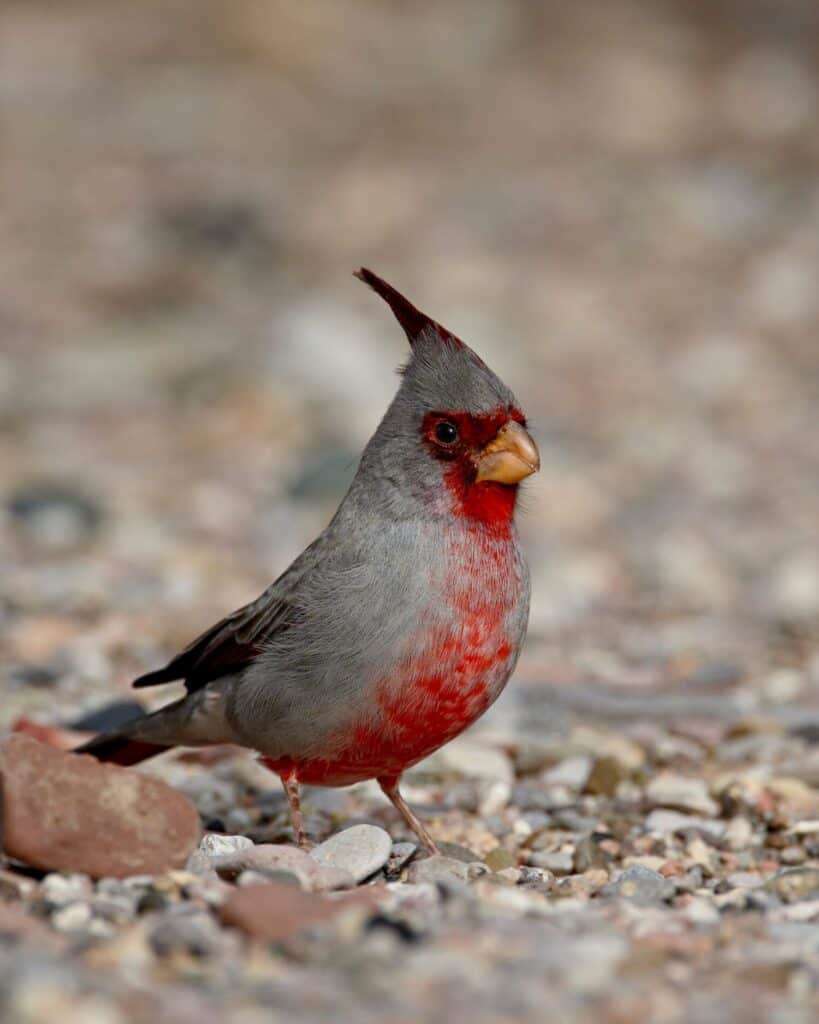
©Robert Harding Video/Shutterstock.com
Native to the Southwestern United States and Mexico, the desert cardinal’s range overlaps with that of the northern cardinal. The desert cardinal’s diet of fruits, seeds, and insects is also similar to that of the northern cardinal.
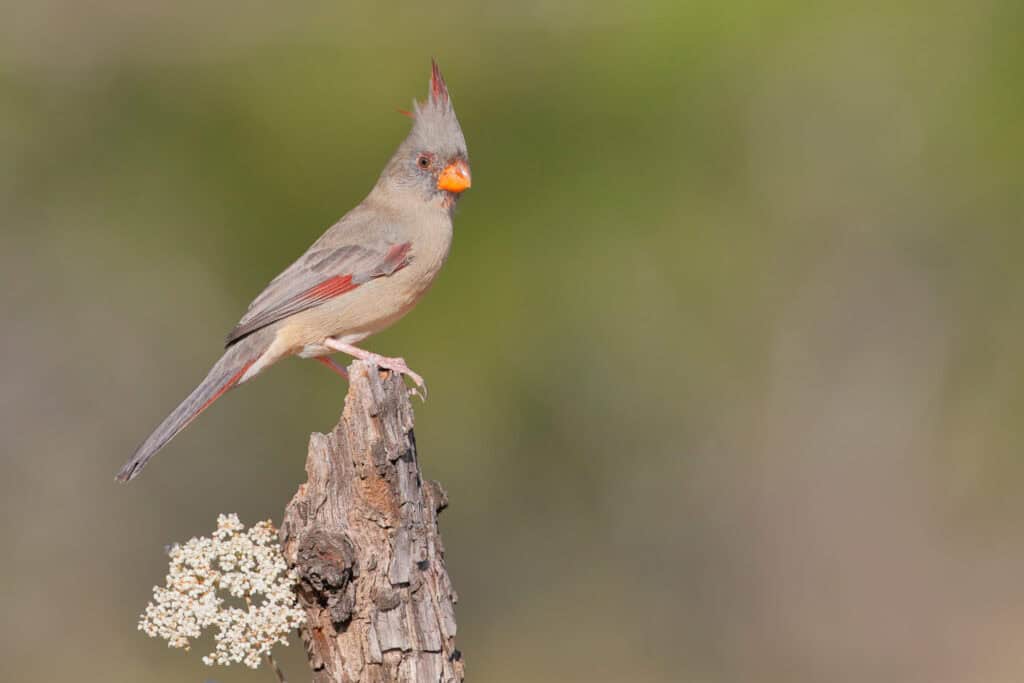
The female desert cardinal has very little red plumage, but her silhouette is very similar to that of the northern cardinal.
©Wilfred Marissen/Shutterstock.com
Phainopepla
The Phainopepla (Phainopepla nitens) is a songbird native to the desert southwest of the United States and Mexico, primarily inhabiting arid desert washes, mesquite scrub, and oak woodlands.
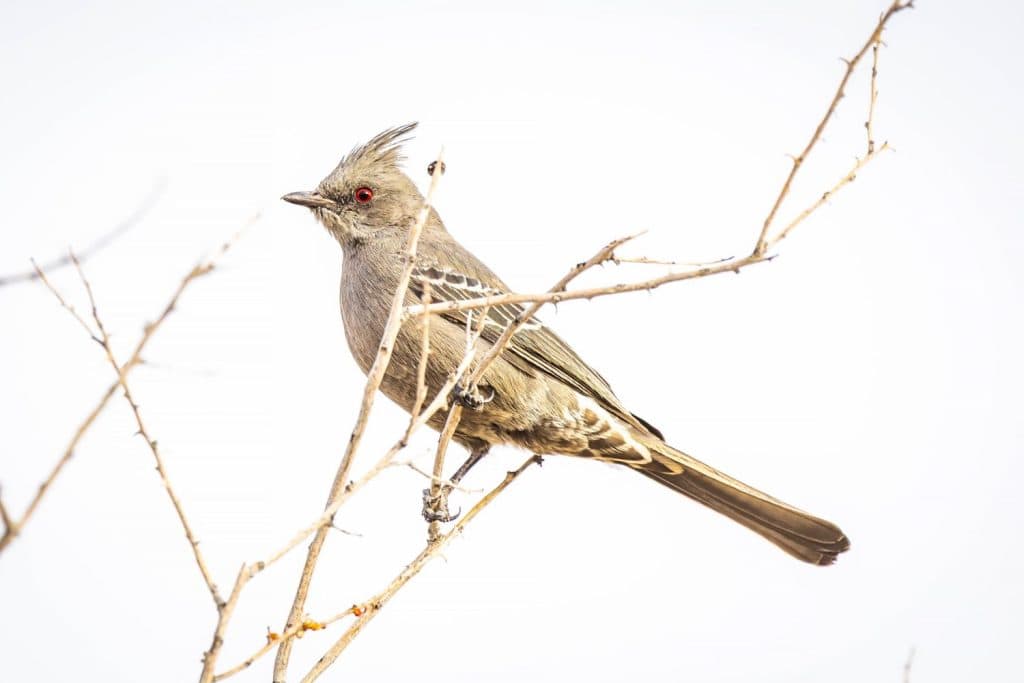
The female Phainopepla resembles a northern cardinal in every way but color.
©Photo Spirit/Shutterstock.com
At 7.1 to 8.3 inches long, the phainopepla bears a striking resemblance to the northern cardinal in almost every physical attribute except coloring. Like the cardinal, it boasts a prominent, sharp crest on its head, similar body proportions, and a long tail. However, while the cardinal has brilliant red or warm brown hues, the adult male phainopepla has uniform, glossy jet-black plumage accented by bold white wing patches visible only in flight, while the female displays a subtle, uniform ash-gray plumage.
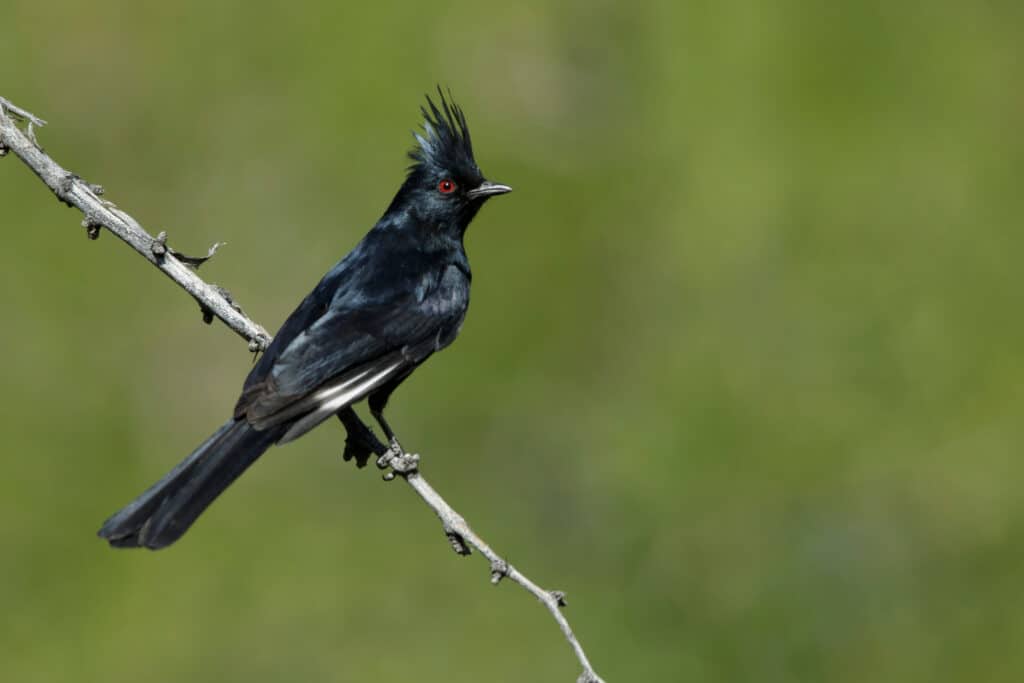
Male Phainopeplas are sometimes called goth cardinals for their black plumage.
©Agami Photo Agency/Shutterstock.com