
Quick Take
- There are four subspecies of elk in North America.
- Elk are large ungulates that can weigh over 700 pounds.
- Elk poop changes appearance based on the season and changes in the elk’s diet.
Elk (Cervus canadensis) are distributed across Western North America and the mountainous regions of Asia, with introduced populations in New Zealand and Argentina. There are four extant subspecies of elk in North America: the Rocky Mountain Elk (C. c. nelsoni), the Roosevelt Elk (C. c. roosevelti), the Manitoba Elk (C. c. manitobensis), and the Tule Elk (C. c. nannodes), distributed across the Western U.S., Canada, and Northern Mexico. Primarily mountain-dwelling ruminants, elk migrate to lower elevations in winter. An elk’s summer diet is significantly different from its winter diet due to seasonal food availability and nutritional needs. These differences are reflected in the quality and consistency of the elk’s scat. Continue reading to discover everything you’ve ever wanted to know about elk poop.
What Does Elk Poop Look Like?
During the spring and summer, elk graze on high-quality, succulent grasses, forbs (wildflowers), and tender new leaves. In winter, they shift to foraging for woody plants, bark (especially aspen), twigs, and dried grasses. These shifts affect the appearance of their solid waste, which is referred to as scat.

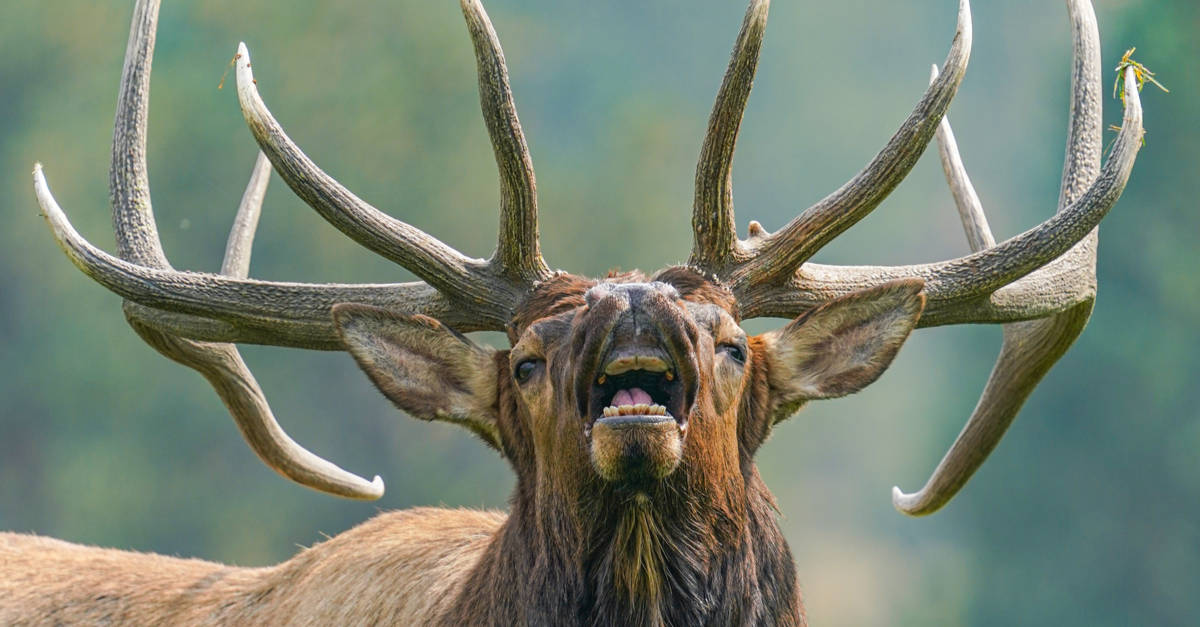
Elk are large ungulates. Adult males (bulls) can weigh between 600 and 1,200 pounds, while females (cows) typically weigh 400 to 600 pounds, depending on the subspecies.
©Thomas Torget/Shutterstock.com
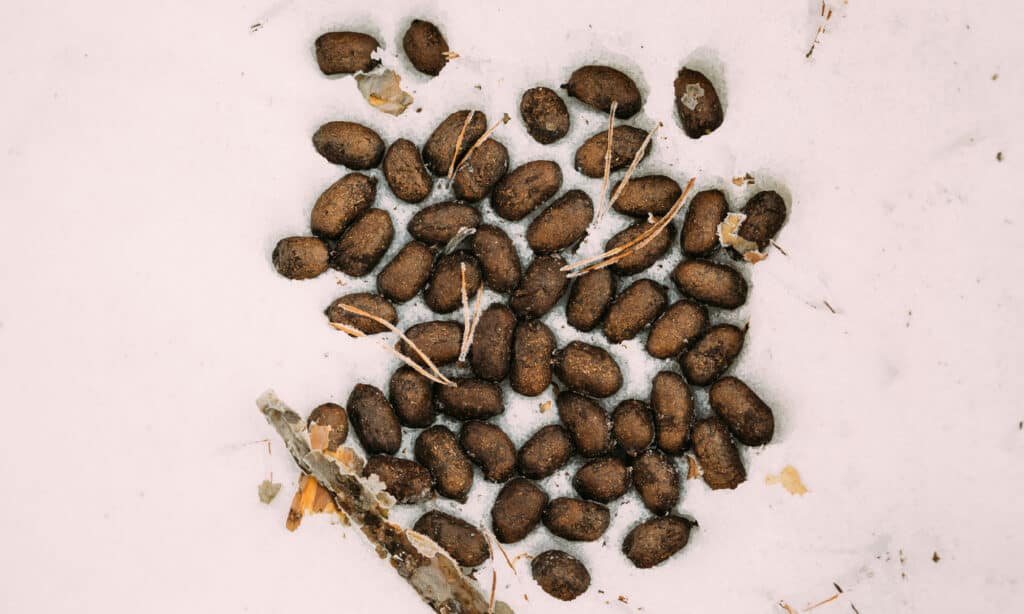
Winter elk scat typically appears as dark, firm individual nuggets of approximately one inch long, often described as almond-shaped, with one pointed end and one indented end. The scat typically consists of large piles containing dozens of nuggets, rather than a continuous trail.
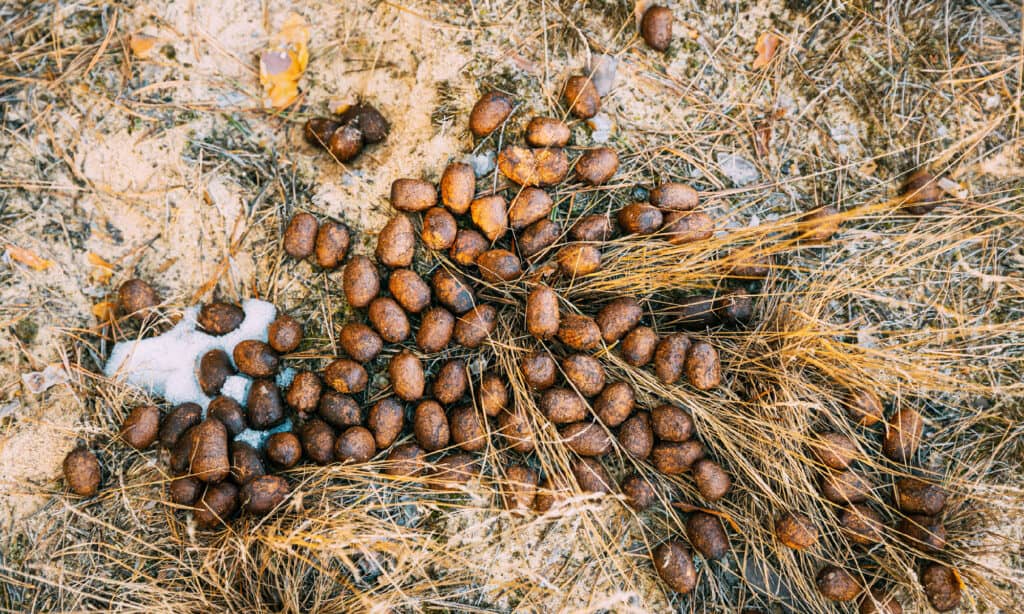
An elk’s poop presents as almond-sized nuggets in the winter.
©iStock.com/bruev
Summer elk scat consists of dark, soft, green-tinted nuggets that frequently clump together into loose piles due to their summer diet of high-moisture vegetation. Unlike the hard, individual nuggets of winter, these summer deposits can resemble soft cow pies or elongated, pliable ropes.
What Does Elk Poop Smell Like?
Elk scat has a strong musky scent, often compared to the smell of cow manure. The higher moisture content of an elk’s summer scat has a pungent aroma that can linger. The more fibrous nature of the elk’s winter scat renders it much less fragrant. The fresher the scat, the more odoriferous it will be.

Elk consume fresh grass during the spring and summer.
©iStock.com/FluidMediaFactory
Is Elk Poop Useful or Dangerous?
Elk poop is good for plants as it contains vital nutrients that can help them develop properly.
©iStock.com/bruev
Elk droppings are rich in nutrients, making them a great organic soil amendment. However, elk poop can also be harmful.
As herbivores, elk produce nitrogen-rich manure that aids in plant development. Although some sources suggest that elk manure is too dry and nutrient-poor due to their efficient digestion, most gardening experts consider herbivore scat beneficial. Although fresh scat can be placed directly in the garden, composting is recommended to break it down and kill potential pathogens.
Elk scat contains enteric bacteria, such as E. coli, which are commonly found in the intestines of animals and humans. E. coli can cause severe illness in people. As ruminants, elk can carry these bacteria and shed them in their feces, potentially contaminating soil and water. E. coli from elk droppings can remain viable in the environment for extended periods.