
Quick Take
- Out of 1,100+ North American bird species, fewer than a dozen are truly black and yellow, and spotting the right one depends on details most birders overlook.
- Some of these birds look completely different in winter, and misidentifying a seasonal plumage change could have you convinced you've spotted a rare species. See the seasonal color shift →
- One bird on this list changes color in a place you'd never expect, and the surprising part is that it's not its feathers. See the unexpected color change →
- Male and female birds of the same species can look so different that even experienced birders mistake them for two entirely separate species. Compare male and female plumage →
There are between 11,000 and 11,500 bird species worldwide, with over 1,100 species recorded in North America. However, fewer than one dozen bird species in North America have primarily black and yellow plumage. While the stark contrast between bright yellow and midnight black is eye-catching, it is important to note that color combinations vary widely by age, sex, and seasonal molt. Continue reading to discover 9 beautiful yellow and black birds and learn about their locations, habitats, and behavior.
American Goldfinch
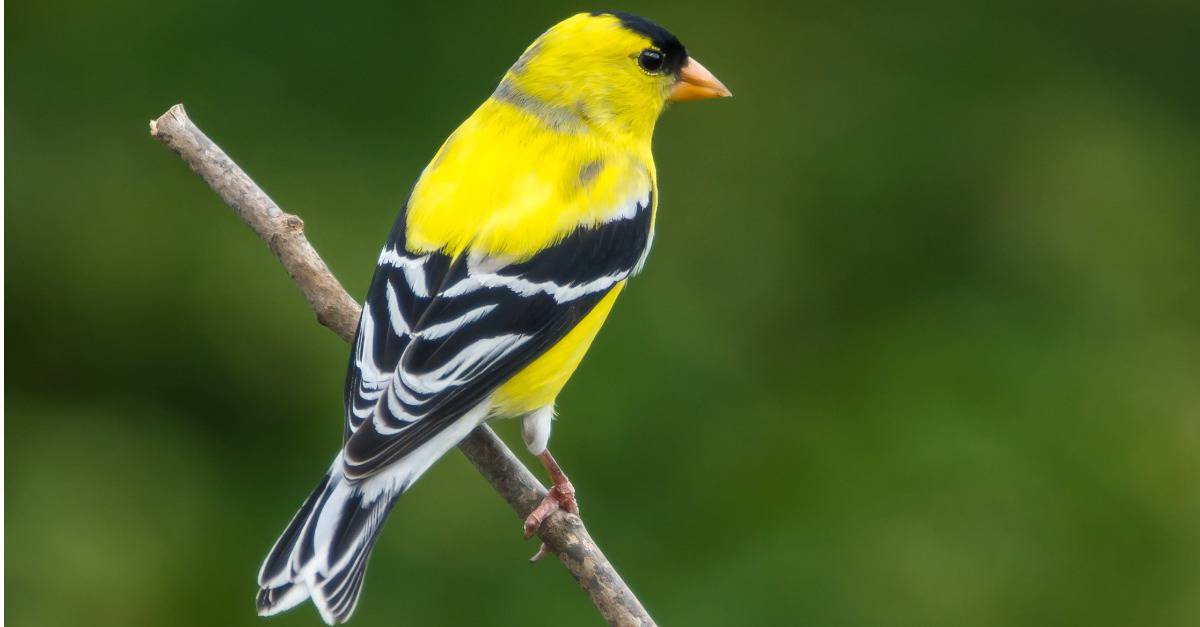
The American goldfinch (Spinus tristis) is a small songbird with a short, conical bill and a notched tail. American goldfinches typically measure 4.3 to 5.5 inches in body length, with a wingspan of 7.5 to 9 inches. During the spring and summer breeding season, adult males display a brilliant, unmistakable canary-yellow body contrasted by a striking jet-black forehead cap and black wings with distinctive white wing bars.
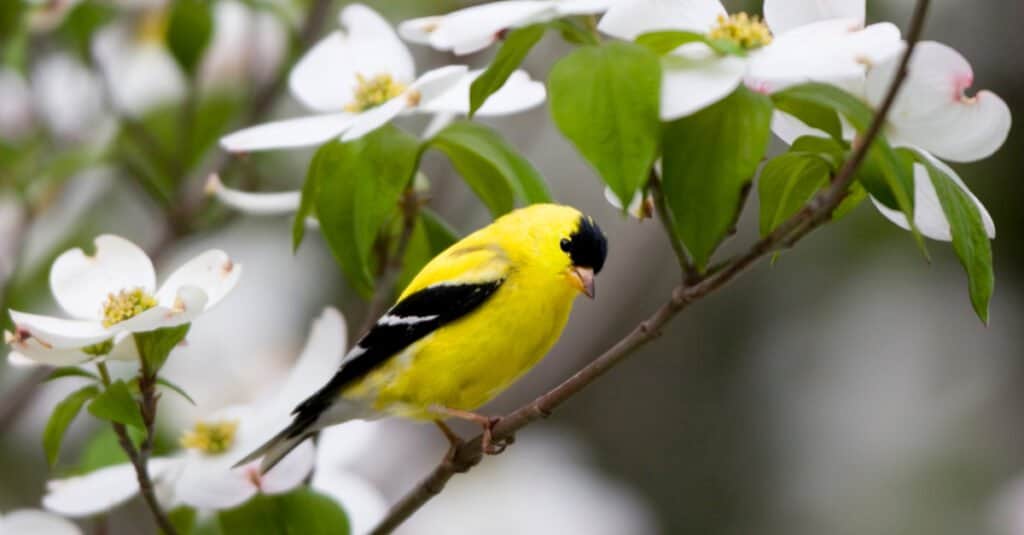
The male has bright coloring in the summer to attract a mate. You can spot them with their bright yellow plumage and black foreheads and wings.
©Danita Delimont/Shutterstock.com
Breeding females are slightly more subdued, showing an olive-yellow or greenish-yellow plumage. To help them blend into their surroundings in the winter, both sexes turn a drab, grayish-brown. The American goldfinch is widely distributed across the United States. Its breeding range covers the northern two-thirds of the country, while its wintering range extends into the Southern states, making it a familiar year-round or seasonal resident throughout the United States.
Yellow-Headed Blackbird
The yellow-headed blackbird (Xanthocephalus xanthocephalus) is a songbird found in the Western United States. Adult males have an unmistakable golden-yellow head and breast contrasting against a jet-black body and a prominent white patch on each wing. Females are more subdued, exhibiting a sooty-brown body with a duller yellow wash on the face and chest.
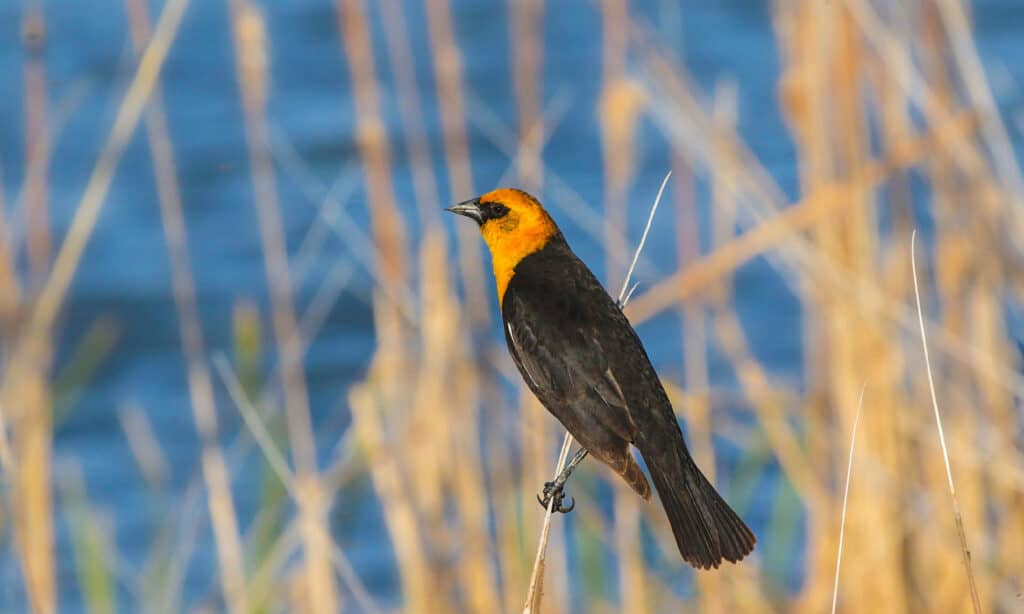
Yellow-headed blackbirds are a familiar sight during summers in the Central and Northwestern United States.
©iStock.com/Nancy Strohm
Yellow-headed blackbirds measure roughly 8.3 to 10.2 inches in body length and have a broad wingspan of 16.5 to 17.3 inches. Their coloring does not undergo dramatic seasonal changes, although juveniles and first-year males may display darker smudging on their heads.
Yellow-headed blackbirds spend their breeding summers in the wetlands and prairie marshes of the West-Central and Western United States. They migrate to spend the winter months foraging in the farm fields and meadows of the Southwest, from California to Texas.
Common Yellowthroat
The common yellowthroat (Geothlypis trichas) is a small New World warbler. Adult males have a vibrant yellow throat and breast and a prominent, sharp black mask across the eyes that is outlined by a thin gray or white line. Females share the olive-brown back and yellow throat but lack the dramatic black facial mask.
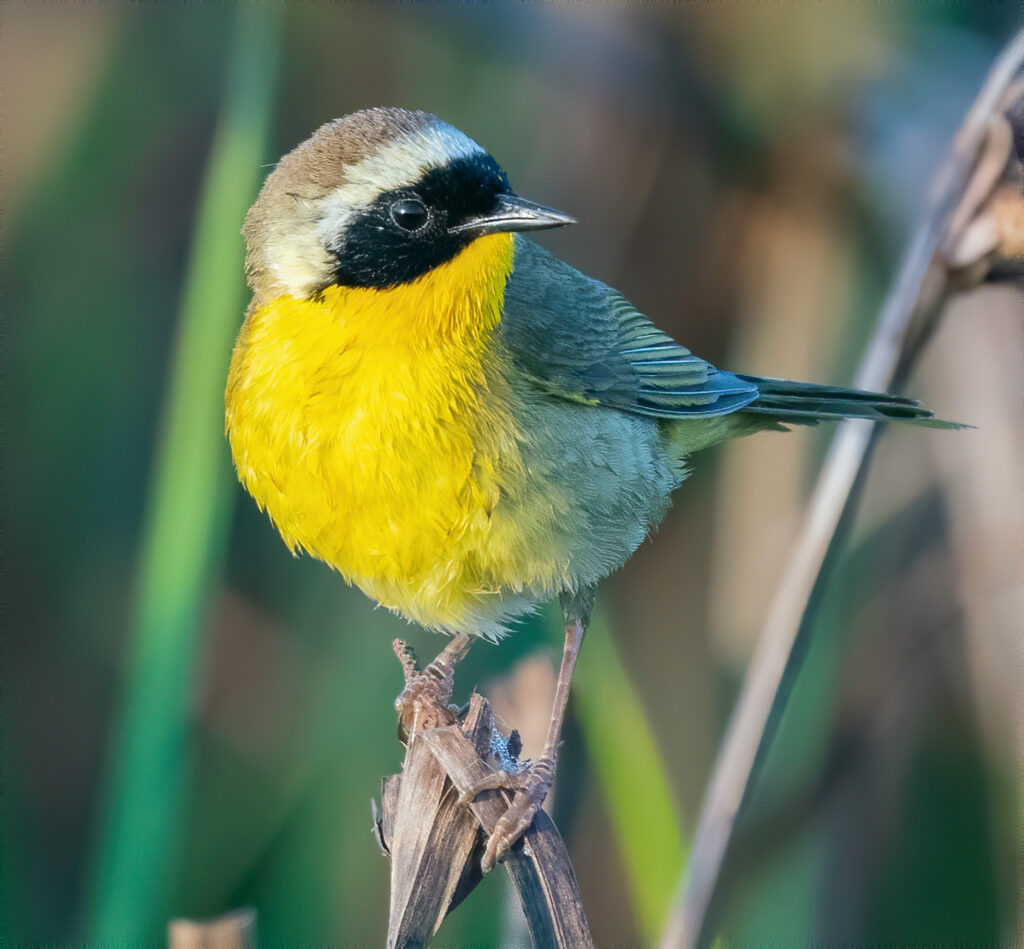
The common yellowthroat is known for its witchity-witchity vocalizations.
©DC Wildlife Photography/Shutterstock.com
The common yellowthroat has a body length of 4.3 to 5.1 inches and a wingspan ranging from 5.9 to 7.5 inches. Their base coloration does not change dramatically by season. The adult male keeps his striking black mask year-round. The common yellowthroat is incredibly widespread, breeding across the North American continent, including into Alaska.
Common yellowthroats primarily inhabit low, dense vegetation in marshes, wetlands, and shrubby fields. While populations in the Northern and Central states migrate south for the winter, some populations remain year-round residents in the Southern states along the Gulf Coast and in the Southwest.
Scott’s Oriole
Scott’s oriole (Icterus parisorum) is a desert songbird. Adult males display a vivid lemon-yellow and velvety black color pattern, featuring a fully black head, breast, and back contrasted against a bright yellow belly and rump. Females are more muted, presenting a dull grayish-olive color above and pale yellow below, often with faint streaks and some variable black markings on the throat. Scott’s oriole is a medium-sized bird, measuring 8 to 9 inches in body length with a wingspan of between 12 and 13 inches. Its bold coloring does not change seasonally.
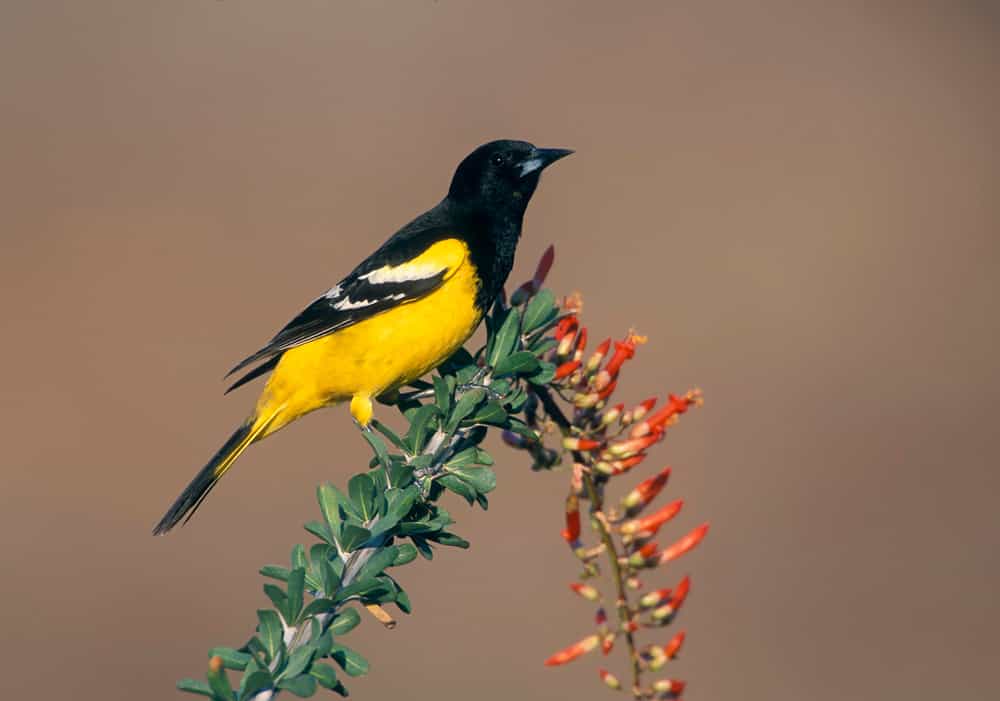
Scott’s oriole lives in arid mountains, foothills, and deserts, where their bright yellow feathers stand out against the stark neutral background.
©Agami Photo Agency/Shutterstock.com
In the United States, Scott’s oriole is a migratory summer resident found primarily across the arid Southwestern states, including Southern California, Arizona, New Mexico, Southwestern Texas, Nevada, Utah, and parts of Western Colorado. The majority of Scott’s orioles overwinter in Mexico.
Eastern Meadowlark
The Eastern Meadowlark (Sturnella magna) is a medium-sized songbird found across the Eastern and Central United States, extending from the Midwest and Great Plains to the Atlantic coast. These birds have a body length of 7.5 to 10.2 inches and a wingspan of 13.8 to 15.8 inches.
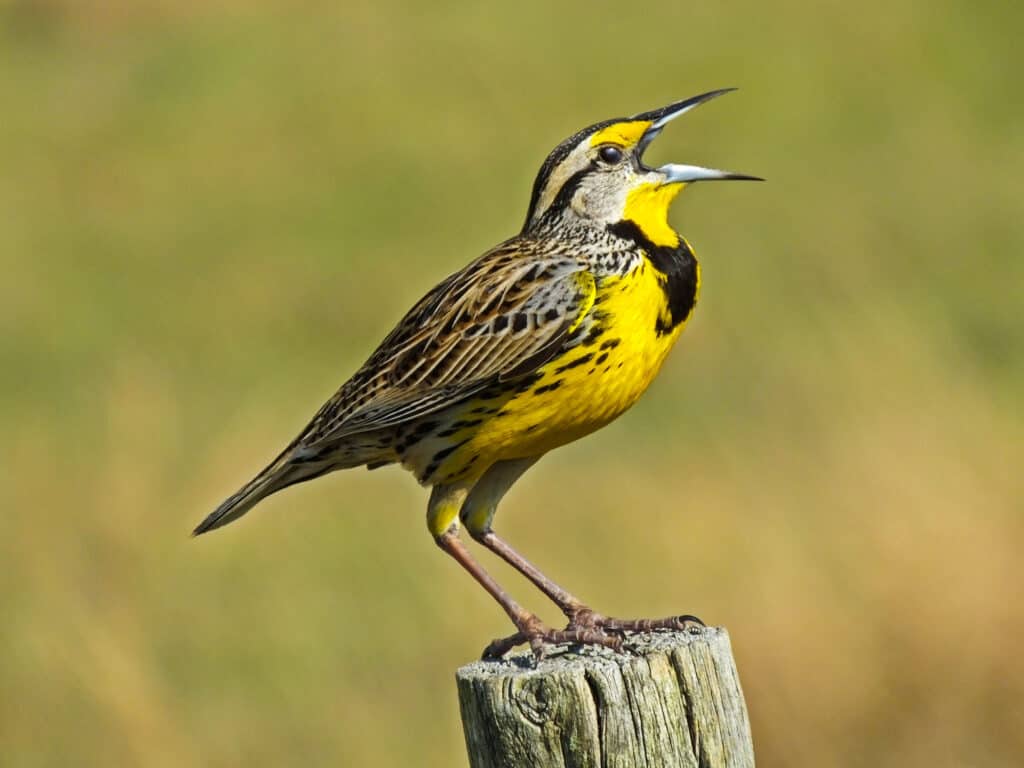
The Eastern meadowlark lives in prairies, pastures, grasslands, and fields.
©iStock.com/passion4nature
Male Eastern meadowlarks are easily recognized by their vibrant, bright-yellow underparts, and a bold, black V-shaped band draped across their chest. Their heads have alternating black and pale stripes, with a distinctive yellow patch near the eye.
The Eastern meadowlark’s coloring does change seasonally. During the winter months, the adult plumage becomes duller and less vibrant as the bright yellow tones soften, the flanks take on a buffy hue, and the bold black chest feathers develop pale tips.
Evening Grosbeak
The evening grosbeak (Hesperiphona vespertina/Coccothraustes vespertinus) is a large finch. Adult males have a bright yellow forehead and body, a dark brown head, and prominent black wings marked by a large white patch. Females and juveniles are more subtly colored, displaying a primarily olive-gray body with black-and-white wings and a slight greenish-yellow tinge on the neck and flanks.
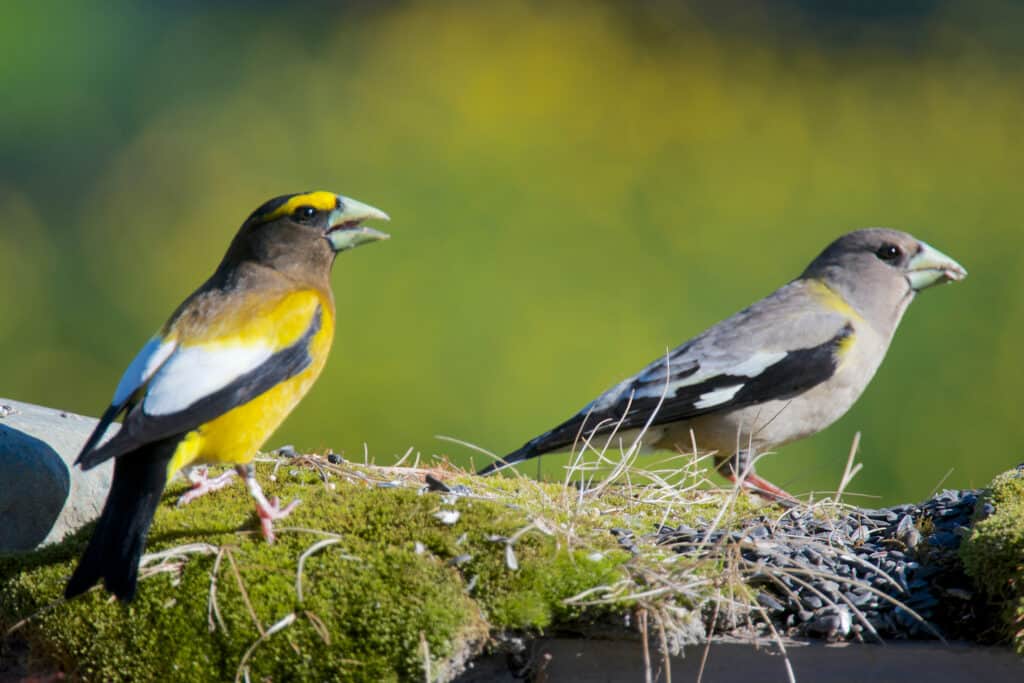
Although the evening grosbeak’s plumage does not drastically change between seasons, its large bill undergoes a notable seasonal color change, shifting from a bone-white or pale cream color in the winter to a distinct pale green or yellowish-green in the spring and summer.
©Danita Delimont/Shutterstock.com
Evening grosbeaks are large songbirds, measuring 6.3 to 7.1 inches in body length with a wingspan of 11.8 to 14.2 inches. Within the United States, evening grosbeaks are found year-round in the coniferous and mixed forests of the Western mountainous regions, but during the winter, they are nomadic, irruptive migrants that can spread across much of the Northern, Midwestern, and Northeastern United States in search of food.
Hooded Warbler
The hooded warbler (Setophaga citrina), is a colorful songbird with bright lemon-yellow underparts and an olive-green back. Adult males have a distinctive, jet-black hood and throat that frames their bold yellow face. Females have a more muted olive-green crown. Hooded warblers measure between 5.1 and 5.5 inches in body length with a wingspan of 6.9 to 8 inches.
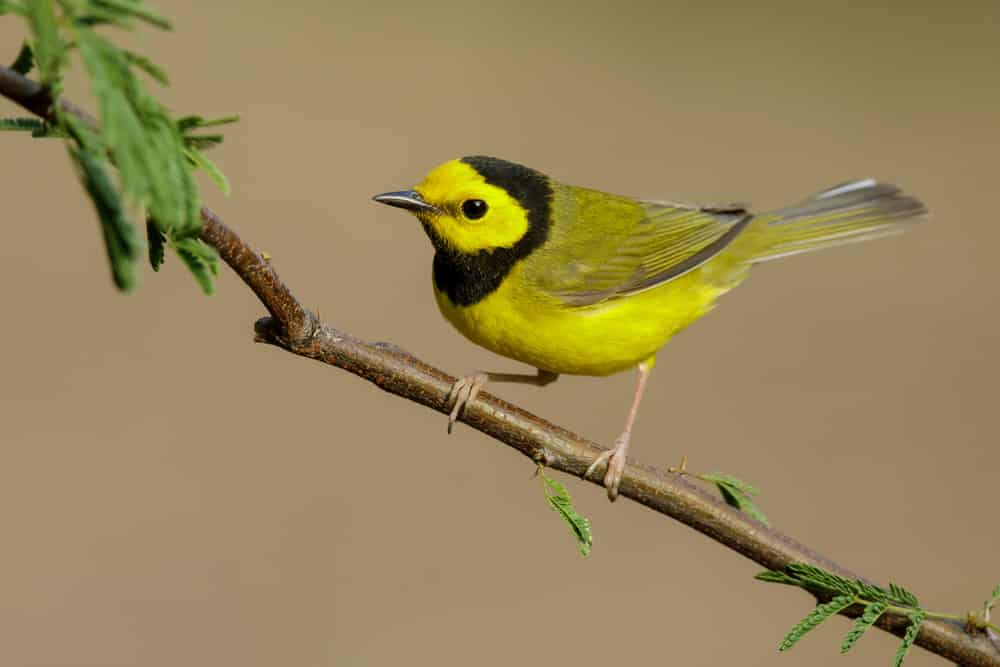
Hooded warblers live in the dense understory of mature deciduous forests.
©Agami Photo Agency/Shutterstock.com
Unlike many other warbler species whose plumages fade into duller tones after the breeding season, the hooded warbler does not experience seasonal color changes and maintains the same vivid appearance year-round.
Within the United States, it is primarily found in the Eastern half of the country, where it breeds in mature deciduous forests and shrubby undergrowth stretching from the Gulf Coast and Northern Florida up to the lower Midwest and Southern New England.
Western Tanager
The Western tanager (Piranga ludoviciana) is a medium-sized songbird that measures 6.3 to 7.5 inches in body length and has a wingspan of approximately 11.5 inches.
During the breeding season, adult males display a flaming orange-red head, a bright yellow body, and solid black wings, back, and tail. Females and immature birds exhibit a much more subdued, camouflage-friendly yellowish-green-to-grayish-olive color year-round.
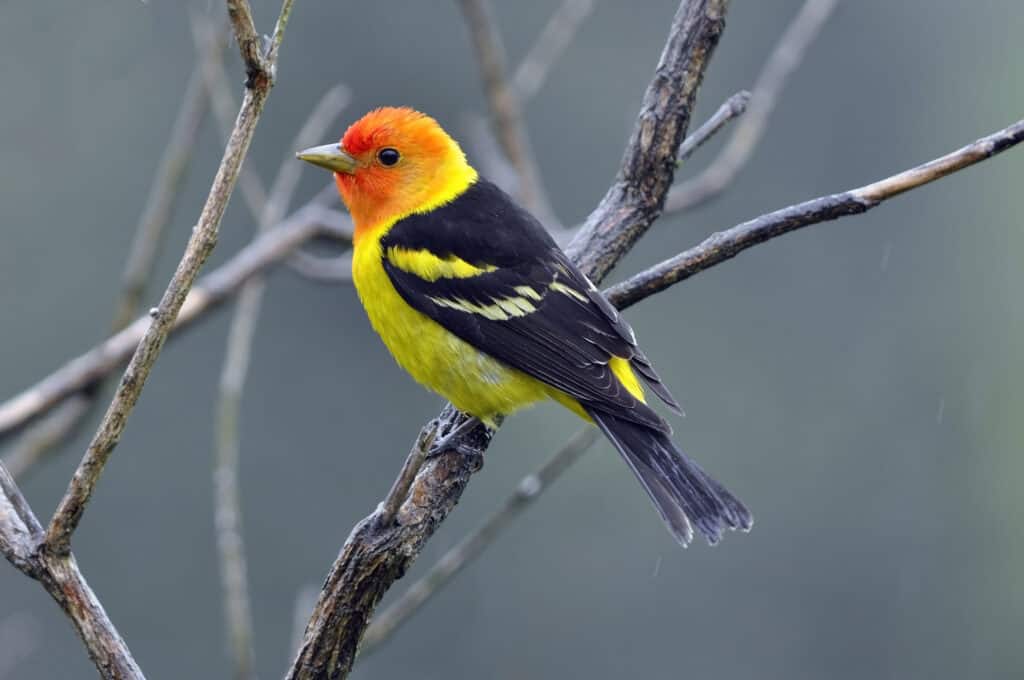
The western tanager is a medium-sized songbird. Look for their bright orange faces, yellow bodies, and black wings.
©Laura Mountainspring/Shutterstock.com
Male Western tanagers undergo a noticeable seasonal color change. When the breeding season ends, adult males molt into a non-breeding winter plumage, in which their brilliant scarlet head fades to a pale yellow-green, matching the more subdued tones of the females.
Western tanagers are primarily found throughout the Western U. S., where they breed from the Mexican border through the Rocky Mountains and Pacific Coast states before migrating south to overwinter in Mexico and Central America.
Wilson’s Warbler
Wilson’s warbler (Cardellina pusilla) is one of the smallest New World warblers. It is characterized by its bright lemon-yellow underparts and face contrasted against a plain yellowish olive-green back and wings. The most distinctive feature of the adult male is its glossy jet-black crown patch, which is fainter or altogether absent in females and juveniles. Wilson’s warblers have a body length of 3.9 to 4.7 inches and a wingspan of 5.5 to 6.7 inches. The male’s overall coloring does not change dramatically by season. Within the United States, Wilson’s warblers have breeding grounds throughout Alaska and across the Western U.S. as far south as Southern California and New Mexico. During spring and fall migrations, they travel between their northern nesting grounds and wintering territories in Mexico, Central America, and parts of the Gulf Coast.
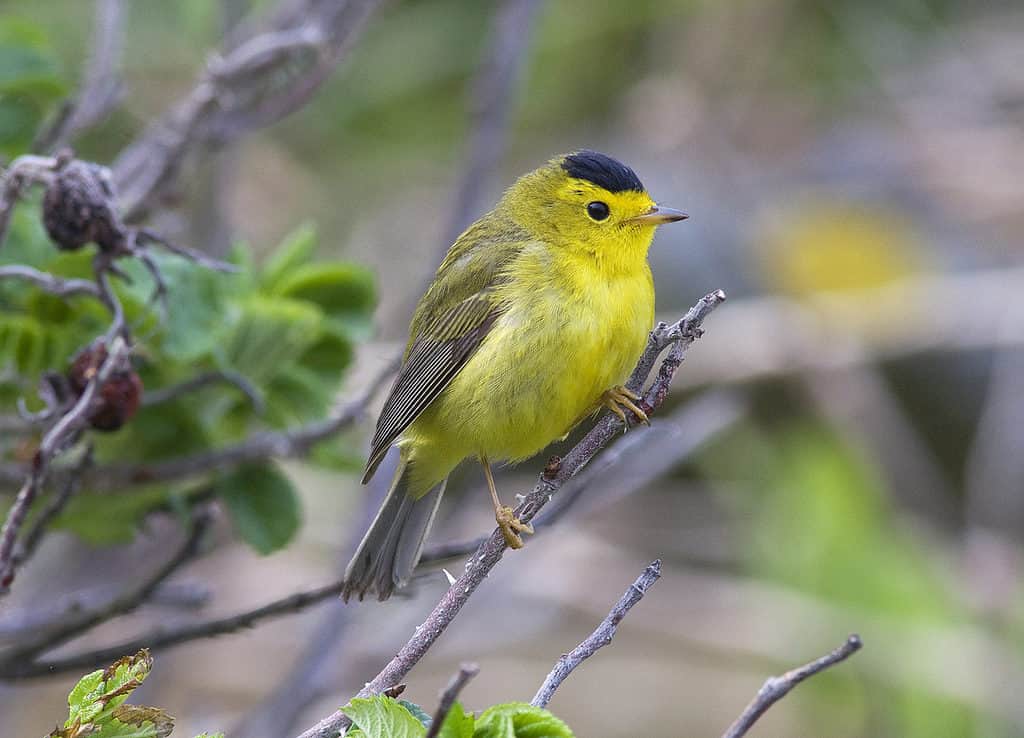
Male Wilson’s warblers have yellow bodies and prominent black caps, giving them the appearance of a perfect patch of black hair on their heads.
©iStock.com/Leon Gin