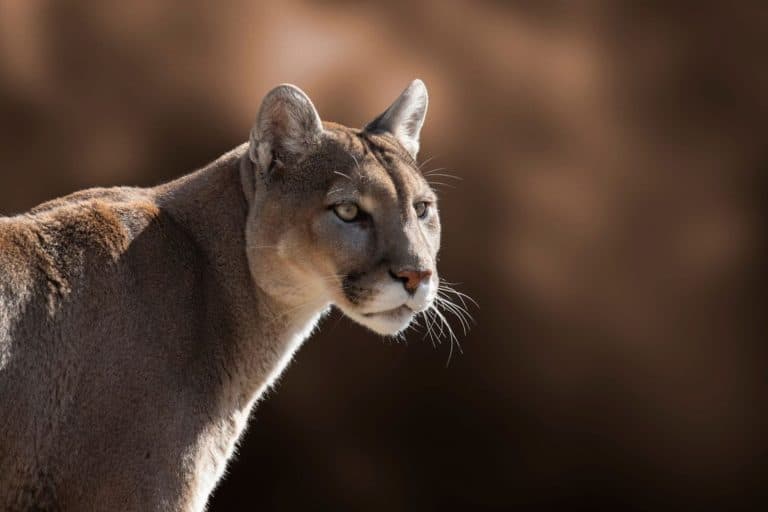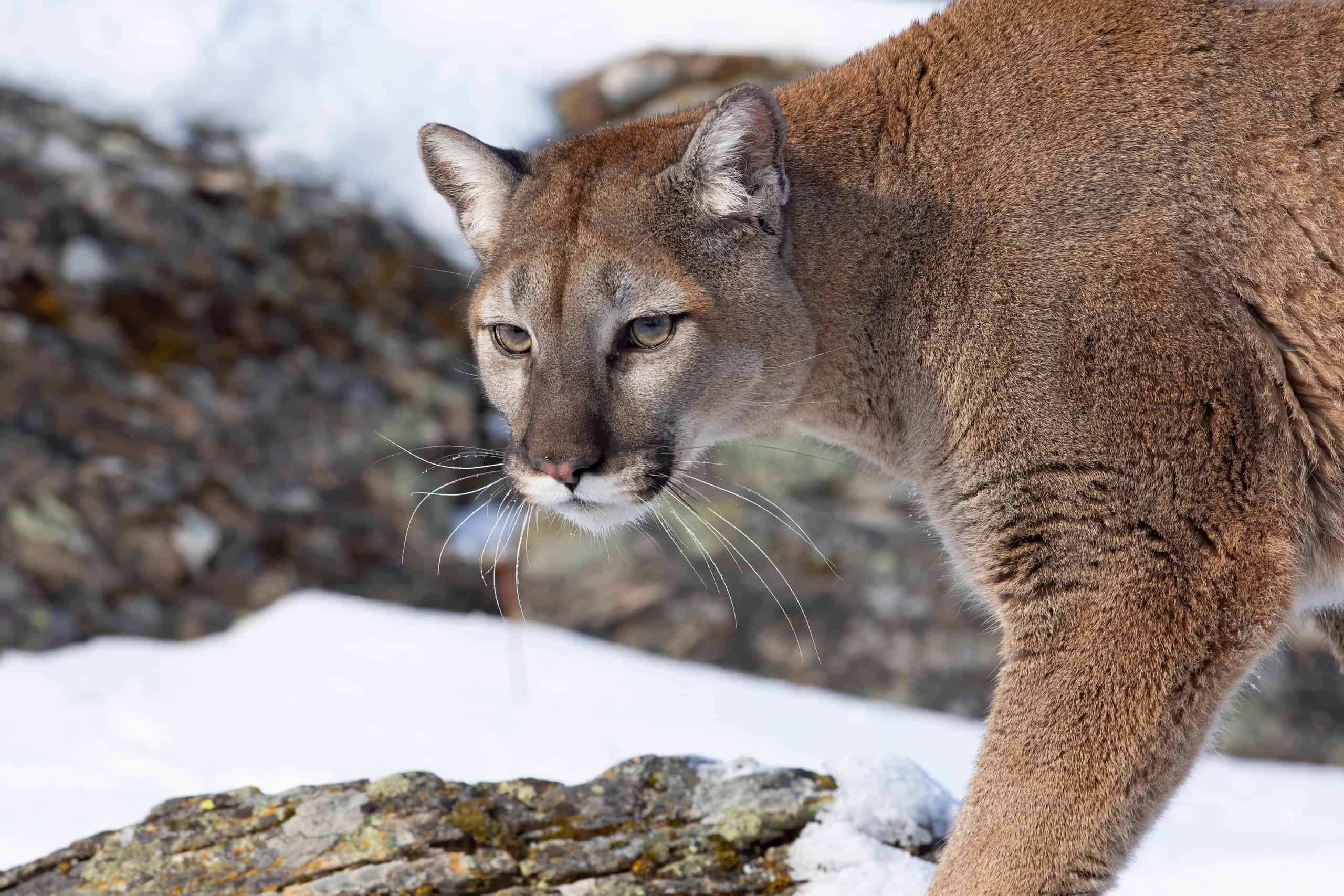

The mountain lion, also known as the cougar or puma, is one of the most imposing big cats in North America. It is the second largest cat on the continent, with only the jaguar being bigger. Although virtually all mountain lions are large, some are bigger than others, depending on the region. Mountain lions are particularly impressive catches because of their speed and agility, which make them difficult to hunt. Read on to learn more about the largest mountain lion ever caught.
Background Information on the Mountain Lion
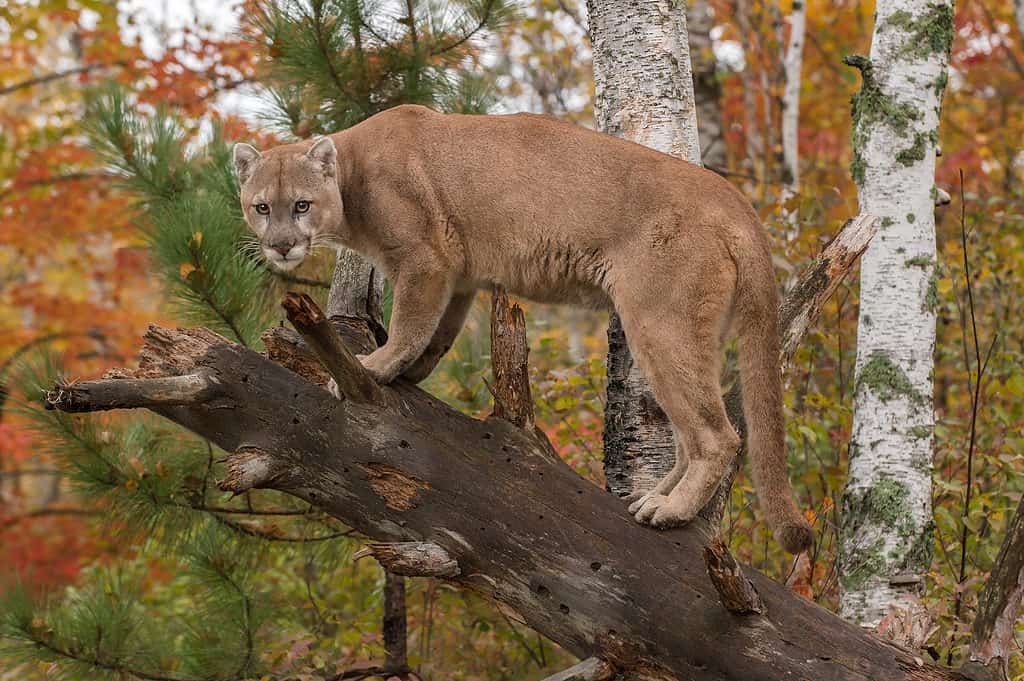
Mountain lions usually prefer habitats where they have dense cover and undergrowth.
©Geoffrey Kuchera/Shutterstock.com
Although mountain lions are predators, they are not as dangerous to humans as many would think. Learn more about these big cats’ habitats, diets, size, and appearance below.
Range and Habitat
Mountain lions were originally plentiful in North America and South America. However, their range has been greatly reduced. Now, these cats are primarily found in at least 16 states throughout the Western United States, as well as in Florida, Alberta, and British Columbia. Occasional sightings have also been reported in some Midwestern states.
Mountain lions usually prefer habitats where they have dense cover and undergrowth. If they perceive a threat, they will remove themselves from the area. Typically, they can live in a variety of habitats. They have been found both at sea level and on mountain peaks. These cats also live in woodlands, hillsides, humid forests, and deserts.
Mountain lions can live anywhere that they find prey and shelter. They have naturally low population densities and need large spacious areas in order to thrive. These wildcats are relatively solitary animals, except during mating season and when parenting their cubs. Males usually have a range of about 100 square miles, and females have a range of 20 to 60 square miles.
Diet
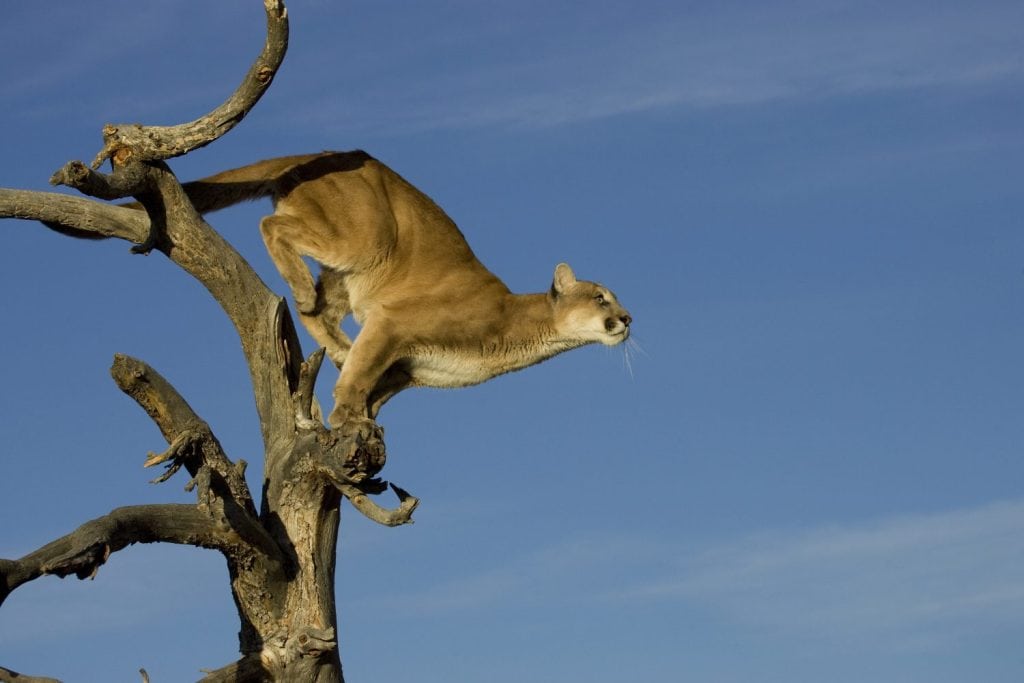
Mountain lions sometimes climb trees to scan the area for prey.
©creativex/Shutterstock.com
Mountain lions are opportunistic hunters. Typically, they will hunt by themselves between dusk and dawn. They sneak up on their prey from behind, often lying in wait or silently stalking before pouncing and delivering a lethal bite to the spinal cord.
Surprisingly, mountain lions have a poor sense of smell. However, they remain adept hunters due to their excellent hearing and vision. Their powerful hind legs allow them to pounce from great distances. Mountain lions can typically jump 40 to 45 feet in a single leap.
A mountain lion’s preferred meal is usually deer. The average mountain lion kills one deer every week. However, they will also eat porcupines, elk, rodents, feral hogs, raccoons, and coyotes. These cats are strict carnivores and will only eat vegetation in rare instances.
In some cases, a mountain lion will drag a carcass to a different area and cover it with natural materials to hide it from other animals. They come back to the spot and feed on the same carcass over the course of several days.
Appearance and Size
While mountain lion cubs have camouflaging rings and spots on their tails, adult mountain lions have more solid tan coats. Males and females look fairly similar, although males are about 30% to 40% larger than females.
Sizes can vary, especially between geographic ranges. However, a typical adult female will be between 80 and 130 pounds, and a typical male will be 110 to 180 pounds. Some mountain lions exceed 200 pounds, but this is fairly rare. In terms of length, adult males are typically between 6 and 8 feet from nose to tail tip, while females are 5 to 7 feet long.
The Largest Mountain Lion Ever Caught
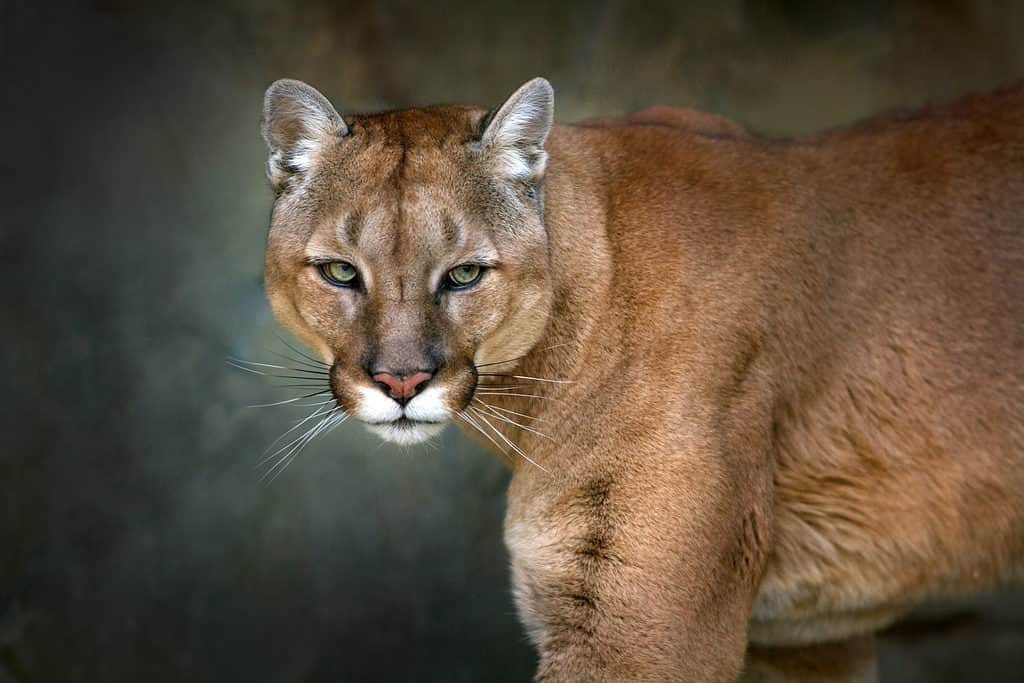
The largest mountain lion ever caught was said to weight 276 pounds.
©Kwadrat/Shutterstock.com
According to the National Park Service, the heaviest wild mountain lion ever documented weighed 276 pounds, although the location and date of this catch are not given.
The largest mountain lion ever caught as recorded by the Boone and Crockett Club had a skull measurement of 16 4/16. This cat was hunted and killed in 1979 in Tatlayoko Lake, British Columbia, Canada. Douglas E. Schuk shot the animal, with the help of his pack of hunting dogs.
Schuk could tell from the noises the dogs were making, and the hissing from the cat in response, that they had the mountain lion cornered. Knowing that these big cats are capable of killing hounds with a single swipe of their paws, he shot the mountain lion with his .308 rifle before it had a chance to injure his dogs.
Charles M. Travers is the current owner of the cougar’s skull. The skull was officially measured while in his possession. Boone and Crockett confirmed this cat to be the record-breaking cougar.
Mountain Lions and Humans
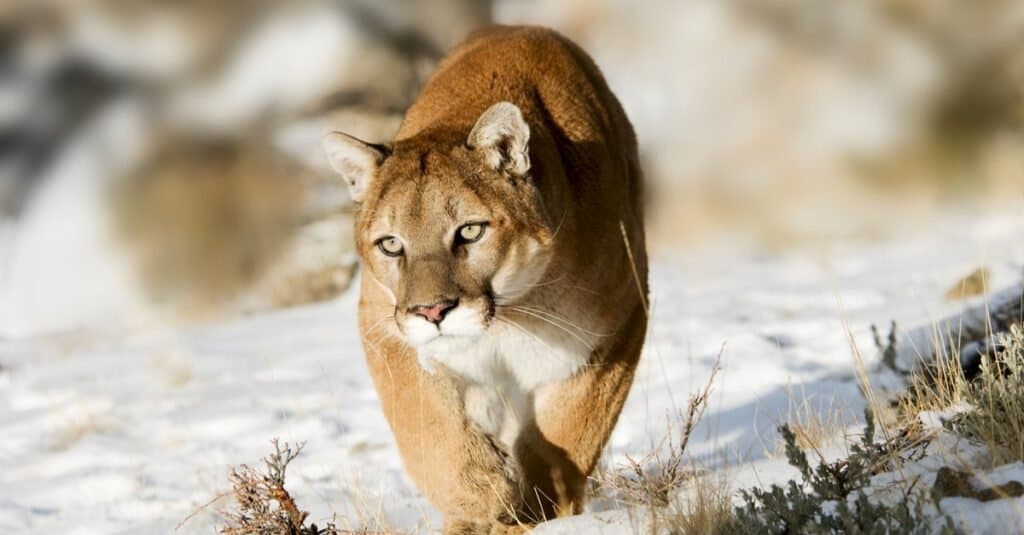
Many are concerned about mountain lions attacking humans. However, this rarely happens.
©Scott E Read/Shutterstock.com
Bounty hunting of mountain lions, bears, and wolves has been an issue in North America since the 1600s. By the 1900s, these animals had been hunted and killed in very high numbers. Although the initial rationale for hunting them was their perceived negative effect on game populations, killing them also had negative consequences. The loss of predator populations threw the ecosystems off balance. This led to an overpopulation of herbivores, such as deer, which increased erosion, overgrazing, and an overall decline in the health of these ecosystems.
Efforts to restore environmental health began in the 1960s, curbing the hunting of these predators. However, mountain lion populations and ranges are still not what they once were. People are often concerned about mountain lion populations because they fear these cats will prey on their livestock. However, in reality, as long as deer populations remain high, mountain lions will generally leave livestock alone.
Additionally, many people worry about mountain lions attacking humans. However, this rarely happens. Even when it does, it is usually an indirect result of human impact on these cats’ habitats. Humans have encroached upon their territories, limiting their range. Dominant male mountain lions push juveniles into marginal habitats, and these juveniles may become desperate for food. In the rare event that a mountain lion attacks a human, it is almost always one of these hungry juveniles. If people respected the habitats of these big cats, humans and mountain lions would be more likely to coexist peacefully.