
Quick Take
- Baby raccoons are born completely blind, deaf, and helpless, yet they develop one cognitive ability that puts them on par with primates. See how kits are born →
- Raccoons keep solving puzzles even after the food reward is gone, and the reason why reveals something surprising about their inner lives. Explore their puzzle-solving behavior →
- That iconic bandit mask isn't just for looks. It actually serves a tactical purpose most people never suspect. Discover the mask's purpose →
- Raccoon paws feel the world in a way that lets them 'see' without looking, which explains how kits outsmart your trash can lid. Learn about their tactile sense →
There are three distinct species of raccoons: the common raccoon (Procyon lotor), the crab-eating raccoon (P. cancrivorus), and the critically endangered Cozumel raccoon (P. pygmaeus). Of these, only the common raccoon, with numerous localized subspecies, is native to and found within the United States. The common raccoon reproduces once a year, giving birth to a litter of between two and five kits. Continue reading for fun facts and precious photos of baby raccoons.
A Baby Raccoon Is Called a Kit
Baby raccoons are called kits and, less often, cubs. An adult male raccoon is called a boar, and an adult female is called a sow. Mature female raccoons have only one litter of kits per year, with a gestation period of approximately nine weeks. The average litter consists of between two and five kits.

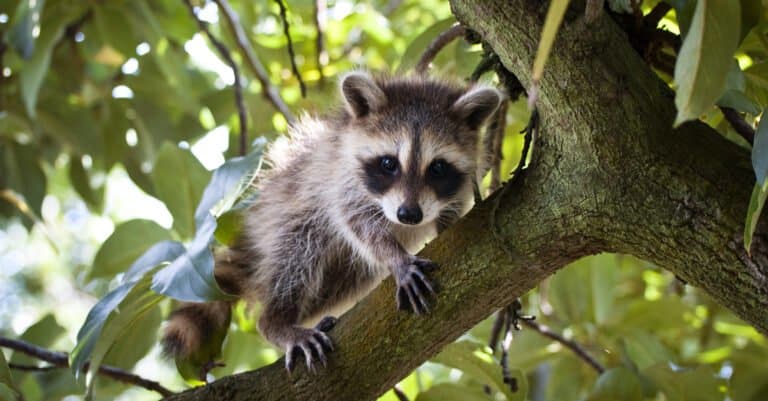
Baby raccoons, called kits, are extremely intelligent, social animals.
©Gerald A. DeBoer/Shutterstock.com
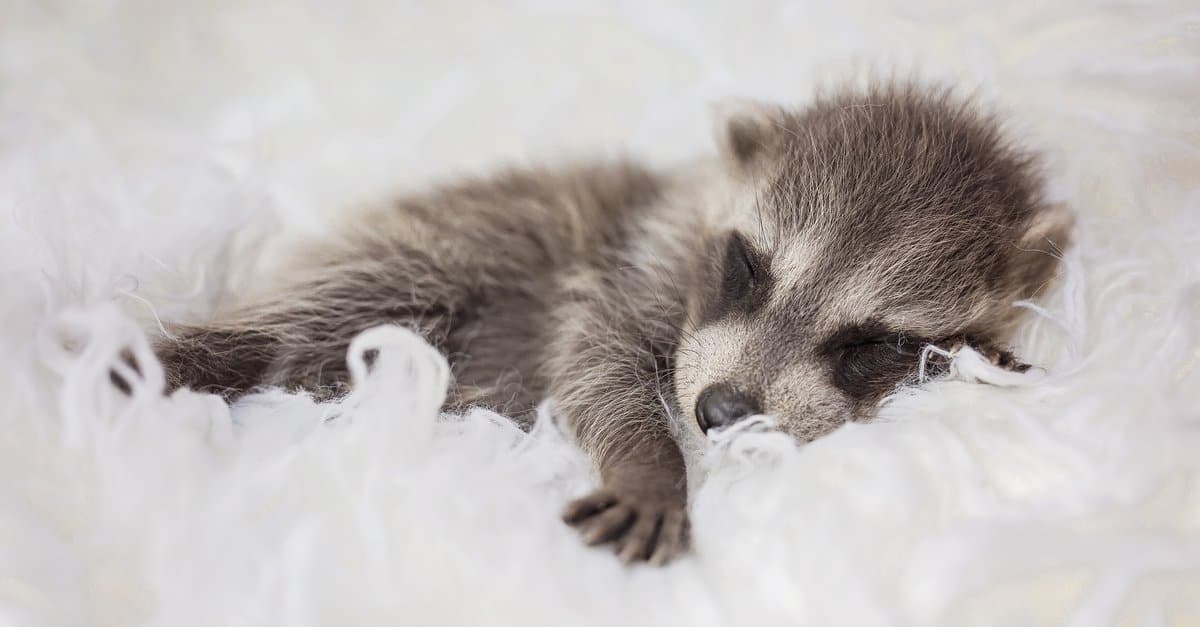
Raccoon kits are altricial, meaning they are born completely helpless and require intensive maternal care. Kits are born with their eyes closed and their ear canals sealed. They cannot see or hear anything for their first 18 to 23 days of life. Kits cannot regulate their own body temperature and rely entirely on the physical warmth of their mother to stay alive.
Raccoon Kits Are Extremely Smart
Scientists and animal behaviorists widely recognize raccoons, including young kits, as exceptionally intelligent. Rather than relying strictly on instinct, baby raccoons possess a remarkable capacity for social learning and mimicry. They closely trail their mothers during development to methodically learn how to navigate hazards, memorize the locations of complex food sources, and manipulate environmental obstacles.

Raccoon kits are among the smartest babies in the world.
©Heiko Kiera/Shutterstock.com
This exceptional cognitive development is backed by anatomical research from Suzana Herculano-Houzel et al., which revealed that the raccoon brain is densely packed with neurons in the cerebral cortex, a density comparable to that of primates.
In a study from the University of British Columbia, scientists Hannah J. Griebling, Shylo R. Johnson, and Sarah Benson-Amram observed that raccoons would continuously manipulate and solve complex puzzle boxes long after they had extracted all available food rewards, suggesting that their problem-solving behavior is driven by a genuine desire for cognitive stimulation rather than mere survival.
Raccoons are Born Without Their Famous Masks
One of raccoons’ most prominent features is the natural mask that makes them look like tiny bandits. However, baby raccoons are born without their signature mask.
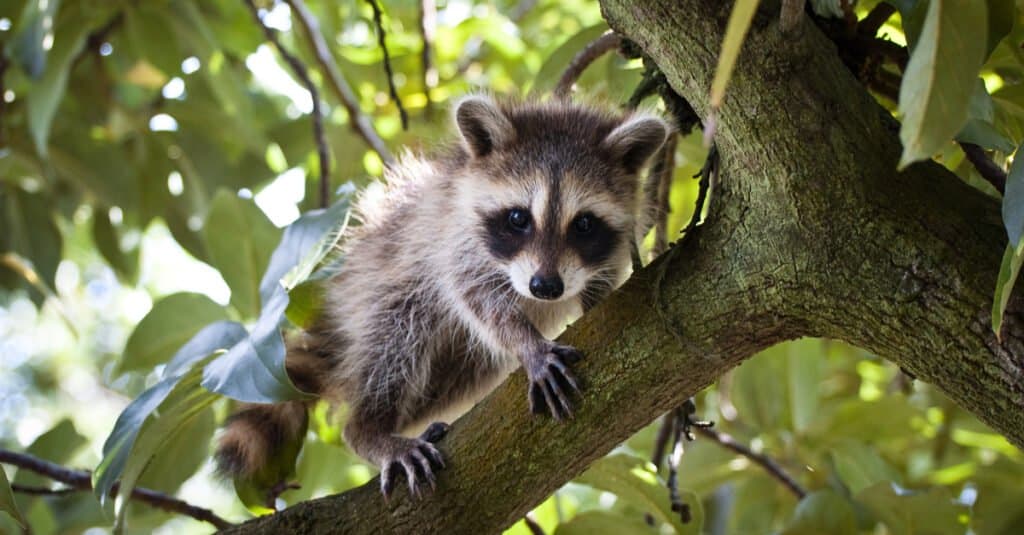
The raccoon’s famous mask is very light on newborn kits, but darkens with age.
©Heiko Kiera/Shutterstock.com
Raccoons are born with a very light pelt that will develop markings later in life. The mask, however, won’t appear until the kit is older.
A raccoon’s black mask functions as a natural anti-glare shield. The shape and intensity of the mask vary slightly among individuals, which may help raccoons identify individual members of their own group. A raccoon’s mask hides where its eyes are pointed, making it harder for predators or prey to tell if the raccoon is looking at them.
Baby Raccoons Have Fingers
If you’ve ever wondered how a raccoon kit can get into your trash cans, the answer is simple: they have fingers. Although they don’t have opposable thumbs, raccoons do have five fingers on each paw.
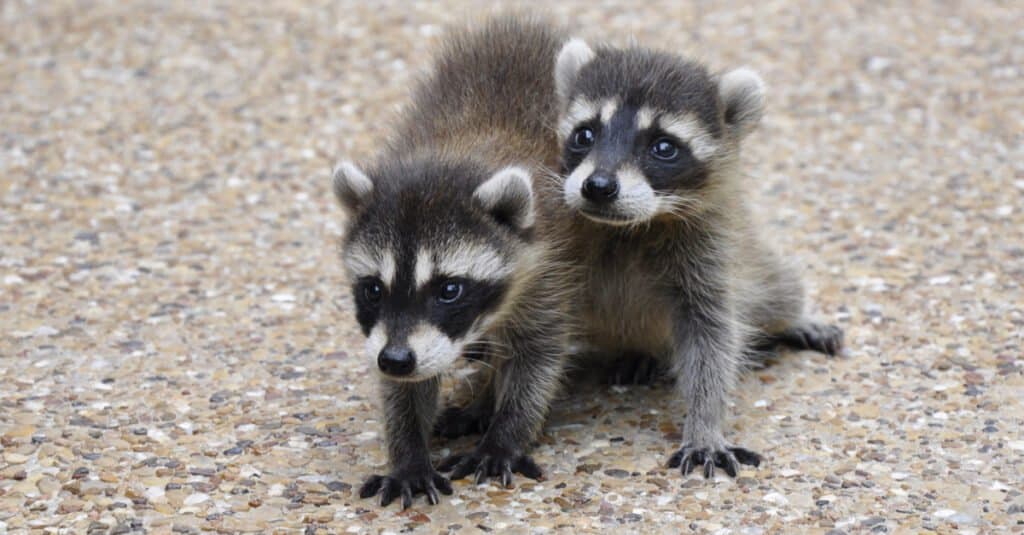
Raccoon kits can use their hands to hold items and even open trashcan lids!
©Becky Sheridan/Shutterstock.com
Raccoons possess a human-like sense of touch due to a massive concentration of specialized nerve cells called mechanoreceptors in their paws. Raccoon kits have four to five times more of these touch-sensing cells than almost any other mammal on Earth, placing them in the same category as primates. Because of this unique biology, raccoons don’t just feel objects; they use their sensitive hands to create mental pictures of their surroundings.
Baby Raccoons Walk in a Single File Line
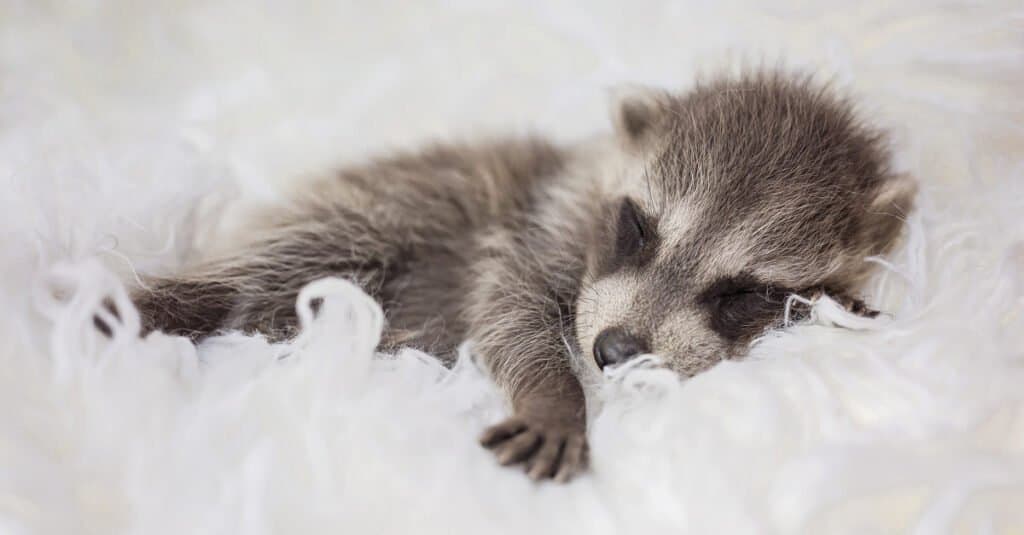
Raccoon babies follow their mothers in a single-file line.
©sinagrafie/Shutterstock.com
Raccoons follow their mother in a single-file line, just as ducklings follow theirs.
Once baby raccoons are able and ready, they leave the den. At this time, mother raccoons lead their babies to a new location. During this journey, mother raccoons take the opportunity to teach their young to forage for food and to detect threats. Raccoon kits will remain with their mothers until they are around 8 to 12 months old.

No matter how cute they may be, do not ever handle wild raccoons. Raccoons are one of the primary carriers of rabies in North America. They are classified as a rabies vector species, meaning they are highly susceptible to the virus and can easily transmit it to other animals and humans through their saliva, usually from a bite or scratch.
©Georgi Baird/Shutterstock.com