
Quick Take
- The world's most solitary great ape does something no researcher expected, a finding that took 15 years of watching to finally prove. See the 15-year study →
- Orangutan mothers know exactly who their neighbors are and who had a baby, and they use that knowledge in a way that mirrors human parenting. See how mothers choose neighbors →
- On certain days, orangutan mothers make a quiet trade-off between their own survival needs and something else entirely, and the reason behind it is unexpected. See the trade-off mothers make →
- Scientists still don't know if all this effort actually pays off, which raises a bigger question about why mothers do it at all. Explore the unanswered question →
Maternal instincts run deep throughout the animal kingdom. A new study brings forth evidence that orangutans, just like human moms, plan playdates for their young. This new finding adds a layer of human-like compassion to the sacrifices mothers make, especially in isolated animal groups.
Orangutans are usually solitary animals, which makes this discovery even more significant. The lengths they go to in order to socialize their offspring mirror those of many other species. And the results are a solemn reminder that no matter the species, motherhood is a universal experience.
Teams Tracked Orangutans Over 15 Years
The study, led by scientists from the Max Planck Institute of Animal Behavior (MPI-AB) and the University of Zurich, Universitas Nasional, and Rutgers University, took more than a decade to complete. Their research followed 31 mother-infant pairs, resulting in 32,600 hours of observations. Orangutans are notorious for being the most solitary of any other great ape group. This gave the team’s findings even more weight as they realized that mothers were willing to travel great distances just to socialize.
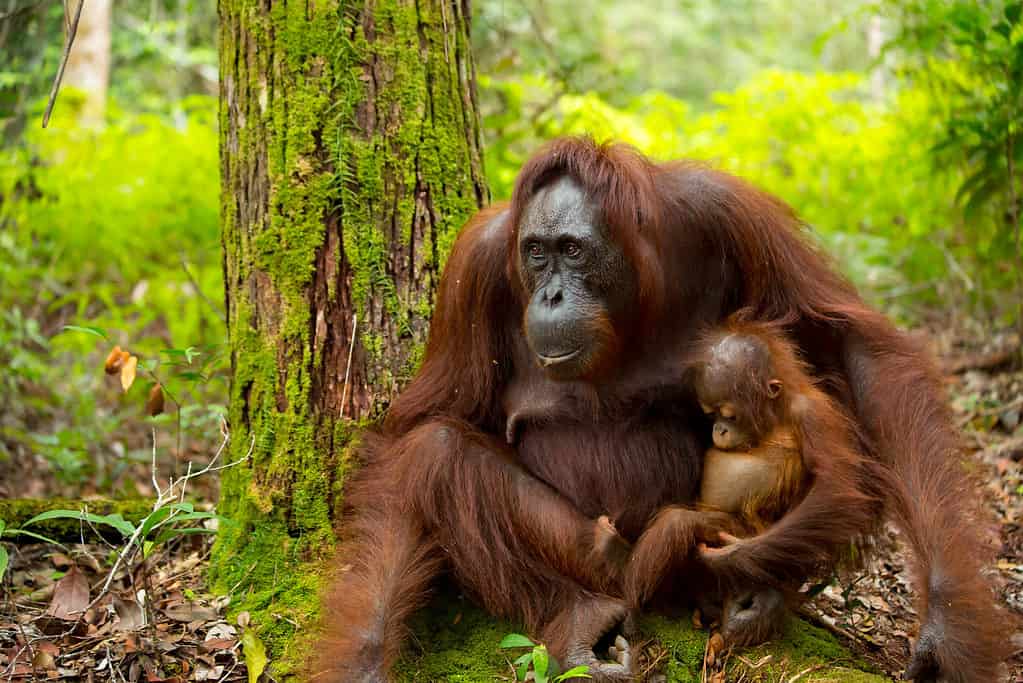
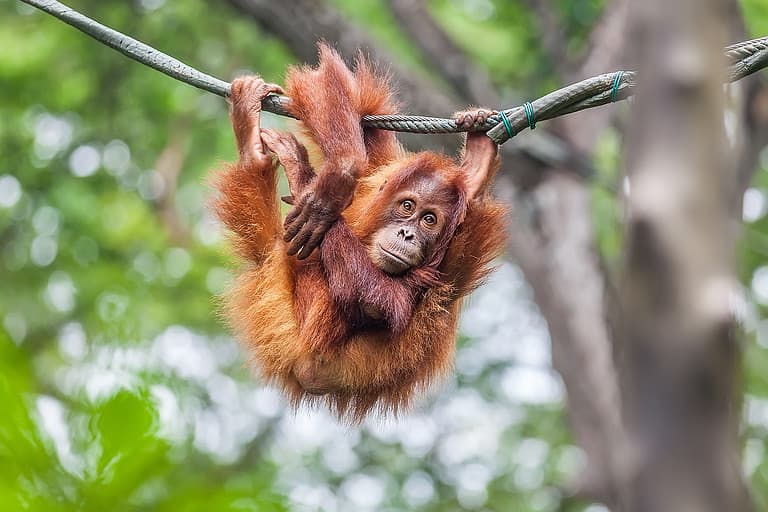
Orangutans are known for being a solitary species.
©Katesalin Pagkaihang/Shutterstock.com
Since 2003, Dr. Maria van Noordwijk, the study’s senior author, and her team have been tracking the movements of these primates. The orangutans’ behaviors from morning until night at Tuanan Research Station on the island of Borneo in Indonesia. Throughout their documentation, the team recognized that something unique was happening that had never been confirmed before.
“It just looked like a really long, hard day for them,” Noordwijk said of her observations. “I knew there was something going on with these playdays, but we needed the right statistical technique to verify this.” To do this, Noordwijk’s team combined the distance mothers traveled with the social behavior of nearby mother-infant pairs. This revealed intimate details about the lengths to which mothers were willing to go, as well as their rare interactions with other mothers.
Mother-Infant Pairs Were Determined by Proximity
One of the first things the team noticed was that mothers sought out one another with similarly aged offspring. Noordwijk coined the term “forest gossip” regarding orangutan mothers’ understanding of their neighbors. “Orangutans might spend most of their day alone, but they are still embedded in a social network. They know exactly who their mostly life-long neighbors are, and they know who had a baby when. From their treetop positions, they can probably get a rough sense of where these neighbors are, at least on occasion,” she said.
After finding a suitable playdate pair, orangutan mothers become extremely cautious around one another. Adults are typically hands-off, avoiding excessive socialization unless absolutely necessary. Which is why it’s so fascinating that for their offspring, females are willing to travel whatever distance is needed to socialize their young.

Mothers play the role of protector, provider, and social chair for their offspring.
©olga_gl/iStock via Getty Images
In contrast, the team observed young orangutans display the opposite behavior. Not unlike human children, they played with one another, seemingly unafraid of strangers. Noordwijk calls this a “play switch,” which goes on or off depending on what a mother decides.
The Ultimate Motherly Sacrifice
The team observed another interesting facet of orangutan “playdates.” As the date grew near, mothers would simultaneously move closer to one another’s core areas. This implies a level of conscious thought and control over where the playdates took place and their proximity to other families. However, this daily movement also comes at a cost for orangutan mothers, who must pay to socialize their young.
On travel days, mothers fed less and focused more on moving their offspring closer to others. Playdates occurred at the expense of a mother’s part as she transported her offspring toward another. Observations made it clear that this was a direct result of isolated living among orangutan groups. Socialization typically occurs naturally in group-living species, but for great apes, this is not always the case.

The role of playdates in a juvenile’s life is still a mystery to researchers.
©tristan tan/Shutterstock.com
Orangutan mothers seemed to have solved that by incorporating playdate travel into their family-raising. In addition to being the food provider and protector of their offspring, adult females also have the task of finding friends.
However, the benefits of these playdates later in life remain unclear. According to co-author Dr. Sri Suci Utami Atmoko, it’s uncertain if the time and energy that orangutan mothers invest actually pays off later in a juvenile’s life. More studies are needed to determine the role these playdates serve, but researchers believe this is a reminder of what happens in isolated societies.