
Quick Take
- Picking up a baby wild animal feels like the right call, even though doing so can actually hurt its chances of survival. Assess before touching →
- The single most important thing to do isn't what most people instinctively reach for first. See the first step →
- Giving a wild animal food or water seems kind, but wildlife experts say it can make things dramatically worse. Why feeding backfires →
- A lone baby animal isn't necessarily abandoned, and acting too fast could sever its only lifeline. See a real example →
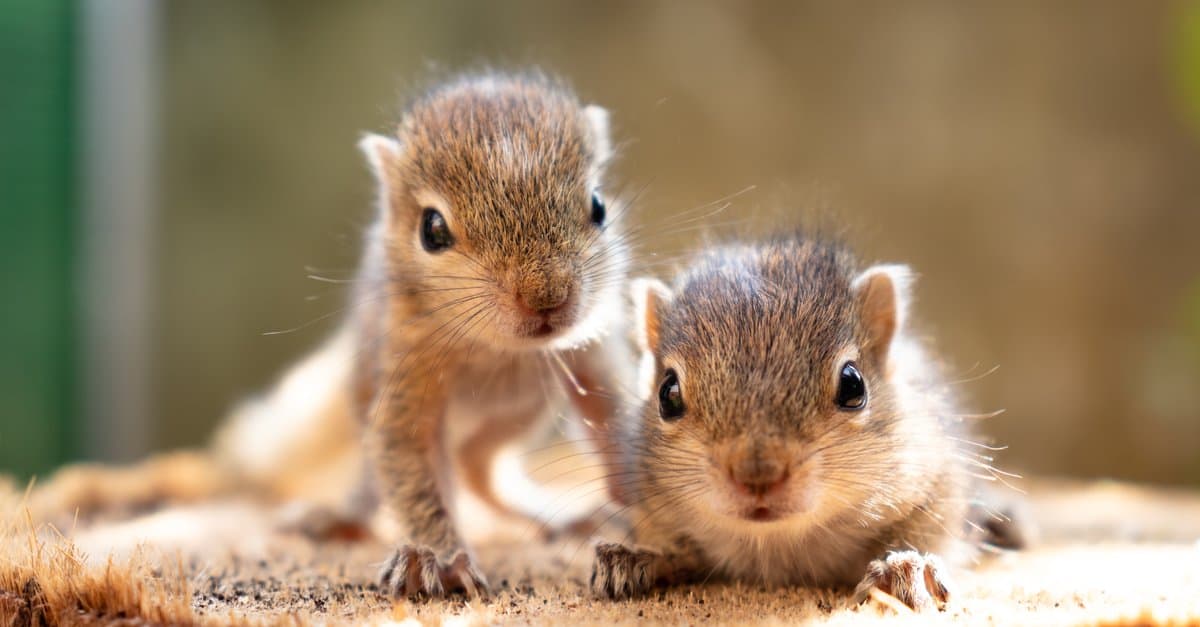
Imagine you’re on your way to work when you spot something small and wriggling on the side of the road. You pull over, take a closer look, and realize it’s a baby squirrel—alone, vulnerable, and seemingly helpless.
Your first instinct may be to scoop it up and take it home. But according to Katie Moore, Senior Director, Animal Rescue at IFAW, that instinct—while compassionate—can sometimes do more harm than good.
“The urge to help an injured or potentially orphaned animal is a wonderful human response,” Moore says. “Unfortunately, good intentions alone are not always enough. Knowing what to do—and what not to do—can make all the difference in that animal’s chances of survival.”

As the Senior Director of Animal Rescue, Katie uses her extensive experience to help plan the future of IFAW’s rescue and rehabilitation efforts.
©Katie Moore Senior Director – Animal Rescue, IFAW – Original / License
The First Step: Call Local Wildlife Experts
No matter what kind of wild animal you find, Moore says your best move is to contact a local wildlife rehabilitation organization or appropriate wildlife agency as soon as possible.
“No matter what type of animal you find, the first and best option is to call your local experts for help,” Moore says. “Local wildlife rescue organizations can guide you on what to do and prepare to receive the animal into their care, if necessary.”
If you can’t reach anyone immediately—such as after hours—the next steps depend on the type of animal you have found and whether it is injured, sick, or truly orphaned.
Before You Intervene, Assess From a Distance
A baby animal’s best chance of survival is often with its mother, especially for young mammals like squirrels.
“For our little squirrel friend, we need to remember that a baby animal’s best chance of survival is with its mother,” Moore says. Before touching the animal, Moore recommends observing carefully.
“Without touching the animal, assess what you see,” Moore says. “Is it injured or bleeding? Is it alert and responsive—looking at you—or is it listless, with its eyes closed?”
If the animal appears injured or sick, Moore recommends contacting a wildlife rehabilitation facility, wildlife officers, natural resources staff, or even the local police, who may be able to connect you with the appropriate help.
If there are no visible injuries, the next question is whether the animal is still dependent on its mother.
“For example, a squirrel whose eyes are still closed is still dependent on its mother,” Moore says.

Is feeding a baby rabbit a good idea?
©Y.S graphic/Shutterstock.com
Sometimes the Right Move Is to Leave the Animal Alone
That may feel counterintuitive, but in many cases, stepping back is exactly what gives the animal the best chance.
“For baby mammals, it is generally best to leave them in the area for several hours, as long as there are no cats or dogs nearby, to see if their mother returns,” Moore says.
She notes that mother animals are unlikely to return if people or pets linger nearby.
“Keep in mind that the mother is unlikely to return while humans or pets are nearby, so be sure to leave the area and check back later,” Moore says. If the animal is still there after about four hours—or remains overnight—it’s time to call a wildlife rescue or rehabilitation center for guidance on safely collecting it.
Different Animals Require Different Responses
There is no single rule that applies to every species. What you should do for a squirrel is not necessarily what you should do for a turtle, frog, or bird.
“The appropriate response varies greatly depending on the type of animal,” Moore says.
For reptiles and amphibians, there may be a simpler fix.
“Turtles and other reptiles and amphibians can usually be moved—with caution and guidance from experienced rehabilitators—to a safer habitat away from roads, if they are not injured,” Moore says.
Birds, however, require more careful observation before you decide whether to help.
“Baby birds, on the other hand, may require a different approach,” Moore says. “As with mammals, we first need to determine whether the animal is ill or injured. If so, call the experts.”
If the bird does not seem injured, the next question is whether it is a nestling or a fledgling. “Does it have feathers? If so, that is a good sign,” Moore says. “It is likely learning to fly and may simply need some time and space. Be sure to keep pets away.”
If the chick does not yet have feathers, she says a local wildlife center may be able to guide you in returning it to its nest.
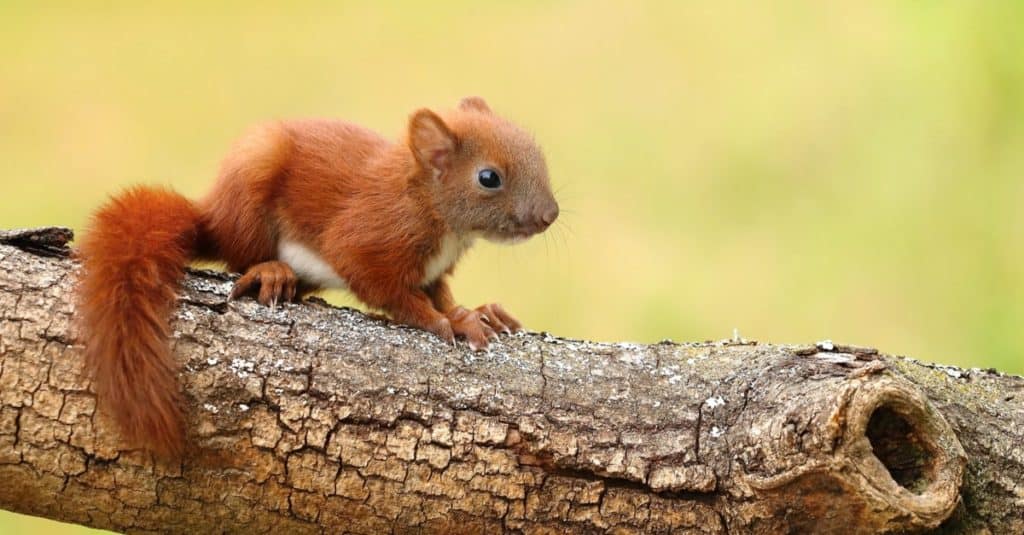
This little baby red squirrel may have a mother close by.
©Miroslav Hlavko/Shutterstock.com
A Real-Life Reminder That Young Wildlife May Not Be Abandoned
Moore recalls one evening when she encountered what appeared to be a baby owl in her own yard.
“I experienced a version of this myself one evening while walking our dog in our fenced backyard,” Moore says. “I suddenly felt something swoop low and almost silently over my head. An owl! It was both amazing and a little alarming.”
She looked around and soon found the reason: “Knowing that this was not typical behavior, I looked around and spotted a small gray-and-white puffball on the ground nearby,” Moore says.
She kept her dog back and approached carefully. “Keeping our dog at a safe distance, I moved closer and discovered a beautiful young owl,” Moore says. “Meanwhile, the adult owl made it very clear that she was not thrilled with my investigation.”
Because the chick appeared healthy and uninjured, Moore and her dog left it alone and gave it space.
“The chick appeared healthy and uninjured, so we went back inside and gave it space,” Moore says. “About an hour later, it was gone, likely having successfully completed an early flying lesson under its mother’s watchful eye.”
The experience underscored an important point: a young animal alone does not always mean it has been abandoned.
“Without touching the animal, assess what you see. Is it injured or bleeding? Is it alert and responsive—looking at you—or is it listless, with its eyes closed?”
Katie Moore, Senior Director, Animal Rescue at IFAW
Don’t Try to Rehabilitate Wildlife at Home
Even if local facilities are closed or full, Moore says people should not assume they can raise or treat a wild animal on their own.
“Wildlife rehabilitation requires training and almost always requires special permitting from the state,” Moore says. “You should not attempt to rehabilitate a wild animal at home.”
That includes feeding it or improvising long-term care, which can unintentionally worsen the animal’s condition.
“Do not give the animal any food or water,” Moore says. “This can do more harm than good to a sick or injured animal.”
If a wildlife professional instructs you to collect the animal—or if you have to do so while waiting for help—Moore says to focus on minimizing stress and protecting both yourself and the animal.
“Protect yourself by wearing gloves to reduce exposure to parasites and diseases,” Moore says.
She also recommends preparing an appropriate container with air holes and suitable materials inside, depending on the species.
“Keep the container in a dark, quiet, warm place,” Moore says. “This may be in your garage, on a porch, or even in your home.”
And once the animal is inside, leave it there. “Keep the animal in the container—do not let it loose and do not handle it,” Moore says. “This increases stress and can impact the animal’s chance of survival.”
Preparation Is Important Before an Emergency Occurs
One of Moore’s clearest recommendations is to think ahead before you ever find yourself faced with a wildlife emergency.
“It is a good idea to know what resources are available nearby, including local wildlife rescue centers, certified rehabilitators, and natural resource or animal control officers,” Moore says. “Keep their numbers in your phone for easy access in an emergency.”
She also points people to national guidance if they have trouble reaching local help.
“If you are having trouble contacting an expert, the National Wildlife Rehabilitators Association provides online guidance on safely rescuing and temporarily caring for an animal while waiting for an expert to respond,” Moore says.
When in Doubt, Pause Before You Act
In many cases, the kindest thing a person can do is slow down, assess the situation carefully, and avoid acting on panic alone.
The recurring lesson in Moore’s advice is simple: not every baby wild animal needs rescuing, but every situation deserves thoughtful care.
“You’ll notice a common theme here: the best option is always to call a local wildlife rehabilitation center or appropriate local agency,” Moore says. “This helps ensure the best possible outcome for the animal while also keeping you safe as you try to help.”