
Quick Take
- One snake in Japan is both venomous AND poisonous, a remarkable trait it achieves by drawing its toxins from an unlikely dietary source. Meet the toad-toxin snake →
- Japan's most dangerous snake hides in plain sight, preferring farmland, meadows, and city-adjacent marshes as its territory. Japan's deadliest pit viper →
- One region of Japan harbors an entire snake population that looks nothing like the rest of its species. See the albino population →
- Most of Japan's venomous snakes carry a designation that rarely appears on wildlife lists, and the article explains exactly what that designation means. Check the medical significance list →
As an island chain separated from continental Asia, Japan’s wildlife has had plenty of time to develop some truly unique traits. When most people think of Japan, however, they don’t really consider the possibility that snakes could live on the islands. However, snakes live in almost every ecological habitat in Japan. Whether it’s a city park or a rural field, you can be sure that there are slithering serpents somewhere nearby. Overall, there are 47 different snake species, and some of them are seriously dangerous. Read on to learn more about the snakes that live in Japan.
The Most Common Snakes In Japan
There are eight regions of Japan, including Hokkaido, Tohoku, Kanto, Chubu, Kinki, Chugoku, Shikoku, and Kyushu. There is an incredible variety of snakes within these regions, each with its own ecological niche. For example, there is an entirely albino population of rat snakes that live in the Chugoku region in the Yamaguchi prefecture. Learn about some of the most common snakes across the country, plus see a list of the rest.
Japanese Rat Snake
Japanese rat snakes (Elaphe climacophora), known as the aodaishō in Japanese, are one of the most common snakes in Japan, inhabiting most of the Japanese archipelago. They inhabit mountain slopes, river valleys, forests, and woodlands, where they spend much of their time hunting in the trees. They are 3-7 feet long and are generally regarded as the largest snake species outside of Okinawa. Japanese rat snakes can be yellow-green or blue-green and have a brown-stripe pattern that mimics the venomous mamushi snake. These snakes are nonvenomous and totally harmless to humans.

The Japanese rat snake is one of the most common and widely distributed snakes in Japan.
©reptiles4all/Shutterstock.com
Japanese Striped Snake
Japanese striped snakes (Elaphe quadrivirgata), often called four-lined snakes, are another common species of snake native to Japan. These opportunistic predators inhabit forests, woodlands, grasslands, agricultural lands, and flooded rice fields all over Japan except for the Ryukyu Islands. These snakes are generally yellow or light brown and have four stripes running from their head to their tail. There is also rarer all-black morph called karasu-hebi or “crow snakes.” Japanese striped snakes generally measure between 3 and 5 feet long. These snakes are nonvenomous and pose no danger to humans.
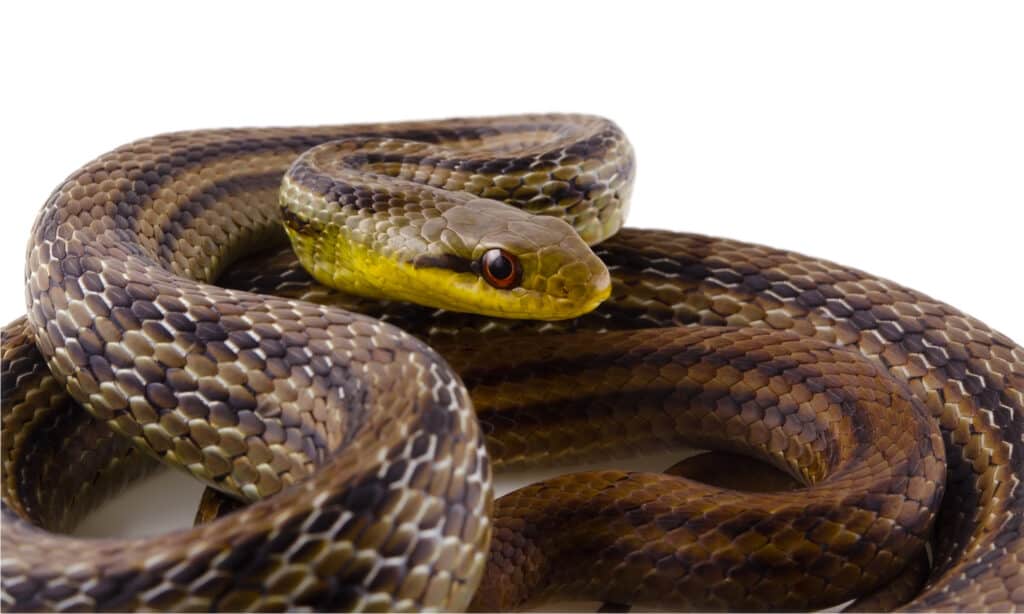
The Japanese striped snake has four lines that run down its back from head to tail.
©eye-blink/Shutterstock.com
Jimguri
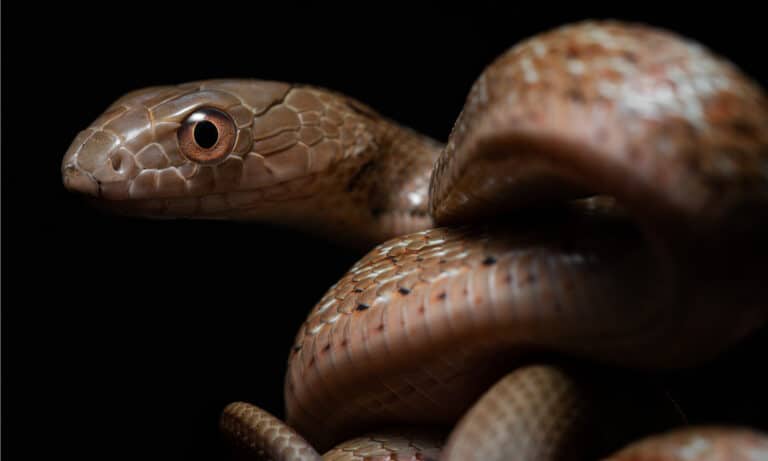
The name “jimguri” translates to “the burrower.” Jimguri snakes (sometimes called burrowing rat snakes) are a common species of snake native to all four main islands of Japan, plus a few smaller islands on the fringes. They are natural burrowers but can be found on the surface during dusk and dawn. Their primary habitat is in the forest, and they are often referred to as Japanese forest snakes. They are reddish-brown and have small black splotches across their bodies ringed in yellow or white. Jimguri snakes typically grow 2.3-3.3 feet in length. These snakes are nonvenomous and not dangerous to humans.
Yamakagashi
The yamakagashi (Rhabdophis tigrinus) goes by many names, including the tiger keelback and the kkotbaem. These snakes can be found across much of mainland Japan and the Ryukyu Islands in mountainous areas and fields, often near water. They are dark brown or olive snakes with orange spots along the first third of their body. Their bellies are usually white or cream. They typically measure between 2 and 3.3 feet in length. Yamakagashi are venomous snakes that get their venom from their diet of poisonous toads. These snakes are also poisonous. After eating the toads, they store the toxins in special glands near the back of their mouth and use them for defense against predators.

The Yamakagashi is one of the most venomous snakes in Japan.
©QueSeraSera/Shutterstock.com
Japanese Keelback
Japanese keelbacks (Hebius vibakari) are small snakes that can be found along forest edges, in rice paddies, and near waterfronts across Japan from Hokkaido to Kyushu. They are usually olive-brown to reddish-brown with small black spots. These snakes may also have yellow patches along the tips of their nose, lips, and neck. Since they only reach 1.31-2.13 feet, their diets mainly consist of small frogs, tadpoles, fish, and earthworms. The Japanese keelback is nonvenomous and harmless to humans.

Japanese keelbacks are small snakes found near waterfronts and flat mountainous forests.
©Urri/Shutterstock.com
Mamushi
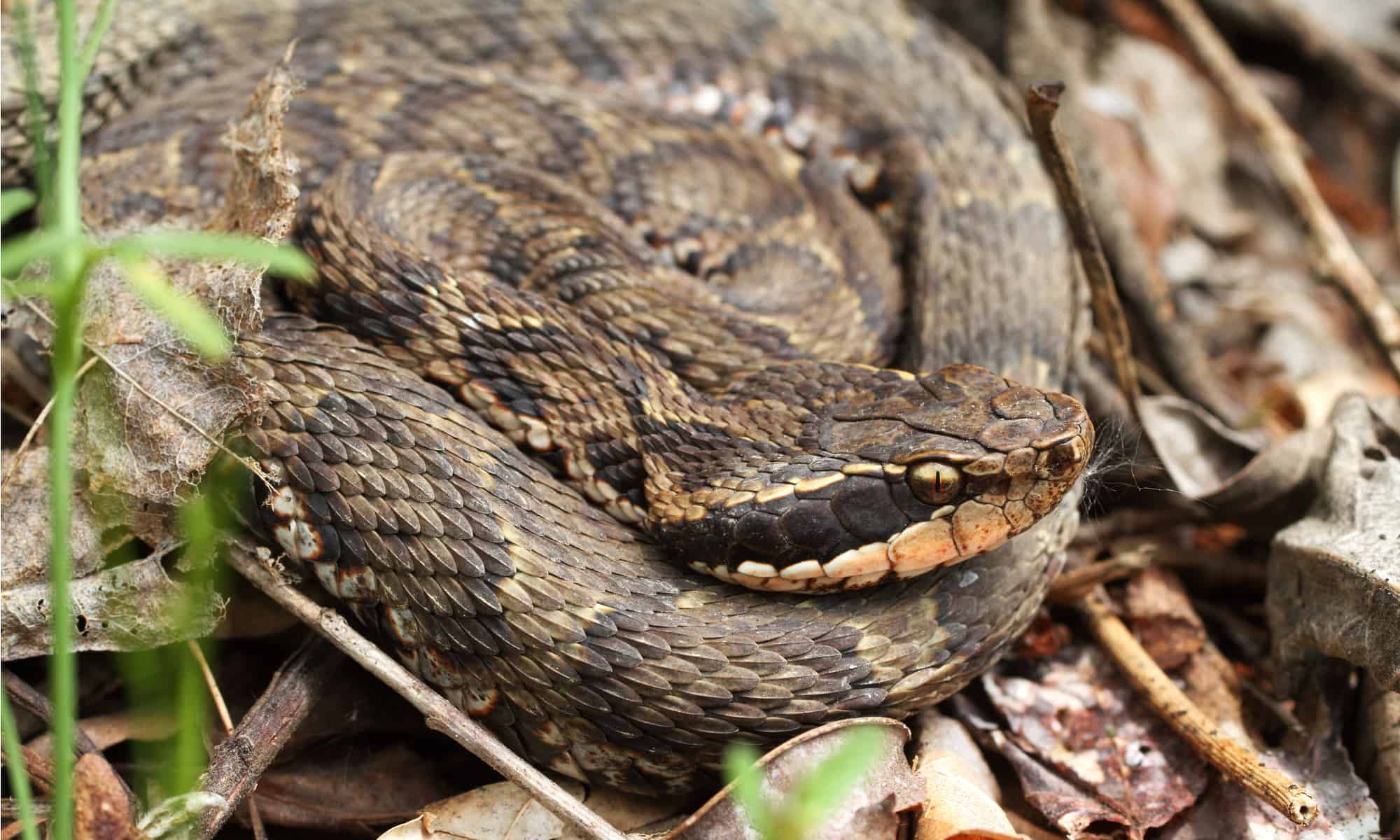
The mamushi (Gloydius blomhoffii) goes by many names, including the Japanese moccasin, Japanese pit viper, Quichun snake, Salmusa, and Japanese mamushi. These snakes live in lowland forests, marshes, meadows, and agricultural farmland all across Japan, with some debate as to whether they are found on the Ryukyu Islands. These snakes are pale gray, reddish-brown, or yellow-brown with irregular splotches and evenly spaced banding down their backs. Their heads are generally dark brown with distinct heat-sensing pits between their eyes and nostrils. Mamushi are the most dangerous snakes in Japan and their venom is considered to be of extreme medical significance. They bite as many as 3,000 people a year, with 1 death out of every 300 bites.
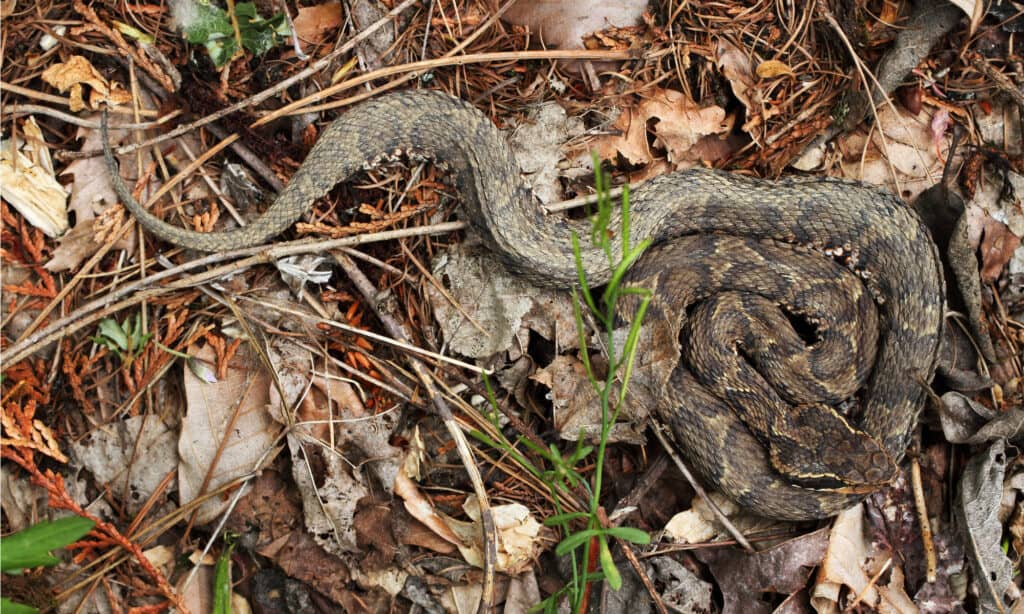
Mamushis are sedentary ambush predators and most bites are on the hands and feet.
©23frogger/Shutterstock.com
A Complete List Of The Snakes In Japan
- Calamaria pavimentata – Collared reed snake
- Calamaria pfefferi – Pfeiffer’s reed snake
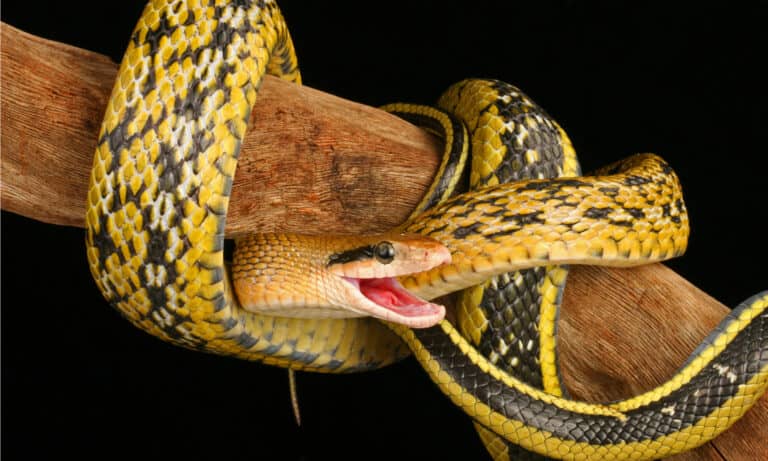
- Elaphe taeniura – Beauty rat snake
- Elaphe quadrivirgata – Japanese four-lined rat snake
- Elaphe climacophora – Japanese rat snake
- Elaphe carinata – King rat snake
- Euprepiophis conspicillata – Japanese woodsnake
- Lycodon semicarinatus – Ryukyu odd-tooth snake
- Lycodon orientalis – Oriental odd-tooth snake
- Lycodon rufozonatus – Red-banded snake
- Lycodon ruhstrati – Ruhstrat’s wolf snake
- Lycodon multifasciatus – Ryukyu Mountain wolf snake
- Ptyas semicarinatus – Ryukyu green snake
- Ptyas herminae – Sakishima green snake
- Rhabdophis tigrinus – Yamakagashi; Tiger keelback**
- Emydocephalus ijimae – Ijima’s sea snake
- Hydrophis cyanocinctus – Annulated sea snake
- Hydrophis melanocephalus – Black-headed sea snake
- Hydrophis ornatus – Ornate reef sea snake
- Hydrophis curtus – Short sea snake
- Hydrophis stokesii – Stokes’s sea snake
- Hydrophis viperinus – Viperine sea snake
- Hydrophis platurus – Yellow-bellied sea snake
- Laticauda laticaudata – Blue-banded sea krait*
- Laticauda semifasciata – Black-banded sea krait*
- Laticauda colubrina – Colubrine sea krait*
- Sinomicrurus japonicus – Japanese coral snake
- Sinomicrurus macclellandi – MacClelland’s coral snake*
- Hebius vibakari – Hebius vibakari
- Hebius pryeri – Pryer’s keelback
- Hebius ishigakiense – Yaeyama keelback
- Hebius concelarum – Miyako keelback
- Opisthotropis kikuzatoi – Kikuzato’s brook snake
- Pareas iwasakii – Iwasaki’s snail-eater
- Indotyphlops braminus – Brahminy blind snake
- Gloydius blomhoffii – Mamushi*
- Gloydius tsushimaensis – Tsushima Island pit viper*
- Ovophis okinavensis – Hime-habu; Ryukyu island pit viper*
- Protobothrops elegans – Sakishima habu*
- Protobothrops flavoviridis – Okinawan habu*
- Protobothrops mucrosquamatus – Taiwanese habu; Pointed-scaled pit viper*
- Protobothrops tokarensis – Tokara habu*
- Achalinus werneri – Amami odd-scaled snake
- Achalinus formosanus – Formosan odd-scaled snake
- Achalinus spinalis – Japanese odd-scaled snake
*The venom of these species is considered to be of medical significance.
**These snakes are both venomous and poisonous.