
Quick Take
- The remote Arctic wilderness sounds like the last place you'd worry about chemical contamination. Yet Svalbard reindeer tell a very different story. See why Svalbard was chosen →
- Svalbard reindeer will have different levels of chemical contaminants in their bodies depending on the time of year. Explore seasonal concentration shifts →
- Toxic metals in Arctic reindeer have been declining for decades, yet PFAS levels have trended in the exact opposite direction, and nobody knows why. See PFAS trends vs. metals →
- Hunters eating wild Arctic reindeer may be adding far more PFAS to their bodies than they realize, with the biggest risk hiding in the organs. Check the health risks for hunters →
When I look around my apartment, I see little tools in each room that help me get through my day with more ease: a collection of eye shadows and lipsticks in my bathroom, nonstick pans in the kitchen to reduce mess while cooking, and stain-resistant carpeting on the floor. The problem is that these items, among many others, often contain synthetic chemicals known as per- and polyfluoroalkyl substances (PFAS). PFAS are long-lasting and nearly impossible to break down. As a result, these “forever chemicals” are accumulating in soil, water, and even in human bodies. As you can imagine, PFAS build-up can be incredibly harmful.
While many companies have begun phasing out PFAS in their products, the damage is already done. PFAS are incredibly widespread. Nearly every person in the United States has PFAS in their blood. PFAS are also found heavily in water sources, leading to environmental impacts. Unfortunately, according to a new study in Environmental Science & Technology, PFAS are even being found in remote areas of the world like Svalbard, a Norwegian archipelago. PhD candidate Malin Andersson Stavridis recently defended her thesis on how PFAS are affecting Svalbard reindeer and how they could shape the future of this subspecies.
What Are PFAS?
PFAS have been used to manufacture various products over the last 70 to 80 years. You can thank PFAS for water-resistant clothing or camping gear, stain-resistant furniture, firefighting foam, beauty products, microwave popcorn bags, and fast-food wrappers, although the U.S. FDA phased out PFAS in grease-proof food packaging in 2024. PFAS are so strong because of their carbon-fluorine bonds, which make them incredibly difficult to destroy or break down.

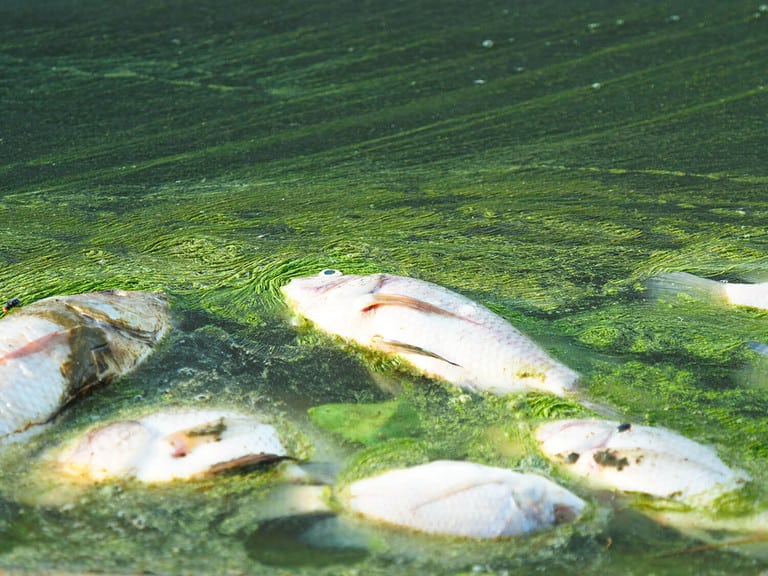
You’ll often find high PFAS concentrations in rivers, especially in industrialized or agricultural areas with heavy runoff.
©ESB Professional/Shutterstock.com
An estimated 14,000 or more PFAS exist. According to the Agency for Toxic Substances and Disease Registry (ATSDR), the most commonly studied PFAS include:
- Perfluorooctane sulfonic acid (PFOS)
- Perfluorooctanoic acid (PFOA)
- Perfluorononanoic acid (PFNA)
- Perfluorohexane sulfonic acid (PFHxS)
Despite these studies, much remains unknown about PFAS, especially newer and unstudied compounds. Scientists are still working to determine the long-term impacts of PFAS on health and the environment, but our current understanding is largely speculative. The full extent of PFAS effects may not be known for decades.
What We Do Know About PFAS
At the same time, the studies that have been conducted are somewhat alarming. A 2021 article published in Environmental Toxicology and Chemistry found that PFAS can cause a wide range of health issues, including:
- Kidney and/or liver disease
- Reduced thyroid and/or immune function
- An increased risk of testicular, kidney, or thyroid cancer
- Potential hormone disruptions
- Adverse reproductive outcomes
There may also be an increased risk of childhood cancers, as many babies are now born with PFAS already present in their blood. In terms of environmental effects, PFAS may harm soil microbial diversity, negatively affect the health or reproductive capabilities of various species, contaminate drinking water, and have far-reaching effects up the food chain as larger predators consume contaminated fish or smaller animals. Stavridis explored this in her Svalbard reindeer research.
Analyzing Contaminants in Arctic Reindeer

Svalbard reindeer are endemic to Svalbard, part of the archipelago’s unique biodiversity.
©Bjørn Christian Tørrissen, CC BY-SA 4.0, via Wikimedia Commons – Original / License
In her paper, Stavridis acknowledges that the Arctic has become increasingly polluted with PFAS, as well as toxic metals such as cadmium (Cd), lead (Pb), and mercury (Hg). Prior research has looked into the effects of these toxic agents on top predators such as polar bears, which often have high levels of pollutants in their bodies that can disrupt their health. However, Stavridis noticed that herbivores like Svalbard reindeer are understudied. As contaminant levels rise, Stavridis aimed to understand the extent of contamination in herbivores, whether contaminant levels in Svalbard reindeer were comparable to those in caribou, and how these contaminants might be harming the animals.
In August 2022 and October 2023, Stavridis and her team collected liver and medial thigh muscle samples from culled female Svalbard reindeer. Most previous studies relied on fecal samples to study chemical accumulation, but organ and muscle samples provided a clearer picture of how contaminants are distributed throughout the body. In addition to the toxic metals, her team evaluated 13 types of PFAS and how those changed during the year.
Chemical Concentration Findings
The research found that contaminant levels in Svalbard reindeer actually varied based on the season. Liver samples from autumn (October) had significantly higher levels of mercury, cadmium, lead, selenium, and PFAS than liver samples taken in the late summer (August). For context, August samples contained 12 nanograms per gram (ng/g) of mercury, while October samples contained 25 ng/g. Interestingly, despite the higher levels, these numbers still represent a decline in toxic chemicals since the 1980s. This is likely due to international emissions regulations and other eco-friendly measures.
Svalbard reindeer are preparing for the winter in October. During this time, reindeer typically have a higher body mass in preparation for the scarcity of food in winter. As a result, they accumulate more toxins in October due to increased food intake. PFAS and metal concentrations may also change depending on the available vegetation.
As Stavridis writes, “Such dietary shifts are relevant for contaminant exposure, as the concentration of contaminants may vary widely among different species of plants.” She also notes that testing showed toxic metal levels in Svalbard reindeer are similar to those of other reindeer subspecies, with Svalbard reindeer having some of the lowest mercury and lead levels.
PFAS Is a Problem
While levels of toxic metals have decreased to some extent, PFAS levels have moved in the opposite direction. A decade ago, PFAS levels in Svalbard reindeer were around 0.6 ng/g. However, samples taken in 2022–2023 showed around 5.48 ng/g, representing a 900% increase. Stavridis also screened Svalbard reindeer genes related to fat metabolism and found that these genes were downregulated (not working as effectively) as PFAS and contaminant levels increased.
Heightened PFAS has implications for Svalbard reindeer and the hunters who depend on these animals for food. Hunters who harvest these reindeer could be consuming highly contaminated food and adding significant amounts of PFAS to their own bodies. Although exposure from eating these reindeer may be lower than from other sources, it could still pose health risks over time.

Svalbard reindeer meat is a delicacy for local residents, often eaten as steaks or in stews.
©giovanni1/Shutterstock.com
For Svalbard reindeer, the long-term effects of PFAS exposure, or the impact of the already high levels in their bodies, on their survival remain uncertain. However, if this does end up affecting reproduction or fat metabolism—both crucial for helping Svalbard reindeer survive harsh winters—there could be significant issues in the future.