
Quick Take
- The spider-tailed horned viper has a tail with a bulb-like tip and elongated scales that closely resembles a spider. Discover the tail's true purpose →
- The snake uses this unusual tail as a lure to attract insect-eating birds before striking from cover. See the figure-of-eight movement →
- This deceptive hunting method is one of the clearest examples of aggressive mimicry in snakes. Explore what sets this viper apart →
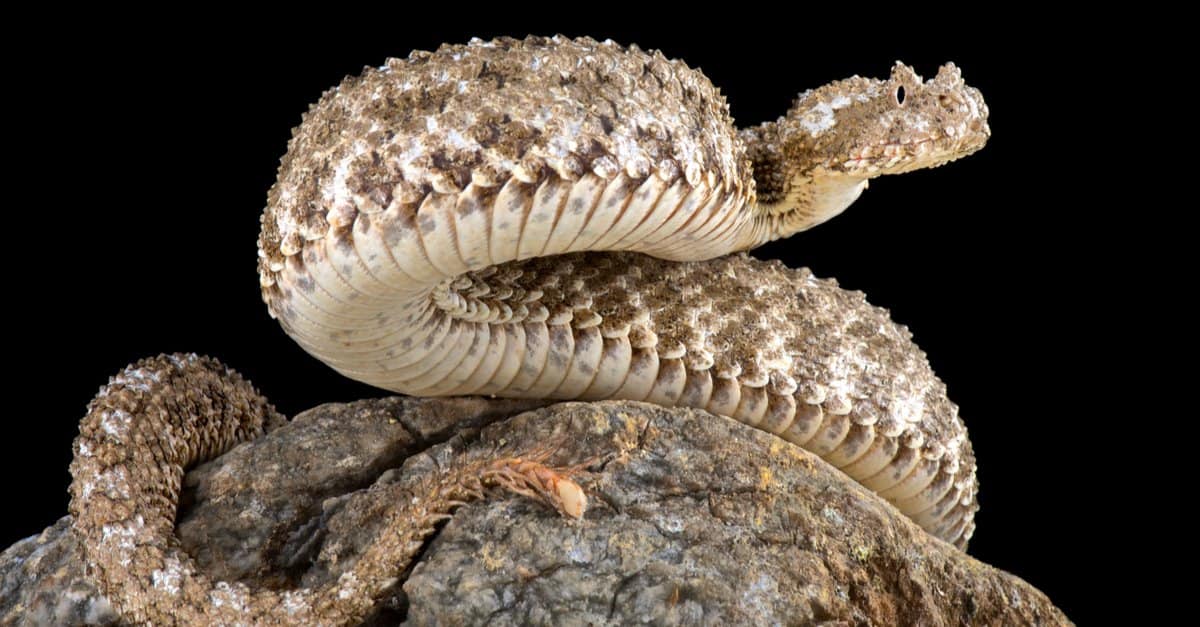
One of the strangest snakes in the world is the spider-tailed horned viper, which has a tail shaped like a spider. These snakes are highly specialized ambush predators and have developed a clever hunting strategy that involves using their tails to attract birds. Keep reading to discover exactly how they do it and what makes it so remarkable!
What Is the Spider-Tailed Horned Viper?
The spider-tailed horned viper (Pseudocerastes urarachnoides) is a venomous snake that is native to parts of western Iran and eastern Iraq. Spider-tailed horned vipers prefer dry, rocky habitats. They typically inhabit the Zagros Mountains, where they can burrow into rocky crevices. However, they are often found lying in the shade of vegetation during the day.
Spider-tailed horned vipers are relatively small snakes, reaching approximately one to two feet long. Their mottled coloration includes shades of dark brown, gray, and tan. This helps them remain camouflaged in their habitat. They also have strongly keeled dorsal scales, which give them a rough appearance. Additionally, they have a distinctive “horned” appearance due to modified, raised scales above their eyes.
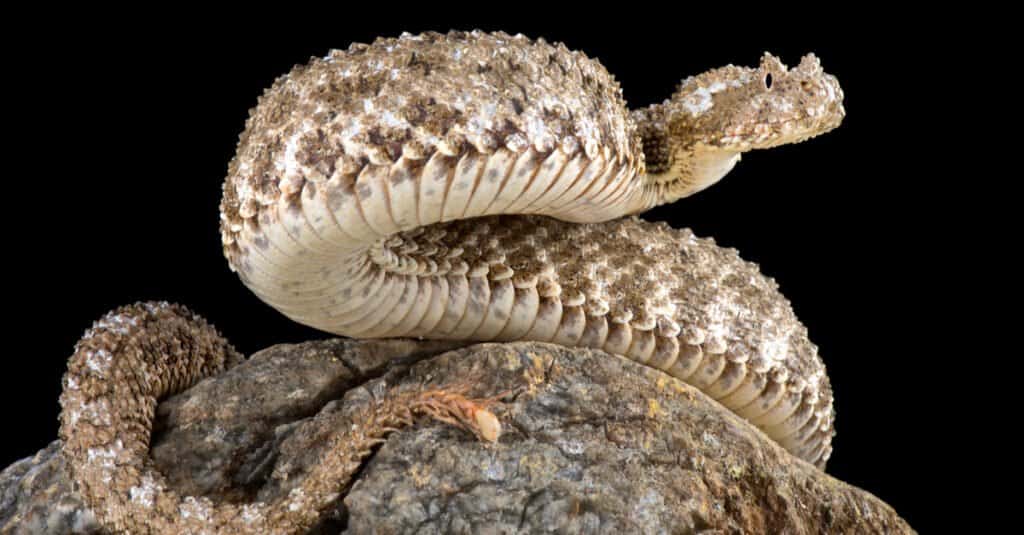
Spider-tailed horned vipers have raised scales above their eyes, giving the appearance of “horns”.
©reptiles4all/Shutterstock.com
Little is known about how often they breed, but they have a decreasing population. They also inhabit a fairly small range, leading to them being classified as Near Threatened in 2022. However, they are also classified as an endangered species by the Iranian government.
What Makes Their Tail So Unusual?
The most unusual thing about spider-tailed horned vipers is their tail. As their name suggests, it has the appearance of a spider. The tip of their tail ends with a bulb-like structure that is surrounded by elongated scales. The bulbous tip resembles the body of a spider, while the elongated scales resemble the legs. However, the tail doesn’t just look like a spider; when the tip is waved, it closely mimics a spider’s movement, especially when dragged along the ground.
The main purpose of this unusual tail is to attract prey. Birds and other animals are drawn to the movement, mistaking it for a real spider. This behavior is a form of aggressive mimicry that is known as “caudal luring”. Interestingly, when this species was first discovered, it was initially assumed that the structure of its tail was due to a deformity.
Why This Hunting Strategy Is So Remarkable
Spider-tailed horned vipers aren’t the only snakes to use their tails to attract prey. Many other species, including juvenile cottonmouths and some adders, use their tail tip itself and vibrate it on the floor so that it appears as though it is something small wriggling on the ground. However, spider-tailed horned vipers are the only species that have elongated scales, which lead to their tails so closely resembling another animal.
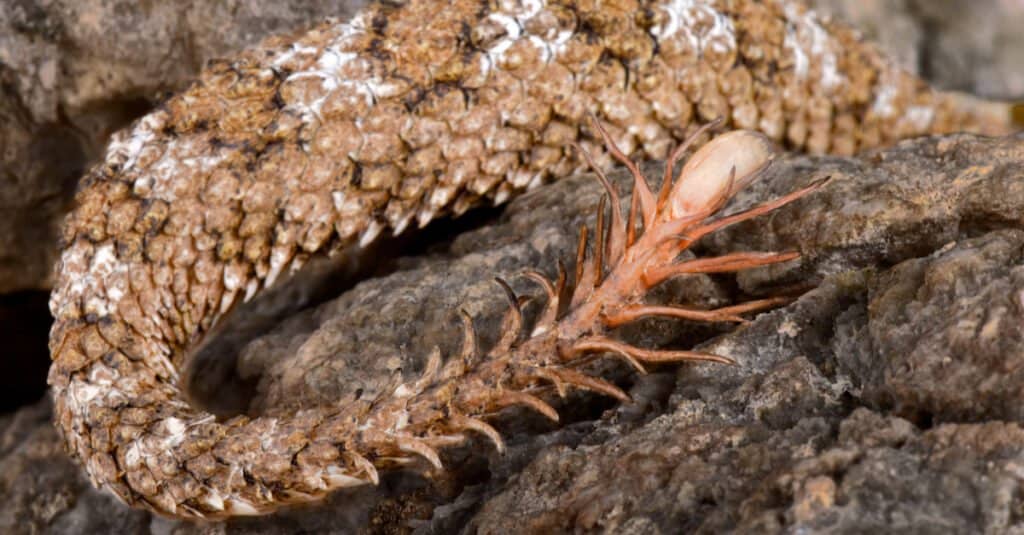
The tail of the spider-tailed horned viper is used to lure unsuspecting birds within reach.
©reptiles4all/Shutterstock.com
Instead of randomly wiggling their tail, these vipers move it in a distinct figure-of-eight pattern, making it look like a spider scuttling along the ground. The rest of their bodies are still and camouflaged with their surroundings as they lie in wait for their prey. When an unsuspecting animal—usually a small insect-eating bird—approaches to catch what it thinks is a spider, the snake strikes and injects a lethal dose of venom. Spider-tailed horned vipers possess cytotoxic venom. This venom type destroys cells and acts as a procoagulant. This causes blood clotting and leads to the prey’s death within seconds of the bite.
Another feature that sets spider-tailed horned vipers apart is their highly specialized diet and hunting method. While other venomous snakes are often opportunistic and prey on a variety of birds and small mammals, the spider-tailed horned viper’s unique tail allows it to deliberately target specific prey, such as insect-eating birds.