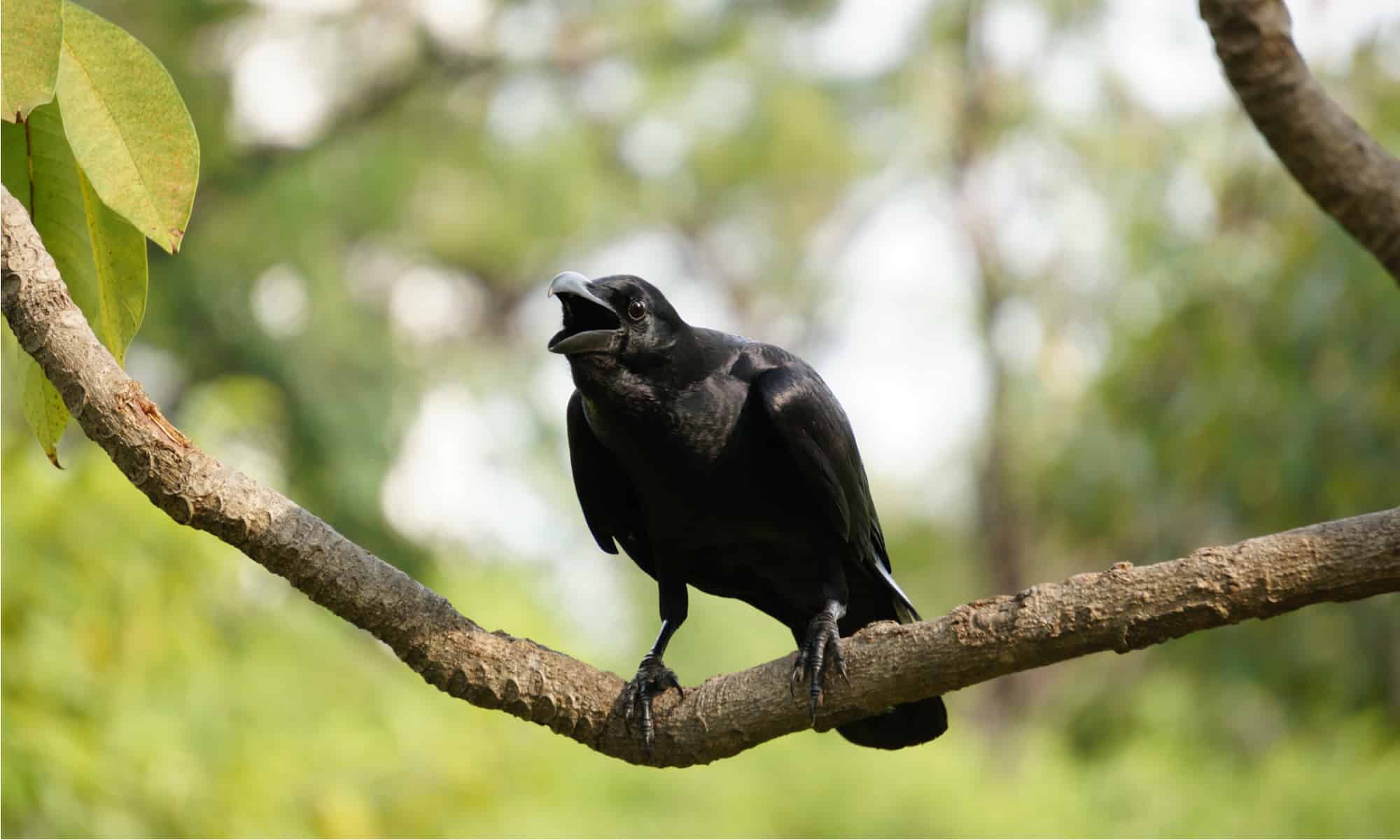

These birds may not have evolved to use tools in the wild, but carrion crows, a member of the crow (Corvid) family, have now shown they’re more than capable of learning how. In a study recently published in Current Biology, scientists demonstrated that these sharp-minded birds can be trained to handle sticks with millimeter accuracy, retrieving food from narrow spaces with a finesse rivaling the world’s most skilled avian tool users.
Which Crows Use Tools?
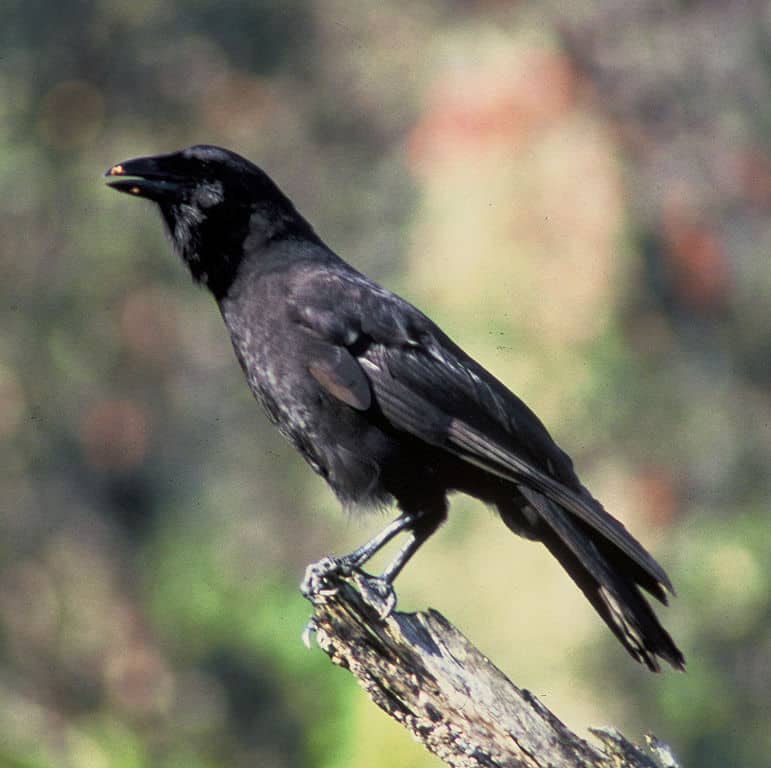
The Hawaiian crow is one of two crow species to use tools.
©U.S. Fish and Wildlife Service / Public Domain / Wikimedia Commons – Original / License
Crows have long fascinated scientists with their problem-solving skills and uncanny intelligence. They can solve puzzles, remember faces, and have a complex social structure. Among them, only two out of the 40 species of crows are known to use tools. Tool use is used by experts as a sign of animal intelligence, and the two crow species that use these tools do not disappoint. The New Caledonian crow (Corvus moneduloides) famously crafts hooks and barbed tools from twigs and leaves to extract grubs from tree bark. The Hawaiian crow (Corvus hawaiiensis)—another island species—uses sticks to probe into holes for insects. Both evolved in isolated island environments, where resource scarcity and low competition encouraged innovative foraging.
“On islands, low predation and competition allow more time for exploration, while resource scarcity and patchiness favor innovative foraging,” explains Dr. Andreas Nieder of the University of Tübingen. “Accessing concealed prey, like larvae in wood or crevices, provides a strong selective advantage for individuals able to use tools effectively.”
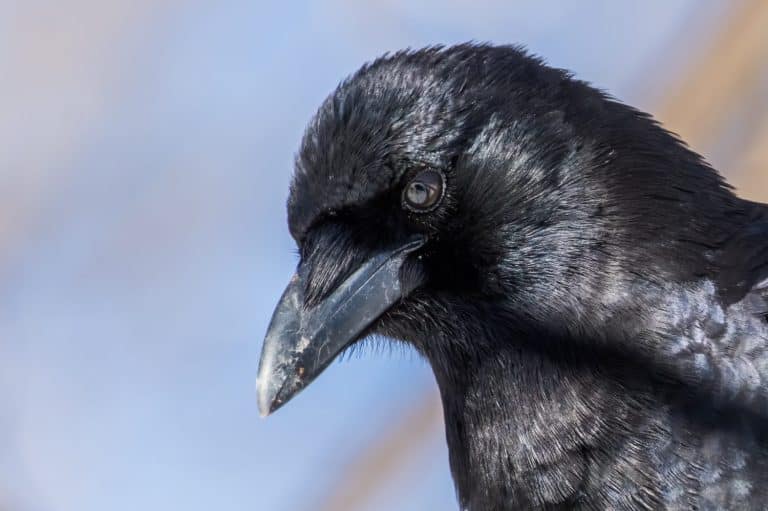
By contrast, the carrion crow (Corvus corone), found across Europe and Asia, has had little reason to develop such behavior. Its adaptable diet—ranging from insects to human scraps—offers easy rewards without the need for tools. Living in bustling cities and open farmlands, carrion crows thrive on ingenuity and memory, but not on tool manipulation.
Crows don’t need to be born tool users to think and act like one. Their brains are already equipped with the cognitive and motor machinery to master complex, feedback-driven behaviors when given the right conditions.
Andreas Nieder, neurophysiologist at the University of Tübingen
Teaching Tool Use
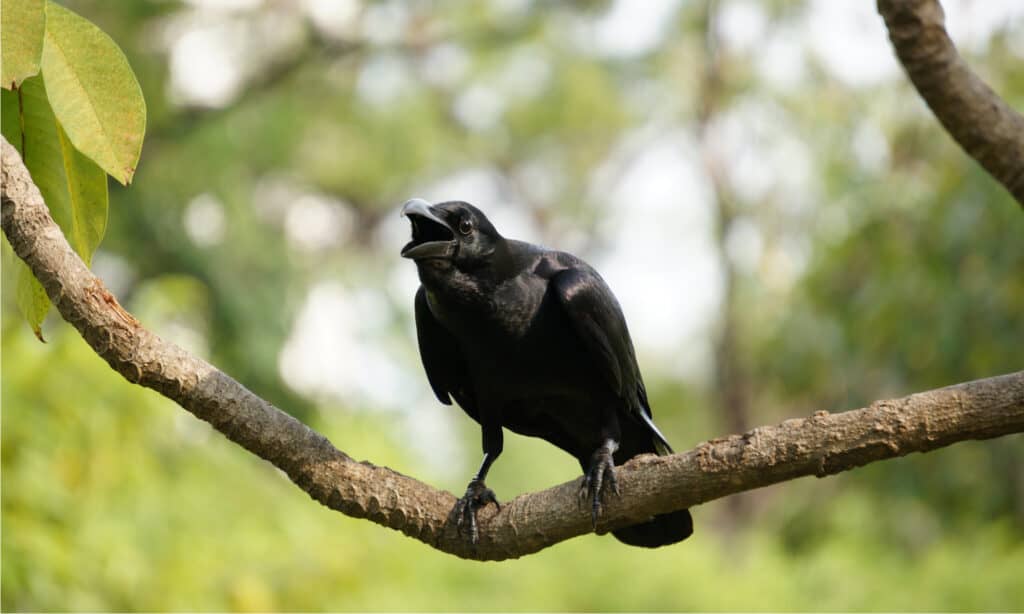
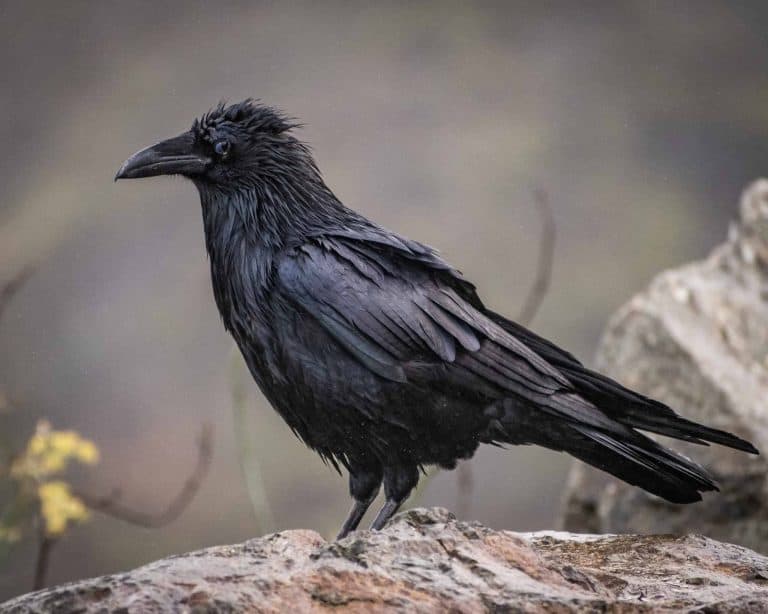
A carrion crow perches on a branch.
©Tomorrow36/Shutterstock.com
Nieder and his colleagues set out to test whether carrion crows could learn precise tool use under controlled conditions, showing that the behavior could be teachable and flexible.
The birds were given a 13-centimeter wooden stick and a transparent Plexiglas box containing food pellets placed in different positions. To succeed, the crows had to use the stick to push or pull the food through narrow openings. Over time, they refined their movements until they could guide the stick with almost surgical accuracy.
“Carrion crows, despite not being natural tool users, can learn to handle tools with remarkable precision, flexibility, and problem-solving skill—matching in many ways the performance of species that evolved to use tools,” Nieder tells A-Z Animals.
He explained that while the crows didn’t modify their tools—since no suitable materials were provided—they did generalize their new skills. “Once they became more proficient at retrieving pellets from the left or right corners, they transferred this proficiency to the middle positions as well,” Nieder says. “As a result, they lost fewer pellets and became faster—even for positions they had not been trained on.”
This ability to transfer learning to new situations—a sign of cognitive flexibility—suggests that carrion crows possess the same mental capabilities as natural tool users. What they lack are the ecological pressures to use these abilities in the wild.
Tool Use: A Debate of Nature Vs. Nurture
Nieder’s and his team’s findings challenge the idea that tool use may require millions of years of evolutionary fine-tuning. Instead, they point to something more universal: the ability of intelligent animals to adapt and innovate when faced with new challenges.
“Crows don’t need to be born tool users to think and act like one,” says Nieder. “Their brains are already equipped with the cognitive and motor machinery to master complex, feedback-driven behaviors when given the right conditions.”
In other words, evolution may have built the brainpower, and experience can awaken it. This echoes what’s seen in primates and even humans: that the line between instinct and learning is thinner than it seems.
A Toolmaker in Waiting
This new study of carrion crows is more than a story about clever birds; it’s a window into the nature of intelligence itself. Tool use, once seen as the pinnacle of cognitive evolution, may instead be an expression of curiosity, learning, and opportunity.
From the forests of New Caledonia to the rooftops of European cities, crows continue to surprise us. As Nieder’s work shows, even species that don’t naturally make tools have the potential to learn tool use, proving that evolution has already equipped these black-feathered thinkers with everything they need. They just haven’t needed to use it. Yet.