
Quick Take
- Ravens are among the smartest birds, showing problem-solving, future planning, and tool use across wild and lab contexts.
- They can learn game-like patterns and may apply rule-based strategies, suggesting a raven could learn tic-tac-toe.
- Ravens display complex social cognition and emotions, including memory for relationships, deception, cooperation, and empathy.
Ravens are incredibly smart birds. Watching a recent Instagram reel, you might be surprised at just how well this particular raven is killing it at tic-tac-toe. While no raven in the wild is scratching X’s and O’s into tree bark, the phenomenon of ravens being able to play games is real. Ravens, and their close relatives in the corvid family, have repeatedly stunned scientists with abilities that mirror those of primates and young children. These birds solve puzzles, plan for the future, understand cause and effect, and even use tools to complete multi-step tasks.
So what would it take for a raven to “play tic-tac-toe”? And just how smart are they, really? Let’s take a closer look at what science reveals.
Why Tic-Tac-Toe Isn’t Such a Stretch
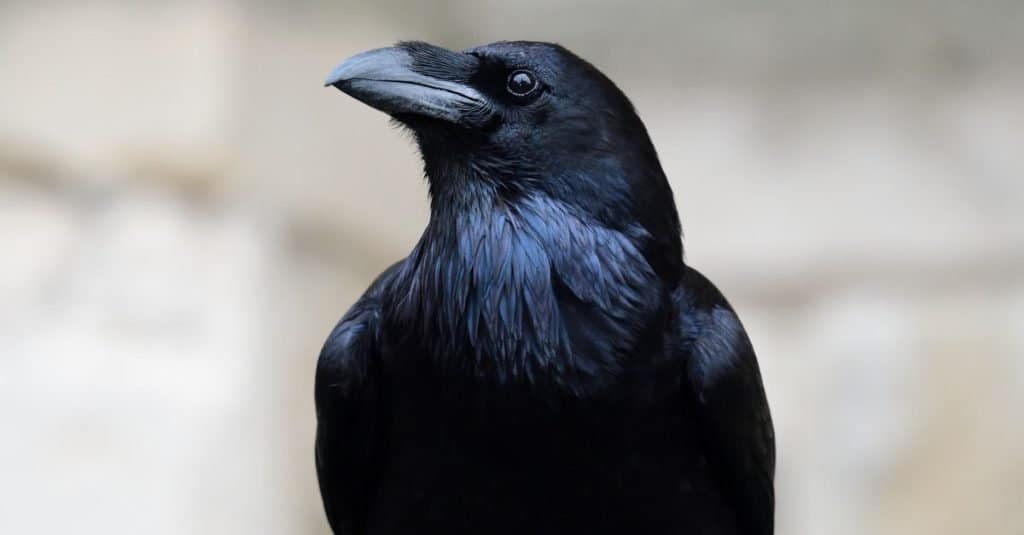
Ravens aren’t just smart. Ravens are intellectually sophisticated, emotionally complex, and creative.
©iStock.com/Tom Meaker
It seems that a raven playing a game like tic-tac-toe is far-fetched, but it’s not as unlikely as it appears. In fact, the cognitive foundations necessary for such a game are already present in the natural behaviors of these birds.
Tic-tac-toe, the game, while seemingly simple, depends on several cognitive skills:
- Recognizing Patterns – Players must identify winning combinations and the patterns that emerge on the board.
- Understanding Turn-Taking – Success in the game requires awareness of whose turn it is and adapting to that rhythm.
- Remembering Previous Actions – Keeping track of past moves is essential to forming effective strategies.
- Adjusting Strategy When New Information Appears – Players must adapt their tactics based on the evolving state of the game.
Ravens exhibit all of these capabilities both in the wild and in laboratory settings. As members of the corvid family, they have proven themselves exceptionally adept at tasks once thought to require primate-level reasoning.
In controlled experiments, ravens have demonstrated remarkable abilities:
- They can solve sequential puzzles that require completing one step before progressing to the next.
- They exhibit tool use, not just by improvising tools but also by selecting the appropriate one in advance for specific tasks.
- Ravens show significant object permanence, comparable to that of great apes, indicating a deep understanding of their environment.
- They can practice delayed gratification, waiting for extended periods for a more significant reward.
- They engage in strategic social behaviors, such as caching food in hidden locations and actively monitoring their surroundings to avoid competitors, even employing deception when necessary.
Given this impressive toolkit of skills, a raven could feasibly grasp the structure of a simple rule-based game like tic-tac-toe. The game’s reliance on patterns, turn-taking, and predictable outcomes aligns well with the cognitive abilities they already display. While they might not interpret symbols like “X” or “O” in the same way humans do, they could easily learn that one mark signifies “mine” while another represents “yours.”
In essence, a raven wouldn’t need a human-like concept of “winning” to play. It would only need to recognize that certain configurations of moves yield more favorable outcomes, a form of reasoning that corvids apply in their everyday lives.
The Remarkable Intelligence of Ravens

Among birds, the smartest groups are parrots and corvids (ravens, crows, jays, magpies).
©J.Copenheaver Photography/Shutterstock.com
Ravens and their corvid relatives are among the most exceptional problem solvers in the animal kingdom. From using tools to planning for the future, these birds display a remarkable array of skills that challenge our understanding of animal cognition.
Problem Solving and Tool Use
Corvids have earned a reputation for their advanced problem-solving capabilities. They exhibit a variety of behaviors that demonstrate their intelligence:
- Using Tools to Access Food – Ravens have been observed using sticks, stones, and other objects to extract food from hard-to-reach places, showcasing their understanding of tool functionality.
- Modifying Tools into Better Shapes – In some instances, these birds can alter the shape of a tool to make it more effective for a specific task, indicating not only creativity but also an understanding of the tool’s purpose.
- Understanding Water Displacement – In a version of the well-known “Aesop’s fable” test, ravens have proven they comprehend the concept of water displacement, manipulating objects in a way that allows them to access rewards.
One of the most telling examples of their cognitive skills involves tests where ravens use a string to pull a reward. This task requires not just physical ability, but also a sequence of actions: they must hold the string with their foot while pulling with their beak. This is a clear indicator of deliberate planning and multi-step reasoning. This is far from a simple trial and error; it reflects a strategic mentality.
Planning for the Future
Ravens display a level of foresight that sets them apart from many other animals, such as dogs and monkeys. Their abilities in this realm include:
- Storing Tools for Future Use – Unlike many creatures that focus on immediate rewards, ravens will store tools they do not need at the moment, understanding that they will require these tools later. This behavior reflects a sophisticated understanding of future needs.
- Engaging in Bartering – Ravens have been observed trading objects with humans or with one another, mirroring human economic practices of bartering. This interaction suggests a complex social structure and the ability to anticipate others’ needs.
- Choosing Tools Based on Future Scenarios– They select tools not merely based on immediate temptation but based on the anticipated requirements of future tasks. This ability indicates a level of cognitive planning that is quite advanced.
These skills place ravens alongside great apes and very young children in terms of mental sophistication, demonstrating that their intelligence is not only functional but also deeply strategic. Their cognitive abilities challenge assumptions about the limits of animal intelligence and invite us to rethink our understanding of problem-solving in the animal kingdom.
Are Ravens Strategy-Minded?
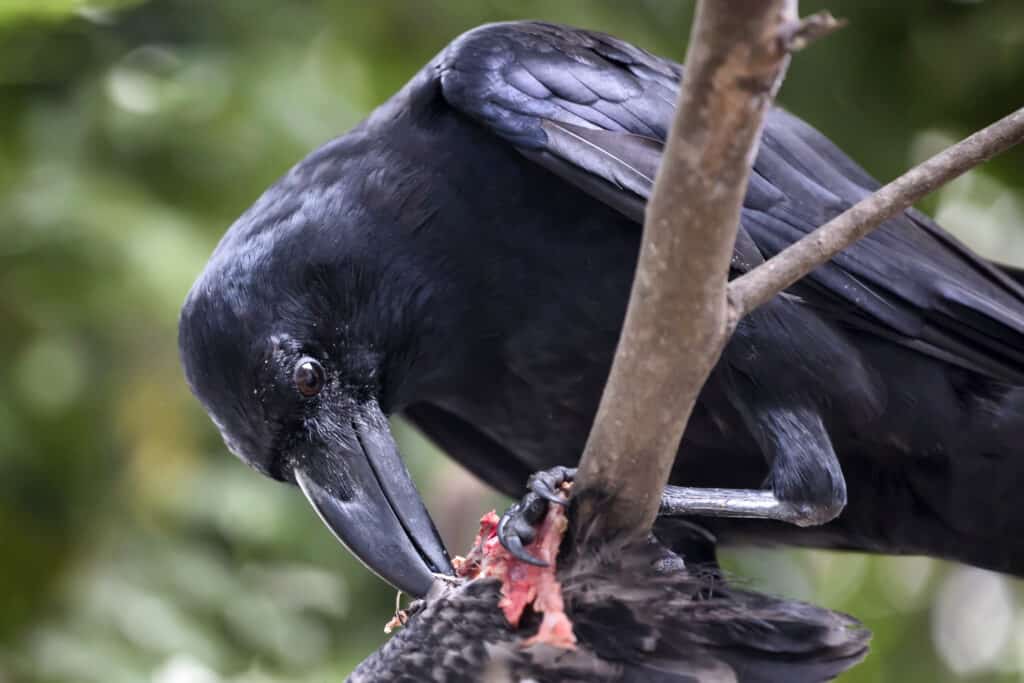
Researchers study ravens to understand the evolution of intelligence, given their strategic thinking skills.
©Raven eating carrion/Shutterstock.com
Ravens are renowned not just for their intelligence but for their sophisticated strategic thinking, which surfaces in various contexts, particularly in social interactions and the management of food resources.
Food Cache Management
Selective Hiding – Ravens are known to create food caches, strategically concealing food to ensure it remains undiscovered by competitors. They meticulously choose locations for these caches based on the presence or absence of potential thieves, demonstrating a keen awareness of their surroundings.
Deceptive Behavior – When under observation, ravens engage in a behavior known as “fake hiding.” They may pretend to cache food in one spot while secretly retaining it for themselves. This act requires not only foresight but also the ability to understand the perspective and intentions of others—an advanced cognitive skill.
Social Dynamics and Relationship Management
Memory and Recall – Ravens demonstrate an uncanny ability to remember individual relationships within their social structures. They keep tabs on whom they can trust or betray, recalling those who have helped them in the past and those who have wronged them. This memory informs their future interactions and alliances.
Revenge and Reciprocity –Their strategic thinking extends to concepts of revenge and reciprocity. For instance, a raven may remember specific individuals who have acted against it and display behaviors that signify aggression or social ostracism toward those individuals later. This ability strengthens social bonds and ensures cooperation among allies.
Cooperation and Collaboration
Synchronized Tasks – Ravens exhibit remarkable cooperation skills, especially in tasks that require synchronized actions, such as hunting or solving complex problems. They can communicate effectively with one another to achieve a shared goal, showcasing their ability to work as a team rather than as isolated individuals.
Contextual Flexibility
Adaptable Strategies – Unlike rigid instinctual behaviors, the tactics employed by ravens are highly flexible and context-dependent. They adapt their strategies based on the specific social dynamics and environmental conditions they encounter. This adaptability is crucial for survival in fluctuating habitats.
Cognitive Complexity
Problem-Solving Skills – Ravens engaging in problem-solving activities, like puzzle-solving or even playing games like tic-tac-toe, illustrate their cognitive complexity. They approach such challenges with the same strategic mindset they apply to food competition. They assess the situation, anticipate opponents’ moves, and adjust their strategies accordingly to maximize potential rewards.
The strategic thinking of ravens embodies a blend of advanced cognitive abilities, social intelligence, and adaptability. Their behaviors reflect a deep understanding of their environment and the interactions within it, making them one of the most intelligent avian species. Whether managing food resources, navigating complex social relationships, or solving intricate problems, ravens consistently display an impressive level of strategic foresight that underscores their status as profound thinkers in the animal kingdom.
Do Ravens Have Feelings?
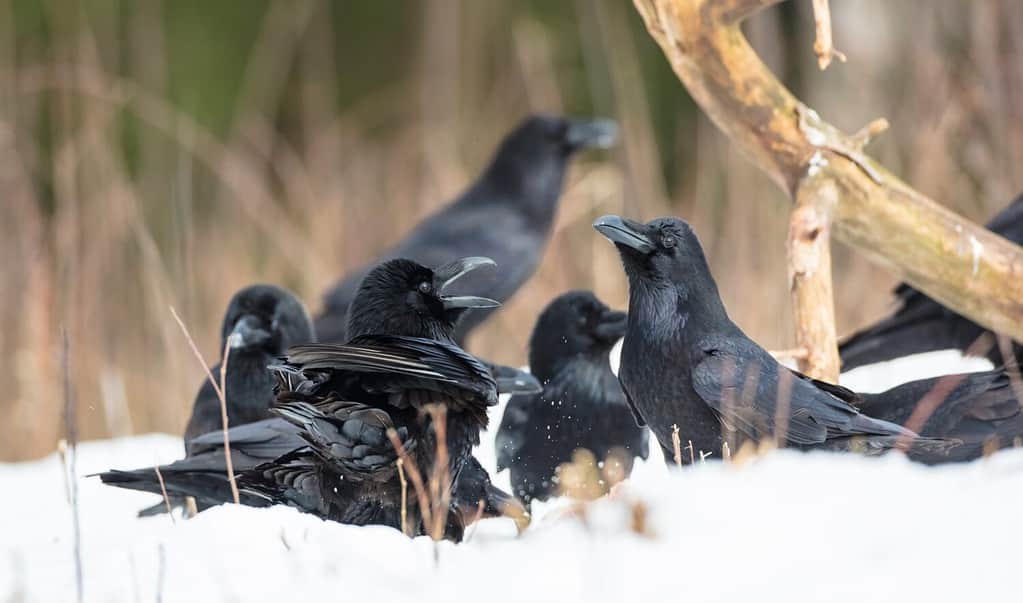
Ravens have remarkable memories and show signs of abstract thought and empathy.
©Simonas Minkevicius/Shutterstock.com
Scientists increasingly recognize that ravens and their close relatives, crows, possess emotional lives far more complex than previously imagined. When researchers describe these birds as having a “sophisticated emotional world,” they’re pointing to a constellation of behaviors, play, empathy, frustration, cooperation, and even mourning, that together suggest these birds don’t just react to the world, but experience it in layered and meaningful ways.
This sophistication comes from several intertwined aspects of their cognition and social structure. Ravens and crows are highly intelligent, capable of planning ahead, solving multi-step problems, and remembering the past in ways that rival some primates. Their emotional capacities seem to evolve alongside this intelligence. For example, their ability to anticipate how another bird might react, or to adjust their own behavior based on subtle social cues, reveals an internal emotional landscape that supports such advanced thinking.
Ravens live deeply social lives, and living in tight-knit groups likely amplifies these emotional capacities. Social animals tend to benefit from empathy, cooperation, and emotional communication, traits that strengthen bonds and improve group survival. Ravens and crows demonstrate exactly this: they soften their behavior when a companion is distressed, share food with partners, play cooperatively, and sometimes engage in consoling gestures that appear to soothe others. These are not random acts; they reflect an ability to perceive emotional states in others and respond in ways that reinforce social cohesion.
What’s especially striking is that many of these behaviors have parallels in mammals known for their social intelligence, like elephants, dolphins, and great apes. This suggests that emotional sophistication may arise through different evolutionary paths whenever species face similar social pressures. In ravens and crows, emotions aren’t simply instinctive reactions; they guide decisions, strengthen partnerships, shape group dynamics, and help individuals navigate a complex social world.
As scientists continue to study these birds, the evidence consistently points toward a richer, more nuanced internal life than we once believed possible in avian species. This doesn’t mean their emotions are identical to human ones, but it does mean that ravens and crows experience their world with a depth of feeling, awareness, and social sensitivity that reflects a truly sophisticated emotional framework.
Are Ravens Smarter Than the Average Bird?
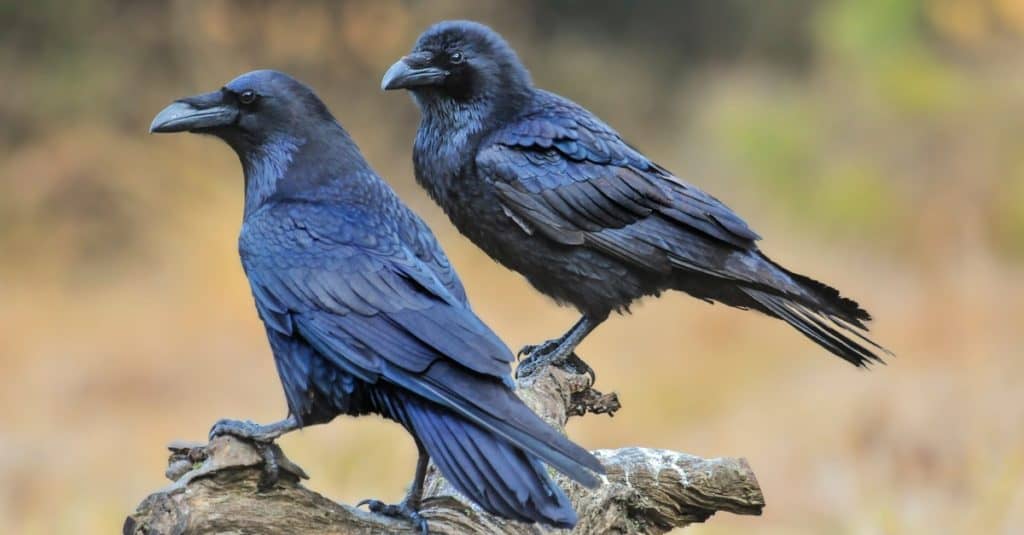
Ravens are adept at complex problem-solving and are more intelligent than most other birds.
©Krasula/Shutterstock.com
Corvids and parrots are considered the two smartest bird groups, and ravens sit near the top. Compared to an “average” bird (a sparrow, pigeon, or finch), ravens outperform in almost every domain.
Cognitive skills vary significantly between ravens and average birds. Ravens exhibit advanced, multi-step tool use, which is rare or absent in most other bird species. Their future planning abilities are strong, in contrast to the minimal capabilities seen in average birds. Social intelligence in ravens is highly complex, while average birds tend to have simpler social interactions. In terms of problem-solving, ravens are exceptional, whereas average birds demonstrate basic problem-solving skills. Ravens possess excellent memory, particularly in spatial contexts, while average birds have moderate memory capabilities. Lastly, ravens are capable of vocal learning and mimicry, unlike average birds, which typically communicate only through species-specific calls.
So…Could a Raven Beat You at Tic-Tac-Toe?

Ravens could easily outsmart you in a game of tic-tac-toe.
©Ummi Hassian/Shutterstock.com
Tic-tac-toe is, at its core, a solved game, simple, structured, and limited to a small number of possible board states. That makes it exactly the kind of task a raven’s cognitive toolkit is well-suited for. With enough exposure, pattern discrimination, and a clear system of rewards, a raven could reasonably learn the core heuristics humans use, like “take the center first” or “block the opponent when they line up two.” These are the same types of rule-based strategies ravens already apply when solving puzzle boxes, navigating social hierarchies, or caching food where rivals are less likely to steal it.
Could a raven consistently beat a human? Possibly. If the human is playing casually, the raven’s sharp pattern memory and quick decision-making could give it an edge. Against an expert who knows how to force a draw? Maybe not, but the raven would still be able to hold its own. What’s fascinating is that ravens don’t just follow rules; they adapt them. They notice sequences, adjust behaviors based on feedback, and rethink approaches when something isn’t working. That flexibility is what would make them formidable game partners.
Would a raven enjoy the game? Almost certainly. Ravens are driven by curiosity and novelty, and they delight in challenges that let them explore cause and effect. Play isn’t just a pastime for them, it’s part of how they learn about the world. A game that involves interaction, predictable reactions, and the chance for a “win” (especially if a treat is involved) would likely be genuinely stimulating.
The Mind of a Raven Is More Intelligent Than We Expected
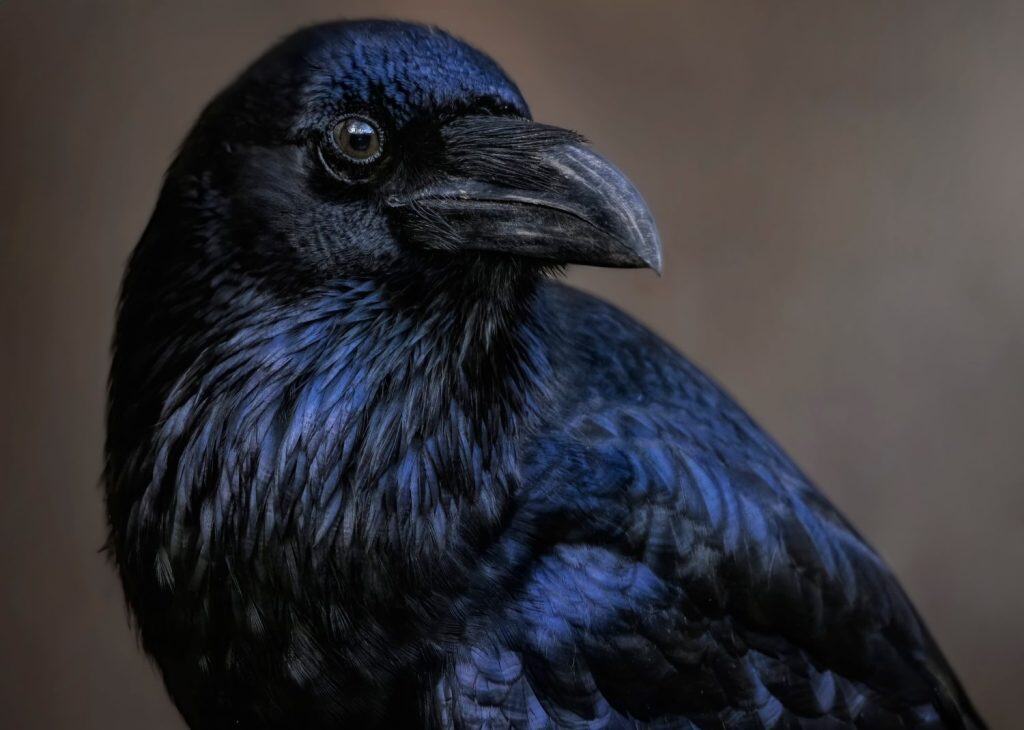
In addition to their complex intelligence, ravens are also known for being playful and mischievous.
©ambquinn/Shutterstock.com
Ravens remind us that intelligence isn’t a human invention; it’s a natural phenomenon that evolves wherever curiosity, complexity, and social living intersect. When we look closely at these birds, we see a form of cognition that challenges long-held assumptions about what it means to think, to plan, or even to feel. Their ability to strategize, empathize, improvise tools, remember intricate social histories, and delight in play reveals a mind far richer than most people expect from a creature with feathers and wings.
A raven playing tic-tac-toe is more than a charming image. It’s a window into the possibilities of nonhuman intelligence. It forces us to expand our understanding of what other species are capable of, and to appreciate that the world is full of minds very different from our own, yet no less extraordinary.
Ravens do not simply survive; they interpret, evaluate, anticipate, and engage. They puzzle over problems, form emotional bonds, and interact with their environment in ways that blur the line between instinct and thought. In their quiet cleverness, their playful mischief, and their startling strategic depth, they offer us a reminder: brilliance isn’t limited to primates. Sometimes, it’s perched on a branch, watching us right back.
And perhaps that’s what makes the idea of a raven beating us at tic-tac-toe so compelling. It speaks to a deeper truth that intelligence comes in many forms.