
Quick Take
- Kanzi, a bonobo, demonstrated symbolic pretend play by correctly tracking the location of imaginary juice in controlled experiments, showing cognitive abilities previously thought to be unique to humans.
- Follow-up tests confirmed Kanzi could distinguish real rewards from pretend ones, indicating an understanding of make-believe scenarios.
- These findings suggest that the cognitive roots of imagination may extend back 6–9 million years to a shared ancestor of humans and bonobos.
For a long time, imagination was considered a human endeavor. When we’re children, we invent invisible friends and turn sticks into swords. As adults spend millions of dollars making movies that are entirely made up in the imaginations of the filmmakers. Scientists once believed that kind of make-believe required a uniquely human mind. But a remarkable bonobo named Kanzi has helped turn that idea on its head. You see, Kanzi seems to be engaging in symbolic, pretend play. And not just simple play. We’re talking about behavior that looks like a whole lot of imagination.
Kanzi’s playful antics suggest that the roots of imagination may stretch back millions of years, long before the first human ever uttered the words “once upon a time” and “happily ever after.”
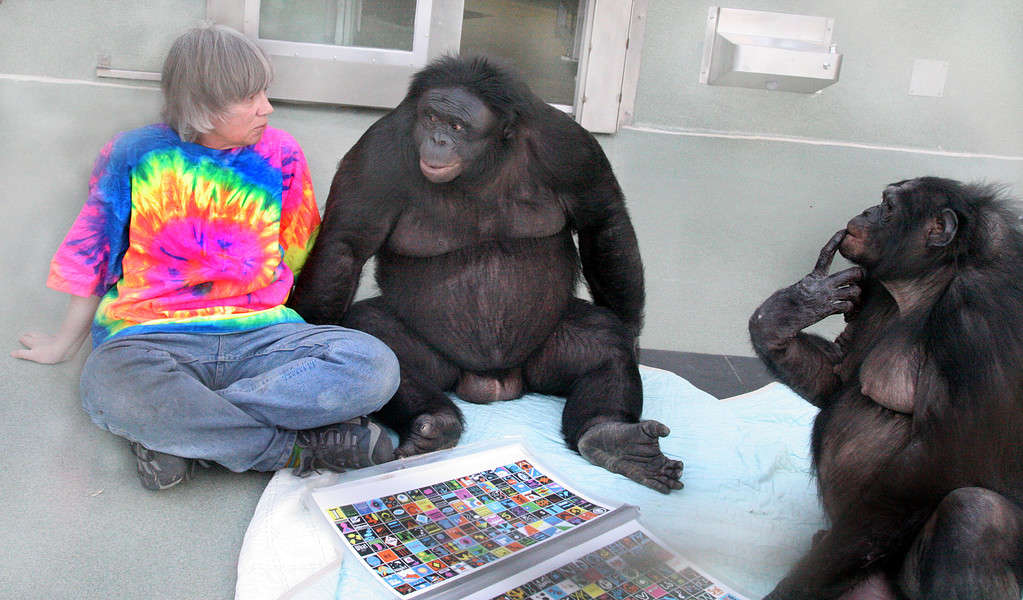
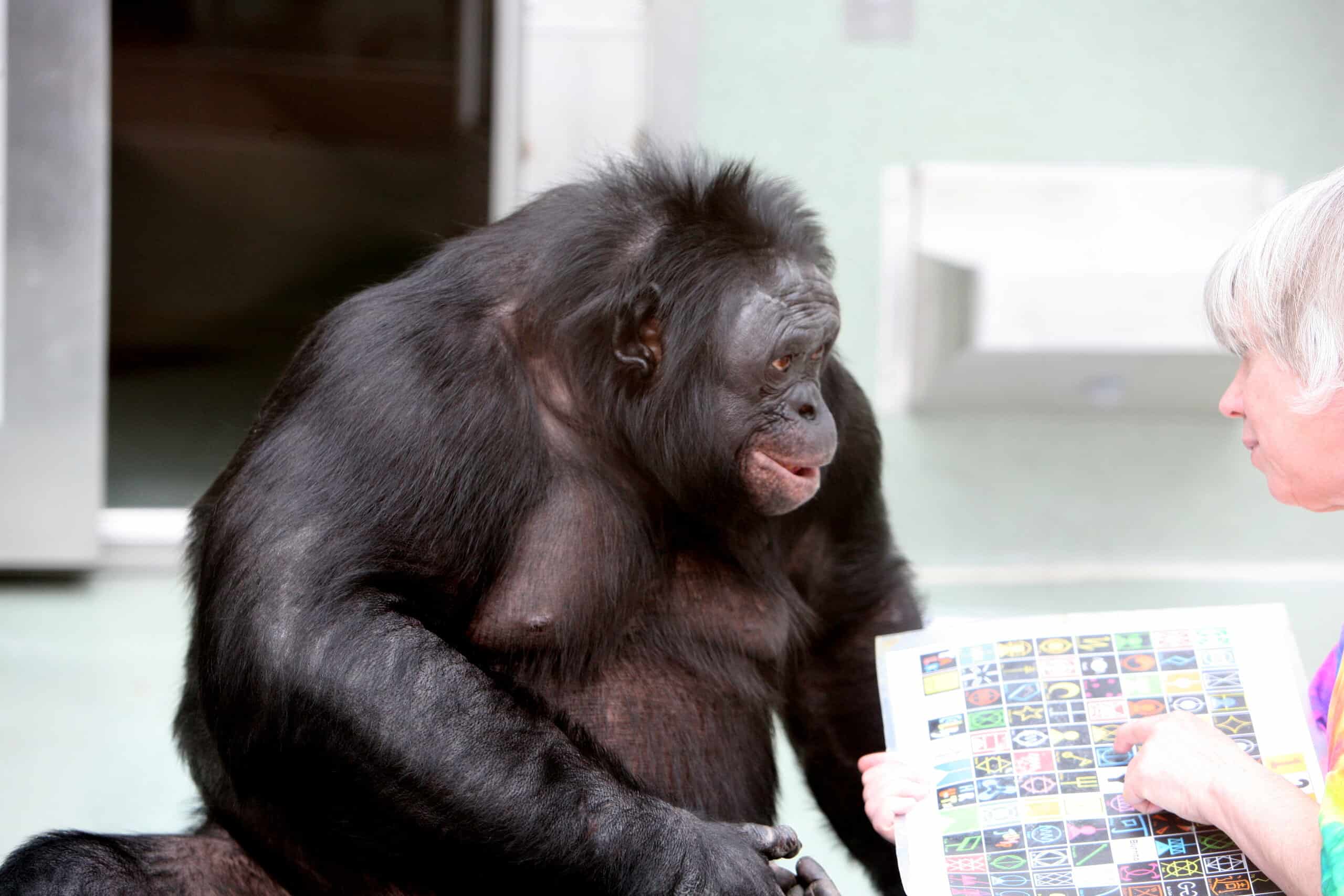
Kanzi could communicate using a lexigram keyboard, understanding spoken English and responding with complex symbol combinations, showcasing advanced language comprehension in a non-human primate.
Meet Kanzi: The Bonobo Who Changed the Conversation
Kanzi is a bonobo, a close relative of chimpanzees and an even closer relative of us. Bonobos and humans share a common ancestor that lived roughly 6 to 9 million years ago. For decades, researchers have studied great apes to understand the building blocks of human intelligence.
But Kanzi stands out. Raised in a language-rich environment by primatologist Sue Savage-Rumbaugh and her colleagues, Kanzi learned to communicate using a keyboard of visual symbols called lexigrams. He could understand spoken English at an impressive level and respond appropriately. Over time, he demonstrated the ability to follow complex instructions, combine symbols meaningfully, and even show signs of planning.
Amazing as that is, language comprehension alone doesn’t prove imagination. What caught scientists’ attention was something more subtle and more human-like.
Kanzi started to pretend. In one series of experiments, Kanzi participated in structured make-believe tests. During an early interaction, he even used his lexigram board to ask two researchers to chase each other. Although the researchers only pretended to chase, Kanzi appeared to enjoy watching the exchange.
In the first formal test, Kanzi sat at a table with two glasses. An experimenter pretended to pour “juice” into both cups from a clear but empty jug. The experimenter then pretended to pour the nonexistent contents of one cup back into the jug and asked Kanzi which cup still held the “juice.” Kanzi selected the correct cup 68 percent of the time, significantly above chance.
Symbolic play, also called pretend play, happens when an individual uses one object to represent another. A banana becomes a telephone. A cardboard box becomes a spaceship. For years, many researchers argued that this kind of mental flexibility requires advanced symbolic thought found only in humans.
Kanzi’s behavior challenges that assumption. According to researchers, his responses in the pretend juice task weren’t random. He appeared to track the location of something that wasn’t physically there, following the internal logic of the pretend scenario.
In other words, he was participating in a shared make-believe situation. In follow-up tests, the researchers made sure Kanzi wasn’t simply confused. In one experiment, he was presented with two cups: one containing real orange juice and another empty cup that had been filled with pretend juice.
When asked which cup he wanted, Kanzi chose the real juice nearly 80 percent of the time. A third test that mimicked the first but used pretend grapes instead of juice again suggested that Kanzi understood where pretend food was located within the game. That suggests he wasn’t just guessing. He appeared to understand when something was real and when it was part of a pretend scenario.
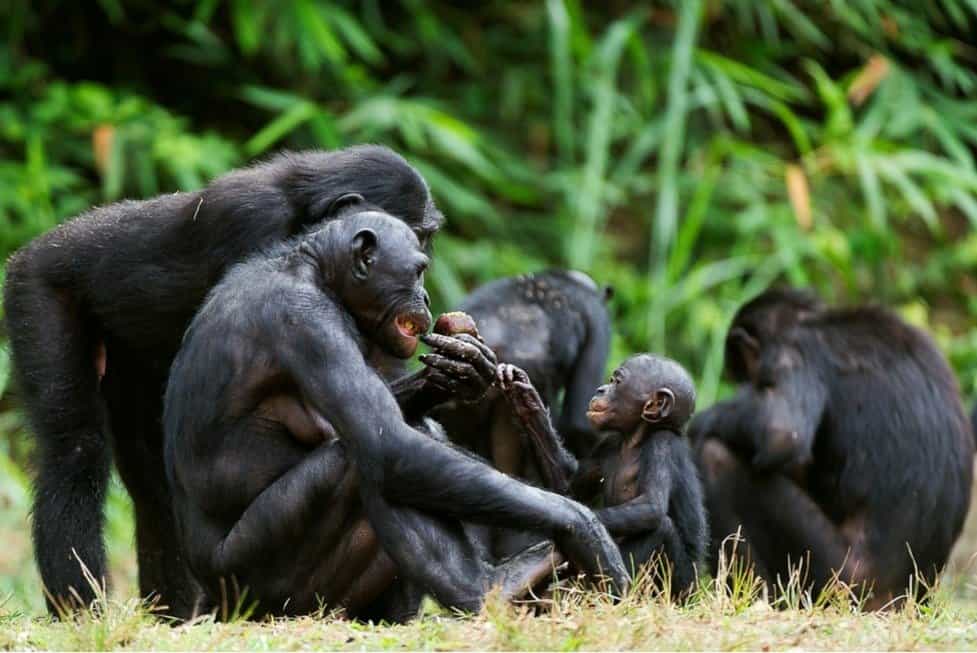
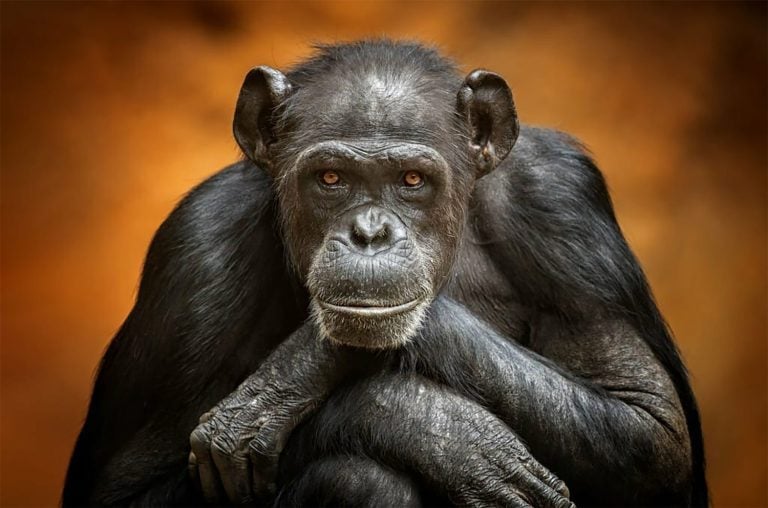
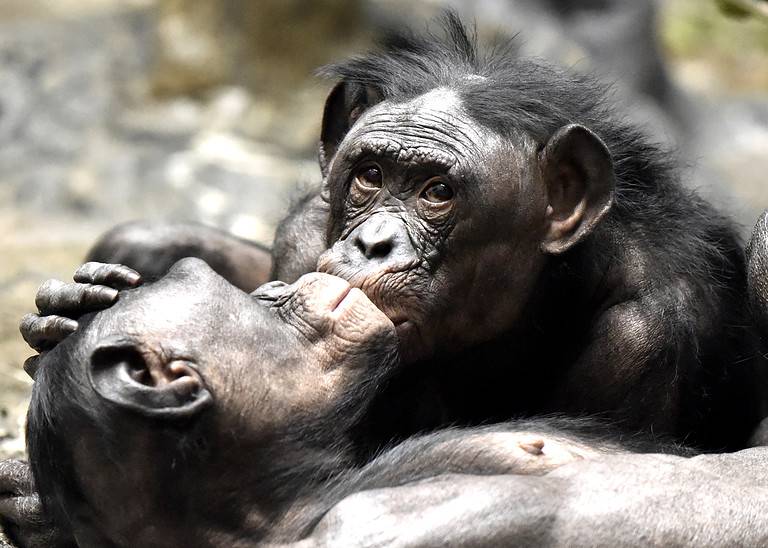
Bonobos and humans share a common ancestor from 6–9 million years ago, suggesting that the roots of imagination may extend deep into our evolutionary history.
©Sergey Uryadnikov/Shutterstock.com
Symbolic Play
Pretending that invisible juice has been poured from one cup to another might not seem particularly groundbreaking, but from a scientific perspective, it’s huge.
Symbolic play suggests that the mind can hold two ideas at once. The cup is empty. But within the rules of the game, it also contains juice. That mental layering requires abstraction—the ability to step beyond what’s physically present and imagine alternatives. Repeat: imagine alternatives.
This capacity is deeply tied to language, culture, and storytelling in humans. It allows us to invent myths, plan for the future, and empathize with others. When a child pretends to feed a doll, they’re practicing caregiving. When they pretend to be a firefighter, they’re experimenting with roles and social rules.
If bonobos can engage in this kind of play, it means the cognitive roots of imagination didn’t suddenly appear in modern humans. They were likely present, at least in basic form, in our shared ancestors.
That being the case, it pushes the origins of complex mental life back millions of years. You may be asking yourself what the big deal is. After all, apes play with objects all the time. They toss things, stack things, and carry things around.
But there’s a huge distinction between simple object play and symbolic play. Simple object play is exploratory. An ape might bang a rock on the ground or wave a branch around just to see what happens. Symbolic play, however, involves assigning meaning.
The Evolutionary Implications
Bonobos and chimpanzees split from the human lineage between about 6 and 9 million years ago. If bonobos today can engage in symbolic play, it’s reasonable to consider that the last common ancestor of humans and bonobos might have had similar cognitive abilities.
That ancestor wasn’t human. It didn’t write poetry or compose symphonies. But it may have possessed the mental flexibility to imagine something beyond the immediate present. For us humans, who probably take imagination for granted, that may not seem like a very big deal. But from an evolutionary standpoint, it’s a very big deal.
For years, many scientists believed that symbolic thinking emerged relatively late in human evolution, perhaps with Homo sapiens or slightly earlier species. It was often linked to cave art, ritual burials, and complex tools.
But if great apes show glimmers of symbolic play, the timeline changes. Instead of imagination being a sudden evolutionary leap, it may have been a gradual development built on older cognitive foundations.
In other words, imagination might not be uniquely human; it might be uniquely refined in humans.
What This Means and Doesn’t Mean
Kanzi lived at the Ape Initiative in Iowa, where researchers continue to study great ape cognition. Their goal isn’t to prove that apes are just like us. They aren’t. Humans have taken symbolic thought to extraordinary heights. But studies like this show that ape minds are far more complex than once believed.
Bonobos already surprise scientists in other ways. They’re known for their cooperative social behavior, strong emotional bonds, and sophisticated communication. They can understand spoken language to a degree that rivals some young children. They use gestures intentionally. They can solve problems and show signs of empathy.
Adding symbolic play to that list paints a richer picture of their mental world. But at the same time, it’s important not to overstate the findings. Kanzi wasn’t writing novels in his head. His pretend play, while compelling, is still quite limited compared to human imagination.
Human children develop increasingly complex layers of make-believe. They invent entire worlds, maintain consistent characters, and follow narrative arcs. That level of structured imagination appears uniquely human.
But the presence of even basic symbolic play in bonobos suggests that the cognitive scaffolding for imagination was already in place long before humans appeared.
Think of it like a foundation. Our ancestors may have had the raw materials. Over millions of years, evolution built on those materials, eventually producing the rich imaginative lives we experience today.
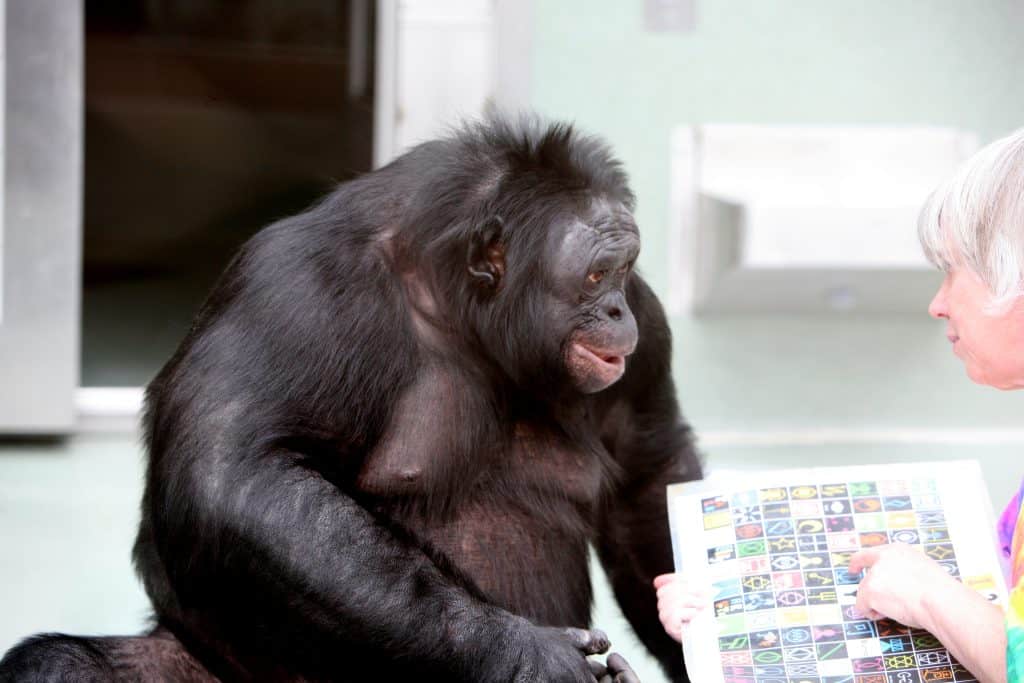
Kanzi’s limited symbolic play indicates foundational cognitive abilities for imagination, but human children still develop far more complex, multi-layered make-believe worlds.
The Bigger Picture
For decades, the dominant view in science was that symbolic thought marked a sharp dividing line between humans and other animals. Language, art, religion, and pretend play were placed firmly on our side.
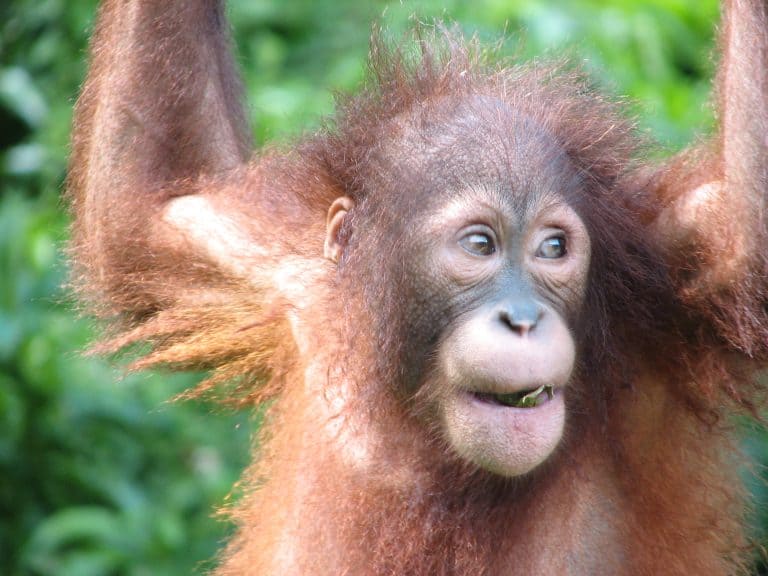
Research on great apes has steadily chipped away at that line. Chimpanzees use tools and plan ahead. Orangutans can solve complex puzzles. Bonobos communicate with remarkable subtlety. And now, evidence suggests that at least some of them can track imaginary juice within a shared pretend framework.
The more we learn, the more it seems that human intelligence didn’t appear overnight. It grew from roots shared with other apes. Kanzi didn’t exactly invent the Star Wars universe or write the Harry Potter series, but in evolutionary terms, participating in a pretend scenario about imaginary juice is just as big a deal, with implications that go back millions of years.