
Quick Take
- Although it is referred to as a buffalo in the official bill, the Kansas state mammal is actually a bison.
- The honey bee was designated the official Kansas state insect to signify its importance to the economy and the environment
- Kansas has recognized two extinct animals as official state fossils.
While all 50 United States have official state animal symbols, many take it even further by adopting official animals from different classifications. Kansas has nine official state animal symbols, including two species that lived over 80 million years ago. Continue reading to learn more about the extant and extinct animals that Kansas has officially recognized.
State Bird: Western Meadowlark
The Western Meadowlark (Sturnella neglecta) became Kansas’ first official animal when it was designated the state bird in 1937.
The Western Meadowlark is a migratory bird with a migration range stretching from Canada to Mexico. While the northern and southernmost reaches of the bird’s range are seasonal, Kansas residents can observe these birds year-round.
The Western Meadowlark is a common sight across the western two-thirds of the continental United States. It is often seen perched on fence posts and in open country.
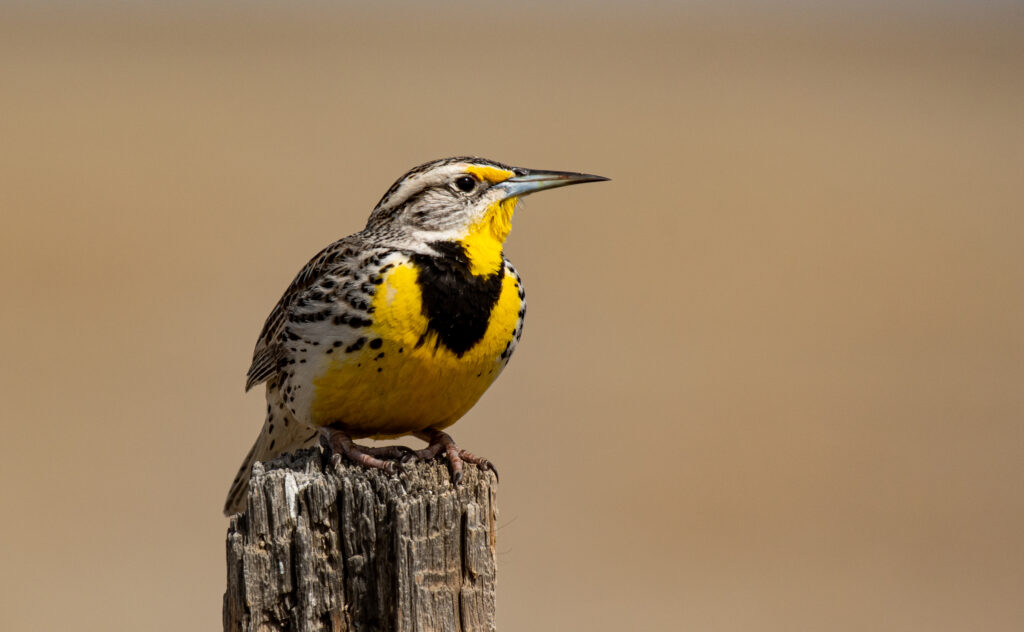
The Western Meadowlark’s song is a melodic series of 7–10 notes.
©Kerry Hargrove/Shutterstock.com
A statewide poll of Kansas schoolchildren in 1925 was conducted to select the official bird for the state. The Western Meadowlark received nearly 125,000 votes. Second and third places went to the Bobwhite Quail and Northern Cardinal, respectively.
After the children of Kansas made their voices heard, it took 12 years for legislators to act. But in 1937, the Western Meadowlark was officially named the first-ever state animal of Kansas.
State Animal: American Bison
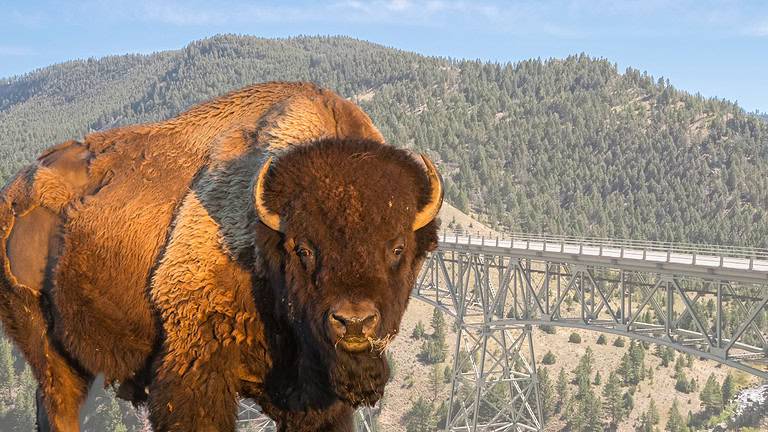
The American bison (Bison bison) was adopted as Kansas’ official animal symbol in 1955. It is listed as the American buffalo in the official state record, but bison is the more accurate term, as true buffalo are a distinct species found in Africa and Asia.
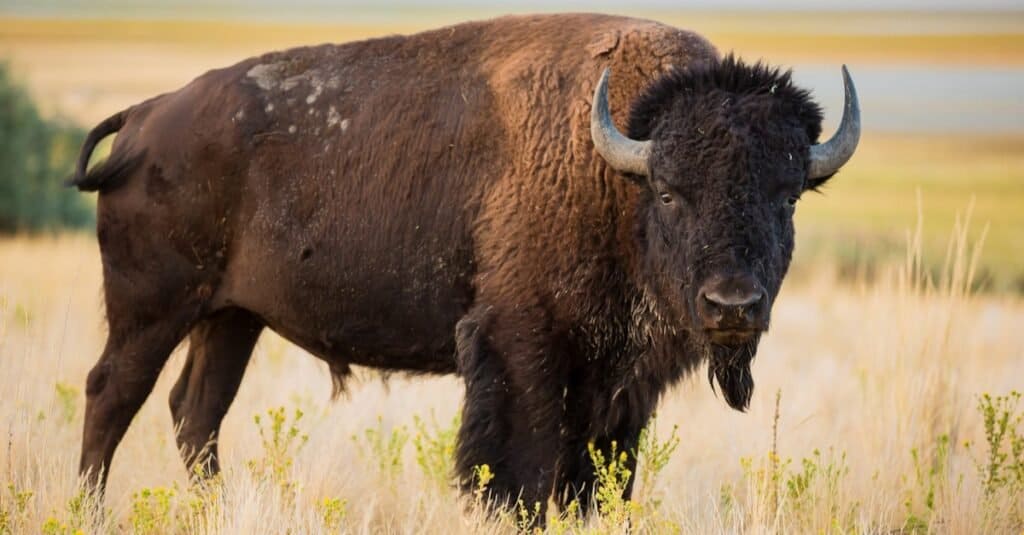
The bison is the largest land animal in North America. A bull can weigh up to 2,000 pounds and stand six feet tall, while a cow can weigh 1,000 pounds and reach a height of five feet.
©O.S. Fisher/Shutterstock.com
The Kansas state flag and state seal depict Native American hunters pursuing a herd of bison. The bison is also featured on the commemorative Kansas state quarter released by the U.S. Mint on August 29, 2005.
In 2016, the bison was designated as the national mammal of the United States.
They were critical to indigenous peoples as well as settlers. The plains bison’s range once covered much of the continental United States, but overhunting decimated the population. Bison were on the verge of extinction, but thankfully conservation and relocation efforts have helped this American icon mount a comeback.
Kansas boasts the fifth-largest bison population in the United States today. While many of them are on ranches, the Maxwell Wildlife Refuge near Canton has the state’s largest public herd with 200 bison.
State Insect: Honey Bee
In 1976, state legislators responded to a petition signed by thousands of Kansas children who advocated for the designation of the honey bee (Apis mellifera) as the official insect of the state.
“The honey bee is like all Kansans in that it is proud; only fights in defense of something it cherishes; is a friendly bundle of energy; is always helping others throughout its lifetime; is a strong, hard worker with limitless abilities; and is a mirror of virtue, triumph, and glory,” per Kansas House Bill 2236, making the designation official.
The Western honey bee is easily the most widespread honey bee species. It is found in most of the world’s ecosystems, except for the most extreme climates. Humans rely on honey bees for much more than just delicious honey. They pollinate many fruits, vegetables, and nuts.
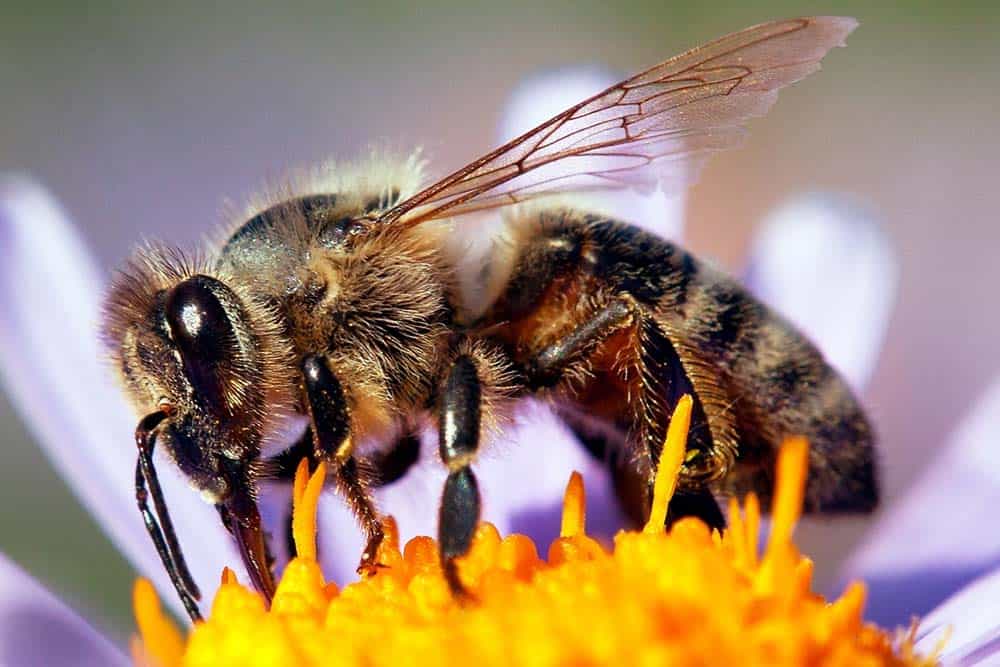
The honey bee is the state insect in 15 U.S. states.
©Daniel Prudek/Shutterstock.com
State Reptile: Ornate Box Turtle
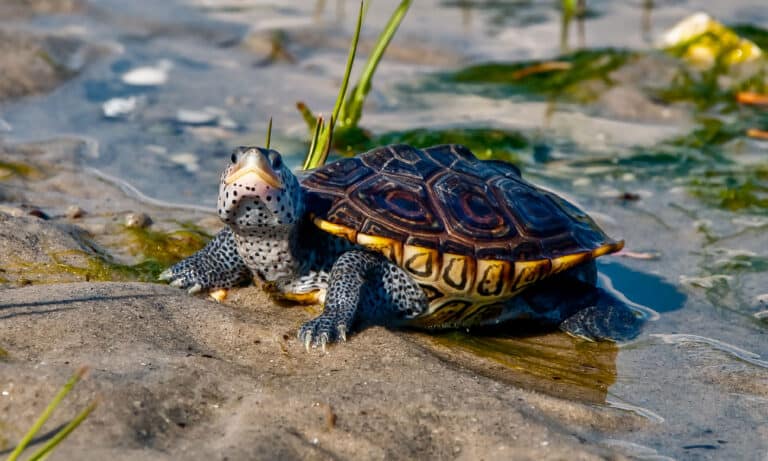
A sixth-grade class in Caldwell, Kansas, nominated the ornate box turtle (Terrapene ornata) as the official state reptile, and Kansas legislators made it official in 1986.
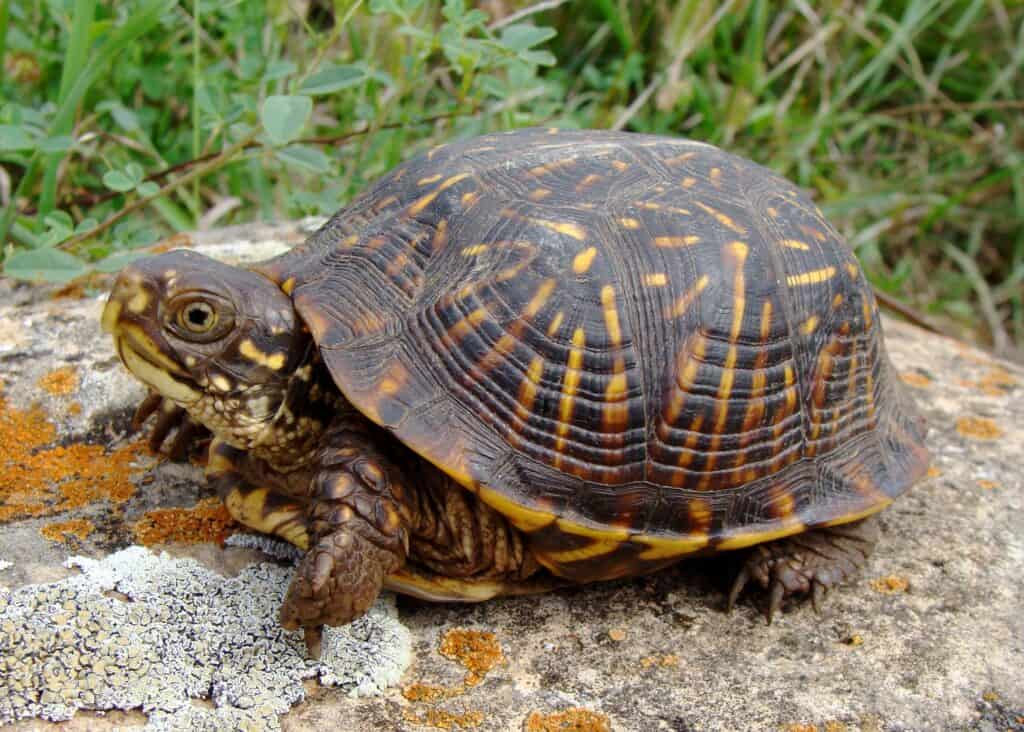
The ornate turtle’s range extends throughout the Great Plains.
©Matt Jeppson/Shutterstock.com
Ornate box turtles are most often found in grasslands that provide some access to water. They also seek out soil with a consistency that allows them to burrow and enables females to nest.
The turtle’s ornate shell coloration gave rise to its name. The shell features a colorful striped pattern of yellow, black, and red. Ornate box turtles are a small turtle species, only measuring around six inches long when fully grown.
The ornate box turtle’s small size and colorful shell have made this species a popular pet. However, it is illegal to remove this species from the wild to keep as pets.
The ornate box turtle is classified as a Near Threatened species. The fragmentation and development of prairie land are two of the greatest threats to the ornate box turtle population.
State Amphibian: Barred Tiger Salamander
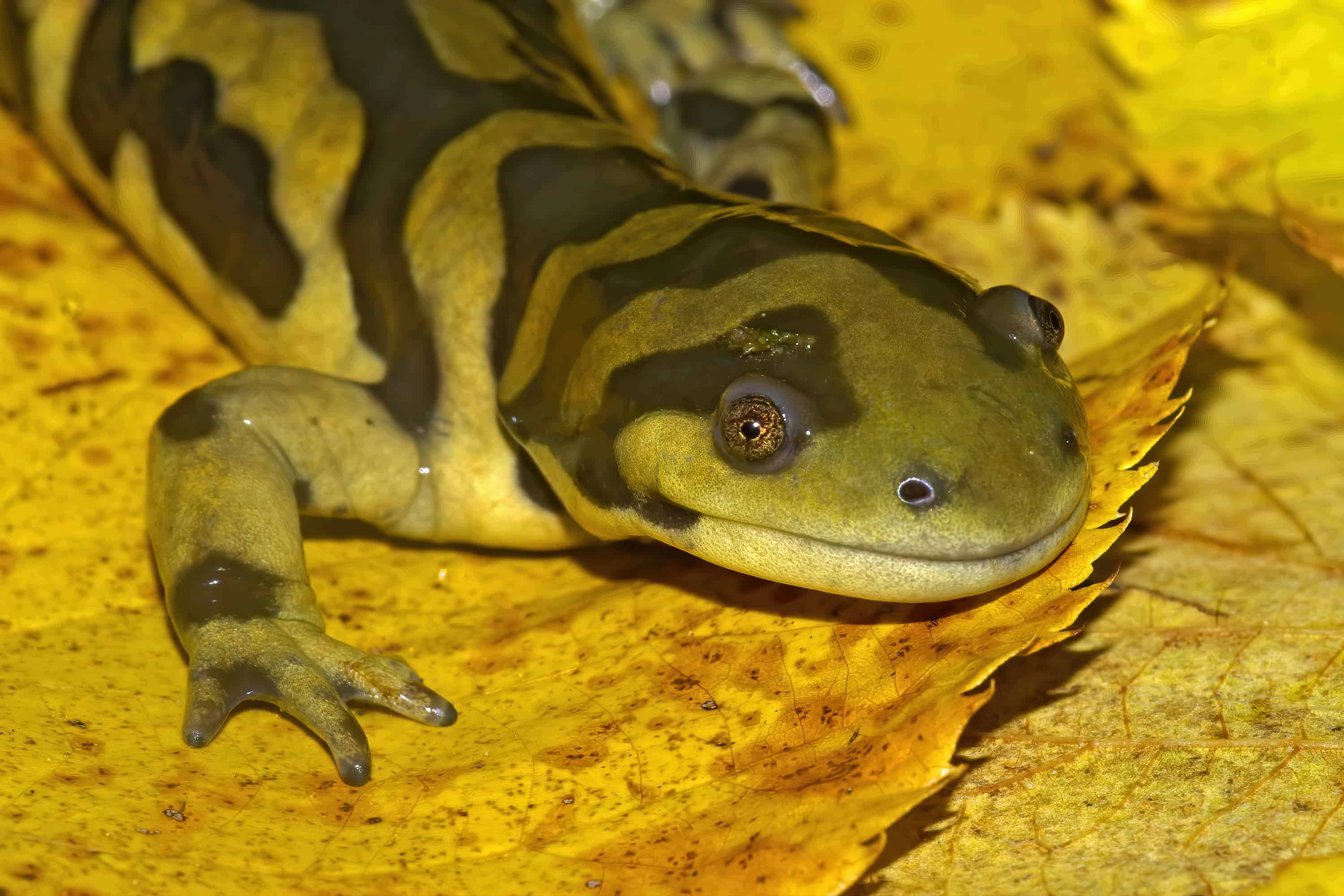
The barred tiger salamander (Ambystoma mavortium), also called the Western tiger salamander, was named the state amphibian of Kansas in 1994.
Tiger salamanders were once thought to be a single species with multiple subspecies. Genetic analysis has since shown that many subspecies represent distinct species. The barred tiger salamander is now classified as its own species, with several subspecies.
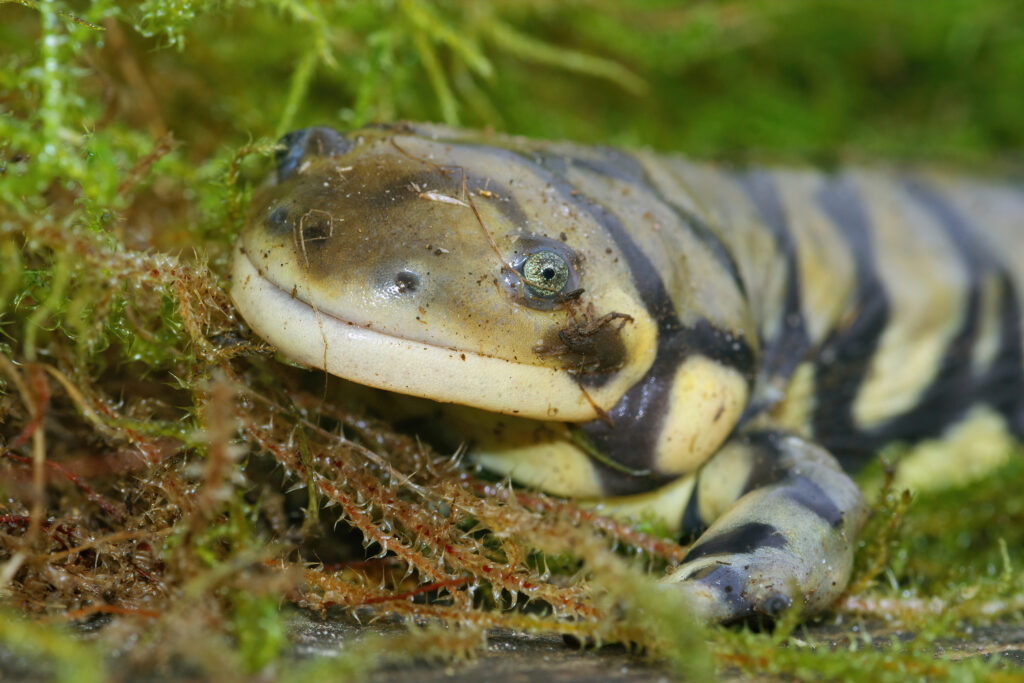
Tiger salamanders can grow up to 14 inches long.
©iStock.com/Wirestock
The tiger salamander’s range extends throughout the Western United States, Southwestern Canada, and Northern Mexico. As juveniles, these amphibians are exclusively aquatic and are equipped with gills. When mature, they can be found in woodlands and grasslands close to ponds, lakes, or streams.
The barred tiger salamander is largely nocturnal and is an opportunistic feeder. It is not a picky eater, consuming anything from insects, frogs, snails, slugs, worms, fish, and other salamanders. If no other prey is available, it will even cannibalize members of its own species.
State Marine Fossil: Tylosaurus
On the same day in 2014 that the Pteranodon was named the state’s official flying fossil, the Tylosaurus (Tylosaurus proriger) was designated Kansas’ official marine fossil.
Statute 73-3301 reads, “Tylosaurus, a giant Mosasaur which inhabited the great inland sea that covered portions of Kansas during the Cretaceous Period of the Mesozoic Era and grew to lengths of more than 40 feet, is hereby designated as the official marine fossil of the state of Kansas.”
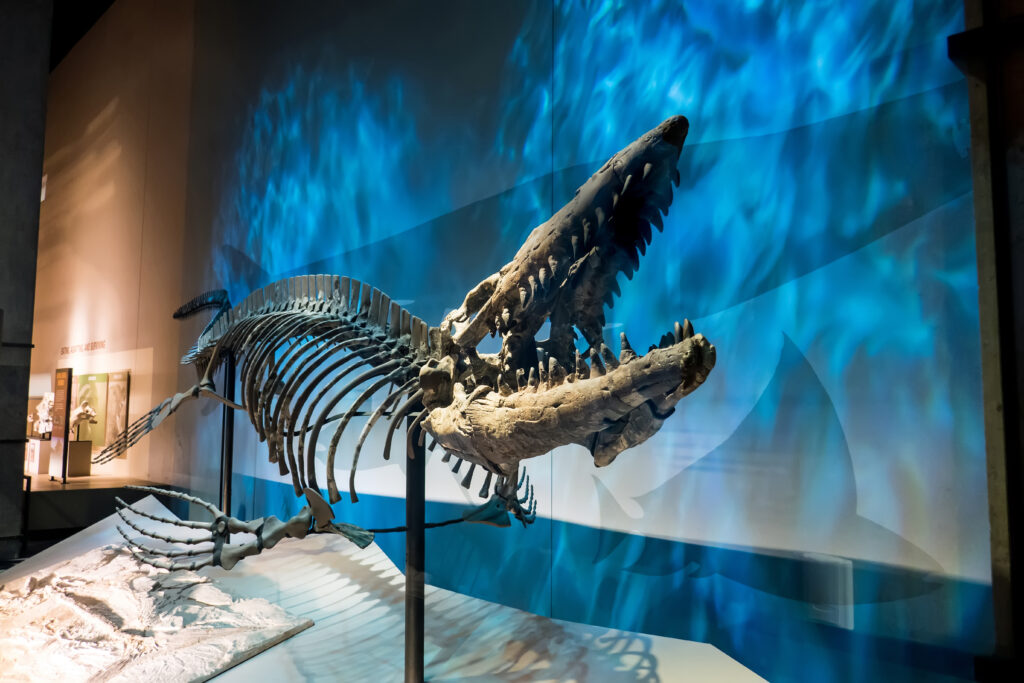
A Tylosaurus skeleton is in the permanent collection at the Perot Museum of Nature and Science in Dallas, Texas.
©William Cushman/Shutterstock.com
Is It a Dinosaur?
Although this creature is often mislabeled as a dinosaur, it was not a dinosaur but rather a Mosasaur, a family of massive, air-breathing carnivorous marine lizards that lived during the late Cretaceous Period, the same time as the Pteranodon. This prehistoric marine predator is closely related to modern monitor lizards and snakes.
The Tylosaurus hunted the Western Interior Seaway that covered the land we know today as Kansas. Its name means large protuberance, in reference to its elongated snout.
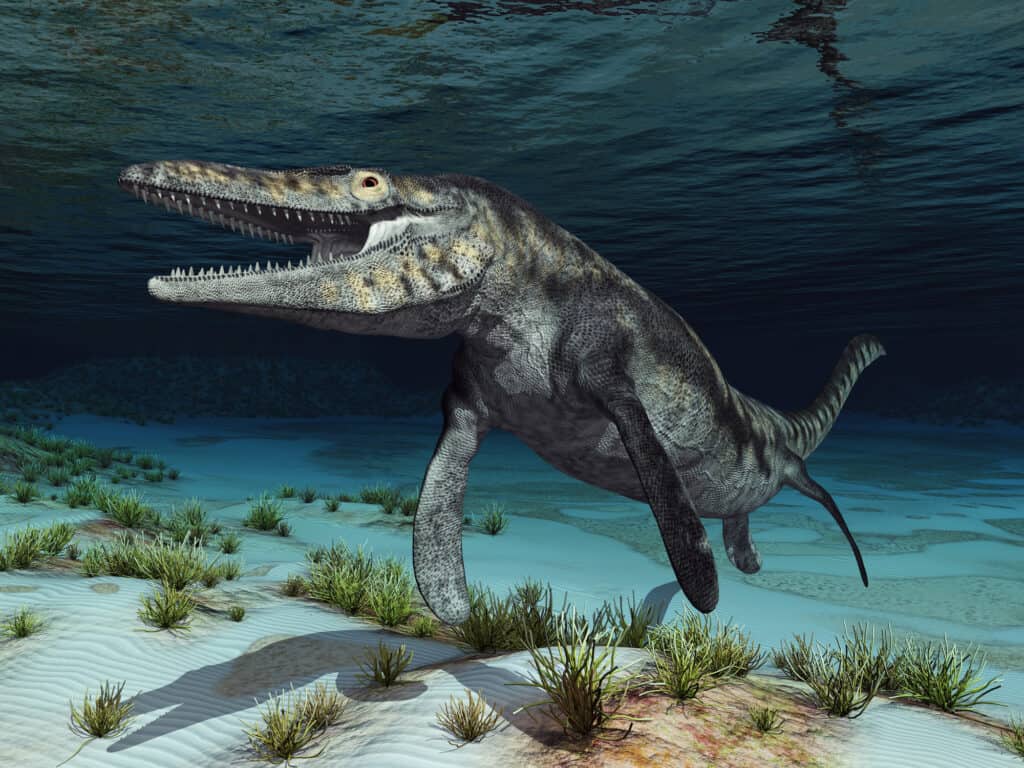
The Tylosaurus hunted the sea that once covered Kansas.
©iStock.com/MR1805
The Tylosaurus measured over 50 feet long and weighed more than 1,000 pounds. This ancient apex predator featured sharp teeth and a deadly bite.
Many Tylosaurus fossils have been found in Kansas, the first of which was discovered in 1868 in Gove County. which is reflected in its scientific name Tylosaurus proriger, the species officially recognized as Kansas’s state marine fossil.
State Flying Fossil: Pteranodon
The Pteranodon (Pteranodon longiceps) was named the official state flying fossil of Kansas on April 9, 2014. On that date, Statute 73-3401 was passed, stating, “Pteranodon, a great, winged pterosaur with a wingspread of more than 24 feet, which flew the skies of Kansas during the Cretaceous Period of the Mesozoic Era, is hereby designated as the official flying fossil of the state of Kansas.”
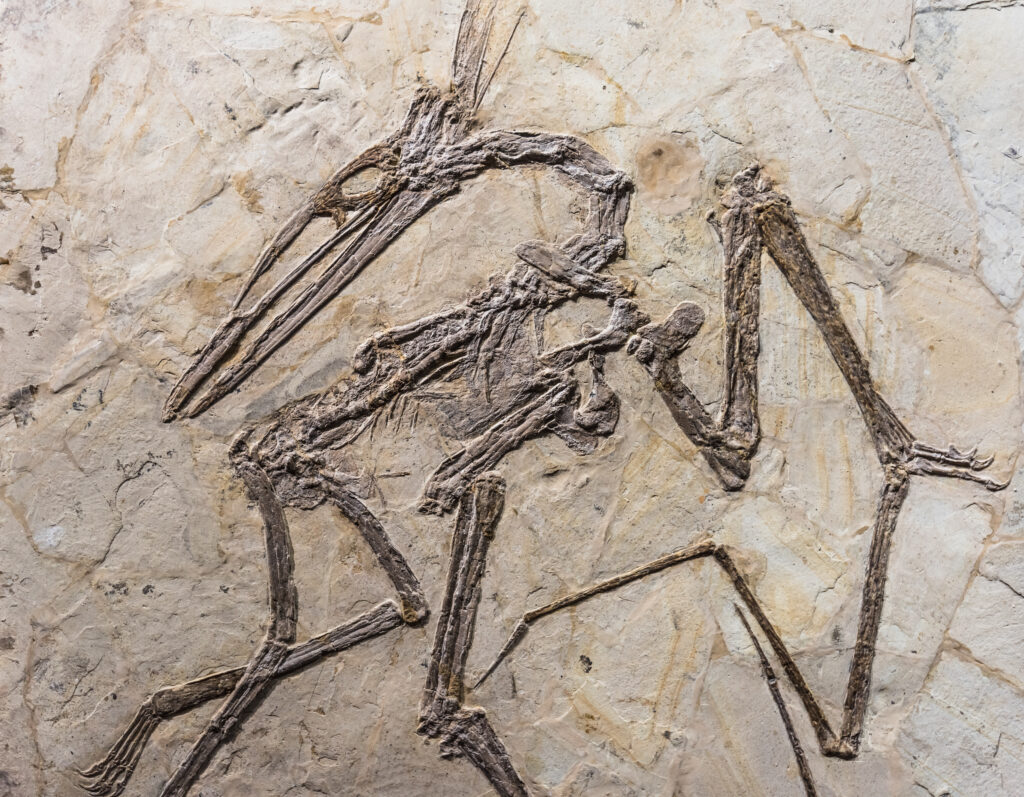
Many Pteranodon fossils have been found in Kansas.
©Captain Wang/Shutterstock.com
Is It a Dinosaur?
The Pteranodon isn’t actually a dinosaur. Instead, it was part of a group of flying reptiles known as pterosaurs. These creatures are often depicted with sharp, menacing teeth, but that’s another misconception. They were actually toothless. In fact, the name Pteranodon means wing with no teeth.
Pteranodons lived during the late Cretaceous Period, more than 83 million years ago. During that time, Kansas was covered by a shallow sea called the Western Interior Seaway.
Most of the Pteranodon fossils found in Kansas have come from the Smoky Hill Chalk of western Kansas. These massive flying reptiles were likely either feeding on sea creatures or migrating across the sea. This winged predator’s diet was largely made up of fish. Paleontologists believe the Pteranodon would swoop down and dip its long beak into the water. It would then skim the water’s surface until its quarry was caught in its jaws.
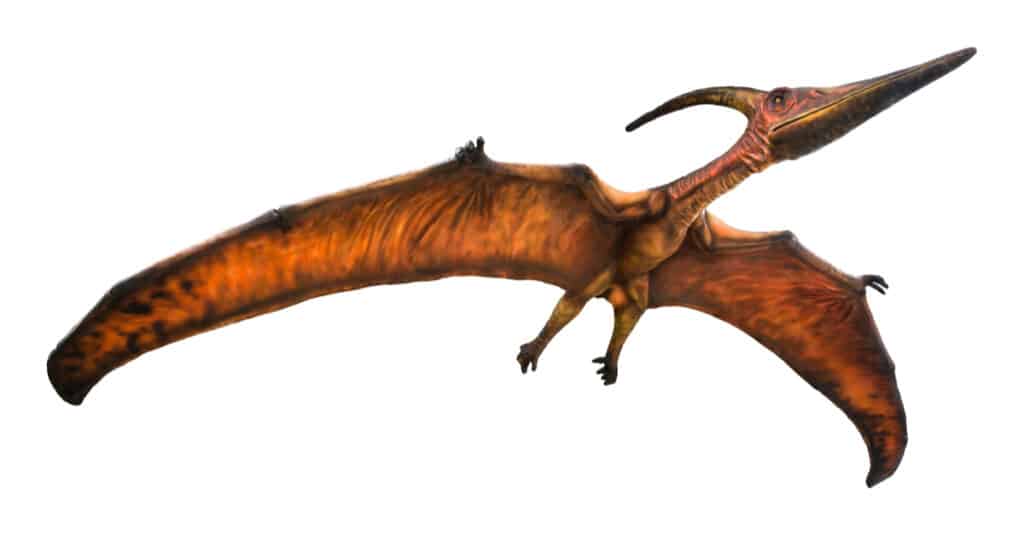
The Pteranodon was part of a group of flying reptiles known as pterosaurs.
©YuRi Photolife/Shutterstock.com
State Fish: Channel Catfish
Legislators named the channel catfish the state fish of Kansas in 2018.
Senator Anthony Hensley (D) called the designation “long overdue,” stating that he recalled discussions about this legislation as far back as the 1980s.
Senator Dennis Pyle (R) jokingly quipped that the channel catfish must have “nine lives.”
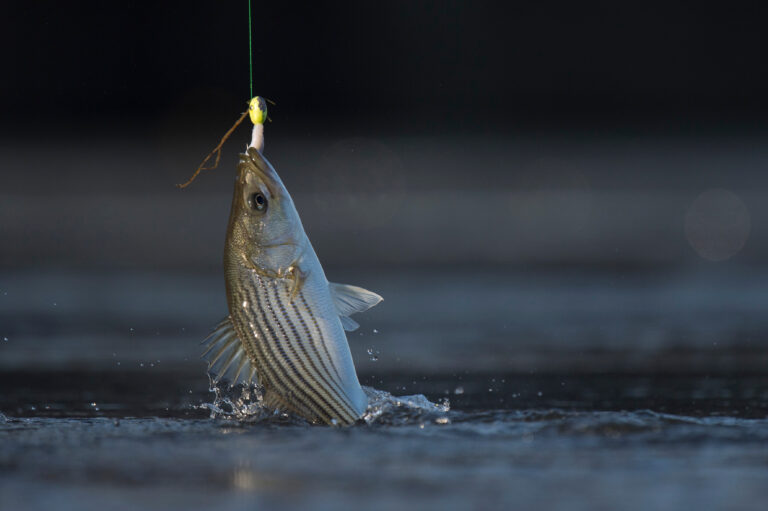
It may have taken a while, but the channel catfish has secured its place as an official state symbol in Kansas. The fish is native to Kansas waters and is a primary target for the state’s anglers. In fact, the Kansas Department of Wildlife and Parks refers to the channel catfish as, “the bread and butter of Kansas fishing.”
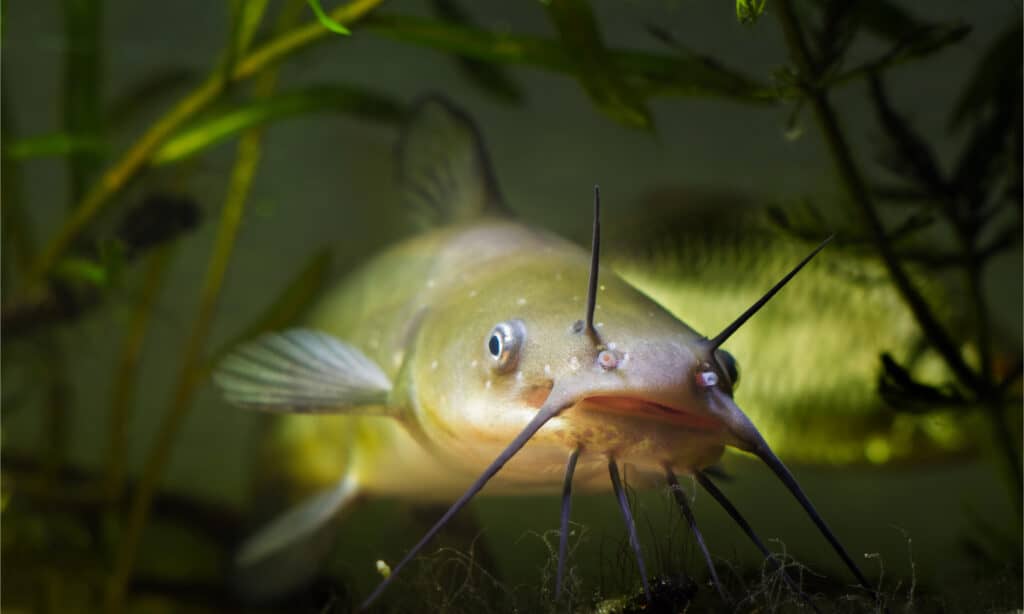
Millions of channel catfish are added to Kansas’ waters each year to preserve the quality of the state’s fisheries.
©Aleron Val/Shutterstock.com
The fish is found in rivers, lakes, reservoirs, ponds, and streams throughout the state. To maintain Kansas’ position as a top fishery for channel catfish, millions are produced in state hatcheries each year to stock Kansas’ waters.
Channel catfish are brownish-yellow with white bellies. The weight of channel catfish can vary widely depending on several factors, including the water body where it resides, food supply, and competition from other predators. Adult channel catfish can weigh 2-4 pounds, though much larger catfish of 10-15 pounds are often caught by Kansas anglers.
State Land Fossil: Silvisaurus condrayi
The most recent addition to Kansas’ state animals is Silvisaurus condrayi, receiving the title in 2023. It was a species of nodosaurid ankylosaur that existed during the Early Cretaceous period.
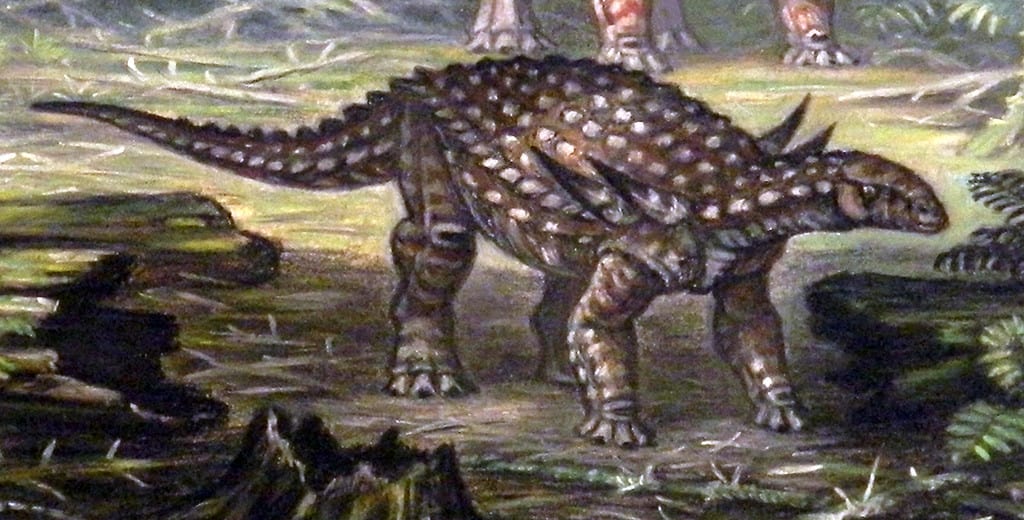
Artist’s interpretation of Silvisaurus condrayi.
©ABelov2014 (https://abelov2014.deviantart.com/), CC BY-SA 3.0 <https://creativecommons.org/licenses/by-sa/3.0>, via Wikimedia Commons – Original / License
While many fossils (such as those of fish and marine reptiles) are found in Kansas’ chalk beds, Silvisaurus condrayi is the only named dinosaur species based on fossils discovered in Kansas. The fossil is named after Warren Condray, who found the fossil on his ranch in Ottawa County, Kansas, in 1955.