
Quick Take
- A desert tortoise can survive for extended periods without water.
- mountin bluebirds are members of the thrush family.
- Damselflies are closely related to dragonflies.
Nevada’s topography features a basin-and-range structure, with mountain ranges separated by arid valleys. Elevations range from approximately 470 to over 13,000 feet. This dramatic variation creates diverse habitats, from cold, high-elevation alpine forests to hot, low-elevation Mojave desert basins, that support an abundance of wildlife. The state of Nevada has officially recognized six native species as its official animals. These animals were chosen because they embody Nevada’s unique history, culture, and geography. Continue reading to discover the six official state animal symbols that represent the Silver State.
State Bird: Mountain Bluebird
The first of Nevada’s official state animals, the mountain bluebird (Sialia currucoides) was selected as Nevada’s state bird in 1967. The bird makes its home in Nevada year-round, making it a logical choice for the official avian symbol of the state.
The mountain bluebird is known as the bluest of the bluebirds for its vibrant blue plumage. Male mountain bluebirds feature a bright blue back and a pale white belly. Females are grey, brown, or pale orange with a bluish tail and wings. The birds measure about six to seven inches in length and weigh approximately one ounce.
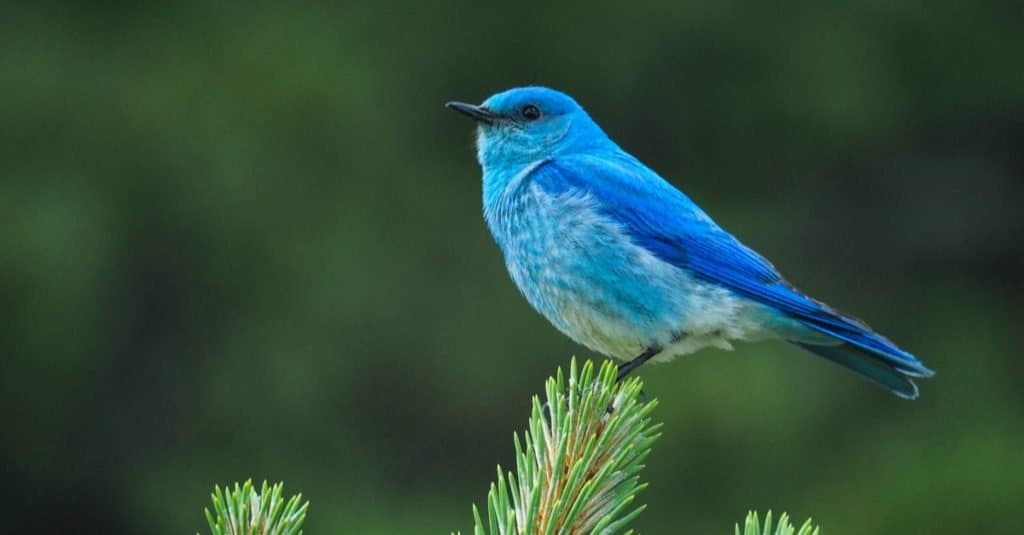
The male mountain bluebird is known as “the bluest of the bluebirds.”
©MTKhaled mahmud/Shutterstock.com
The mountain bluebird has an expansive range throughout Western North America. Depending on the time of year, the bird can be found from Alaska to Mexico.
Mountain bluebirds are members of the thrush family. Like many of the thrushes, these bluebirds feature a variety of vocalizations and warbles.
These omnivorous birds are important to the ecosystem. While they eat small fruits, they also prey on potentially destructive insects.
Once a male mountain bluebird successfully woos a female, the two remain monogamous for life. The female constructs and maintains the nest while the male hunts for food. There are an estimated six million mountain bluebirds throughout the North American West today.
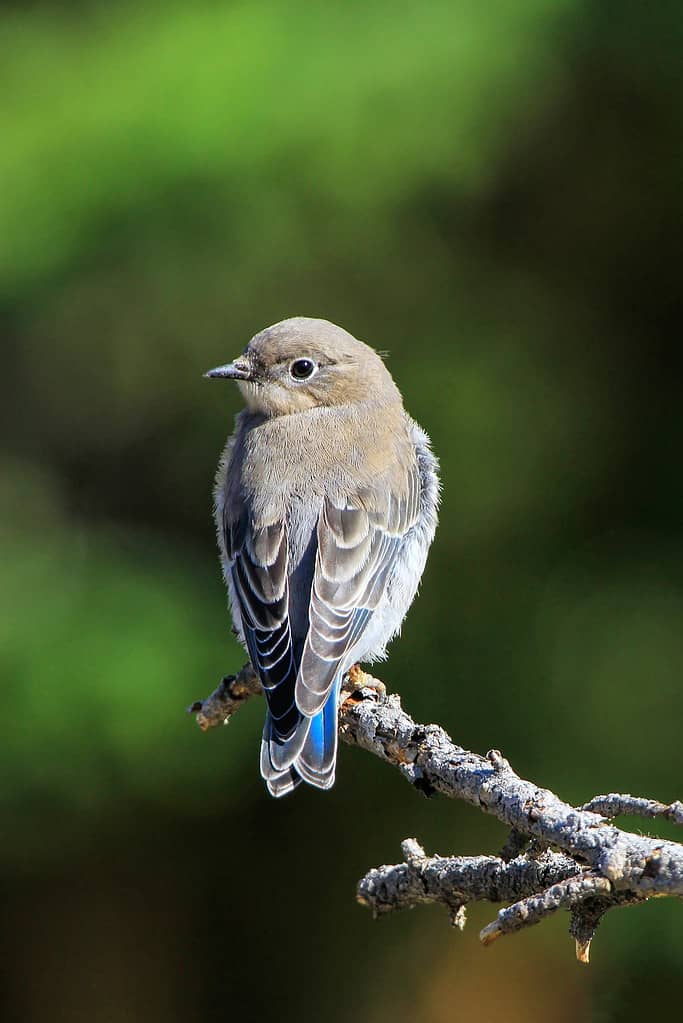
The female mountain bluebird is gray or tan with blue hues on its tail and wings.
©iStock.com/Donyanedomam
State Animal: Desert Bighorn Sheep
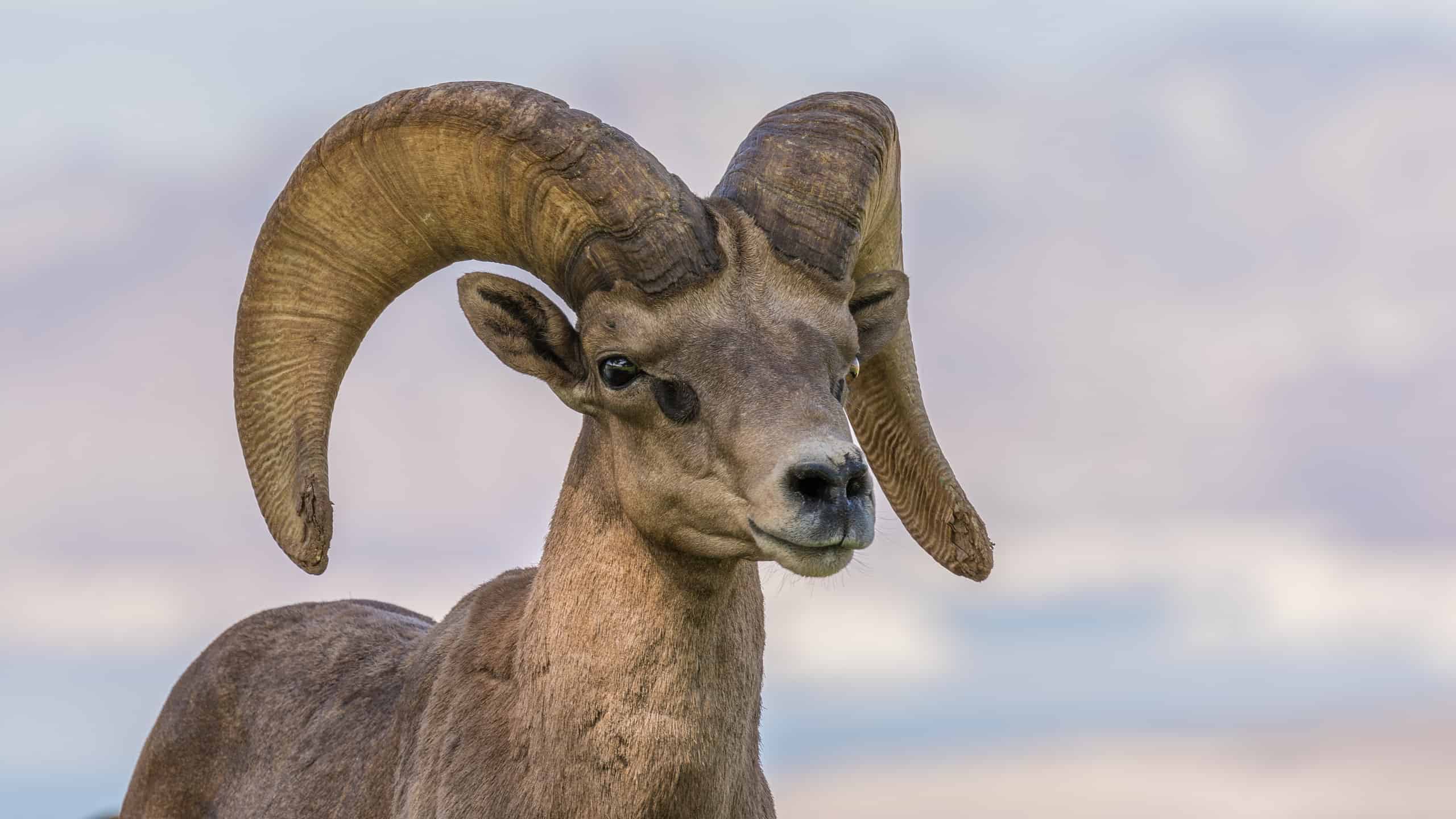
The desert bighorn sheep (Ovis canadensis nelsoni) was chosen as Nevada’s state animal in 1973. The sheep is most often found in Southern Nevada, where the rocky and steep mountainous habitat offers protection from predators.
The desert bighorn is perfectly adapted to life in the driest state in the U.S., able to survive with less water than many other mammals. The sheep also has a nine-stage digestive cycle that allows it to extract maximum benefit from the nutrient-poor desert vegetation that makes up its entire diet.
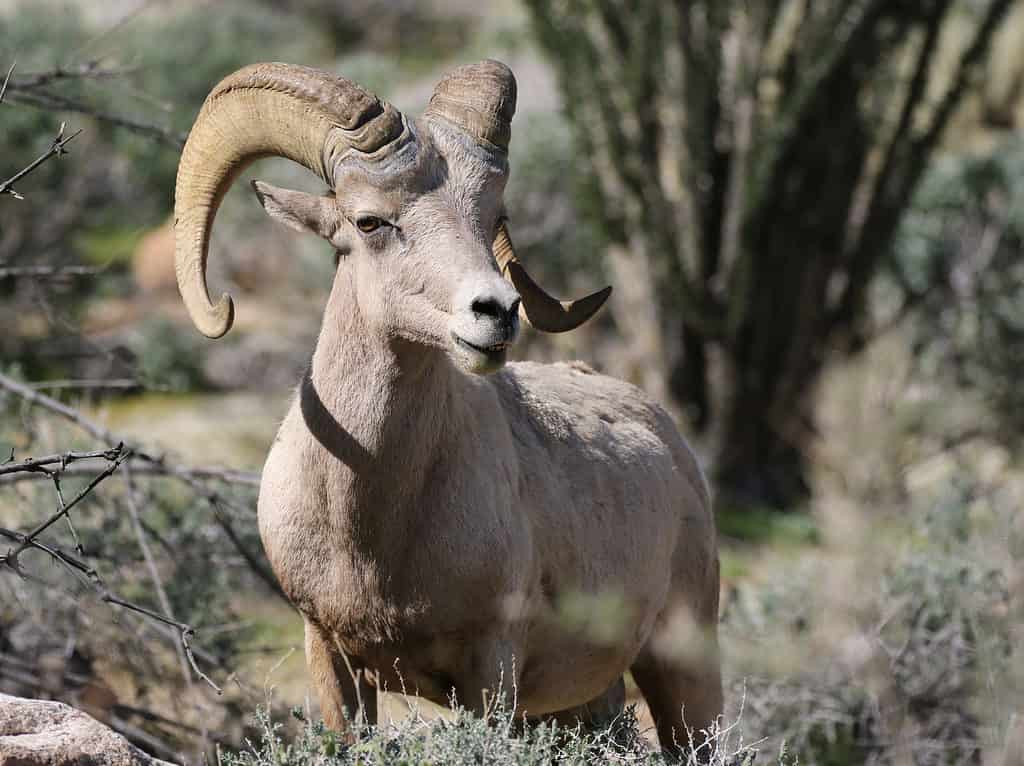
The desert bighorn sheep weighs about 80-100 pounds at maturity.
©iStock.com/randimal
Desert bighorn sheep have permanent, unbranched horns that grow throughout their lives. Rams (male sheep) have large horns that curl back over their ears and up past their cheeks. Ewes (female sheep) have significantly smaller and straighter horns than rams.
Nevada’s herd of desert bighorn sheep once numbered tens of thousands. However, by the 1960s, that number dropped to around 2,000. The species has significantly rebounded, with populations that now number around 10,000 individuals.
State Fossil: Ichthyosaur
The Ichthyosaur (Shonisaurus popularis) is an extinct marine reptile that lived some 200 million years ago. This predator stalked the Triassic Sea, which covered the land we know today as Nevada. The Ichthyosaur was named the official fossil of Nevada in 1977.
Nevada is the only state to possess a complete fossilized skeleton of the ichthyosaur species Shonisaurus popularis. The skeleton was found in Berlin, Nevada, and measures about 55 feet long.
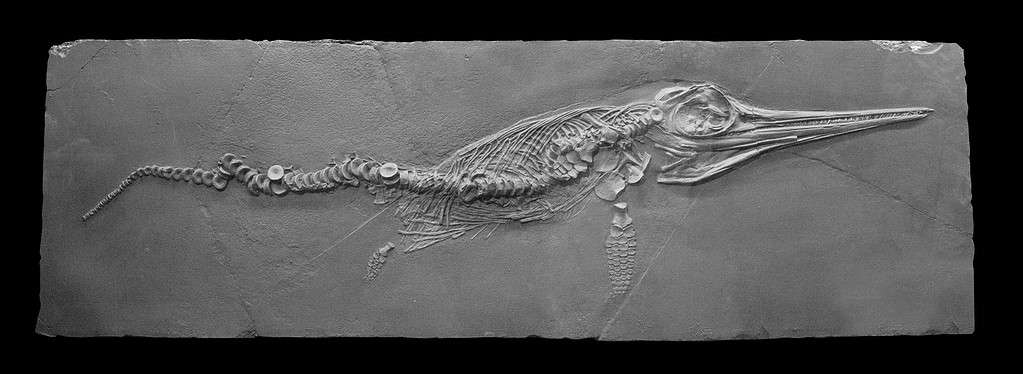
Berlin-Ichthyosaur State Park in Nevada protects nearly 40 massive, school bus-sized ichthyosaur fossils embedded in rock, offering a glimpse into a prehistoric marine ecosystem.
©iStock.com/valeniker
State Fish: Lahontan Cutthroat Trout
The Lahontan cutthroat trout (Salmo clarki henshawi) was designated as the official state fish of Nevada in 1981.
The Lahontan cutthroat trout is native to the Lahontan Basin in Northern Nevada, Northeastern California, and Southeastern Oregon. It is the largest of the cutthroat trout species.
At the turn of the 19th century, approximately 370,000 acres of lakes and more than 7,400 miles of streams in Nevada were inhabited or potentially habitable by the Lahontan cutthroat trout. Today, the trout now occupies only about 8.6% of its historical stream habitat and has been lost from almost 99% of its historic lake habitat.
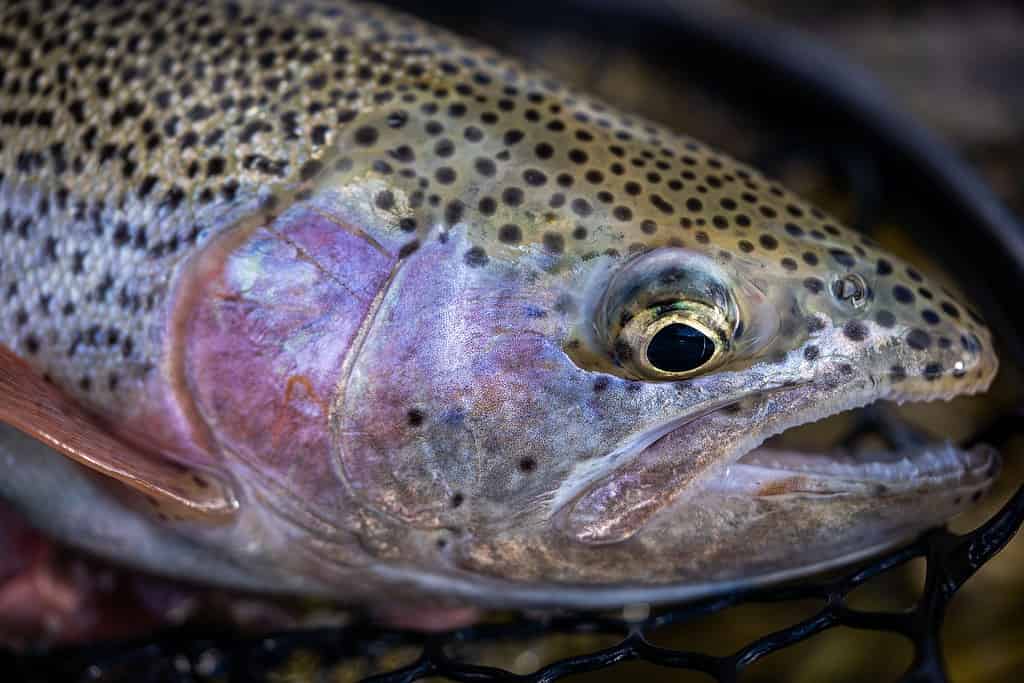
Lahontan cutthroat trout fishing is well-regulated to protect the species.
©iStock.com/Wirestock
While the Lahontan cutthroat trout are found in 14 of Nevada’s 17 counties, Elko, Humboldt, and Nye counties feature streams with the largest populations.
The Lahontan cutthroat trout is classified as a threatened species under the Endangered Species Act. State, tribal, and federal hatcheries are raising and releasing Lahontan cutthroat trout in its native Nevada, California, and Oregon. These fish are released to help with species recovery and also to provide a boost to the fisheries in these states. Although the species is listed as threatened, a special rule under the Endangered Species Act still permits regulated angling.
State Reptile: Desert Tortoise
The desert tortoise (Gopherus agassizii) was chosen as Nevada’s official state reptile in 1989.
The desert tortoise grows up to 14 inches long and can weigh up to 15 pounds. The tortoise’s coloration fits with its desert habitat, with hues of yellow, brown, tan, and black. It is remarkably long-lived, with a lifespan of 60 years or more.
The tortoise belongs to the Gopherus genus, and it’s easy to see why that name was chosen. This tortoise beats the heat of its desert environment by burrowing into the ground, much in the same way that a gopher does. A desert tortoise may spend as much as 95% of its life in tunnels underneath the desert sands.
Along with digging tunnels, the desert tortoise will also dig troughs in the sand to catch rainwater. When the rare desert rains come, the desert tortoise will drink copiously from these troughs. After such a drink, the tortoise may go up to a year before drinking again.
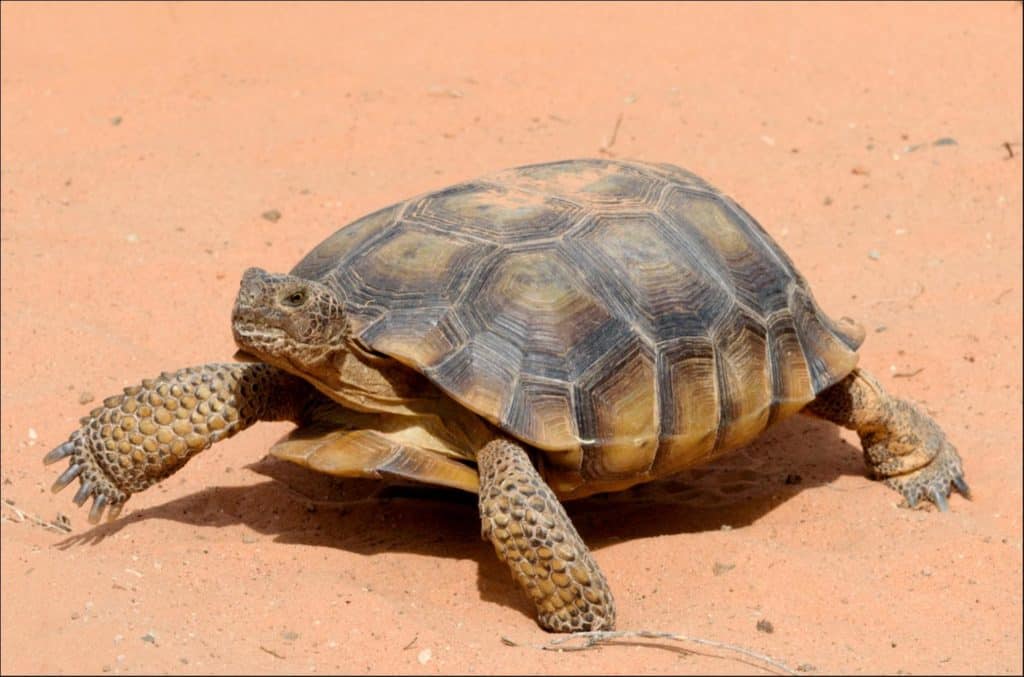
The desert tortoise uses its claws to burrow into tunnels, much like a gopher.
©John Andrus/Shutterstock.com
In 1990, it was classified as a threatened species under the Endangered Species Act.
Drought is a primary threat to the desert tortoise. While it needs remarkably little water, it still requires some water to survive. Drought has also reduced the grasses and flowers that are its primary food source. Habitat loss, vehicular traffic, and disease also threaten the desert tortoise.
State Insect: Vivid Dancer Damselfly
Nevada legislators proposed a contest for schoolchildren throughout the state to select the official state insect. A group of fourth-graders from Beatty Elementary School in Las Vegas submitted the winning proposal, requesting the vivid dancer damselfly (Argia vivida) be named the official state insect of Nevada in 2009.
The students made a compelling case: The vivid dancer damselfly is found throughout Nevada, it eats mosquitoes, and it is blue and silver, the official state colors of Nevada.
The damselfly is related to the dragonfly, but there are significant differences between the two. Damselflies are smaller, and when they are resting, their wings are close against their bodies. Dragonfly wings remain outstretched, even when they are at rest.
Damselflies eat butterflies, wasps, moths, bees, flies, and virtually any other flying insect they can catch. They are found near freshwater rivers, streams, lakes, and ponds on every continent except Antarctica.
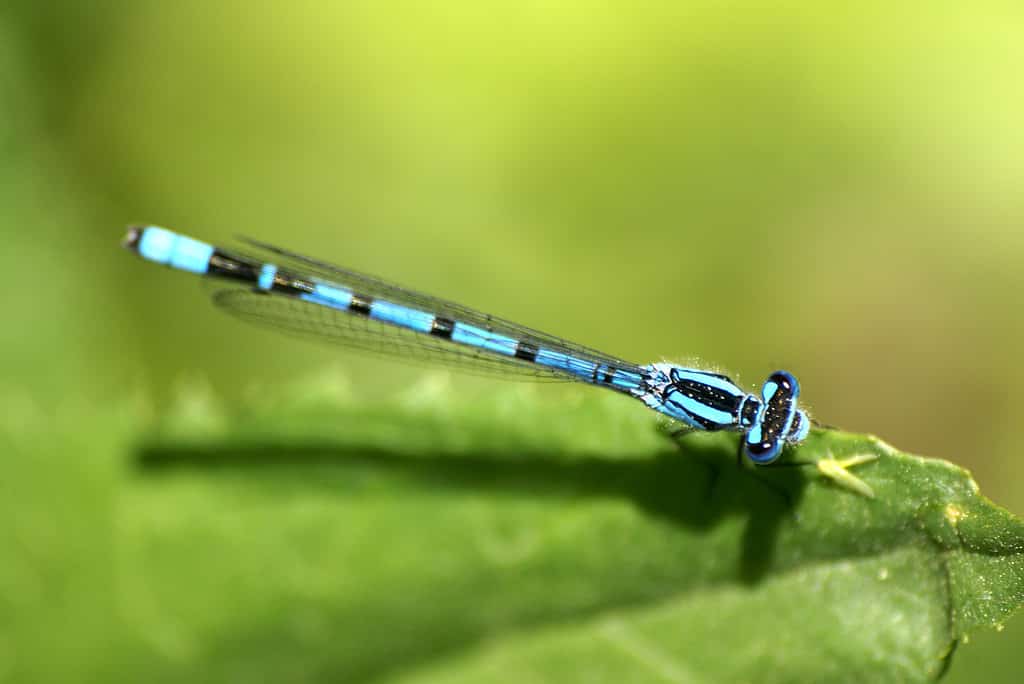
Unlike dragonflies, vivid dancer damselflies close their wings while at rest.
©Gurcharan Singh/Shutterstock.com